

Market Update For September 3, 2026
The Nigerian Exchange (NGX) extended its upward movement on Thursday, September 3, 2026, with the benchmark All-Share Index (ASI) closing higher, although the broader market remained under pressure as more stocks declined than advanced.
The ASI gained 369.05 points, representing a 0.15% increase, to close at 246,388.22. The rise pushed market capitalisation higher by ₦238.37 billion to ₦159.15 trillion, reflecting gains in selected heavyweight stocks.
However, the positive index performance did not translate into broad-based buying. Market breadth remained negative, as 35 stocks recorded losses compared to 22 gainers, suggesting that the day’s advance was largely supported by a limited number of stocks, particularly large-cap counters, rather than a widespread recovery across the market.
SEPLAT emerged as the strongest performer, rising by the maximum 10.00% to ₦13,552.60. The energy stock’s performance came as crude oil prices continued to strengthen in the international market, with renewed geopolitical tensions raising concerns about potential disruptions to Middle Eastern oil supplies.
UPDCREIT also recorded a strong performance, gaining 9.88%, while LEARNAFRCA advanced 9.49%. REGALINS and JAIZBANK completed the top five gainers, rising 4.76% and 4.22%, respectively.
On the losing side RTBRISCOE lost 10.00%, closing at ₦9.90, which made it the worst-performing stock of the session. SOVRENINS fell 9.73% to ₦2.04, while DAARCOMM and NASCON dropped 8.28% and 8.03%, respectively. ARADEL rounded out the top five losers with a 5.84% decline.
Trading Activity Strengthens
Market activity improved during the session, pointing to increased investor participation. A total of 434.02 million shares valued at ₦29.30 billion changed hands in 42,303 deals, representing a 1.68% increase in traded volume.
UBA remained the dominant stock by activity, with 113.26 million shares traded at a value of ₦5.23 billion. The bank alone accounted for 26.10% of total market volume and 17.84% of the day’s traded value.
GTCO and ACCESSCORP followed UBA in volume, accounting for 7.89% and 5.73% of total market activity, respectively. GTCO and MTNN also ranked behind UBA in terms of traded value.
The concentration of activity in major banking stocks highlights the continued importance of financial institutions to overall market liquidity. Banks remain among the most actively traded counters on the NGX because of their large market capitalisation, relatively high liquidity and strong participation from both institutional and retail investors.
The increased volume is encouraging from a market perspective, particularly as the index continues to trade near recent highs. However, the negative breadth means the improvement in turnover should be interpreted with some caution. Strong volume accompanied by widespread declines can sometimes indicate rotation between sectors or profit-taking rather than a broad-based accumulation phase.
Oil Market
The domestic equity market also received an important external signal from the continued rise in crude oil prices.
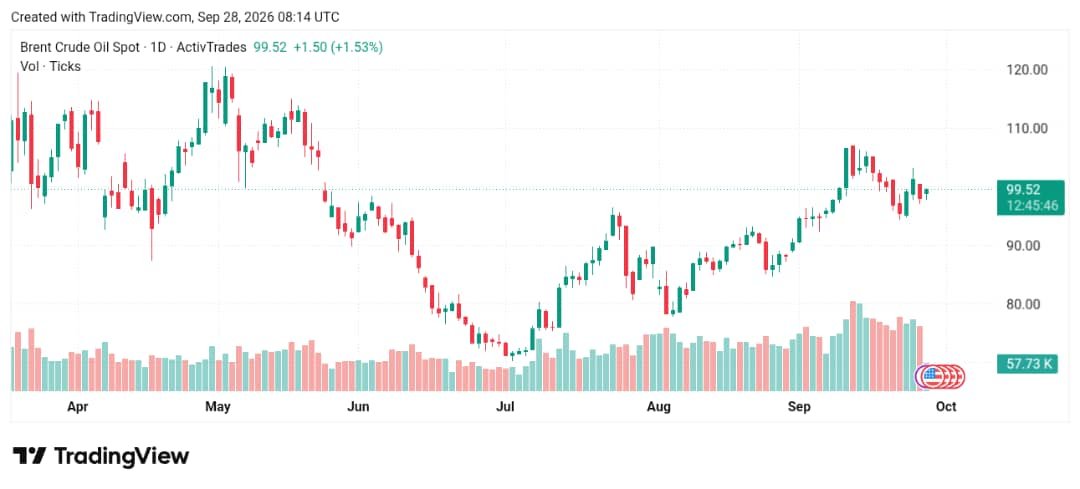
Brent crude futures rose 59 cents, or 0.62%, to $96.22 per barrel by 1327 GMT, while U.S. West Texas Intermediate crude futures increased by 78 cents, or 0.86%, to $91.79. Both benchmarks were on course for a fourth consecutive session of gains after reaching six-week highs earlier in the trading session.
The rally in crude was driven largely by heightened geopolitical concerns following renewed military activity involving the United States and Iran, alongside fresh Israeli threats against Tehran. The developments have revived concerns that further escalation could disrupt oil production, exports and shipping routes across the Middle East.
Concerns surrounding the Strait of Hormuz are particularly significant. The waterway is a critical route for global energy supplies, and any prolonged disruption could have a major impact on international crude prices.
The latest escalation has already resulted in casualties. Iran’s health minister reported that 18 people were killed and 108 wounded following Tuesday night’s U.S. strikes across Iran. The Iranian Red Crescent also reported casualties from a strike near the Strait of Hormuz.
For Nigeria, the rise in crude prices could provide some support for external balances, government revenue and foreign-exchange earnings. Since crude remains a major source of Nigeria’s export receipts, stronger international prices could improve the country’s dollar inflows if production and export volumes remain stable.
The oil price environment could also support investor sentiment toward Nigerian energy stocks. Companies with significant exposure to crude production and upstream earnings may benefit from stronger realised prices, although individual company performance will still depend on production levels, operating costs, taxes, financing and other company-specific factors.
However, higher oil prices could have mixed implications for the wider global economy. A sustained increase in energy costs could feed into inflation, potentially making major central banks more cautious about cutting interest rates. This could keep global financial conditions relatively tight and reduce appetite for riskier emerging and frontier-market assets.
For Nigerian equities, the impact could therefore be two-sided: higher crude prices may support the country’s external position, while tighter global financial conditions could limit foreign portfolio inflows.
Market Breadth Remains A Concern
One of the major concerns from Thursday’s session was the weak market breadth.
Although the ASI gained 0.15%, the market recorded 35 declining stocks against only 22 advancing stocks. This divergence indicates that the index’s performance was not representative of the broader market.
The situation suggests that investors may be concentrating their buying interest on selected heavyweight stocks while reducing exposure to weaker or less liquid counters.
For the current upward trend to gain stronger technical confirmation, market participation would need to broaden. A combination of rising index levels, stronger trading volume and an improving advance-decline ratio would provide a healthier signal for the market.
Conversely, if the ASI continues to rise while the number of declining stocks remains significantly higher than gainers, the market could become increasingly vulnerable to profit-taking and short-term corrections.
Investors should therefore look beyond the headline index performance and monitor sector rotation, market breadth and individual stock fundamentals.
Technical Analysis and Outlook
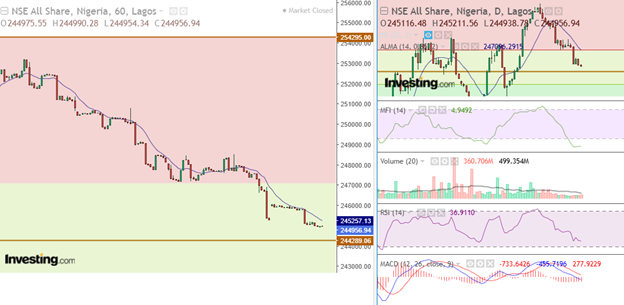
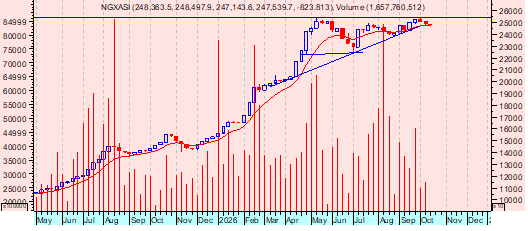
From a technical perspective, the ASI continues to maintain a positive medium-term structure. The index is trading close to the 246,500–247,000 resistance zone, making this region important for determining the next direction of the market.
A decisive break above 247,000, particularly if supported by stronger volume and improved market breadth, would strengthen the bullish outlook. Such a move could signal renewed buying interest and create room for the index to test higher levels.
However, failure to break above the resistance area could result in a period of consolidation or profit-taking. Investors who entered positions during the recent recovery may look to lock in gains if upward momentum begins to weaken.
The first major support zone remains around 244,000–245,000. Holding above this region would help preserve the current bullish structure, while a sustained break below it could signal a deeper correction.
The negative breadth therefore remains the major technical caution. While the index is moving higher, the lack of broad participation means investors should remain selective rather than interpret the latest gain as a confirmation of a broad market rally.
In the near term, the market is likely to remain influenced by movements in large-cap stocks, particularly banking and energy counters. Developments in the international oil market could also play an increasing role in investor sentiment, especially if crude prices remain elevated.
The outlook remains cautiously bullish, provided the ASI holds above its immediate support and eventually breaks through the 247,000 resistance area. A failure to sustain buying interest, however, could lead to consolidation as investors reassess valuations and take profits.
Overall, Thursday’s session reflected a market that is still attempting to build on its recent recovery but has yet to achieve sufficient breadth. The combination of higher turnover, strength in selected large-cap stocks and elevated crude oil prices provides some support, but the high number of decliners means investors should continue to exercise caution.
Market Summary: The NGX All-Share Index closed at 246,388.22, up 369.05 points (+0.15%), while market capitalisation increased by ₦238.37 billion to ₦159.15 trillion. Total volume rose 1.68% to 434.02 million shares, with transactions valued at ₦29.30 billion across 42,303 deals. The market’s overall performance was positive but narrowly driven, with the ASI gaining 0.15% while market breadth remained negative at 22 gainers against 35 losers. UBA was the most active stock, recording 113.26 million shares worth ₦5.23 billion, representing 26.10% of total volume and 17.84% of traded value. GTCO and ACCESSCORP followed in volume, while GTCO and MTNN ranked next in traded value. Top Gainers: SEPLAT (+10.00% to ₦13,552.60), UPDCREIT (+9.88%), LEARNAFRCA (+9.49%), REGALINS (+4.76%) and JAIZBANK (+4.22%). Top Losers: RTBRISCOE (-10.00% to ₦9.90), SOVRENINS (-9.73% to ₦2.04), DAARCOMM (-8.28%), NASCON (-8.03%) and ARADEL (-5.84%).