
Market Update For September 2, 2026
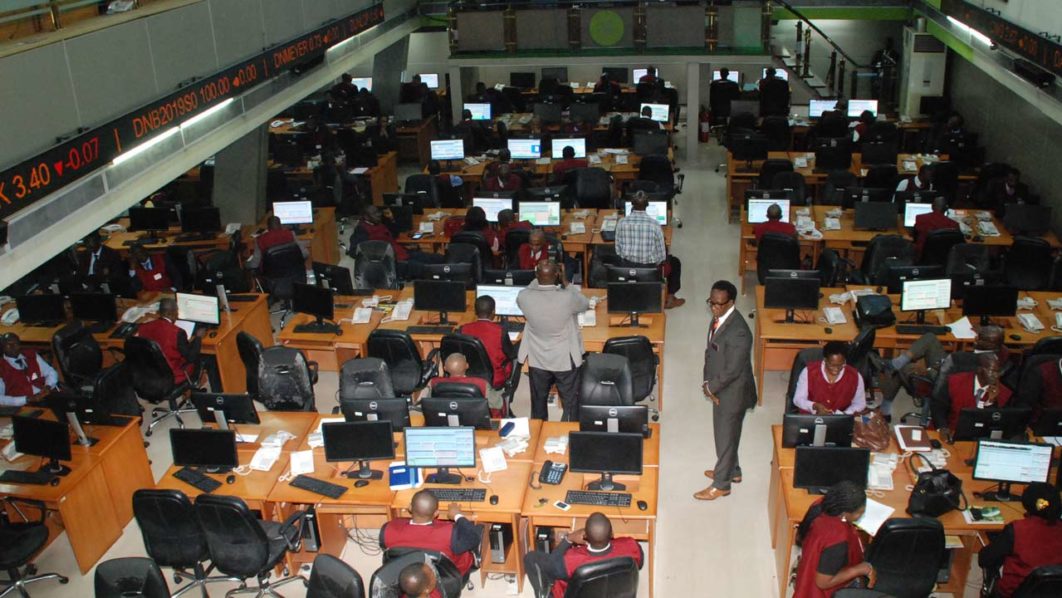
The Nigerian equities market closed lower on Wednesday, September 2, 2026, breaking a four-session winning streak as profit-taking in several heavyweight stocks dragged the benchmark index into negative territory.
The decline was driven mainly by losses in large-cap banking and consumer stocks, with NASCON, BETAGLAS, ACCESSCORP, UBA, FIDELITYBK and STANBIC among the major decliners. However, strong gains in several mid- and small-cap stocks helped limit the overall market decline.
Market Performance
Investor sentiment turned cautious after four consecutive sessions of gains, suggesting that some investors moved to lock in profits following the recent rally. Despite the pullback, the decline remained marginal, indicating that the broader bullish trend has not yet been disrupted.
The sell-off in heavyweight stocks had a disproportionate impact on the index because of their large market weights. NASCON and BETAGLAS each declined by about 10%, while ACCESSCORP, UBA and FIDELITYBK also recorded notable losses.
Trading Activity
Market activity weakened during the session, with 379.27 million shares worth ₦25.37 billion traded across 39,758 deals.
ACCESSCORP led trading volume with 31.97 million shares, while STANBIC recorded the highest traded value. The decline in turnover suggests a more cautious approach from investors as the market consolidates after its recent advance.
Market Movers
TRIPPLEG was the best-performing stock, gaining 10% to ₦2.86. SOVRENINS, OANDO, MCNICHOLS and NEM also recorded strong gains.
On the other hand, NASCON and BETAGLAS recorded the steepest declines, each falling by about 10%. ACADEMY, CWG and LEARNAFRCA also posted significant losses.
The wide price movements highlight continued stock-specific activity, with investors rotating between counters despite the broader market weakness.
Technical Analysis
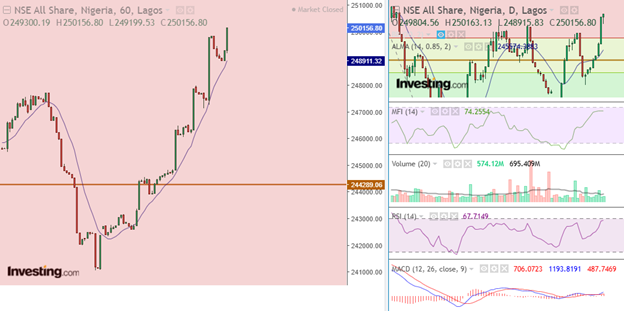
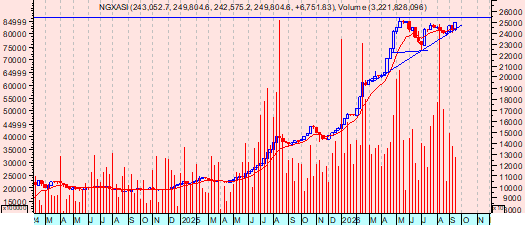
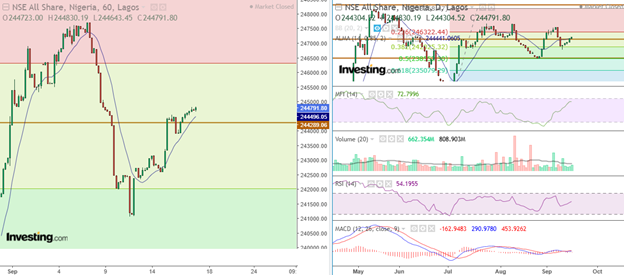
Technically, the ASI remains in a broader bullish structure despite Wednesday’s decline. The pullback appears more consistent with short-term profit-taking following the recent rally than a confirmed trend reversal.
The 246,000-point region remains an immediate resistance level. A decisive break above this area could strengthen bullish momentum and open the way toward recent highs.
On the downside, 245,000 points remains an important support level. Holding above this zone would preserve the current bullish setup, while a sustained break below it could trigger deeper profit-taking and consolidation.
Market breadth and volume will be important indicators in the coming sessions. A rebound supported by stronger turnover would signal renewed buying interest, while further declines accompanied by rising volume could indicate increasing distribution.
Outlook
The near-term outlook remains cautiously bullish, although volatility is likely to persist. The market’s ability to hold above 245,000 points will be key to maintaining the current upward structure.
Investors may continue to favour fundamentally strong stocks while remaining selective, particularly in counters that have recorded substantial gains. Large-cap banking, industrial and oil-related stocks are likely to remain important to the direction of the broader market.
Oil Market
Crude oil prices remained elevated and volatile on Wednesday as renewed military tensions between the United States and Iran raised concerns about potential supply disruptions from the Middle East.
Brent crude rose marginally to around $94.90 per barrel, while West Texas Intermediate (WTI) traded near $90.32 per barrel. Both benchmarks swung sharply during the session as investors weighed the potential impact of the renewed conflict on global oil supplies.
For Nigeria, sustained high crude prices could support foreign-exchange earnings, government revenue and the earnings outlook for oil and gas companies. However, prolonged geopolitical tensions could also keep global energy prices elevated and increase inflationary pressures, potentially affecting interest-rate expectations and risk appetite across emerging markets.
The elevated oil-price environment could remain supportive for Nigerian oil and gas stocks, although investors will need to distinguish between short-term gains driven by geopolitical risk and sustainable improvements in company fundamentals.
Conclusion
Wednesday’s decline appears to have been driven largely by profit-taking rather than a broad deterioration in market sentiment. The NGX remains significantly higher on a year-to-date basis, while the ASI continues to trade within a broader bullish structure.
The next sessions will be important for determining the market’s direction. A sustained move above 246,000 points would strengthen the case for further gains, while a break below 245,000 points could lead to deeper consolidation. Meanwhile, crude oil prices and developments in the Middle East will remain important external factors for Nigerian equities.
The NGX All-Share Index (ASI) fell 180.33 points (-0.07%) to close at 245,902.30 points, while market capitalisation declined by ₦116.48 billion to ₦158.84 trillion; YTD performance eased to +58.10%. Market breadth was negative, with 31 gainers against 36 decliners and one unchanged. Total volume stood at 379.27 million shares, valued at ₦25.37 billion across 39,758 deals. ACCESSCORP led market movers by volume with 31.97 million shares, while STANBIC recorded the highest traded value. TRIPPLEG (+10.00% to ₦2.86), SOVRENINS (+9.71% to ₦2.26), OANDO (+9.43% to ₦38.30), MCNICHOLS (+9.09% to ₦5.40) and NEM (+7.99% to ₦34.45) were the top gainers, while NASCON (-10.00% to ₦175.50), BETAGLAS (-9.99% to ₦506.60), ACADEMY (-9.76% to ₦5.55), CWG (-9.35% to ₦19.40) and LEARNAFRCA (-9.20% to ₦7.90) recorded the biggest losses.