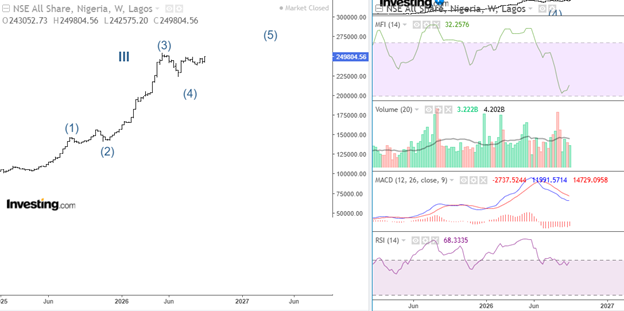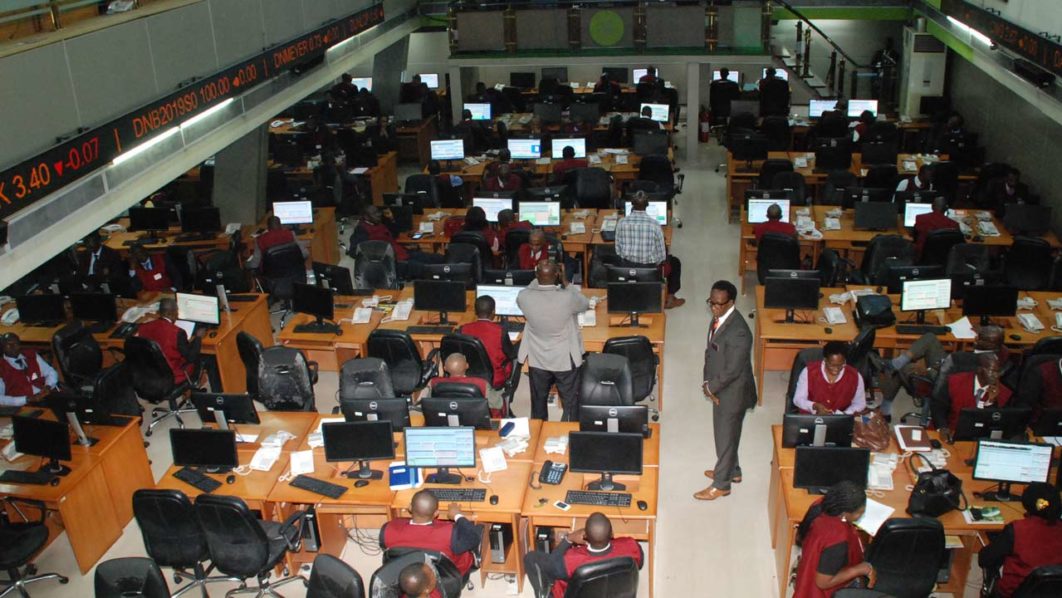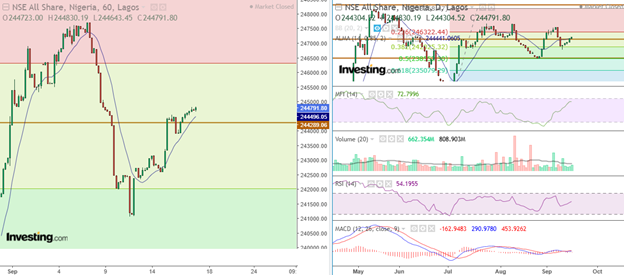

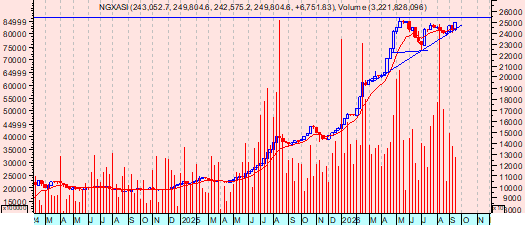
The Nigerian equities market maintained its bullish run during the week ended September 18, 2026, with the NGX All-Share Index (ASI) advancing 2.78% to 249,804.56 points. Market capitalisation rose 2.90% to ₦162.157 trillion, while the year-to-date return climbed to 60.53%.
The market started the week on a positive note, with the ASI gaining 0.10% on Monday to 243,299.24 points. NGXGROUP led the gainers, while JOHNHOLT recorded the biggest decline. Trading volume fell 22.41% to 428.97 million shares worth ₦20.52 billion in 54,592 deals.
On Tuesday, the ASI rose another 0.41% to 244,304.51 points, extending its winning streak to four sessions. NGXGROUP and ARADEL led the gainers, while ETI posted the largest decline. Trading activity improved, with 520.65 million shares valued at ₦37.14 billion exchanged in 71,977 deals.
The market extended its gains on Wednesday as the ASI added 0.20% to close at 244,791.79 points. NB, NGXGROUP and TRANSCORP were among the major gainers, while IMG recorded the biggest decline. Volume increased to 662.43 million shares valued at ₦37.45 billion.
Thursday saw the ASI rise 0.62% to 246,315.38 points, marking six consecutive sessions of gains. BETAGLAS and BUACEMENT gained 10.00% each, while TRANSPOWER recorded the largest decline. Market breadth remained positive with 34 gainers and 23 decliners.
The last trading day of the week closed stronger, with the ASI jumping 1.42% to 249,804.56 points. MTNN, WEMABANK and FIRSTHOLDCO led the gainers, while TRANSPOWER remained the biggest decliner. Trading volume stood at 526.01 million shares worth ₦96.91 billion, with SEPLAT accounting for the highest traded value at ₦67.51 billion.
Overall, investors traded 3.249 billion shares worth ₦237.986 billion in 287,919 deals during the week, compared with 3.647 billion shares valued at ₦130.151 billion in 244,777 deals the previous week.
The Financial Services Industry dominated activity, accounting for 2.581 billion shares worth ₦97.212 billion in 138,900 deals, representing 79.43% of total equity turnover volume and 40.85% of value. The Services Industry followed with 131.102 million shares valued at ₦2.731 billion, while ICT recorded 114.622 million shares worth ₦21.541 billion. Fidelity Bank, Sterling Financial Holdings and Mutual Benefits Assurance led trading by volume, jointly accounting for 1.229 billion shares worth ₦15.942 billion in 7,796 deals. Their combined volume represented 37.83% of total equity turnover.
Market breadth improved significantly, with 52 stocks gaining during the week, compared with nine in the previous week. Decliners fell to 32 from 80, while 63 stocks remained unchanged, against 58 previously. All major indices closed higher, except the NGX Growth Index, which slipped 0.14%.
Week-to-date, the All-Share Index has gained 2.78%, NGX 30 is up by 2.86%, the Banking Index has increased by 4.43%, the Pension Index increased by 3.57%, the Insurance Index inclined by 3.79%, the Consumer Goods Index increased by 0.52%. However, the Oil and Gas Index recorded a positive return of 3.71%. Year-to-date, the All-Share Index has gained 60.53%, NGX 30 is up by 62.12%, the Banking Index has increased by 74.22%, the Pension Index increased by 84.63%, the Insurance Index declined by 7.57%, the Consumer Goods Index increase by 2.36%. However, the Oil and Gas Index recorded a positive return of 125.94%.
UPDCREIT Chart
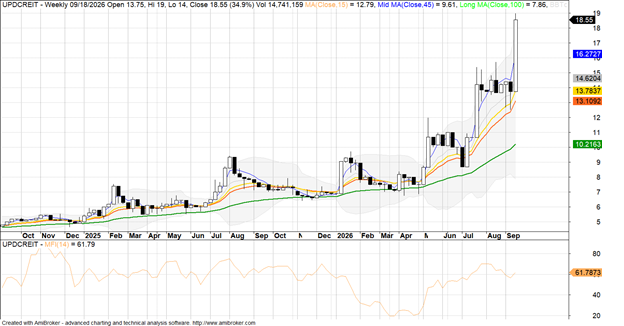
UPDC Real Estate Investment Trust led the gainers, rising from ₦13.75 to ₦18.55, a gain of ₦4.80 or 34.91%. Sovereign Trust Insurance advanced from ₦1.68 to ₦2.20, gaining ₦0.52 or 30.95%. Mutual Benefits Assurance increased from ₦2.95 to ₦3.60, up ₦0.65 or 22.03%. Nigerian Exchange Group rose from ₦148.00 to ₦179.90, gaining ₦31.90 or 21.55%, while First HoldCo advanced from ₦136.00 to ₦160.00, up ₦24.00 or 17.65%.
Transcorp Power Plc
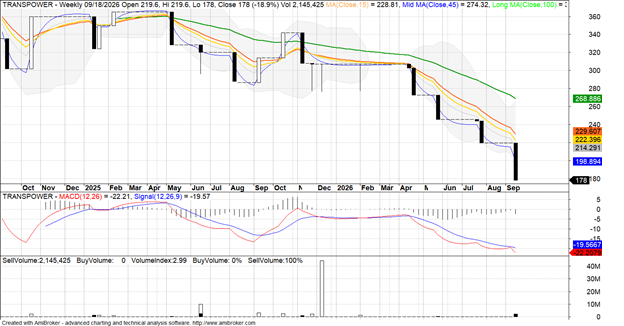
On the decliners’ list, Transcorp Power fell from ₦219.60 to ₦178.00, losing ₦41.60 or 18.94%. John Holt declined from ₦9.00 to ₦7.30, down ₦1.70 or 18.89%, while Ellah Lakes dropped from ₦10.20 to ₦8.35, losing ₦1.85 or 18.14%. LivingTrust Mortgage Bank declined from ₦3.15 to ₦2.60, down ₦0.55 or 17.46%, while Omatek Ventures fell from ₦1.37 to ₦1.20, representing a decline of ₦0.17 or 12.41%.
NGX Weekly Comparative Analysis
The Nigerian equities market recorded a strong turnaround in the week ended September 18, 2026, with the NGX All-Share Index (ASI) gaining 2.78% to 249,804.56 points, compared with a 1.60% decline to 243,052.74 points in the previous week. Market capitalisation rose 2.90% to ₦162.157 trillion, from ₦157.59 trillion, while YTD return improved from 56.19% to 60.53%.
The latest week was positive throughout, with the ASI gaining 0.10% on Monday, 0.41% on Tuesday, 0.20% on Wednesday, 0.62% on Thursday and 1.42% on Friday. This was a sharp reversal from the previous week, when the market gained 0.29% on Monday, fell 1.17% on Tuesday and 1.05% on Wednesday, before recovering 0.06% on Thursday and 0.28% on Friday.
Trading volume fell 10.91% to 3.249 billion shares from 3.647 billion shares, while transaction value increased 82.87% to ₦237.986 billion, from ₦130.151 billion. Deals also rose 17.62% to 287,919, compared with 244,777 previously.
Market breadth improved considerably. 52 stocks gained, 32 declined and 63 remained unchanged, compared with nine gainers, 80 decliners and 58 unchanged stocks in the previous week.
The Financial Services Industry remained the most active, recording 2.581 billion shares worth ₦97.212 billion in 138,900 deals, representing 79.43% of total volume and 40.85% of value. Last week, the sector recorded 2.909 billion shares valued at ₦56.668 billion in 106,662 deals, accounting for 79.76% of volume and 43.54% of value. The Services Industry followed this week with 131.102 million shares worth ₦2.731 billion, while ICT recorded 114.622 million shares valued at ₦21.541 billion. Fidelity Bank, Sterling Financial Holdings and Mutual Benefits Assurance led trading volume with 1.229 billion shares worth ₦15.942 billion, representing 37.83% of total market volume.
Overall, the comparison shows a clear shift from broad-based selling and weak market breadth last week to stronger buying interest and improved participation this week. All major indices closed higher except the NGX Growth Index, which declined 0.14%, while the ASI moved closer to the 250,000-point level.
Technical Analysis View
The NGX All-Share Index maintained a strong bullish structure during the week, advancing 2.78% to close at 249,804.56 points after recording gains in all five trading sessions. The sustained upward movement indicates that buyers remained in control, while the improvement in market breadth from the previous week points to broader participation across the market. The index is now trading close to the 250,000-point psychological level, making this zone an important area to watch in the coming sessions.
The recent rally has also lifted the index further above its previous trading range, strengthening the short-term upward trend. However, the speed of the advance could encourage some investors to lock in profits, particularly around the 250,000-point mark. A successful break and sustained close above this level, supported by stronger volume and positive breadth, would reinforce the current momentum and could expose the index to higher levels.
On the downside, the 246,000–248,000 region could serve as an important near-term support zone. Holding above this area would help preserve the current bullish structure,
while a decisive move below it could lead to a period of consolidation as investors reassess positions. Trading volume will also remain important, as stronger turnover on advancing sessions would provide additional confirmation of buying strength.
Market Outlook
The near-term outlook remains positive, with the market supported by sustained buying interest, improved breadth and seven consecutive sessions of gains. Nevertheless, the index is entering a critical resistance area, where profit-taking and increased volatility may emerge. Investors will therefore be watching the 250,000-point level closely. A sustained break above the resistance zone could strengthen the upward trend, while failure to clear the level may result in temporary consolidation or a mild pullback before the next directional move.
Trending in the Economy: Nigeria’s external reserves rose by $1.9 billion month-on-month to $53.8 billion in August, extending the increase to four consecutive months. The growth was supported by stronger portfolio inflows, remittances and improved oil earnings, with FPI inflows rising 19% to $5.2 billion and IMTO inflows reaching a record $947 million in July.
Meanwhile, headline inflation eased slightly to 15.39% in August 2026 from 15.43% in July, according to the NBS. Month-on-month inflation fell to 0.71% from 1.57%, while food inflation declined to 19.57% year-on-year. Core inflation also moderated to 13.29%, down from 22.93% in August 2025, indicating a broader easing in price pressures.
Global Market and Oil: Global equity markets closed Friday with a modest gain as a late recovery on Wall Street helped offset losses in Europe. The session capped a volatile week dominated by inflation concerns, higher bond yields, geopolitical tensions and a series of major central-bank decisions. In the United States, the Dow Jones Industrial Average fell 0.18%, while the S&P 500 gained 0.17% and the Nasdaq Composite rose 0.40%. The S&P 500 and Nasdaq recovered from earlier losses, supported by technology and industrial shares, while materials, utilities and real estate stocks declined. For the week, the Dow and S&P 500 ended lower, while the Nasdaq finished higher.
The S&P 500 closed at 7,650.50, the Dow at 51,682.64, while the Nasdaq finished at 26,522.55. The Russell 2000 fell 0.5% to 2,860.40. For the week, the S&P 500 declined 0.1%, the Dow dropped 1.7%, and the Russell 2000 fell 1.5%, while the Nasdaq gained 0.7%. Year-to-date, the S&P 500 was up 11.8%, the Dow 7.5%, the Nasdaq 14.1%, and the Russell 2000 15.2%.
European shares remained under pressure, with stocks across the region falling 1.1% on Friday and recording a weekly decline. MSCI’s gauge of global equities edged up 0.07% during the session but still ended the week lower.
Monetary policy remained the dominant market theme as investors assessed the outlook for inflation and interest rates. The Middle East conflict, approaching its seven-month mark, continued to support oil prices above $100 per barrel, raising concerns that higher energy costs could prolong inflationary pressures. The uncertainty also contributed to rising government bond yields.
The Federal Reserve raised interest rates on Wednesday for the first time in three years and adopted a more aggressive stance towards inflation. The move added pressure on the yen, which was heading for a 2% weekly decline against the dollar, its worst weekly performance in two years.
In Japan, the Bank of Japan raised its policy rate to 1.25%, its highest level in 31 years, with two board members dissenting. The yen weakened 0.50% to 156.76 per dollar, although it remained 1.8% higher for the month, supported by expectations of further BOJ rate increases and early signs of Japanese investors repatriating funds.
In the United Kingdom, the Bank of England kept interest rates unchanged but warned that rates could rise if the Iran conflict continues to fuel inflation. The European Central Bank had also signalled the possibility of further tightening after raising rates the previous week. In Australia, the central bank said some of the upside inflation risks previously identified by policymakers appeared to be materialising.
Currency markets were relatively subdued outside Japan. The euro fell 0.10% to $1.1488, while the dollar index remained flat at 100.19.
In the commodities market, Brent crude futures fell nearly 1% to $103.87 per barrel, putting the benchmark on course for a weekly decline. The move followed reports that China had asked Tehran to help rein in the Houthis after their military activity during the week. Expectations that Gulf oil exporters could find alternative routes to transport crude also eased some supply concerns.
The bond market remained under pressure after another sharp sell-off during the week. The 10-year U.S. Treasury yield moved above 5%, reaching its highest level since 2007, before settling at 5.00%, up 5.73 basis points. Yields across the euro zone and Britain also reached multi-year highs during the week, although they eased slightly on Friday.
Gold continued to attract demand amid the uncertain environment. Spot gold rose 0.98% to $4,382.59 per ounce, as investors monitored inflation, interest-rate expectations, bond yields and geopolitical developments.
Overall, global markets ended the week on a mixed note, with gains in U.S. technology and industrial shares helping Wall Street recover from early losses, while European equities remained under pressure. Investors continued to adjust to a higher interest-rate environment, elevated energy prices and persistent geopolitical risks, with the Dow down 0.18%, S&P 500 up 0.17%, Nasdaq up 0.40%, European shares down 1.1% and MSCI global equities up 0.07% on Friday.
INVESTDATA Q4 MASTER CLASS
Theme NEW TRADING OPPORTUNITIES ON THE NGX: MASTERING V0LATILITY, POLITICAL RISKS
Sub-Topics
- The Profitable Trading & Investing Strategies To Play NGX For The Rest Of 2026 And Beyond- Alhaji Garba Kurfi, MD/CEO APT Securities & Funds Ltd)
- Election Cycle & Patterns On The NGX: How To Trade Profitably & Protect Capital- Mr Abdul-Rasheed Oshoma Momoh, Executive Director Operations, TRW Stockbroking Limited
- How To Position & Pick Smart Money Stocks In Q4 And Post Election Rally- Dr Sylvester Anaba (PhD, FCS) , Head Research, United Capital Plc
- Straightforward Sell Or Hold Techniques To Handle & Manage Winning Stocks On NGX-Mr Ambrose Omordion, CRO, InvestData Consulting Ltd
Volatility or market corrections are not losses. They are stock repricing activities. When the market corrects or pulls back, quality companies that were once expensive become affordable with fundamentals remaining intact. That is where long-term wealth starts. Add political risk to that and you get two things: A mix of fear and opportunity.
Fear makes people sell first and ask questions later. Opportunities show up because prices drop below business value and discerning market players buy. In Nigeria, political cycles always create volatility. But they also create entry points. Money doesn’t leave the market forever. It rotates. It waits for clarity, then it rushes back in. So the playbook is simple: Use the correction to build a watchlist of strong companies with real earnings and dividends. Use political risk to buy in phases, or Naira=cost Averaging, not all at once. Scale in as uncertainty peaks. The investors who do well in the NGX are not the ones who avoid corrections and politics. They are the ones who use both to buy quality at a discount. Every correction ends. Political cycles end too. Position now ahead of sentiment flips.
So, are you interested in learning how to safely navigate the financial market in today’s trading and changing investment environment that is clouded with uncertainties, noise and surprises that are driving the volatile markets across the globe plus the election that is close? Despite these headwinds, discerning investors and smart traders on the NGX are positioning for high profits with practical strategies of effective combination of fundamentals, technicals and sentiment analysis. That will be share at the forthcoming InvestData Q4 last Master Class for the year 2026, which we believe is for you. Among others, we know you will learn exact steps in real time using the new strategies by following the current volatility as the election gets closer. Don’t forget that election makes quality stocks available at a discount.
As a result, we have put together this Q4 masterclass to help you identify and buy quality fundamental stocks, avoid those needless losses and build a profitable portfolio with high ROI after the election.
Specifically, you will learn:
- How to hedge against inflation and preserve capital in sectors and industry with the potential to drive profit that will support equity prices.
- How sentiment and technical analyses have helped many trader succeed in this highly volatile market environment.
- How to filter market noise and identify the most opportune time to join any trade.
- Workable and practical strategies during any market cycle that signal real money making opportunities to boost bottom line.
- Five hot stocks that can deliver returns double inflation rate and deliver over 50% within a short timeframe of 91 days or below
- How to buy right on the both sides of equity investing- fundamental vs technical, risk vs profit, buy vs sell and bears vs bulls.
Date: October 3rd. 2026
Time: 9AM Prompt
Fee: N100,000 per participant
Venue: ZOOM
During this practical session our top industry experts will reveal profitable trade ideas and opportunities than can help consolidate your gains in Q4 and ride on year-end seasonality to maximise returns. These you can implement immediately to start tracking the result by yourself. You definitely want to be among the smart traders and investors in Q4. So, send “YES” or “STOCKS” to 08028164085 and 08179547605.