
Market Update For September 8, 2026
The Nigerian equities market reversed sharply on Tuesday, September 8, 2026, as widespread profit-taking across major stocks pushed the market deeper into a cautious phase. The session was characterised by heavy selling pressure across banking, industrial, consumer and insurance counters, with the weakness extending to several highly liquid stocks that had supported the market’s earlier rally.
The broad nature of the sell-off suggests that investors were not simply reacting to company-specific developments but actively reducing risk, and locking in gains after the market’s strong year-to-date performance. The sharp deterioration in market breadth further reinforced the bearish tone, as only a handful of stocks attracted buying interest while losses spread across much of the exchange.
The decline also came against the backdrop of increased portfolio repositioning ahead of the Dangote Refinery Initial Public Offering, which is scheduled to open for public subscription on September 14, 2026. The forthcoming offer could become an important liquidity event for the domestic market, potentially encouraging investors to raise cash by trimming existing positions. This may be contributing to the increased selling pressure in stocks that have recorded significant gains.
The banking sector was particularly weak, with several major financial institutions coming under pressure. FIRSTHOLDCO, ACCESSCORP, UBA and ZENITHBANK all recorded notable declines, weighing in on sentiment in one of the most actively traded segments of the market. NEM also declined significantly despite emerging as the most actively traded stocks during the session.
The weakness was, however, not restricted to financial stocks, as industrial and consumer giants like CAP, MAYBAKER, UACN and DANGSUGAR recorded substantial losses. The simultaneous decline across multiple sectors points to a market-wide risk-off session and raises the possibility that investors are becoming more selective after the substantial gains recorded earlier in the year.
AVACAP was among the weakest counters, falling to ₦5.40 and trading below its previous 52-week level. FTGINSURE, CORNERST, ROYALEX and NSLTECH also suffered sharp declines, highlighting the intensity of selling among several lower-priced stocks.
Despite the widespread weakness, a few equities managed to attract positive interest. ZICHIS led the gainers, while NGXGROUP and LEARNAFRCA also closed higher. However, the limited number of advancing stocks provided little support for the broader market, with the overwhelming dominance of decliners reinforcing the negative sentiment.
Trading activity increased considerably as investors repositioned their portfolios. Volume surged by 84.67% to more than 753 million shares, while market value remained substantial. The combination of higher turnover and falling prices is particularly important from a market-structure perspective, as it suggests that the decline was accompanied by meaningful selling participation.
NEM dominated activity with 131.73 million shares traded, representing a significant portion of total market volume. The stock also led value turnover with transactions worth ₦4.07 billion. MBENEFIT and STERLINGNG followed among the most actively traded stocks by volume, while MTNN and HBMNG also featured prominently in value transactions.
The rise in activity during a declining session suggests that investors were not simply staying on the sidelines. Instead, substantial positions were changing hands as market participants reassessed valuations and adjusted exposure. If elevated volume continues during further declines, it could strengthen the case for a deeper correction. Conversely, a decline in selling volume alongside price stabilisation would provide an early indication that the current profit-taking phase may be losing momentum.
Investor sentiment has become increasingly sensitive to valuation after the NGX’s strong performance this year. With the market still delivering a substantial YTD return, investors who entered positions earlier in the rally have greater incentives to secure profits, particularly where individual stocks have moved significantly ahead of underlying earnings expectations.
The Dangote Refinery IPO adds another layer to the liquidity outlook. Investors looking to participate in the offer may reallocate funds from existing holdings, creating additional pressure on stocks with weaker near-term catalysts. The impact could become more visible as the subscription date approaches.
However, the current correction does not necessarily signal a fundamental deterioration in the Nigerian equity market. Corporate earnings, domestic liquidity and improved investor participation remain important medium-term drivers. The key issue is whether the current selling represents a temporary reset following an extended rally or develops into a broader change in market trend.
Large-cap stocks will remain particularly important in determining the market’s next direction. A stabilisation in banking and other heavyweight counters could help the ASI recover, while continued weakness in these stocks could keep the benchmark under pressure even if smaller counters begin to stabilise.
Technical Analysis and Outlook
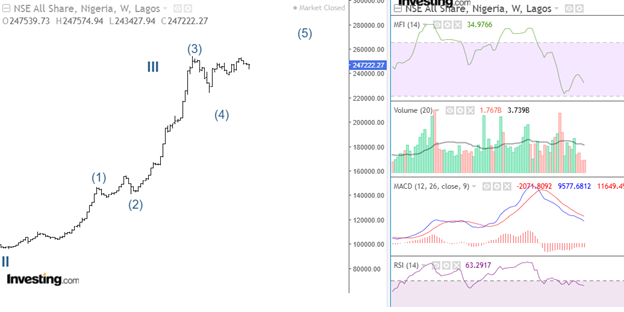
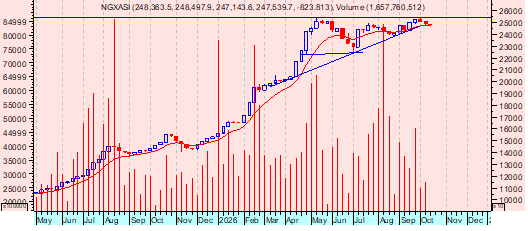
Technically, Tuesday’s session represents a clear deterioration in short-term market momentum. The ASI had been recovering towards the 247,700-point area but was rejected sharply, resulting in a sizeable decline that pushed the index towards the lower end of its recent range.
The 244,000–242,000 region is now an important near-term support area. If buyers defend this zone, the market could attempt a technical rebound, particularly if large-cap stocks begin to recover. A move back above 247,700 points would provide a stronger signal that bullish momentum is returning.
On the downside, a decisive break below the 242,000 area, particularly on heavy volume, could increase the risk of further losses and shift the market into a deeper correction. The next sessions will therefore be critical in determining whether Tuesday’s decline represents a one-day sell-off or the beginning of a broader technical retracement.
Market breadth will also be a key indicator to monitor. The extremely wide gap between decliners and gainers shows that selling pressure remains widespread. A meaningful improvement in breadth, accompanied by stronger performance from large-cap stocks, would strengthen the case for market stabilisation.
Investors should also watch volume behaviour. A decline in volume during subsequent down sessions could suggest that sellers are becoming exhausted, while strong volume accompanying additional declines would indicate that distribution remains active.
From a positioning perspective, the current environment favours selectivity rather than aggressive market-wide exposure. Investors may focus on companies with strong earnings prospects, healthy balance sheets, attractive valuations and sustainable dividend potential, while exercising caution around stocks that have experienced sharp price appreciation without a corresponding improvement in fundamentals.
Oil Market
The external environment provided some support through stronger crude oil prices. Brent crude rose to around $97.48 per barrel after earlier reaching $99.46, its highest level since July 24, while West Texas Intermediate climbed to $92.55.
The rally in oil prices was driven by renewed geopolitical concerns following attacks on Saudi energy facilities and escalating tensions involving Iran and the Strait of Hormuz. Concerns over supply disruptions have added a geopolitical risk premium to crude prices, while reduced tanker flows through the region have raised concerns about physical supply.
For Nigeria, sustained elevated crude prices could provide support for foreign exchange liquidity, government revenues and broader macroeconomic sentiment. Higher oil receipts could also strengthen expectations around external reserves and fiscal capacity.
However, the geopolitical dimension remains a double-edged sword. Although higher oil prices are positive for an oil-producing economy such as Nigeria, a prolonged escalation in the Middle East could increase global inflationary pressures, disrupt trade flows and encourage investors to move towards safe-haven assets. This could limit the benefit to emerging-market equities.
Outlook
The NGX is likely to remain volatile in the near term as investors balance profit-taking against the market’s underlying fundamental outlook. The upcoming Dangote Refinery IPO could remain an important source of portfolio repositioning, while movements in crude oil prices, corporate earnings expectations and domestic liquidity will continue to influence sentiment.
The immediate technical focus remains on the 244,000–242,000 support region. Holding this area could create the foundation for a rebound, while a sustained break below it would increase downside risk. On the upside, reclaiming the 247,700-point region would be necessary to restore stronger bullish momentum.
Overall, Tuesday’s session calls for a more defensive approach. The market remains fundamentally attractive in selected areas, but the combination of elevated valuations, widespread profit-taking, weak breadth and portfolio rebalancing suggests that investors should prioritise quality and valuation discipline. Confirmation of renewed buying interest, particularly in large-cap stocks, would be required before a stronger recovery can be established.
The NGX All-Share Index declined by 2,897.67 points, or 1.17%, to close at 244,802.11 points, while market capitalisation fell by ₦1.88 trillion to ₦158.72 trillion. Total transaction value stood at ₦27.81 billion from 753.14 million shares traded in 53,966 deals, with trading volume rising 84.67%, while the market’s YTD performance moderated to 57.31%. Market breadth was firmly negative, with four gainers, 63 losers and 80 unchanged. NEM was the dominant market mover by volume, recording 131.73 million shares traded and ₦4.07 billion in value. Other notable movers included FIRSTHOLDCO (-9.30%), CAP (-7.73%), MAYBAKER (-7.09%), ACCESSCORP (-7.06%), UACN (-5.51%), NEM (-5.50%), UBA (-5.00%), TIP (-4.54%), ETERNA (-4.17%), ZENITHBANK (-3.94%), OANDO (-3.32%), DANGSUGAR (-2.79%), MTNN (+2.39%), GTCO (+1.52%) and HBMNG (-1.22%). Top gainers were ZICHIS (+3.79% to ₦18.89), NGXGROUP (+1.38% to ₦131.90) and LEARNAFRCA (+1.16% to ₦8.75), while top losers were AVACAP (-10.00% to ₦5.40), FTGINSURE (-9.89% to ₦1.64), CORNERST (-9.26% to ₦4.90), ROYALEX (-9.09% to ₦1.00) and NSLTECH (-8.22% to ₦0.67).