
Market Update For March 18, 2026
The Nigerian equities market extended its pullback on Wednesday, March 18, 2026, as sustained profit-taking pressure overshadowed recent bullish momentum, with investors trimming positions ahead of the Eid-el-Fitr holiday.
After several sessions of strong upside, the market encountered resistance as traders moved to lock in gains, particularly in high-performing and fundamentally strong counters. This shift in sentiment triggered a broad-based decline, cutting across the banking, oil & gas, consumer goods, and industrial sectors, and reflecting a cautious near-term outlook.
The selloff was largely driven by short-term market participants and portfolio rebalancing, rather than a fundamental deterioration in macroeconomic conditions. This suggests that the current weakness is more of a technical correction within an existing uptrend, as investors create room for fresh entries at more attractive price levels.
Notably, the market continues to exhibit resilience in terms of liquidity and participation, indicating that institutional investors remain active, though increasingly selective in their positioning. The strong turnover recorded during the session reinforces the view that funds are rotating rather than exiting the market entirely.
Liquidity Surge Signals Strategic Positioning
Trading activity spiked significantly, underlining heightened investor engagement despite the bearish close. Total volume traded surged by 246.00% to 6.06 billion units valued at ₦130.06 billion across 58,562 deals.
ETRANZACT dominated the volume chart with 5.15 billion units, accounting for 85.31% of total traded volume, suggesting large block trades or strategic accumulation/distribution. In value terms, DANGCEM led with ₦56.48 billion, contributing 43.42% of the total value traded, highlighting sustained institutional interest in blue-chip names.
Other notable contributors included WEMABANK and WAPIC on the volume side, while ETRANZACT and MTNN followed DANGCEM in value terms. The combination of rising volume and declining prices signals distribution, as investors offload positions into market strength.
Oil Prices Rally Amid Escalating Geopolitical Tensions
In the global commodities market, crude oil prices surged sharply, driven by escalating tensions in the Middle East and growing concerns over supply disruptions.
Brent crude gained 4.4% to $107.95 per barrel after touching an intraday high of $108.60, marking its fourth consecutive session above the $100 level. U.S. West Texas Intermediate (WTI) also rose by 2% to $98.12.
The rally follows renewed threats to critical energy infrastructure, including Iran’s South Pars field, as geopolitical risks intensify. Although Iraq has resumed partial exports via pipeline, production remains significantly below pre-crisis levels, while tanker movement through the Strait of Hormuz is still constrained.
For Nigeria, elevated oil prices remain a positive macro driver, supporting fiscal stability and boosting sentiment around oil-linked equities. However, persistent global uncertainty continues to inject volatility into financial markets, influencing investor behavior and risk appetite.
Technical Analysis: Market at a Critical Inflection Point
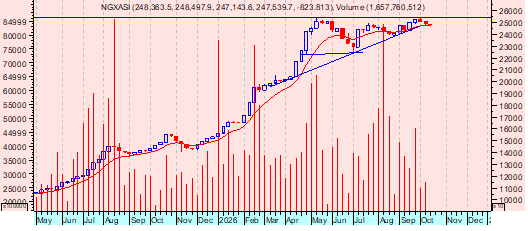
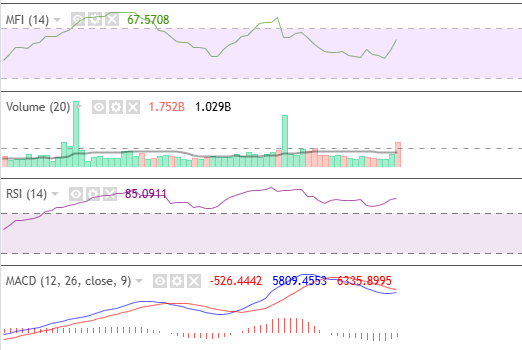
From a technical perspective, the NGX is currently at a crucial juncture. While the broader trend remains bullish, the recent decline signals weakening momentum and a potential pause in the uptrend.
The All-Share Index is still trading above the key psychological support level of 200,000 points, which serves as a critical threshold for market direction. Holding above this level suggests that the bulls are still in control in the medium term, despite the short-term pullback.
However, the formation of bearish candlesticks and declining momentum indicators points to increased distribution and reduced buying strength. If selling pressure persists, the market may test lower support levels around 198,000 and 195,000 points.
On the upside, a rebound above recent highs would require renewed buying interest, particularly from institutional investors, supported by strong earnings expectations and positive macro signals.
Sector-wise, banking stocks are likely to remain under pressure in the near term due to profit-taking, while oil & gas stocks may benefit from rising crude prices. Consumer goods stocks could see mixed sentiment as investors weigh inflationary pressures against earnings resilience.
Outlook: Cautious Optimism with Near-Term Volatility
Looking ahead, the market is expected to remain volatile in the short term, influenced by post-holiday liquidity conditions, institutional re-entry, and global market developments.
While the long-term outlook remains positive, supported by strong corporate fundamentals and attractive valuations, short-term risks persist. Investors are likely to adopt a more selective approach, focusing on fundamentally sound stocks with strong earnings visibility and defensive characteristics.
The recent pullback may also present buying opportunities for medium- to long-term investors seeking to enter the market at discounted levels, particularly in fundamentally strong sectors.
Overall, the NGX remains structurally sound, but the current phase reflects a healthy correction that could set the stage for the next leg of the rally.
Market Summary
Selling pressure was widespread, with major decliners including REDSTAREX (-9.98%), ARADEL (-9.68%), PRESCO (-9.30%), GTCO (-7.41%), NGXGROUP (-4.47%), ETERNA (-4.40%), UBA (-4.22%), WEMABANK (-2.35%), UACN (-1.49%), MAYBAKER (-1.21%), ACCESSCORP (-1.15%), ZENITHBANK (-1.04%), NB (-0.66%), NAHCO (-0.63%), NASCON (-0.62%), NEM (-0.30%), MTNN (-0.26%), and 21 others. The All-Share Index (ASI) declined by 0.69% to close at 201,156.85 points from 201,474.89 points, shedding 318.04 points. Market capitalisation fell to ₦129.13 trillion, while year-to-date return eased to 29.27%. Market breadth closed negative at 38 decliners against 31 gainers. NSLTECH led the gainers’ chart, while REDSTAREX topped the losers’ list, as GUINNESS and JOHNHOLT traded at new 52-week highs of ₦423.20 and ₦11.85, respectively.