
Market Update For March 27, 2026
The Nigerian equities market closed Friday on a slightly negative note, extending the ongoing pullback as investors intensified profit-taking across major sectors. The session reversed the modest gains recorded previously, as market participants continued to rebalance portfolios following the sustained rally that pushed the benchmark index to historic highs. Selling pressure was evident across consumer goods, banking, and select industrial counters, with notable declines in CADBURY, ETRANZACT, ETERNA, CWG, NB, STANBIC, DANGSUGAR, FIRSTHOLDCO, TRANSCORP, PZ, MTNN, UBA, and ZENITHBANK, among others.
The market tone reflected a cautious undertone, driven by a mix of valuation concerns, sector rotation, and short-term profit booking. Many of the affected stocks had recorded significant price appreciation in recent sessions, prompting investors to take advantage of elevated price levels. This trend of distribution suggests that while the broader market remains in an uptrend, near-term volatility is likely to persist as participants reassess entry points and risk exposure.
Trading activity weakened notably, reinforcing the cautious sentiment. Both volume and value traded declined during the session, indicating reduced participation and a temporary withdrawal of aggressive buying interest. WEMABANK dominated the activity chart, accounting for a significant share of total traded volume and value, highlighting sustained interest in the banking space. LEGENDINT and ZICHIS also posted strong volume contributions, reflecting increased retail participation and speculative positioning in low- and mid-cap counters. On the value side, ARADEL and MTNN followed behind WEMABANK, underscoring continued institutional focus on fundamentally sound and highly liquid stocks.
Interestingly, despite the broader market softness, a number of stocks maintained strong bullish momentum. PREMPAINTS, JOHNHOLT, and LEGENDINT traded above their 52-week highs, signaling sustained demand and positive sentiment around these counters. This divergence highlights the current structure of the market, where selective opportunities continue to outperform even as the broader index consolidates. It also reflects ongoing sector and stock rotation, with investors reallocating capital into stocks with stronger earnings prospects and momentum profiles.
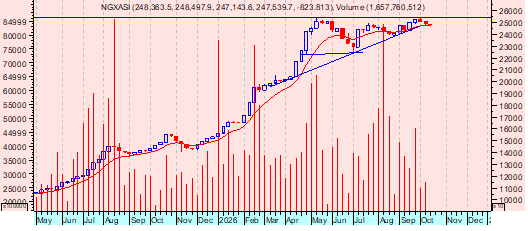
From a technical standpoint, the All-Share Index (ASI) remains in a consolidation phase around the psychologically important 201,000 level. The marginal decline observed in the session suggests ongoing distribution, but the index continues to hold above key support levels, indicating that the underlying bullish structure has not been compromised. Momentum indicators are gradually easing from overbought territory, while oscillators show mixed signals, pointing to a market in transition. This phase of consolidation is healthy in the context of a broader uptrend, as it allows the market to build a new base for potential upward movement.
In the near term, the market is expected to trade within a tight range, with a mild bearish bias as profit-taking persists. However, the presence of bargain hunters and institutional investors in fundamentally strong stocks should help cushion downside risks. Sector rotation will likely remain a dominant theme, with opportunities emerging in undervalued and earnings-driven counters. Investors are therefore advised to adopt a disciplined and selective approach, focusing on stocks with solid fundamentals, attractive valuations, and supportive technical setups.
On the macro front, developments in the global oil market continue to play a significant role in shaping investor sentiment. Oil prices rose during the session but remained on track for their first weekly decline since early February, reflecting a partial easing of geopolitical tensions. Brent crude gained $2.85 or 2.64% to trade at $110.86 per barrel, while U.S. West Texas Intermediate (WTI) rose by $2.53 or 2.68% to $97.01 per barrel. Despite these gains, Brent declined by 1.2% for the week, while WTI fell by 1.3%.
The broader trend, however, remains strongly bullish, with Brent up over 53% and WTI up about 45% since late February, driven by the escalation of conflict in the Middle East. The recent pause in attacks on Iran’s energy infrastructure has temporarily eased supply concerns, but uncertainty persists, particularly around the Strait of Hormuz and key oil export terminals. Any escalation or disruption to supply routes could trigger a sharp repricing in global oil markets.
For Nigeria, as an oil-dependent economy, these developments carry significant implications. Elevated oil prices support government revenues and external reserves but also introduce inflationary pressures and policy uncertainties. Consequently, movements in the oil market are likely to continue influencing investor sentiment on the domestic bourse, particularly in oil and gas counters and broader macro-sensitive sectors.
The All-Share Index (ASI) declined by 0.02% to close at 200,913.06 points from 200,957.89 points in the previous session, while market capitalisation shed ₦28.78bn to settle at ₦128.97trn. Year-to-date return eased slightly to 29.11%, reflecting the impact of recent selloffs. Market breadth closed negative, with 36 decliners against 33 gainers, underscoring weak underlying sentiment. On the gainers’ chart, PREMPAINTS advanced by 10.00% to ₦37.50, JOHNHOLT gained 9.98% to ₦18.95, and LEGENDINT rose by 9.75% to ₦2.59. On the losers’ side, ABBEYBDS, CADBURY, ETERNA, and ETRANZACT all declined by 10.00% each, while CWG dropped by 3.93% and NB fell by 3.14%. Total volume traded declined by 12.24% to 595.15 million units valued at ₦24.47bn across 43,440 deals, highlighting softer market activity and a cautious trading environment.