

Market Update For March 30, 2026
The Nigerian equity market closed Monday, March 30, 2026, on a softer note, extending its recent pullback as persistent profit-taking across major sectors continues to weigh on sentiment. The decline reflects a market in transition, where investors are increasingly cautious after a strong rally that pushed valuations in many counters to elevated levels.
Sell pressure was evident across bellwether and mid-cap stocks, with notable declines in MAYBAKER, WAPCO, ZENITHBANK, DANGSUGAR, GTCO, and WEMABANK, alongside a broader list of decliners. The spread of losses across sectors highlights a market-wide distribution phase as investors tactically reduce positions and rebalance portfolios in response to changing risk dynamics and external uncertainties.
This phase of correction is not entirely unexpected, because after a prolonged upward trend markets typically undergo periods of consolidation or retracement, allowing prices to adjust while allowing for new entry points to emerge. What is significant in the current context is the persistence of sell pressure despite intermittent buying interests, indicating that market participants are prioritizing capital preservation in the near term.
Notwithstanding the bearish undertone, trading activity remained relatively healthy, suggesting that liquidity is still present within the system. ACCESSCORP once again dominated the volume chart, reflecting its continued appeal among both retail and institutional investors. On the value side, FIRSTHOLDCO led the market, with strong contributions also recorded in ZENITHBANK and NESTLE. This concentration of value in large-cap stocks underscores ongoing institutional engagement, even as the broader market weakens.
A key feature of the session was the divergence in performance across stocks. While the benchmark index trended lower, selective counters such as TRANSEXPR, TIP, NAHCO, and EUNISELL advanced to new 52-week highs. This is an indication that pockets of strength still exist driven by company-specific fundamentals, earnings expectations, or speculative momentum. Such divergence often characterizes a maturing market cycle, where leadership becomes narrower and capital rotates strategically rather than broadly.
On the global front, crude oil prices continued their impressive rally, adding another layer of complexity to the investment landscape. Brent crude remained firmly above $113 per barrel, while WTI hovered above $101, supported by escalating geopolitical tensions in the Middle East. The disruption of supply routes, particularly around the Strait of Hormuz, has intensified concerns about global energy security and inflationary pressures.
For Nigeria, the implications of rising oil prices are mixed. While higher oil revenues are supportive of fiscal stability and external reserves, they also pose risks in terms of imported inflation and potential tightening of monetary policy.
These factors create an environment of uncertainty, where investors must balance the positive macroeconomic impact of higher oil prices against the potential drag on corporate performance and consumer demand.
Technical Analysis & Market Behaviour
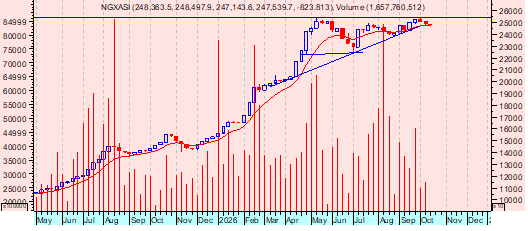
From a technical perspective, the Nigerian All-Share Index (ASI) is currently navigating a short-term bearish phase. The index has slipped below the key psychological threshold of 201,000 points, a level that previously acted as support. This breakdown suggests that bearish momentum is gaining traction, with sellers maintaining control in the near term.
Market breadth further reinforces this outlook, as the number of declining stocks continues to outpace gainers. This indicates that the weakness is not isolated but rather broad-based, affecting a wide range of sectors and market capitalizations. Additionally, the pattern of declining prices on relatively strong volume points to sustained distribution, likely driven by institutional profit-taking.
However, a broader view of the market reveals that the long-term uptrend remains intact. The ASI is still trading above critical medium-term support levels, which suggests that the current decline is a corrective move rather than a full-scale reversal. Such corrections are often necessary to reset market conditions, improve valuation metrics, and pave the way for the next leg of growth.
Momentum indicators are currently subdued, signaling that the market may continue to experience sideways or downward movement in the short term. However, the presence of stocks making new highs indicates that not all segments of the market are weakening, reinforcing the case for selective investment strategies.
Outlook:
Looking ahead, the Nigerian equities market is likely to remain volatile, with a mixed to cautious bias dominating near-term trading. Profit-taking is expected to persist, particularly in stocks that have delivered strong gains year-to-date. At the same time, bargain hunting may begin to emerge gradually, especially as prices adjust to more attractive levels.
Investor focus will likely remain on a combination of domestic and global factors, including liquidity conditions, interest rate expectations, corporate earnings outlook, and developments in the global oil market. The interplay of these factors will determine the pace and direction of market recovery.
In the near-term, the market may enter a consolidation phase, characterized by intermittent rebounds and continued sector rotation. Stocks with strong fundamentals, resilient earnings, and positive catalysts are likely to attract sustained interest, while weaker counters may continue to face pressure.
Ultimately, the ability of the market to stabilize and resume its upward trajectory will depend on renewed investor confidence, supported by improved macroeconomic clarity and sustained institutional participation. Until then, cautious trading and selective positioning are expected to define market behavior.
ASI declined by 0.21% to close at 200,484.43 points from 200,913.06 points, as market capitalisation fell by N275.15bn to settle at N128.69trn, with the year-to-date return easing to 28.84%. Market breadth remained negative at 34 losers against 27 gainers, reflecting weak sentiment. On the gainers’ chart, AUSTINLAZ led with a 10.00% gain, while other advancers posted modest increases. On the losers’ side, NSLTECH (-10.00%) topped the chart, followed by MAYBAKER (-9.42%), WAPCO (-3.26%), ZENITHBANK (-2.86%), DANGSUGAR (-2.79%), GTCO (-0.99%), and WEMABANK (-0.76%). In terms of activity, ACCESSCORP recorded the highest volume traded at 86.64 million units, while FIRSTHOLDCO led the value chart with N4.26bn, with ZENITHBANK and NESTLE also featuring prominently among the most traded by value.