

Market Update For April 1, 2026
The Nigerian equities market sustained its upward momentum in mid-week trading to begin the month of April and second quarter of the year, while reinforcing the bullish sentiment that has defined recent sessions. The market continues to benefit from sustained liquidity inflows and investor preference for fundamentally strong, large-cap stocks, particularly within the banking sector. This trend has remained a defining feature of the current rally, with institutional players driving activity in high-value counters while broader participation remains relatively subdued.
Trading patterns during the session reflected a market that is advancing, but not without underlying fragility. While the benchmark index posted gains, activity levels declined, pointing to a degree of caution among market participants. Investors appear to be increasingly selective, focusing on stocks with strong earnings visibility and defensive qualities, while avoiding exposure to weaker or more volatile counters. This selective accumulation has continued to support the market’s upward movement, even as selling pressure persists across a wider segment of listed equities.
The financial services sector once again played a pivotal role in shaping market direction, with sustained demand for tier-one banking stocks providing the backbone for the day’s performance. These stocks continue to attract interest due to their liquidity, earnings strength, and positioning in a high interest rate environment. However, outside of this segment, the market remains relatively thin, with limited participation across mid- and small-cap stocks, highlighting the uneven nature of the rally.
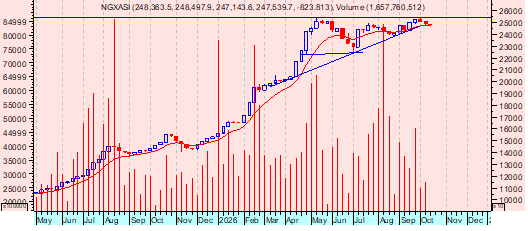
From a technical standpoint, the All-Share Index remains firmly above the 200,000 psychological threshold, a level that now serves as a critical support zone for the market. Holding above this mark reinforces the prevailing bullish structure, suggesting that the broader trend remains intact. However, the negative market breadth and declining volume signal weakening internal strength. This divergence—where the index rises while the majority of stocks decline—typically reflects a narrowing rally driven by a handful of heavyweights.
Momentum indicators continue to point upward but are beginning to moderate, suggesting that the pace of gains may slow in the near term. This creates the possibility of a consolidation phase, where the market could trade within a range or experience mild pullbacks as investors take profits. Such movements would be consistent with a healthy market cycle, particularly after a sustained period of gains. The key factor to watch remains whether buying interest in large-cap stocks can continue to offset selling pressure across the broader market.
In the global oil market, prices retreated as geopolitical tensions showed early signs of easing. Brent crude declined to around $101.91 per barrel, while U.S. West Texas Intermediate (WTI) crude traded near $99.99 per barrel, both reflecting a reduction in risk premium. The decline followed signals suggesting a possible de-escalation in the conflict involving the United States and Iran, which had previously raised concerns about prolonged supply disruptions.
Despite the pullback, the oil market remains sensitive to developments in the Middle East, particularly around the Strait of Hormuz, a key route for global oil shipments. Disruptions in this region have already affected supply flows, and even with easing tensions, normalization is expected to take time. Additionally, production constraints among major oil producers and earlier output declines continue to shape a tight supply environment, leaving room for continued volatility in oil prices.
For the domestic market, movements in global oil prices remain a critical external factor, given their implications for Nigeria’s fiscal position and foreign exchange dynamics. While easing oil prices may reduce inflationary pressures globally, sustained weakness could present downside risks if it impacts government revenues or investor sentiment towards oil-dependent economies.
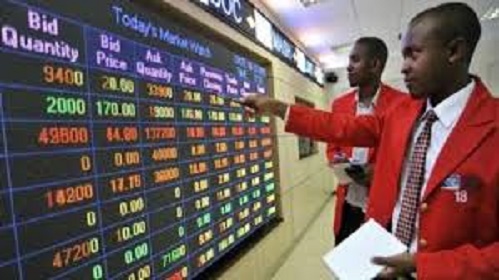
At the close of trading, the All-Share Index (ASI) advanced by 0.21% to settle at 201,703.55 points, gaining 415.77 points from the previous session. Market capitalisation rose by N599.41bn to close at N129.81trn, while the year-to-date return improved to 29.62%, reflecting continued strength in the market’s overall performance. Market breadth remained negative, with 22 gainers against 41 losers, highlighting persistent selling pressure beneath the surface.
On the gainers’ chart, UPDCREIT led with a 10.00% increase, followed by ZENITHBANK (+7.52%), GTCO (+7.37%), PZ (+1.22%), ACCESSCORP (+0.58%), WEMABANK (+0.38%), and WAPCO (+0.05%), alongside other marginal advancers. Conversely, OMATEK topped the losers’ table with a 10.00% decline, with additional losses recorded across several mid- and small-cap stocks.
Market activity softened, as total volume traded declined by 8.13% to 815.48 million units, valued at N33.29bn across 52,641 deals. WEMABANK recorded the highest volume with 77.75 million units, accounting for 9.53% of total trades, while GTCO dominated the value chart with N8.97bn, representing 26.94% of total turnover. ACCESSCORP and GTCO also featured prominently in volume contribution, while ZENITHBANK and FIRSTHOLDCO ranked among the top in traded value, underscoring continued institutional interest in these counters.