

Quarter Under Review: FULL YEAR 2025
Current Share Price: N18.40
Price At Release Date: N18.35
Latest Final Dividend: N0.70
Latest Interim Dividend: N0.30
Estimated Beta Value: 0.21x
Estimated Intrinsic Value: N16.93
Rating: Buy/Accumulate-Especially on Dips
Analyst: Jeariogbe Tunde Segun
The Company
United Capital was incorporated on March 14th, 2002 in Nigeria as a private limited liability company operating within the financial services ecosystem as an arm of the United Bank for Africa Plc Group where it started as UBA Capital Plc. Specifically, it functioned as the investment banking arm of the group handling capital market and investment advisory services. The company became an independent investment banking group, and a public listed company on the Nigerian Exchange floor. It is notable for being the first investment bank listed on the exchange. In December, 2014, the company officially changed its name from UBA Capital Plc, to United Capital Plc.
After rebranding, United Capital grew into a diversified financial services group, with operations in: investment banking, assets management, securities trading, wealth management, and consumer finance and micro-finance. It established multiple subsidiaries such as: United Capital Asset Management Ltd, United Capital Securities, United Capital Trustees, and UCEE Microfinance Bank Ltd.
The Released Numbers
At the end of its operations for the financial year 2025, the Gross Earnings of United Capital stood at N58.547 billion, a 34.81% improvement on the N43.431 billion reported in the previous year. Net Operating Income was valued at N53.534 billion versus N36.556 billion. Personnel Expenses stood at N5.679 billion and Other Operating Expenses- N20.373 billion, bringing Total Operating Expenses for the year to N26.071 billion against N16.183 billion in the corresponding period of 2024. Depreciation and Amortisation is valued at N934.464 million against N664.909 million in the comparable year. Thus, Operating Profit is N39.313 billion from N27.475 billion. Profit Before Tax estimate stood at N41.182 billion versus the previous N30.102 billion, Tax Expenses is N13.036 billion as against N6.00 billion, and Profit for the year amounted to N28.146 billion versus N24.102 billion in the corresponding year of 2024. Note that Total Comprehensive Income was slightly boosted to N30.970 billion versus N59.474 in 2024. See the table below for details:
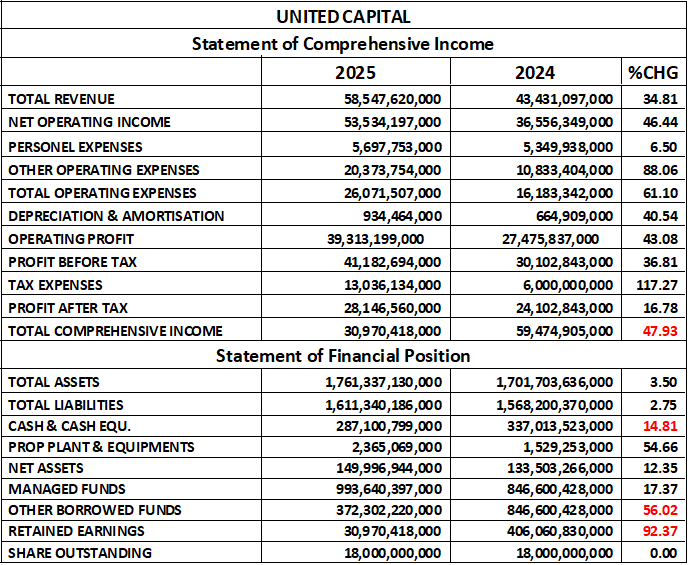
Representing the full year 2025 performance is the Total Assets of N1.761 trillion, an inch above the reported N1.701 trillion in 2024. Total Liabilities is valued at N1.611 trillion against N1.568 trillion. Cash and Cash equivalent at the end of business is estimated at N287.100 billion versus N337.013 billion. Property Plant and Equipment stood at N2.365 billion from N1.529 billion. Net Assets stood at N149.996 billion against N133.503 billion in the comparable year. Retained Earnings stood at N30.970 billion against N406.060 billion in 2024. See the table above for details.
Financial Strength
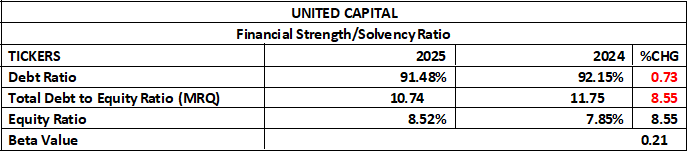
- Debt Ratio is currently valued at 91.48%, meaning that over 91% of total assets are financed by liabilities. This is very high in absolute terms. But for an investment/financial services firm, it is normal as client funds (managed funds) inflate liabilities, and the business model is naturally leveraged. In other words, the performance can be interpreted as indicating high leverage structure, but industry-consistent. This is a slight improvement from 2024 (92.15%) which confirms marginal deleveraging.
- Debt-to-Equity Ratio at 10.74x means that for every N1 of equity, the company uses N10.74 of liabilities. This is very high compared to those of non-financial firms. But again, typical for firms like asset managers and investment banks. Coming down from 11.75x, this is a positive signal showing that either equity is growing faster or liability growth is being controlled. In our view, this is still highly leveraged, though with improving capital structure.
- Equity Ratio is simply the inverse perspective of leverage. Only 8.52% of assets are funded by shareholders. This is low in absolute terms, but aligns with the company’s capital-light, liability-driven model. Note also that the improvement from 7.85% to 8.52% is very important, suggesting that the company is building stronger capital buffers, which is likely driven by: retained earnings growth or strong profitability.
Financial Strength Final Verdict: United Capital shows: a strong but highly leveraged financial position (industry normal). The stock is neither weak nor conservative. The trend improvement is the most encouraging signal signaling that the business is stable because of its model, not low leverage.
Profitability Ratio
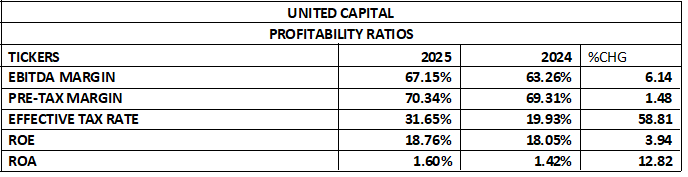
- EBITDA Margin: As shown in the table below, the ratio moved from 63.26% to 67.15% which is extremely strong. It means for every N1 revenue it retains approximately N0.67 before tax, up from the previously estimated 63.26%. This shows strong cost discipline, and operating expenses is not rising as fast as income. This is not top-tier profitability, but very typical of high-margin investment firms.
- Pre-Tax Margin at 70.34% is even more impressive, meaning that the company converts over 70% of revenue into profit before tax. The implications are: minimal leakage below operating line, strong contribution from investment income and fair value gains. The trend between the compared years shows slight improvement, confirming the fact that earnings quality remains strong.
- Return on Equity is very solid at 18.76%. In our opinion, anything above 15% is strong, and now we have almost 205 returns. With the slight increase from the previous year’s, we can say the profit growth is keeping pace with equity expansion.
- Return on Assets: At first glance, this looks low at 1.60%, but if we consider the fact that for a financial services firm, assets are usually very large (N1.7 trillion in the case of UCap). We can, therefore, safely conclude that ROA is naturally compressed.
Final Profitability Verdict: The combination of ROE and ROA confirms that profitability is being amplified by leverage, which correlates with our earlier observed high Debt-to-Equity ratio, meaning that the business model relies on low asset yield plus high leverage to achieve strong equity returns. Summarily, we observe, exceptionally high margins (67%-70%), strong earnings conversion, consistent ROE near 20%, and improving efficiency (ROA trending up). Thus, we conclude that Ucap is profitable with premium margins and strong return profile. We therefore conclude that, the business is; efficient, sociable, with rich earnings.
Efficiency Ratios
- Operating Expenses to Revenue: The movement in this ratio from 37.26% to 44.53% reveals a rising cost pressure, as the increase indicates 19.51% cost jump above the previous year’s. Possible drivers include: staff cost increase, expansion (new business lines), and inflation impact (very relevant in Nigeria). Nevertheless, this is still acceptable for the industry where it operates. The firm still retains almost 55% margin before other charges, combined with 70% pre-tax margin. This means: cost pressure exists, but profitability is still very strong.
- Revenue to Total Assets: The ratio shows strong improvement from the 2.55% of prior year to 3.32%, confirming the improved deployment of capital, and more productive asset base.
Final Efficiency Verdict: United Capital Plc shows: a strong but slightly cost-pressured efficiency profile. Business is still highly efficient in the overall, but, cost trend needs monitoring.

Investment Ratios
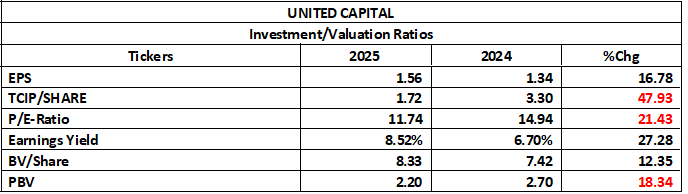
- Earnings Power (EPS): The ratio shows a growth of 16.78% at N1.56 from N1.34 each, a strong growth that indicates: consistent profit expansion, backed by strong margins we noted earlier.
- Total Comprehensive Income: This is a decline to the tune of 47.93%. This is very important and often overlooked. The Total Comprehensive income dropped sharply, due to fair value reserve movements, and investment market volatility. Meaning some unrealized gains reversed, but core profit (PAT) still grew. So, this is not a fundamental weakness but it is worth mentioning.
- P/E-Ratio: Now estimated at 11.74x. By this we can say the stock is not cheap, but, also not expensive for a high-margin financial firm with approximately 19% ROE. Compared to its quality, this is actually reasonable.
- Earnings Yield: This ratio at 8.52% shows that investors earned 27.285 over the comparable year yield. Benchmarked mentally against the yield of Nigerian Treasury Bills, it is similar. Meaning that the stock is fairly competitive against the fixed income instrument.
- Book Value & Price-to-Book Value: At 2.2x we can say the market is pricing the company at 2.2x its net assets, reflecting the strong profitability (ROE app 19%), the confidence lies in earnings sustainability and management quality.
Dividend Information
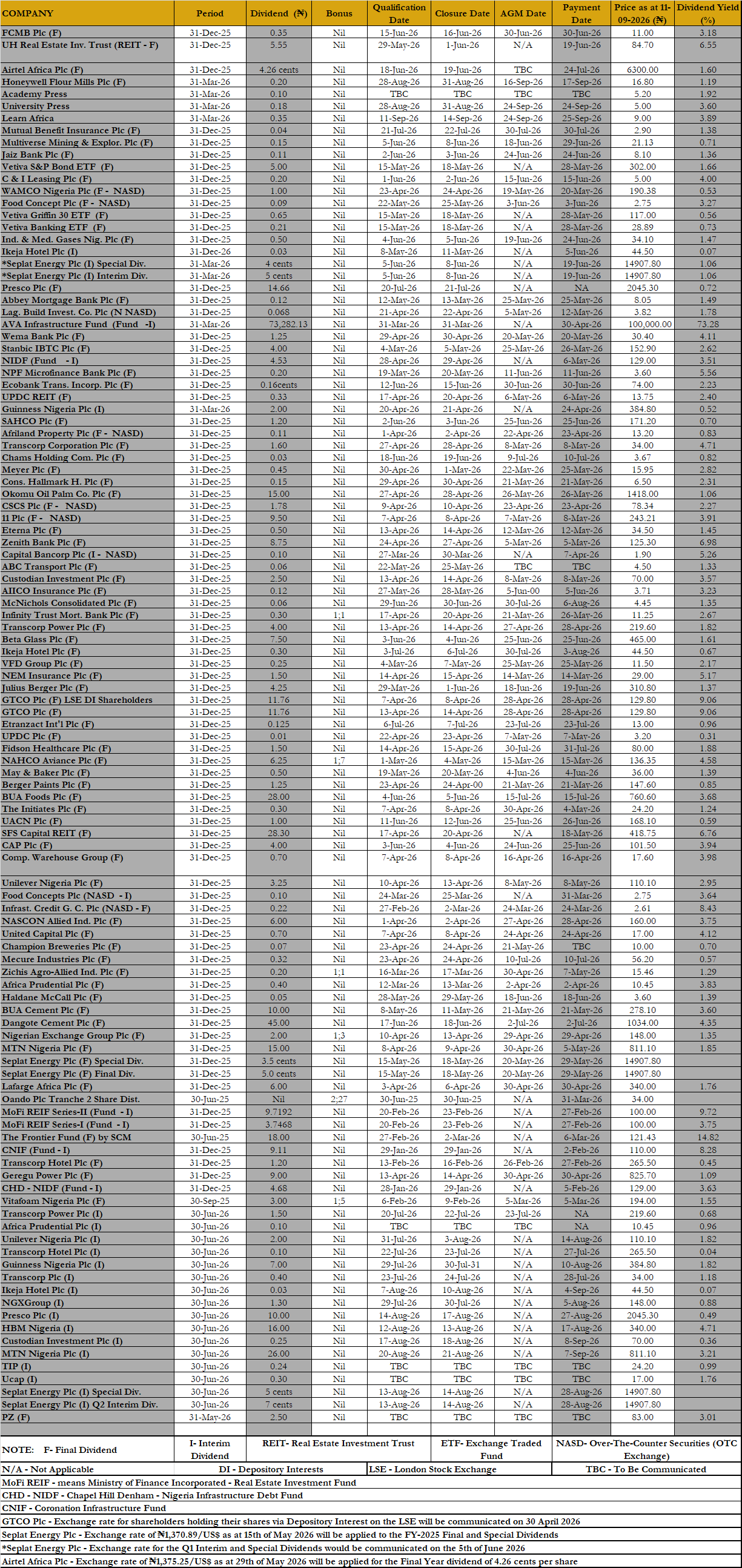
- Shareholders Return: Although ratios calculated are based on the N0.70 final dividend, the company also paid an interim dividend of 30k within the year, bringing the total dividend to N1.00 each. Using the total dividend therefore, the payout ratio is 64% and total dividend yield is 5.4%. This is what investors actually received in cash.
- See below for other dividend ratios. We can conclude here that, United Capital Plc shows a flexible and investor-friendly dividend policy. Conservative on paper, but generous in reality.

Overall Verdict: From our view, the stock is not undervalued enough to call for a strong or aggressive buy, but it is too strong fundamentally to be ignored. We have therefore rated United Capital shares Buy/Accumulate, especially on dips this is because of the high quality earnings, strong dividend income and reasonable valuation strength. The stock is ideal for income investors, and long term compounders.