
Market Update For April 2, 2026
The Nigerian equities market closed the holiday-shortened week on a cautious note, as profit-taking in key bellwether stocks offset gains recorded across the broader market. Investors appeared to lock in profits following the recent bullish run, leading to mild sell pressure in counters such as HONYFLOUR, NB, OANDO, CUSTODIAN, UBA, and ACCESSCORP. This tempered overall sentiment, leaving the market largely directionless at the close of trading.
Despite the weak finish, underlying sentiment remained relatively resilient, supported by selective buying in mid- and small-cap stocks. This divergence highlights a market in transition, where investors are gradually rotating out of overbought large-cap names into undervalued opportunities across other segments. The mixed tone reflects a balance between profit-taking activities and bargain hunting, as market participants reassess valuations and earnings expectations.
Trading activity slowed considerably during the session, reflecting the impact of the shortened trading week and a more cautious stance among investors. Both volume and value traded declined sharply, signaling reduced participation. Market turnover was concentrated in a handful of stocks, with NSLTECH accounting for the highest traded volume, while ZENITHBANK led in value terms. WEMABANK and VFDGROUP also saw notable volume contributions, while GTCO and MTNN remained dominant in value trades. This pattern suggests that while overall participation weakened, institutional interest in fundamentally strong and liquid stocks remains intact.
On the global front, developments in the oil market continue to shape investor sentiment. Crude oil prices surged significantly, crossing the $110 per barrel mark amid escalating geopolitical tensions between the United States and Iran. Brent crude advanced by $7.96, representing a 7.9% increase to settle at $109.12 per barrel, while West Texas Intermediate (WTI) rose by $12.48 or 12.5% to $112.60 per barrel. Both benchmarks recorded their strongest gains in years and touched their highest levels since March, although they remain below the peak levels of around $120 per barrel seen earlier in the conflict.
The rally in oil prices is being driven by fears of prolonged supply disruptions, particularly given the absence of clear signals pointing to de-escalation. Concerns over potential constraints in key supply routes, including the Strait of Hormuz, have heightened market anxiety. Additionally, warnings from global energy authorities about possible supply shocks beginning to impact major economies have further reinforced bullish sentiment in the oil market. For Nigeria, higher oil prices present a mixed outlook—supportive of fiscal revenues but also posing inflationary risks that could influence monetary policy and overall economic stability.
Technical Analysis & Outlook:
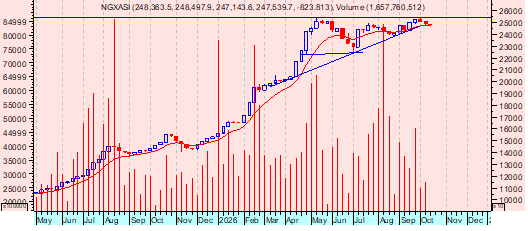
Technically, the Nigerian market continues to exhibit signs of consolidation after an extended bullish rally. The All-Share Index is hovering around the 201,000 psychological support level, indicating indecision among market participants. Momentum indicators suggest that buying pressure is gradually weakening, while intermittent selloffs in large-cap stocks point to ongoing profit-taking.
However, the positive market breadth observed during the session indicates that underlying demand remains present, particularly in mid- and small-cap stocks. This suggests that the broader market still retains some bullish undertone, even as the headline index struggles to gain traction. The current pattern aligns with a typical consolidation phase, where the market digests previous gains before establishing a clearer direction.
Looking ahead, the market is expected to trade within a narrow range in the short term, with a slight bullish bias supported by sector rotation and bargain hunting. Elevated oil prices could sustain interest in energy-related stocks, while banking and consumer goods stocks may continue to see mixed sentiment due to profit-taking and valuation concerns. Global uncertainties, particularly around geopolitics and inflation, are likely to keep investors cautious.
In this environment, investors are advised to focus on fundamentally sound stocks with strong earnings visibility, while maintaining a disciplined approach to risk management. Selective positioning and patience will be key as the market navigates this phase of consolidation and evolving macroeconomic dynamics.
The benchmark All-Share Index (ASI) declined marginally by 0.002% to close at 201,698.89 points from 201,703.55 points, shedding 4.66 points. Market capitalisation dipped by N3bn to N129.81trn, while the year-to-date return remained strong at 29.62%. Market breadth closed positive with 34 gainers against 24 losers, reflecting underlying resilience. UNILEVER led the gainers’ chart with a 10.00% increase, while JOHNHOLT topped the losers with a 10.00% decline. Other notable laggards included HONYFLOUR (-4.54%), NB (-2.78%), OANDO (-2.22%), CUSTODIAN (-0.68%), UBA (-0.43%), and ACCESSCORP (-0.19%). Total volume traded fell by 31.33% to 559.98 million units valued at N19.26bn across 49,676 deals. NSLTECH recorded the highest volume with 59.69 million units, accounting for 10.66% of total trades, while ZENITHBANK led in value terms with N2.47bn, representing 12.84% of total traded value. WEMABANK and VFDGROUP accounted for 9.28% and 6.43% of volume respectively, while GTCO and MTNN followed ZENITHBANK in value contribution.