

Period Under Preview: FULL YEAR 2025
Current Share Price: N718:00
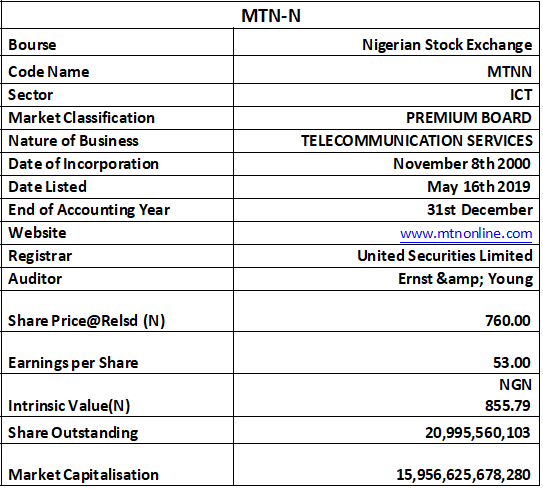
Price At Release Date: N760:00
Latest Final Dividend: N15:00
Latest Interim Dividend: N
Estimated Beta Value: 0.55x
Estimated Intrinsic Value: N855.79
Rating: Hold
Analyst: Jeariogbe Tunde Segun
The Company
MTN Nigeria was incorporated in 2000 following the liberalization of Nigeria’s telecommunications sector. In 2001, it secured a GSM license and became one of the first operators to launch mobile services in the country, making the first GSM call in May 2001. At the time, Nigeria’s telecom infrastructure was highly underdeveloped, creating a strong opportunity for rapid growth. The company experienced significant expansion in its early years, driven by aggressive network rollout and the adoption of prepaid services suited to the Nigerian market. Within five years, MTN Nigeria grew its subscriber base to over 10 million, establishing itself as a dominant player in the industry.
By 2006, MTN obtained a Unified Access Service License, enabling it to diversify into data and other telecom services. Over the following decade, it solidified its market leadership, surpassing 50 million subscribers and building extensive nationwide infrastructure. Subsequently, MTN Nigeria transitioned from a voice-centric business to a data and digital services provider, investing heavily in broadband infrastructure and fintech solutions. In 2019, it was listed on the Nigerian Exchange, becoming one of the largest publicly traded companies in the country.
Released Numbers
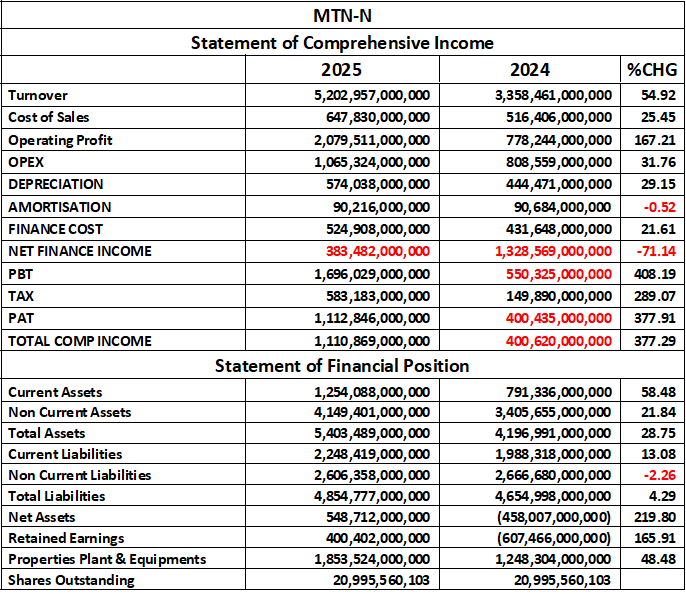
MTN Nigeria recorded a strong financial turnaround in 2025, driven primarily by significant revenue growth and a reversal of prior-year’s foreign exchange losses. Revenue increased substantially by approximately 55%, rising from ₦3.36 trillion in 2024 to ₦5.20 trillion in the period under review. This growth reflects strong performance in data services, increased tariff adjustments, and continued expansion of the company’s subscriber base and digital offerings.
Despite the strong revenue growth, operating costs also increased across major cost lines. Direct network operating costs, commissions, employee expenses, and depreciation all rose, reflecting continued investment in network infrastructure, inflationary pressures, and expansion of operations. Notably, depreciation and amortization remained significantly high, consistent with the capital-intensive nature of the industry.
Importantly, the growth in revenue outpaced that of operating expenses, leading to a significant rise in operating profit from ₦778.2 billion in 2024 to ₦2.08 trillion in 2025. This indicates improved operational efficiency and stronger cost absorption.
At the finance level, the most critical development was the sharp reversal in foreign exchange movements. In the 2024 full year, MTN recorded a massive FX loss of ₦925.4 billion which as would be expected, significantly impacted profitability. In contrast, 2025 saw a net FX gain of ₦90.3 billion, providing a major boost to earnings. Although finance costs remained high at ₦524.9 billion due to borrowings and lease obligations, the FX gain offset much of this pressure. As a result, the company reported a profit before tax of ₦1.70 trillion, compared to a loss of ₦550.3 billion in the previous year. After accounting for a tax expense of ₦583.2 billion, MTN Nigeria delivered a profit after tax of ₦1.11 trillion, representing a full recovery from the prior year’s loss of ₦400.4 billion.
MTN Nigeria’s financial position strengthened in 2025, supported by asset growth and a return to positive equity. Total assets increased by about 29%, from ₦4.20 trillion in 2024 to ₦5.40 trillion in 2025. This growth was largely driven by increases in non-current assets, particularly property, plant and equipment and right-of-use assets, indicating continued investment in network infrastructure and leased assets.
Current assets also grew significantly, especially cash and cash equivalents from ₦253.4 billion to ₦632.5 billion. This improvement suggests stronger liquidity and enhanced cash generation during the year. Additionally, current investments increased, reflecting better treasury management. On the liabilities side, total liabilities rose moderately from ₦4.65 trillion to ₦4.85 trillion. The company continues to carry a high level of lease liabilities, which remain the largest component of its obligations, highlighting its reliance on leased infrastructure. Borrowings, however, declined, indicating some level of debt reduction or restructuring.
A major highlight of the financial position is the significant improvement in equity. In 2024, the company reported negative equity of ₦458.0 billion, largely due to accumulated losses driven by FX shocks. In 2025, this position reversed to a positive equity of ₦548.7 billion, supported by the strong profit recorded during the year. Retained earnings moved from a deficit position to a positive balance, signaling restored financial stability. Current liabilities increased, particularly trade payables and tax liabilities, reflecting higher business activity and profitability. The sharp increase in tax payable aligns with the strong earnings reported during the year.
Financial Strength
MTN Nigeria’s financial strength in 2025 shows a significant improvement compared to 2024, primarily driven by the company’s return to profitability and the restoration to positive equity. However, despite this improvement, the company still maintains a highly leveraged capital structure, largely due to substantial lease obligations and borrowings.
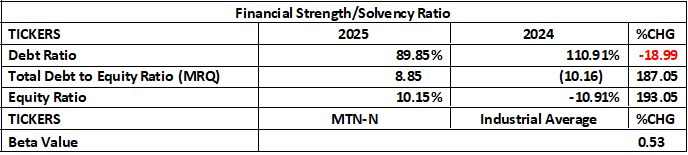
- Debt Ratio declined from 110.91% in 2024 to 89.85% in 2025, indicating a reduction in the proportion of assets financed by liabilities. This is a major positive development, as the 2024 ratio at above 100% reflected a technically weak position where liabilities exceeded assets. The 2025 improvement shows that MTN Nigeria has regained balance sheet stability, with assets now exceeding liabilities. However, a debt ratio close to 90% still suggests that the company remains heavily dependent on external financing, which exposes it to financial risk, especially in periods of economic or currency volatility.
- Debt-to-Equity Ratio improved significantly from (10.16x) in 2024 to 8.85x in 2025. The negative ratio in 2024 was due to negative equity, indicating financial distress at that time. This return to a positive ratio reflects the recovery in shareholders’ funds. Despite this improvement, a ratio of 8.85x is extremely high, meaning that for every ₦1 of equity, MTN Nigeria carries about ₦8.85 in debt. This highlights a highly leveraged structure, which increases financial risk, particularly with rising interest rates or currency pressures.
- Equity Ratio improved sharply from -10.91% in 2024 to 10.15% in 2025. This turnaround is very significant, as it indicates that shareholders’ equity now contributes positively to asset financing, compared to a deficit position in the prior year. However, an equity ratio of just 10.15% remains relatively low, meaning that equity finances only a small portion of the company’s assets. This reinforces the view that MTN Nigeria is still largely financed by liabilities.
- Beta Value (Risk Indicator): MTN Nigeria’s Beta of 0.53 suggests that the stock is less volatile than the overall market, indicating: Lower market risk compared to peers, more stable price movements, and Attractive characteristics for risk-averse investors. However, it is important to note that low market volatility does not eliminate financial risks, especially given the company’s high leverage.
Overall Financial Strength Verdict: MTN Nigeria’s financial strength in 2025 reflects a clear recovery from a weak position in 2024, supported by strong profitability and improved equity. The positive sides are: The return to positive equity, improved solvency ratios, and reduced debt pressure relative to assets. Meanwhile, the concerns include: High leverage (Debt/Equity still elevated), continued reliance on lease liabilities and borrowings, and of course exposure to interest rate and FX risks. We, therefore, safely conclude that: overall, MTN Nigeria’s solvency position has improved significantly but remains moderately weak due to its high leverage. While the company is no longer in a distressed position, its capital structure still requires careful monitoring. The company is financially recovering, but not yet fully strong.
Profitability Ratios:
MTN Nigeria’s financial strength in 2025 shows a significant improvement compared to 2024, primarily driven by the company’s return to profitability and the restoration to positive equity. However, despite this improvement, the company still maintains a highly leveraged capital structure, largely due to its substantial lease obligations and borrowings.
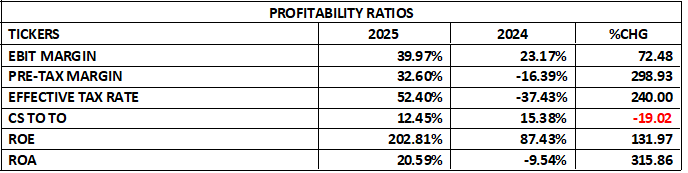
- Debt Ratio declined from 110.91% in 2024 to 89.85% in 2025, indicating a reduction in the proportion of assets financed by liabilities. This is a major positive development, as the 2024 ratio above 100% reflected a technically weak position where liabilities exceeded assets. The 2025 improvement shows that MTN Nigeria has regained balance sheet stability, with assets now exceeding liabilities. However, MTN Nigeria’s profitability in 2025 shows a strong and a decisive turnaround from 2024, driven by the improved operating performance and a significant recovery from foreign exchange losses that impacted the prior year. The company moved from a loss-making position in 2024 to strong profitability in 2025, reflecting better cost management, revenue growth, and improved macro conditions.
- EBIT Margin increased significantly from 23.17% in 2024 to 39.97% in 2025. This sharp improvement indicates that MTN Nigeria became much more efficient at generating operating profit from its revenue. The increase suggests: Strong revenue growth, better control of operating expenses, and reduced pressure from cost drivers such as energy and network expenses. It is important to understand that: at nearly 40%, this is a very strong operating margin, highlighting the company’s core business strength.
- Pre-Tax Margin improved dramatically from -16.39% in 2024 to 32.60% in 2025. The negative margin in 2024 reflects the impact of heavy foreign exchange losses, which wiped out operating profits. The return to a strong positive margin in 2025 is a sign of: Significant reduction in FX losses, recovery in earnings before tax, and strong underlying profitability. This is one of the clearest indicators of MTN’s turnaround.
- Effective Tax Rate: The effective tax rate increased to 52.40% in 2025 from -37.43% in 2024. The negative tax rate in 2024 was due to the company’s losses, following which it enjoyed tax credits. In 2025, the high tax rate suggests: Full return to taxable profitability, and possible inclusion of deferred tax adjustments. While profitability improved, the high tax burden slightly reduces net earnings.
- Cost-to-Turnover Ratio (CS to TO) declined from 15.38% in 2024 to 12.45% in 2025, indicating improved cost efficiency, as a smaller portion of revenue is being consumed by direct costs. This improvement supports the strong growth in EBIT margin and reflects: Better cost control, economies of scale, and operational efficiency.
- Return on Equity (ROE) increased significantly from 87.43% in 2024 to 202.81% in 2025. This extremely high ROE reflects: Strong profit generation, and a relatively low equity base (due to prior losses). While this appears highly attractive, it should be interpreted with caution because: the equity base is still recovering. Note also that: a high leverage amplifies returns.
- Return on Assets (ROA) improved from -9.54% in 2024 to 20.59% in 2025 indicating that MTN Nigeria is now efficiently using its assets to generate profit, compared to a loss position in the previous year. A 20% ROA is very strong, showing effective asset utilization.
Overall Profitability Verdict: MTN Nigeria’s profitability profile in 2025 is exceptionally strong, marking a full recovery from the challenges of 2024. The key strengths are: strong operating efficiency (high EBIT margin), return to profitability at all levels, improved cost management, and a high returns on assets and equity. While the key watch points should be: the very high ROE that was driven by low equity base, the high effective tax rate, and sensitivity to foreign exchange movements. We therefore conclude that; MTN Nigeria delivered a remarkable profitability turnaround in 2025, transitioning from losses to strong earnings performance. In our opinion, the company is now highly profitable, operationally efficient, and recovering strongly, although sustainability will depend on continued FX stability and cost discipline.
Efficiency Ratios
MTN Nigeria’s efficiency position in 2025 shows clear operational improvements, particularly in cost control and asset utilization. However, the company still operates with negative working capital, which is typical for telecoms but requires careful interpretation.
- OPEX to Turnover (OPEX / TO) declined from 24.08% in 2024 to 20.48% in 2025. This is a strong improvement in cost efficiency, meaning: A smaller portion of revenue is consumed by operating expenses, better cost discipline across personnel and other operating expenses, and improved operating leverage. This aligns perfectly with the sharp rise in EBIT margin, confirming that profitability growth is driven by real efficiency gains, not just revenue growth.
- Turnover to Total Assets (TO / TA): Asset turnover increased from 80.02% in 2024 to 96.29% in 2025. This indicates that MTN Nigeria is: Generating more revenue per naira of assets, utilizing its network infrastructure more efficiently, and benefiting from scale and subscriber growth. This near 1x asset turnover is very strong for a capital-intensive telecom business, showing improved asset productivity.
- Working Capital Turnover: Working capital turnover moved from -2.81x in 2024 to -5.23x in 2025. The negative values indicate that: MTN operates with negative working capital (current liabilities exceed current assets). The increase in magnitude (more negative) suggests: a greater reliance on short-term liabilities (e.g., payables, deferred revenue), and more aggressive working capital structure. In telecoms, this is not necessarily bad because: customers often pay in advance (airtime/data), and the business enjoys strong cash inflows before expenses are settled. However, it still requires monitoring for liquidity risk.
- Working Capital Ratio improved from 0.40 in 2024 to 0.56 in 2025. Although still below 1, the improvement indicates: Better short-term liquidity position, and a reduced pressure on current obligations. That said, A ratio below 1 means current liabilities still exceed current assets. The company depends on continuous cash flow to meet obligations
Overall Efficiency Ratio Verdict: the key strengths observed are: Strong reduction in operating cost burden, improved asset utilization, and better alignment between revenue growth and cost control. While the key watch points includes: Persistent negative working capital structure, dependence on continuous cash inflows, and potential liquidity pressure if cash cycle weakens. In conclusion, MTN Nigeria’s efficiency in 2025 significantly improved and supports its return to profit. The company is: More cost-efficient, using its assets more effectively, and operating a telecom-typical but aggressive working capital model.

Investment/Valuation Ratios
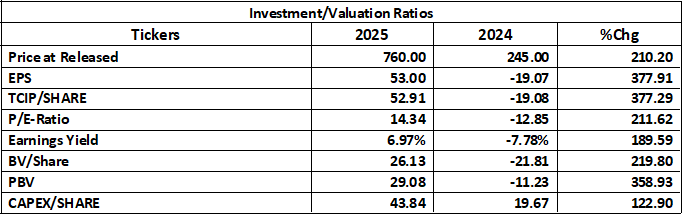
MTN Nigeria’s valuation metrics in 2025 reflect a strong market re-rating, driven by its return to profitability after the 2024 losses. The sharp improvements across EPS, earnings yield, and valuation multiples indicate: Renewed investor confidence, strong earnings recovery, and aggressive price appreciation
- Share Price Movement: Share price increased significantly from ₦245.00 in 2024 to ₦760.00 in 2025 (+210.20%). This massive rally reflects: Market reactions to earnings turnaround, improved macro outlook (especially FX stability), and the dividend expectation. The price movement confirms that MTN has shifted from a distressed valuation to a growth/recovery valuation.
- Earnings Per Share (EPS) improved from -₦19.07 in 2024 to ₦53.00 in 2025. This is a complete earnings reversal, driven by: Recovery in core operations, rduction in FX losses, and strong margin expansion. EPS growth is the primary driver of valuation recovery.
- Total Comprehensive Income Per Share (TCIP/Share): TCIP/share increased from -₦19.08 to ₦52.91. This aligns closely with EPS, indicating: Minimal distortion from other comprehensive income, and strong quality of earnings. Earnings are clean and sustainable, not driven by one-off gains.
- Price-to-Earnings Ratio (P/E): P/E ratio moved from negative (-12.85x) in 2024 to 14.34x in 2025. This suggests: Return to normal valuation metrics, and market pricing in sustainable earnings. A P/E of ~14x is: Reasonable for a telecom company, and it is not overly expensive given the growth recovery
- Earnings Yield: Earnings Yield improved from -7.78% to 6.97%. This reflects: Positive earnings generation, and an improved return to investors relative to price. However, at approximately 7%, it suggests that the stock is no longer cheap, meaning investors are paying for growth and stability
- Book Value Per Share (BVPS): BVPS increased from -₦21.81 to ₦26.13. This is very important: Equity base has recovered from negative to positive, and balance sheet strength is improving. This supports long-term valuation stability.
- Price-to-Book Ratio (PBV): PBV increased sharply from -11.23x to 29.08x. This is extremely high and indicates: Market is valuing MTN far above its book value, and there is a strong expectations of future earnings and cash flows. However: this is partly distorted by previously low/negative equity. This should normalize over time as equity grows.
- CAPEX Per Share: CAPEX per share increased from ₦19.67 to ₦43.84 (+122.90%). This shows: Continued heavy investment in network infrastructure, and expansion in capacity and service quality. This is positive because: It supports future revenue growth, and maintains competitive advantage. But: It may pressure free cash flow in the short term
Overall Investment Assessment Verdict: The key strengths identified are: Strong earnings recovery (EPS turnaround), positive equity restoration, market confidence reflected in the share price growth, and the continued investment in future growth (CAPEX). While the key risks areas are; High valuation (especially PBV), Stock may be partly priced for perfection, and sensitivity to FX and macro conditions CAPEX . intensity could impact cash flows. In conclusion; MTN Nigeria in 2025 is now a re-rated, high-growth recovery stock.
Overall Verdict and Rating: MTN Nigeria’s 2025 ratios show a strong turnaround and solid overall performance, driven by sharp improvements in profitability, efficiency, and earnings recovery. However, valuation is now elevated, and financial strength is still in recovery. MTN Nigeria is best rated as a HOLD at current levels. Underlining reasons are; Strong fundamentals: Profitability and efficiency have improved significantly, earnings recovery: Clear turnaround story is already playing out, But valuation is stretched: The sharp price rally (+200%+) means much of the upside is already priced in.