
Market Update For April 21, 2026
The Nigerian equities market maintained its upward trajectory on Tuesday, April 21, 2026, but the pace of the advance slowed significantly, reflecting a market increasingly influenced by profit-taking and cautious positioning. While the benchmark index closed in positive territory, the broader tone of trading suggested that the bullish momentum seen in previous sessions is beginning to moderate.
The session was characterised by selective buying in fundamentally strong mid- to large-cap stocks, which helped sustain the market’s uptrend. Stocks such as NASCON, WAPCO, UACN, CAP, NEM, FIRSTHOLDCO, and DANGCEM attracted notable demand, driven largely by institutional investors seeking value and earnings resilience in a market that is gradually transitioning from broad-based gains to a more stock-specific rally.
This pattern reflects a maturing bull phase, where investors are becoming increasingly discerning, focusing less on speculative plays and more on companies with strong fundamentals, consistent earnings performance, and strategic positioning within their sectors. Gains in select Tier-1 banking names like GTCO and ETI further supported market stability, highlighting continued confidence in the financial services sector despite prevailing macroeconomic uncertainties.
However, beneath the surface, the market showed clear signs of strain. Profit-taking activities intensified across several counters, particularly those that had recorded significant price appreciation in recent weeks. This was evident in the negative market breadth, as decliners outnumbered gainers by a wide margin, signaling that selling pressure remains elevated even as the headline index posts marginal gains.
This divergence between index performance and market internals is a critical signal for market participants. It suggests that while the overall trend remains upward, the strength of the rally is weakening, and the market may be approaching a near-term inflection point. In such an environment, volatility tends to increase, and price movements become less predictable, reinforcing the need for disciplined investment strategies.
Market activity also reflected this cautious sentiment. Total volume and value traded declined compared to the previous session, indicating reduced participation and a more measured approach by investors. Despite the overall slowdown, trading remained concentrated in a handful of highly liquid and capitalised stocks. ACCESSCORP dominated the volume chart, accounting for a significant portion of total transactions, while MTNN led in value traded, reaffirming its status as a major liquidity driver in the market.
Other notable contributors to market turnover included FCMB, FIDELITYBK, ZENITHBANK, and GTCO, all of which continue to attract both retail and institutional interest due to their liquidity and relative stability. This concentration of trading activity further underscores the ongoing shift toward quality and liquidity as key considerations for investors navigating the current market phase.
On the global front, developments in the oil market remain a major influence on investor sentiment, particularly for an oil-dependent economy like Nigeria. Crude oil prices traded slightly lower on Tuesday, reflecting a mix of profit-taking and cautious optimism surrounding geopolitical developments.
Brent crude declined by approximately $0.40, or 0.4%, to around $95.08 per barrel, while U.S. West Texas Intermediate (WTI) crude for May delivery fell by about $0.41 to $89.20 per barrel. The more actively traded June WTI contract was also lower, trading near $87.00 per barrel, down roughly 0.5%.
This modest pullback follows a sharp rally in the previous session, where Brent and WTI surged by 5.6% and 6.9% respectively, driven by escalating tensions in the Middle East. Key among these developments was the disruption of shipping activities through the Strait of Hormuz—a strategic chokepoint responsible for nearly 20% of global oil supply—following renewed hostilities involving the United States and Iran.
The oil market is currently caught between opposing forces. On one hand, supply disruptions and geopolitical risks are supporting prices, while on the other hand, expectations of potential diplomatic resolution are exerting downward pressure. Comments from U.S. leadership indicating reluctance to extend ceasefire timelines have added to the uncertainty, while signals from Iran regarding participation in peace talks remain inconclusive.
Adding to supply-side concerns, Russia has reportedly reduced its oil output by approximately 300,000 to 400,000 barrels per day in April, partly due to infrastructure disruptions, including a fire incident at the Tuapse export terminal. These developments continue to tighten global supply conditions, even as demand outlook remains relatively stable.
For Nigeria, these oil market dynamics carry significant implications. Sustained high oil prices could provide fiscal support and improve foreign exchange inflows, while volatility and uncertainty could complicate economic planning and investor confidence. As such, movements in crude oil prices will remain a key variable influencing both macroeconomic stability and equity market performance in the near term.
Technical Analysis & Outlook
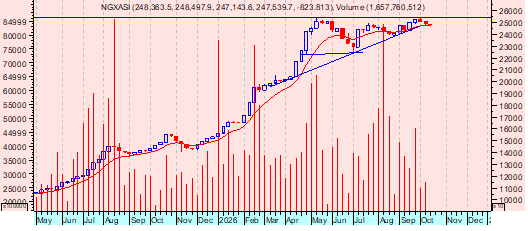
From a technical perspective, the Nigerian equities market remains in an established uptrend, with the All-Share Index holding firmly above key support levels. However, recent price action suggests that the strength of the uptrend is gradually weakening.
The marginal gain recorded in the latest session, coupled with negative market breadth and declining trading activity, points to fading momentum. Technical indicators are beginning to signal overbought conditions, which typically precede periods of consolidation or corrective pullbacks.
In the short term, the market is likely to experience increased volatility, with alternating sessions of gains and losses as investors continue to take profits and reposition portfolios. Sector rotation is expected to remain a dominant theme, with capital flowing into stocks that offer strong fundamentals, defensive characteristics, and attractive valuation metrics.
Investors are advised to adopt a cautious and selective approach, prioritising quality over quantity, and maintaining a focus on risk management. Close attention should also be paid to macroeconomic indicators, including oil price trends, exchange rate movements, and monetary policy signals, all of which will play a crucial role in shaping market direction.
Market Summary
The All-Share Index rose by 0.06% to close at 218,249.81 points, up from 218,113.84, while total market capitalisation increased by ₦87.53bn to ₦140.52trn, bringing year-to-date return to 40.25%. Market breadth remained negative with 25 gainers against 44 losers, reflecting sustained sell pressure.
Top gainers were: NASCON ₦171.60 (+10.00%), UNIONDICON ₦19.95 (+9.92%), WAPCO ₦270.00 (+9.64%), TRANSEXPR ₦7.31 (+8.27%), UACN ₦110.00 (+7.84%), AFRIPRUD ₦14.00 (+7.69%), CUTIX ₦3.33 (+6.67%), ZICHIS ₦12.30 (+6.61%), MBENEFIT ₦3.90 (+6.10%), and CAP ₦101.95 (+5.26%).
Top losers were: LEGENDINT ₦6.26 (-9.92%), ABBEYBDS ₦6.60 (-9.59%), STANBIC ₦152.75 (-8.96%), ACCESSCORP ₦29.95 (-8.83%), VERITASKAP ₦1.87 (-7.50%), REGALINS ₦1.06 (-7.27%), GUINEAINS ₦1.06 (-7.02%), UPDC ₦4.20 (-6.67%), JAPAULGOLD ₦3.20 (-6.29%), and ROYALEX ₦1.67 (-6.08%).
NASCON, WAPCO, and TRANSEXPR traded at new 52-week highs, reinforcing strong momentum in select counters. Total volume traded declined by 14.38% to 842.48 million units, valued at ₦44.86bn across 61,617 deals. ACCESSCORP led volume with 110.81 million units (13.15% of total volume), while MTNN dominated value with ₦6.55bn (14.60% of total value), followed by ZENITHBANK and GTCO.