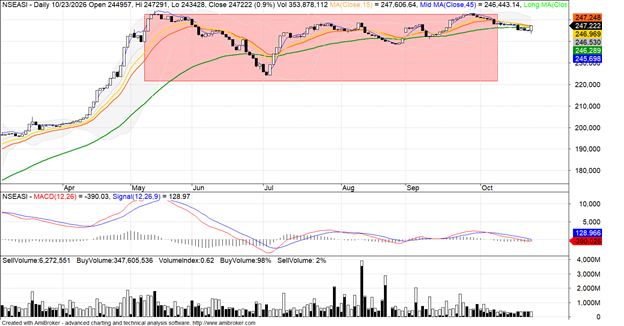

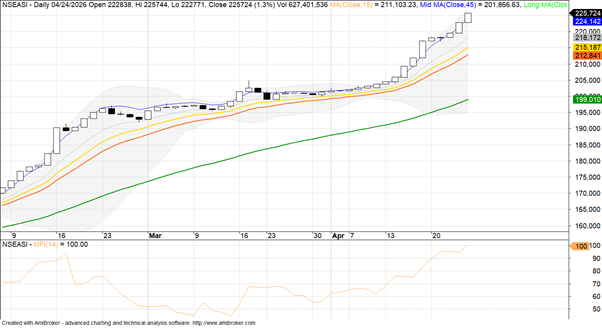
The bull-run on the Nigerian Exchange continued for a fourth consecutive week on the back of increasing buying interests in highly priced stocks and blue-chip companies with strong fundamentals. Such stocks parade expanding earnings power and capacity to support price and higher payouts, even as all eyes are on the expected Q1 numbers and dividend income with closing and payment dates of many drawing closer. Below is the NGX Daily Chart:
Overall, weekly market activity improved, with investors trading 3.805 billion shares worth ₦213.96 billion in 297,202 deals, higher than the previous week’s 3.588 billion shares valued at ₦195.31 billion in 254,553 deals.
The Financial Services sector remained the dominant driver of activity, accounting for 2.739 billion shares worth ₦106.27 billion across 135,101 deals—about 71.99% of total volume and 49.67% of value. It was followed by the Services sector with 212.32 million shares worth ₦4.02 billion, and the Consumer Goods sector with 180.08 million shares valued at ₦13.27 billion.
Key market activity was driven by ACCESSCORP, UBA, and FIRSTHOLDCO, which jointly accounted for 814.06 million shares worth ₦39.03 billion, representing 21.40% of total volume and 18.24% of total value.
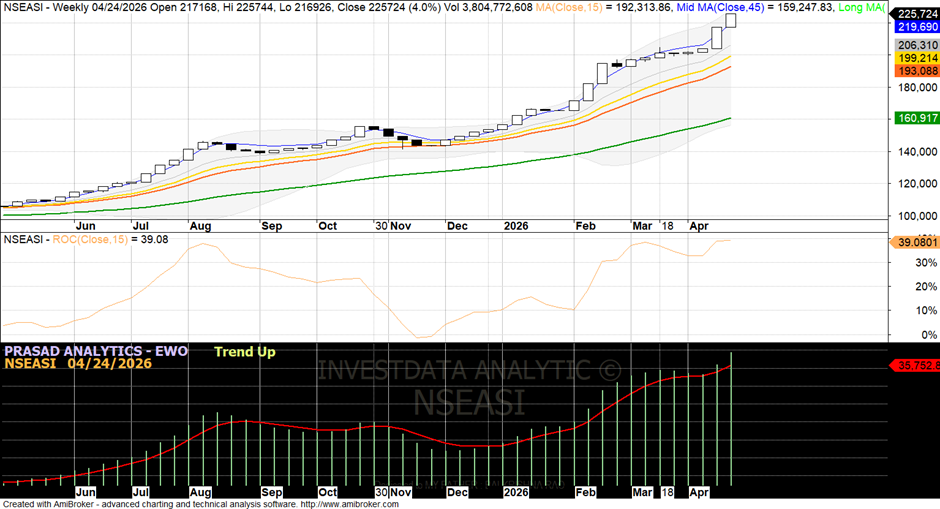
The market closed the week firmly in the green, with the NGX All-Share Index rising 3.94% to 225,722.49 points and market capitalisation increasing to ₦145.34 trillion. Most sectoral indices ended positive, except for the NGX Growth and NGX Commodity indices, which slipped slightly by 0.02% and 0.41% respectively.
The week’ trading started on positive note, stretching its winning run to ten straight sessions at the end of Monday’s trading session. The All-Share Index rose 0.44% to 218,113.84 points, lifting market capitalisation to ₦140.44 trillion and pushing year-to-date returns to 40.16%. However, sentiment was mixed as declining stocks outnumbered gainers. Trading volume also weakened, falling 21.79% to 983.95 million shares worth ₦50.77 billion, with ACCESSCORP leading in volume while ZENITHBANK topped value traded.
On Tuesday, the market posted a marginal gain of 0.06%, closing at 218,249.81 points. Market capitalisation edged up to ₦140.52 trillion, with YTD return improving to 40.25%. Buying interest in selected large and mid-cap stocks supported the index, although losers still dominated gainers. Activity slowed further as volume dropped 14.38% to 842.48 million shares valued at ₦44.86 billion. ACCESSCORP again led volume, while MTNN dominated value.
Midweek’s trading remained positive as the ASI advanced 0.61% to 219,586.20 points, raising market capitalisation to ₦141.38 trillion and YTD return to 41.11%. Market sentiment improved slightly as gainers edged out losers. Trading activity, however, declined with volume down 18.85% to 683.68 million shares worth ₦36.17 billion, led by FIRSTHOLDCO in both volume and value.
The bullish momentum strengthened on Thursday, with the index jumping 1.48% to 222,837.68 points. Market capitalisation climbed to ₦143.48 trillion and YTD return rose to 43.20%. Buying pressure was broad-based, particularly in consumer goods, industrials, and banking stocks, though market breadth still leaned negative. Volume eased 2.30% to 667.94 million shares worth ₦38.12 billion, with ACCESSCORP leading volume and MTNN dominating value.
The last trading day of the week ended on a firm bullish note as the benchmark NGX All-Share index gained 1.29% to close at 225,722.49 points, pushing market capitalisation to ₦145.33 trillion and YTD return to 45.05%. Strong demand across banking, industrial, and consumer counters supported the rally, with gainers outpacing losers. Trading activity slowed slightly, with volume down 6.04% to 627.52 million shares worth ₦44.51 billion. ACCESSCORP led volume while MTNN recorded the highest traded value.
Week-to-date, the All-Share Index gained 3.94%, trailed by the NGX 30 index’s 3.83% surge, the Banking Index increased by 6.81%, the Pension Index 4.35%, the Insurance Index inclined by 0.40%, and the Consumer Goods Index 5.25%. However, the Oil and Gas Index recorded a positive return of 0.86%.
Year-to-date, the All-Share Index has gained 45.5%, NGX 30 is up by 44.90%, the Banking Index has increased by 59.29%, the Pension Index increased by 61.39%, the Insurance Index inclined by 0.90%, the Consumer Goods Index increase by 18.29%. However, the Oil and Gas Index recorded a positive return of 99.65%.
In terms of market breadth, 46 stocks advanced last week, while 53 suffered some set back.
UACN Chart
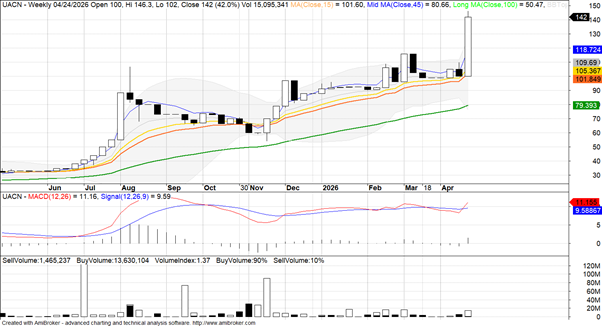
On the gainers’ table, UACN Plc, a Nigerian conglomerate involved in everyday consumer products (food, drinks, restaurants) as well as industrial and property businesses, with over a century of history in the country, opened at ₦100.00 and closed at ₦142.00, gaining ₦42.00 or 42.00%. Union Dicon Salt Plc moved from ₦16.50 to ₦21.90, up ₦5.40 or 32.73%. NASCON Allied Industries Plc rose from ₦156.00 to ₦206.90, adding ₦50.90 or 32.63%. Trans-Nationwide Express Plc increased from ₦6.05 to ₦7.90, gaining ₦1.85 or 30.58%, while Zichis Agro Allied Industries Plc advanced from ₦12.41 to ₦15.60, up ₦3.19 or 25.71%.
Infinity Trust Mortgage Bank Plc Chart
On the losers’ side, Infinity Trust Mortgage Bank Plc, a specialized Nigerian mortgage bank that helps individuals and developers access loans to build or buy homes, with a strong focus on affordable housing finance, declined from ₦19.00 to ₦9.35, shedding ₦9.65 or 50.79%. Abbey Mortgage Bank Plc fell from ₦8.10 to ₦5.40, down ₦2.70 or 33.33%. Guinea Insurance Plc dropped from ₦1.25 to ₦1.06, losing ₦0.19 or 15.20%. Stanbic IBTC Holdings Plc slipped from ₦188.55 to ₦162.50, down ₦26.05 or 13.82%, while LivingTrust Mortgage Bank Plc eased from ₦4.10 to ₦3.65, declining by ₦0.45 or 10.98%.
Technical Analysis View
The index’s breakout above the 222,000 psychological level reinforces bullish momentum, with the market now firmly trading in uncharted territory for the current cycle. Previous resistance zones around 218,000 and 222,000 have now flipped into support, strengthening the underlying trend.
Despite the strong price action, market breadth remained uneven for most of the week, indicating that gains were concentrated in select heavyweight counters rather than broad market participation. This selective rally was largely driven by banking and industrial stocks, with financial services continuing to dominate liquidity flows.
Volume trends showed mild weakness on certain sessions, suggesting that while buyers remain in control, conviction buying is not fully widespread across all sectors. Nonetheless, the consistent upward price movement confirms strong institutional interest in large-cap stocks. From a momentum perspective, the market remains firmly in an overbought-to-strong momentum zone. However, there are no immediate technical reversal signals, indicating that the trend remains intact in the short term.
Market Outlook
The near-term outlook for the NGX remains cautiously bullish. As long as the index sustains above the 222,000–218,000 support range, the broader uptrend is expected to continue, with potential targets extending toward 227,000 and possibly 230,000 points.
That said, after a strong multi-session rally and a YTD return above 45%, intermittent profit-taking is likely, especially in overextended counters. This may lead to short-term consolidation or mild pullbacks, which could provide fresh entry opportunities for medium-term investors. Sustained momentum will depend heavily on continued strength in the banking sector, which remains the key driver of market direction. A broader participation from consumer goods and industrial stocks would further enhance market stability and reduce reliance on a few large-cap names.
Overall, the market structure remains firmly bullish, with dips expected to be shallow as long as macro liquidity and earnings expectations remain supportive.
Trending in the Economy: Nigeria’s debt servicing bill climbed to about N16 trillion in 2025, up 22.9% from the previous year, largely due to higher interest payments on domestic borrowing, according to the Debt Management Office.
Most of the cost came from local debt obligations, where interest payments dominated the increase, while external debt servicing rose at a slower pace despite ongoing Eurobond repayments. The trend highlights growing pressure on public finances as borrowing costs and total debt stock continue to rise.
In a related development, President Bola Tinubu has asked lawmakers to approve a $516 million loan to finance the first phase of a major highway project connecting the northwest to the southwest. The Deutsche Bank-arranged facility comes with a nine-year repayment period and up to three years’ grace. The 1,000km Sokoto-to-Badagry highway is expected to improve transport links, boost trade, and strengthen national integration. It follows a $747 million loan previously secured for another coastal highway project last year.
Global Market and Oil: The S&P 500 and Nasdaq closed at fresh record highs on Friday, supported by optimism around possible U.S.–Iran peace negotiations and a strong rally in semiconductor stocks, particularly Intel.
Reports from Pakistan suggested Iran’s foreign minister, Abbas Araqchi, was expected in Islamabad to discuss restarting peace talks. At the same time, White House Press Secretary Karoline Leavitt said U.S. special envoy Steve Witkoff and presidential aide Jared Kushner would travel to Islamabad on Saturday for discussions on Iran, mediated by Pakistan. These developments helped ease market concerns, even as uncertainty persisted over the conflict and the continued closure of the Strait of Hormuz.
Markets had recently rallied on hopes of a resolution to the war and strong earnings, though sentiment weakened midweek as optimism faded. As one portfolio manager noted, the situation remains uncertain, but there are still “some rays of sunlight.”
On the trading floor, the Dow Jones Industrial Average fell 79.61 points, or 0.16%, to close at 49,230.71. The S&P 500 gained 56.68 points, or 0.80%, finishing at 7,165.08, while the Nasdaq Composite rose 398.09 points, or 1.63%, to end at 24,836.60. For the week, the S&P 500 added 0.55%, the Nasdaq climbed 1.5%, and the Dow dropped 0.44%.
Semiconductors remained the strongest segment of the market. The Philadelphia SE Semiconductor Index advanced 4.32%, extending its record winning streak to 18 consecutive sessions. Intel surged 23.65% to close at a record $82.57 after issuing a better-than-expected second-quarter revenue forecast.
The stock was the top performer on the S&P 500. AMD and Arm both jumped about 14%, while Nvidia gained 4.32%, also closing at a record level as it approached a $5 trillion market valuation. Market sentiment was further boosted as concerns eased over AI capital expenditure returns from major tech firms including Amazon, Google, Microsoft, and Meta.
The S&P 500 technology index rose 2.46%, making it the best-performing of the 11 major sectors. Tech stocks also shrugged off concerns tied to competition from DeepSeek’s preview of its upcoming model. For the week, the S&P 500 and Nasdaq both recorded their fourth straight weekly gain, the longest winning streak since the fourth quarter of 2024. The Dow, however, ended its three-week advance.
Attention is now turning to the Federal Reserve meeting next week, where investors will look for signals on interest rate cuts and leadership changes. The U.S. Justice Department is reportedly closing its investigation into Fed Chair Jerome Powell, removing a potential hurdle for the confirmation of Kevin Warsh as a possible successor.
Market pricing shows a 39% probability of at least a 25-basis-point rate cut at the Fed’s December meeting, up from 23% in the previous session, according to CME’s FedWatch Tool. Earnings season has also supported equities, with first-quarter earnings growth expectations rising to 16.1% from 14.4% at the start of April, based on LSEG data.
Market breadth was positive, with advancing stocks outpacing decliners by a 1.47-to-1 ratio on the NYSE and 1.38-to-1 on the Nasdaq. The S&P 500 recorded 34 new 52-week highs and 8 new lows, while the Nasdaq Composite posted 126 new highs and 90 new lows. Total trading volume on U.S. exchanges reached 17.81 billion shares, compared with the 18.39 billion average over the last 20 trading sessions.
Oil prices whipsawed in volatile trade on Friday but still ended the week higher as traders balanced supply disruption risks against renewed hopes of U.S.–Iran peace talks that could ease tensions. Brent crude futures settled at $105.33 a barrel, up 26 cents or about 0.3%, while U.S. West Texas Intermediate (WTI) fell $1.45, or 1.5%, to $94.40 a barrel. For the week, Brent gained about 16% and WTI rose nearly 13%. Crude initially gave up gains after reports that Iranian Foreign Minister Abbas Araqchi was heading to Islamabad to discuss restarting peace negotiations following earlier breakdowns in talks. Prices slipped further after reports that the U.S. was sending special envoy Steve Witkoff and Jared Kushner to Pakistan for Iran-related discussions.