
Market Update For May 5, 2026
The Nigerian equities market slipped into negative territory on Tuesday, May 5, 2026, halting a strong bullish streak as investors engaged in widespread profit-taking across major sectors. The pullback reflects a natural correction after weeks of sustained upward momentum that had pushed valuations in several large-cap stocks to elevated levels, prompting cautious repositioning by both institutional and retail investors.
Selling pressure was most pronounced in bellwether stocks across the banking, telecom, and industrial goods sectors. Heavyweights such as MTN Nigeria and Tier-One banks came under significant pressure, dragging the broader market lower and overshadowing gains recorded in several mid- and small-cap stocks. This pattern highlights a shift in market dynamics, where investors are rotating capital away from previously overbought blue-chip stocks into relatively undervalued or momentum-driven counters.
Despite the negative close, the underlying tone of the market remains relatively firm. Select stocks continued to attract strong buying interest, with a number of them breaking above their previous resistance levels to record fresh 52-week highs. This indicates that liquidity is still present in the market, albeit more selective and strategic. Investors appear to be focusing on stocks with strong earnings potential, resilient fundamentals, and attractive dividend yields, reinforcing the idea that the broader bullish sentiment has not completely dissipated.
Sectoral performance was mixed, with pockets of strength observed in consumer goods and industrial names, while the banking and telecom sectors bore the brunt of the selloff. The decline in financial services stocks is particularly notable, given their significant weighting in the market and their role in driving recent gains. The ongoing profit-taking in these names suggests that investors may be locking in gains ahead of potential macroeconomic shifts, including interest rate adjustments and liquidity tightening.
Market activity slowed compared to the previous trading session, with both volume and value of transactions declining. However, the level of participation remained relatively robust, pointing to sustained institutional involvement. The financial services sector continued to dominate trading, reflecting its liquidity and attractiveness to large investors. FCMB emerged as the most traded stock by volume, while GTCO led in value traded, followed closely by MTN Nigeria and Zenith Bank. This concentration of activity in a few key stocks underscores their importance in shaping overall market direction.
On the global stage, crude oil prices experienced a notable pullback, adding another layer of influence on investor sentiment. Brent crude declined by about 3.0% to settle around $111.01 per barrel, while U.S. West Texas Intermediate (WTI) fell by approximately 4.3% to $101.87 per barrel. The decline comes after a sharp rally that saw Brent crude surpass $114 per barrel, reaching its highest level in nearly four years.
The recent drop in oil prices is largely attributed to easing geopolitical tensions in the Middle East, particularly between the United States and Iran. Despite intermittent exchanges, both sides have maintained a fragile ceasefire, reducing immediate fears of a full-scale disruption to global oil supply. Additionally, efforts by the United States to secure and reopen the Strait of Hormuz—a critical chokepoint for global energy trade—have begun to yield results, with some vessels successfully transiting the route.
The Strait of Hormuz remains one of the most strategically important waterways in the world, accounting for roughly 20% of global oil and liquefied natural gas shipments. Any disruption to this route typically triggers sharp price spikes, as seen in recent weeks. However, the gradual restoration of traffic through the strait has helped to ease supply concerns, leading to the current price correction.
Nonetheless, the situation remains highly volatile. Reports of renewed missile and drone activity in the region highlight the fragile nature of the ceasefire and the persistent risk of escalation. As a result, oil prices are likely to remain sensitive to geopolitical developments, with potential implications for global inflation, energy costs, and investor sentiment.
For Nigeria, fluctuations in oil prices carry significant macroeconomic implications. As a major oil-exporting country, government revenue, foreign exchange inflows, and fiscal stability are closely tied to crude oil performance. A sustained decline in oil prices could exert pressure on the naira and limit fiscal space, while elevated prices provide a buffer for economic stability and external reserves. Consequently, movements in the global oil market remain a key driver of sentiment in the domestic equities market.
Technical Analysis & Outlook:
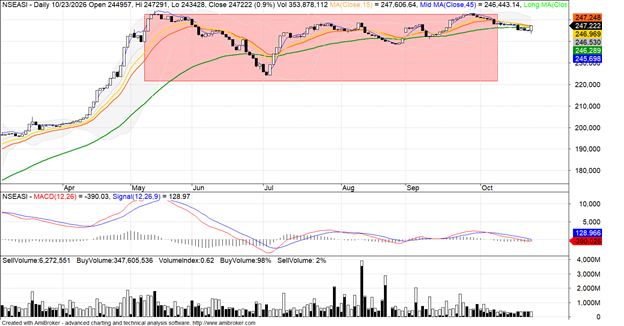
From a technical perspective, the market’s decline signals a corrective phase within a broader bullish trend. The NGX All-Share Index remains above key psychological and technical support levels, suggesting that the long-term uptrend is still intact. The positive market breadth further reinforces this outlook, indicating that buying interest persists beneath the surface despite the headline decline.
In the near term, the market is likely to experience increased volatility as investors continue to rebalance portfolios and digest both domestic and global developments. Profit-taking may persist, particularly in stocks that have recorded significant gains in recent weeks. However, the presence of strong fundamentals in many listed companies could provide support and limit downside risk.
Key factors to watch include movements in global oil prices, monetary policy direction, inflation trends, and upcoming corporate earnings releases. A rebound in oil prices or positive macroeconomic signals could reignite bullish momentum, while adverse developments may trigger further corrections.
Investors are encouraged to adopt a disciplined and selective approach, focusing on fundamentally sound stocks with strong earnings visibility, robust balance sheets, and consistent dividend history. Portfolio diversification and risk management remain critical in navigating the current market environment.
The NGX All-Share Index declined by 0.58% to close at 241,750.15 points from 243,158.97, while market capitalisation fell by N904.40bn to N155.15trn, bringing year-to-date return to 55.35%. Market breadth remained positive with 46 gainers against 26 losers. Top gainers included RT Briscoe (+10.00%), Vitafoam (+10.00%), Zichis (+9.98%), CAP (+9.96%), Dangote Sugar (+9.92%), and Consolidated Hallmark (+9.78%), all trading at or near their 52-week highs. On the downside, Guinness (-10.00%) led the losers, followed by Wema Bank (-8.72%), MTN Nigeria (-8.63%), Aradel (-5.81%), Beta Glass (-4.68%), TIP (-4.41%), FirstHoldCo (-3.77%), WAPCO (-2.21%), AccessCorp (-1.96%), UBA (-1.87%), Zenith Bank (-0.93%), GTCO (-0.71%), and Custodian (-0.17%). Total volume traded declined by 9.85% to 1.27 billion units valued at N75.23bn across 102,665 deals, with FCMB accounting for 160.59 million units (12.66% of total volume), while GTCO led value traded at N13.09bn (17.40%), followed by MTN Nigeria and Zenith Bank.