

Period Under Review: 1st Quarter Ended March 2026
Current Share Price: N25.40
Price At Release Date: N27.00
Latest Final Dividend: NIL
Latest Interim Dividend: N
Estimated Beta Value: 0.43x
Estimated Intrinsic Value: N25.88
Rating: BUY (with caution)
Analyst: Jeariogbe Tunde Segun
The Company
Access Holdings Plc traces its origins to the establishment of Access Bank Plc, which was granted an operating licence in 1988 and commenced business in 1989 as a privately owned commercial bank in Nigeria. It transitioned into a public limited company in 1998 and was subsequently listed on the Nigerian Stock Exchange, marking its early institutional growth phase. A major turning point occurred in 2002 with the appointment of Aigboje Aig-Imoukhuede and Herbert Wigwe, who led a strategic transformation that repositioned the bank as a leading corporate banking institution, delivering rapid balance sheet expansion and sustained profitability.
Over the following decades, the institution pursued aggressive expansion through mergers, acquisitions, and internationalization. Notable milestone in this corporate journey was the acquisition of Intercontinental Bank Plc in 2012, and merger with Diamond Bank in 2019. Both business combinations significantly strengthened Access Bank’s retail banking footprint and digital capabilities. These strategic moves enabled the group evolve into one of Nigeria’s largest banks by assets and customer base, while extending its presence across multiple African countries and global financial hubs. The transformation culminated in the creation of Access Holdings Plc as a non-operating holding company structure, designed to consolidate its diverse financial service offerings and support broader growth ambitions across Africa and beyond.
Today, Access Holdings Plc operates as a diversified financial services group with core lines of business spanning commercial banking, retail banking, corporate and investment banking, payments, and digital financial services. Its flagship subsidiary, Access Bank, remains the primary revenue driver, offering services such as trade finance, treasury operations, wealth management, and lending to individuals, SMEs, and large corporates. In addition, the group is increasingly focused on sustainable finance, global payments infrastructure, and financial inclusion initiatives, positioning itself as a leading African financial institution facilitating cross-border trade and economic development.
The Released Numbers
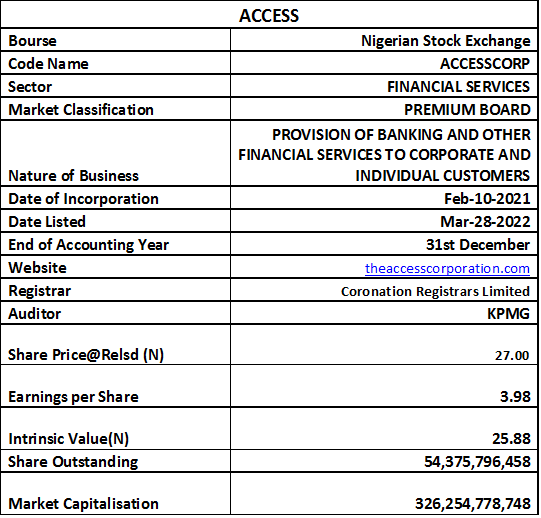
The financial performance of Access Holdings for the first quarter ended March 30th 2026 shows a slight contraction in top line, with gross earnings declining marginally by 2.61% to ₦1.38 trillion from ₦1.41 trillion in the corresponding period of 2025. This drop was largely driven by an 8.73% decline in interest income, suggesting either reduced yield on earning assets or a shift in asset mix. However, this pressure is significantly offset by a sharp 26.86% reduction in interest expenses, which indicates improved funding efficiency or a re-pricing of liabilities. As a result, net interest income rose strongly by 53.88% to ₦338.86 billion, highlighting a substantial improvement in core banking profitability despite weaker revenue generation.
On the cost side, operating expenses grew by 26.27% to ₦403.21 billion, reflecting inflationary pressures, expansion costs, or increased investment in operations and technology. Depreciation and amortisation also rose by 13.60% and 20.94% respectively, indicating continued capital expenditure and asset base expansion. Despite these rising costs, the strong growth in net interest income supported a 22.19% increase in profit before tax (PBT) to ₦272.21 billion. Tax expenses rose even faster at 31.59%, which slightly moderated the bottom-line impact, but profit after tax (PAT) still recorded a solid growth of 18.49% to ₦216.54 billion, confirming the improved earnings resilience.
A major highlight of the performance is the significant turnaround in total comprehensive income, which moved from a negative ₦39.58 billion in 2025 to a ₦126.02 billion positive in 2026, representing a 418.36% improvement. This suggests substantial gains from other comprehensive income components, likely driven by fair value adjustments, foreign currency translation gains, or revaluation reserves.
Overall, the results reflect a bank that is successfully improving its margin efficiency and profitability despite revenue headwinds, though rising operating costs remain a key area to monitor for sustainability.
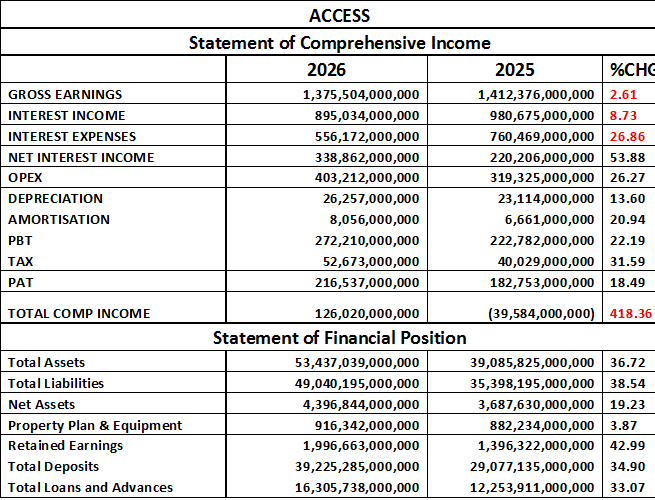
The first quarter 2026 statement of financial position of Access Holdings reflects a strong balance sheet expansion, with total assets growing significantly by 36.72% to ₦53.44 trillion from ₦39.09 trillion in 2025. This growth is largely funded by a corresponding 38.54% increase in total liabilities to ₦49.04 trillion, indicating that the bank continues to rely heavily on borrowed funds and customer deposits to drive asset growth. Net assets (shareholders’ funds) also increased by 19.23% to ₦4.40 trillion, showing a moderate improvement in equity base, though at a slower pace relative to liabilities—suggesting increased leverage.
From an asset composition perspective, property, plant, and equipment recorded a modest growth of 3.87% to ₦916.34 billion, indicating limited expansion in fixed assets and a continued focus on financial asset-driven growth. Retained earnings rose strongly by 42.99% to ₦1.997 trillion, reflecting solid profit retention and internal capital generation, which strengthens the bank’s capacity to absorb shocks and support future expansion. On the funding side, total deposits grew by 34.90% to ₦39.23 trillion, reaffirming a strong deposit mobilization strategy and a stable, low-cost funding base.
In terms of risk asset creation, total loans and advances increased by 33.07% to ₦16.31 trillion, broadly in line with deposit growth, indicating a balanced approach to liquidity and lending. This suggests the bank is effectively converting deposits into earning assets without excessive risk exposure. However, the faster growth in liabilities relative to equity points to rising financial leverage, which, while supportive of returns, could elevate risk if not carefully managed. Overall, the balance sheet shows robust growth, strong deposit franchise, and improved retained earnings, but with a need to monitor leverage and asset quality sustainability.
Financial Ratios/Solvency Ratio
The financial strength and solvency ratios indicate that Access continues to operate with a highly leveraged balance sheet structure in 2026. The debt ratio increased slightly to 91.77% from 90.57% in 2025, implying that a larger proportion of the bank’s assets is financed through liabilities. This is typical for banking institutions; however, the upward movement suggests increasing dependence on external funding. Correspondingly, the total debt-to-equity ratio rose significantly by 16.19% to 11.15x, highlighting a notable expansion in leverage and reinforcing the aggressive balance sheet growth observed in the period.
Equity ratio declined from 9.43% in 2025 to 8.23% in 2026, reflecting a weakening equity buffer relative to total assets. This suggests that although shareholders’ funds are growing in absolute terms, they are not keeping pace with the expansion in liabilities. From a solvency perspective, this trend may increase vulnerability to financial stress if asset quality deteriorates or if there are shocks to earnings. The decline in equity proportion also aligns with the earlier observation of faster liability growth, indicating that the bank is increasingly utilizing leverage to drive returns.
On market risk assessment, the Beta value of 0.43 indicates relatively low volatility compared to the broader market, suggesting that the stock is less sensitive to market movements. This could make it attractive to risk-averse investors despite the high leverage profile. Overall, while the bank demonstrates strong capacity to grow through leverage, the rising debt levels and declining equity ratio point to increasing financial risk, making capital adequacy and risk management critical areas to monitor going forward.

Profitability Ratios
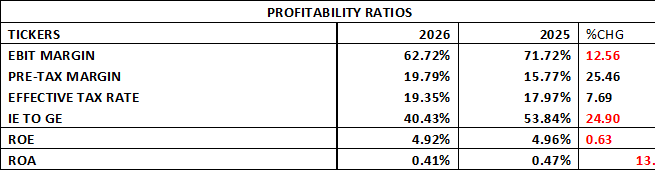
The profitability profile for 2026 presents a mixed performance, with margin dynamics reflecting both operational pressures and efficiency gains. The EBIT margin declined notably to 62.72% from 71.72% in 2025, indicating reduced operating efficiency at the core earnings level, likely driven by rising operating expenses or lower revenue yield. However, this weakness is contrasted by a strong improvement in pre-tax margin, which increased to 19.79% from 15.77%, suggesting that below-operating-line factors—such as reduced funding costs or improved net interest income—played a significant role in supporting profitability.
Efficiency gains are further evident in the interest expense to gross earnings ratio (IE to GE), which dropped sharply to 40.43% from 53.84%. This indicates a substantial reduction in funding costs relative to earnings, aligning with earlier observations of declining interest expenses and improved margin management. On the tax side, the effective tax rate increased moderately to 19.35%, which slightly diluted bottom-line gains but remains within a manageable range. Despite the improved pre-tax profitability, the benefits did not fully translate into stronger returns for shareholders.
Return metrics show marginal weakness, with return on equity (ROE) declining slightly to 4.92% from 4.96%, and return on assets (ROA) dropping to 0.41% from 0.47%. These declines suggest that the company’s expanded asset base and equity are not yet generating proportionate returns, pointing to efficiency gaps in asset utilization. Overall, while the group demonstrates improved cost of funds and stronger pre-tax profitability, declining operating margins and weaker return ratios highlight the need for improved cost control and more efficient deployment of assets to sustain long-term profitability.
Efficiency Ratios
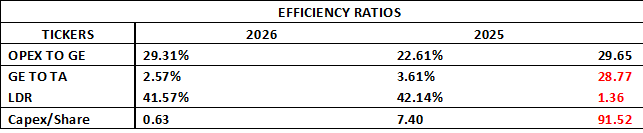
The efficiency ratios for 2026 indicate a deterioration in cost efficiency despite some stability in balance sheet utilization. The OPEX to gross earnings ratio increased significantly to 29.31% from 22.61% in 2025, representing a 29.65% rise. This suggests that operating expenses are growing faster than earnings, pointing to cost pressures possibly driven by inflation, expansion, or increased investment in technology and operations. This trend aligns with the earlier observed decline in EBIT margin, reinforcing concerns around operational efficiency.
Asset utilization also weakened, as reflected in the gross earnings to total assets ratio, which declined sharply to 2.57% from 3.61%, a 28.77% drop. This indicates that the bank’s expanded asset base is generating relatively lower income, suggesting inefficiencies in asset deployment or a shift toward lower-yielding assets. In contrast, the loan-to-deposit ratio (LDR) remained relatively stable at 41.57% compared to 42.14% in 2025, indicating a consistent lending strategy and a cautious approach to liquidity management, with no aggressive expansion in credit relative to deposits.
A notable development is the sharp decline in capex per share to 0.63 from 7.40, representing a 91.52% reduction. This suggests a significant slowdown in capital investment on a per-share basis, which could imply a pause in expansion projects or a shift toward optimizing existing infrastructure. While this may support short-term cash flow, it could have longer-term implications for growth if underinvestment persists. Overall, the efficiency metrics highlight rising cost pressures, weaker asset productivity, and reduced capital investment, pointing to the need for improved cost discipline and more effective asset utilization strategies.
Investment/Valuation Ratios
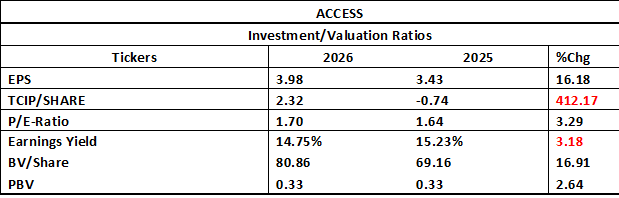
The investment and valuation metrics for 2026 reflect a generally improving earnings profile alongside a persistently discounted market valuation. Earnings per share (EPS) increased by 16.18% to 3.98 from 3.43, indicating solid bottom-line growth and improved value generation for shareholders. Similarly, total comprehensive income per share (TCIP/share) recorded a significant turnaround from a negative position of -0.74 in 2025 to 2.32 in 2026, representing a sharp recovery driven by the strong improvement in total comprehensive income observed earlier. This suggests enhanced overall performance beyond core earnings, including gains from other comprehensive income components.
Valuation metrics, however, indicate that the stock remains undervalued relative to its earnings capacity. The price-to-earnings (P/E) ratio increased slightly to 1.70 from 1.64, but remains very low, suggesting that the market is pricing the stock conservatively despite earnings growth. Correspondingly, the earnings yield declined marginally to 14.75% from 15.23%, reflecting the slight increase in valuation, yet still remains relatively high, reinforcing the attractiveness of the stock from an income perspective. Book value per share rose strongly by 16.91% to 80.86, indicating sustained growth in shareholders’ equity and intrinsic value.
Despite these positive fundamentals, the price-to-book value (PBV) ratio remained flat at 0.33, implying that the stock continues to trade at a significant discount to its book value. This disconnect suggests that market sentiment may still be cautious, possibly due to macroeconomic risks, regulatory concerns, or perceived balance sheet risks such as high leverage. Overall, the metrics point to a fundamentally stronger company with improving earnings and book value, but one that remains undervalued, presenting potential upside for investors if market confidence improves.
Final Verdict/Recommendations/Rating
Access Bank Plc’s Q1 2026 performance presents a strong but not flawless picture, combining improved core profitability with rising structural pressures. On the positive side, the bank delivered significant growth in net interest income, profit before tax, and profit after tax, driven largely by a sharp reduction in funding costs and improved margin efficiency. The turnaround in total comprehensive income further strengthens the earnings quality narrative, while balance sheet expansion, strong deposit growth, and increased retained earnings confirm continued franchise strength and market dominance. In addition, valuation metrics show the stock is deeply undervalued (low P/E and PBV) despite improving earnings, which is a key attraction.
However, there are clear areas of concern that cannot be ignored. Cost efficiency weakened materially, with OPEX rising faster than earnings, leading to pressure on operating margins. Asset utilization also declined, as reflected in the weaker earnings-to-asset ratios and slightly lower ROA and ROE. More importantly, the bank’s leverage position has increased, with higher debt ratios and a declining equity ratio, indicating a growing reliance on liabilities to fund expansion. While this is typical in banking, the pace of increase raises some caution, especially if asset quality or macroeconomic conditions deteriorate.
Access Bank remains a fundamentally strong and growing institution, but currently in a transition phase where efficiency and risk management need to catch up with growth. The stock is clearly undervalued relative to its earnings and book value, but the market appears to be pricing in concerns around cost pressures, leverage, and asset efficiency.
Investment Recommendation:
Rating: BUY (with caution)
For new investors: This is an attractive entry point given the deep valuation discount and strong earnings growth potential.
For existing investors: HOLD and ACCUMULATE on dips, as long-term fundamentals remain intact.
Risk factors to monitor: Cost-to-income trend, asset quality (NPLs), and leverage levels.
In summary, Access Bank offers strong upside potential, but investors should remain watchful of efficiency and risk indicators to ensure the growth is sustainable.