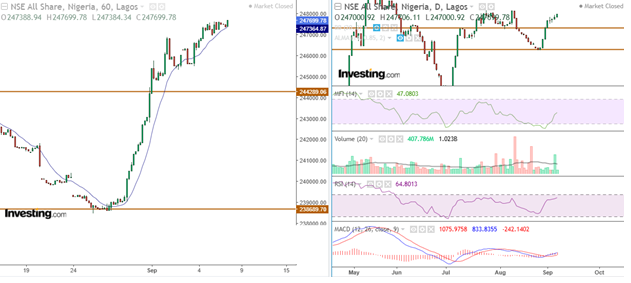

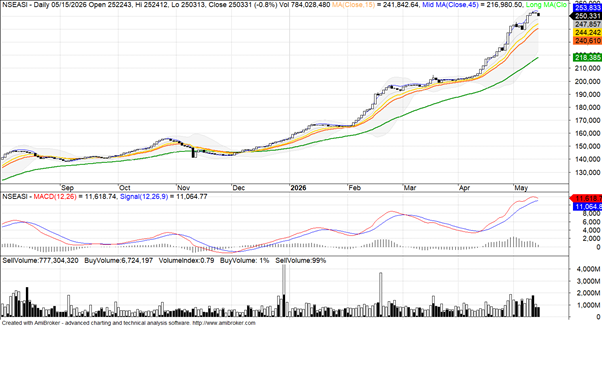
Nigeria’s stock market recorded a mixed trend in the face of bull-run last week, trading above the T-line and all moving averages thereby indicating strong momentum and buying interest, despite profit taking across sectors and industries. Also during the week, macroeconomic indices such as the consumer price index ticked up for the second consecutive month to 15.68% in the month of April that is linked to the ongoing Mid-East tension that has spike oil prices. The daily All-Share index’s action recorded up and down movements as revealed by the chart below
NGXASI Daily Chart
Overall, the week’s trading on the Nigerian Exchange strengthened, with investors exchanging 7.772 billion shares worth ₦374.04 billion in 402,945 deals, compared to 7.075 billion shares valued at ₦324.35 billion in 474,436 deals the previous week. Financial Services dominated activity with 4.774 billion shares worth ₦196.35 billion, representing 61.43% of total volume and 52.49% of value. ICT followed with 1.118 billion shares worth ₦57.83 billion, while Services recorded 601.75 million shares worth ₦6.98 billion.
FirstHoldCo, UBA and CHAMS emerged as the most traded, accounting for 2.195 billion shares worth ₦99.82 billion. They contributed 28.24% of total volume and 26.69% of total market value. The NGX ASI ultimately advanced 2.27% to close at 250,330.92 points, while market capitalisation rose 2.13% to ₦160.44 trillion. Most sector indices ended higher, except Oil & Gas, Sovereign Bond and Commodity indices, which declined by 1.19%, 0.08% and 0.80% respectively.
The week’s trading activities started on a strong bullish note on Monday, May 11, 2026, as sustained demand pushed the NGX All-Share Index (ASI) up by 2.33% to 250,481.42 points from 244,775.83 points. Market capitalisation jumped by ₦3.16 trillion, while year-to-date return climbed to 60.96%, reflecting firm investor confidence. Strong performances in stocks such as DANGCEM, GTCO, UBA, ZENITHBANK, MTNN, TRANSCORP, FIRSTHOLDCO, ETERNA, BERGER, MECURE and UHOMREIT drove the rally.
Market breadth closed strongly positive with 59 gainers against 21 losers, led by CHAMS, FTNCOCOA, LIVESTOCK, RTBRISCOE and UHOMREIT, while PRESTIGE topped losers. FTNCOCOA, BERGER and ZICHIS also traded above their 52-week highs. Activity improved as volume rose 28.65% to 1.49 billion shares worth ₦68.45 billion in 94,834 deals, with VERITASKAP leading volume and MTNN topping value chart at ₦12.39 billion.
On Tuesday, May 12, 2026, the market extended its rally as the NGX ASI rose 0.77% to 252,411.67 points, adding ₦1.52 trillion in market capitalization, lifting YTD return to 62.20%. Gains in IKEJAHOTEL, UHOMREIT, NB, PZ, UNILEVER, ACCESSCORP, UBA and ZENITHBANK supported the advance. Market breadth remained positive with 45 gainers versus 33 losers, led by IKEJAHOTEL, UHOMREIT and UPL, while FTGINSURE led decliners. Trading activity strengthened further as volume surged 36.48% to 2.03 billion shares worth ₦87.71 billion in 80,888 deals. CWG led volume while UBA recorded the highest value traded at ₦16.78 billion.
At midweek’s session, momentum slowed slightly but the market still edged higher, with the ASI up 0.04% to 252,508.19 points and YTD return improving to 62.27%. Gains in CWG, DAARCOMM, FIDSON and LIVESTOCK supported the session, while NCR led losers. FIDSON, LIVESTOCK, BERGER, FTNCOCOA and UPDCREIT traded above their 52-week highs. However, trading activity weakened as volume fell 6.70% to 1.89 billion shares worth ₦117.80 billion in 82,203 deals, with FIRSTHOLDCO dominating both volume and value.
On Thursday, May 14, 2026, the market slipped as profit-taking set in. The ASI shed 0.10% to 252,243.11 points, with market capitalization down ₦169.90 billion and YTD return easing to 62.10%. Weakness in MEYER, WEMABANK, TIP, STANBIC, ACCESSCORP, NB, NGXGROUP, ZENITHBANK and OANDO weighed on the index, though WAPCO and UBA offered mild support. Market breadth stayed positive at 37 gainers against 28 losers, with LEARNAFRCA leading gainers and ZICHIS topping losers. Activity dropped sharply as volume fell 45.06% to 1.04 billion shares worth ₦41.64 billion in 74,822 deals, led by CHAMS (volume) and ARADEL (value).
The last trading session of the week ended on a weaker note, as selling pressure and profit booking persisted. The ASI dropped 0.76% to 250,330.92 points, while market capitalisation fell by ₦1.23 trillion and YTD return eased to 60.87%. Declines in TIP, ARADEL, NB, NAHCO, MTNN, ZENITHBANK, WAPCO and GTCO drove the downturn. Despite this, market breadth remained positive with 47 gainers against 28 losers, led by ABCTRANS and MAYBAKER, while ZICHIS led laggards. Trading activity improved slightly as volume rose 4.28% to 1.08 billion shares worth ₦44.29 billion, with CHAMS leading volume and ARADEL dominating value.
Week-to-date, the NGX-30 rose by 2.02%, the Banking Index has increased by 2.82%, the Pension Index increased by 2.74%, the Insurance Index inclined by 2.74%, the Consumer Goods Index increased by 1.65%. However, the Oil and Gas Index recorded a negative return of 1.19%. Year-to-date, the All-Share Index has gained 60.87%, NGX 30 is up by 59.73%, the Banking Index has increased by 57.68%, the Pension Index increased by 72.62%, the Insurance Index Inclined by 6.61%, the Consumer Goods Index increase by 26.34%. However, the Oil and Gas Index recorded a positive return of 118.24%. In terms of market breadth, 74 stocks advanced, while 24 declined.
Berger Paints Plc
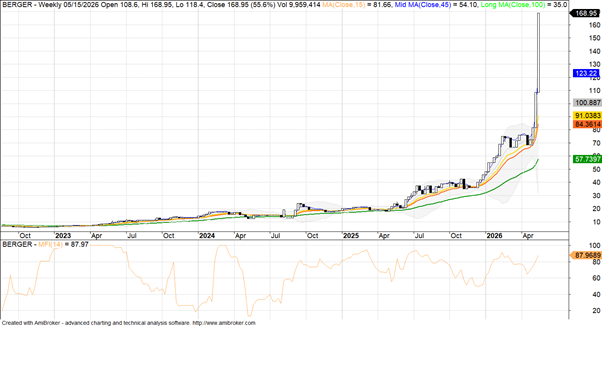
On the gainers’ table, Berger Paints Plc led with a 55.57% appreciation, rising from ₦108.60 to ₦168.95, gaining ₦60.35 each. SCOA Nigeria Plc followed after climbing 45.92% from ₦22.65 to ₦33.05, adding ₦10.40. DAAR Communications Plc gained 42.41% to close at ₦2.25 from ₦1.58, up by 67 kobo. Fidson Healthcare Plc appreciated by 32.52%, moving from ₦103.00 to ₦136.50 with a gain of ₦33.50, while Learn Africa Plc advanced by 32.32% from ₦8.20 to ₦10.85, gaining ₦2.65.
Zichis Plc
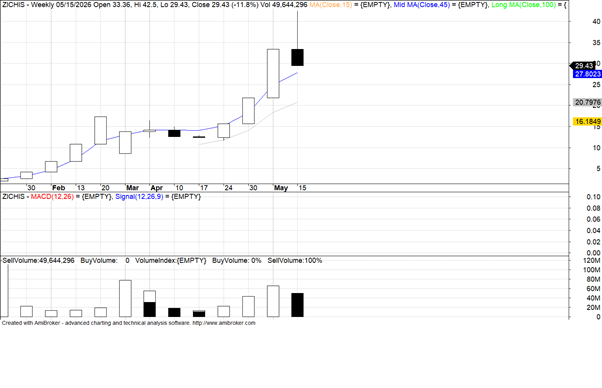
On the flip side, Zichis Agro Allied Industries Plc topped the losers’ chart after declining by 11.78% from ₦33.36 to ₦29.43, shedding ₦3.93. The Initiates Plc fell by 10.03% from ₦35.90 to ₦32.30, losing ₦3.60. NPF Microfinance Bank Plc dropped 10% from ₦6.40 to ₦5.76, while NCR Nigeria Plc also declined by 10% from ₦199.00 to ₦179.10, losing ₦19.90. Custodian Investment Plc weakened by 9.52%, sliding from ₦89.80 to ₦81.25 after shedding ₦8.55.
Technical Analysis View
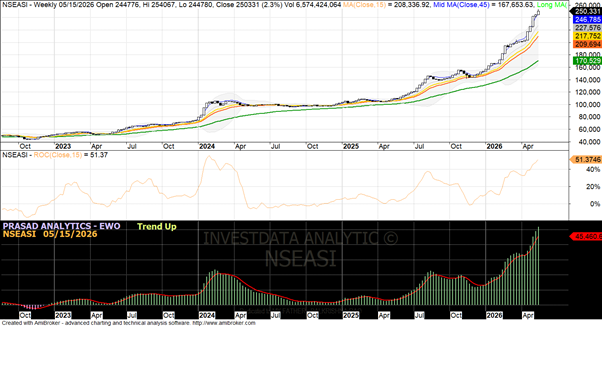
The NGX All-Share Index maintained a strong bullish structure at the start of the week, extending the prior uptrend with a sharp breakout driven by sustained demand in large-cap names. The early-week advance reinforced the dominant bullish trend, with the index pushing decisively above the 250,000 psychological level on strong participation. This phase reflected continuation buying, particularly in banking, industrial, and telecom stocks, which helped sustain upward momentum and broaden market participation.
Midweek’s price action showed signs of transition from accumulation to consolidation. Although the index continued to edge higher, the pace of gains slowed significantly, indicating weakening upside momentum. This deceleration is typical after a strong impulsive rally, as market participants begin to lock in profits while new inflows become more selective. Market breadth remained supportive during this phase, but the reduction in volume growth signaled that buying conviction was gradually fading.
By Thursday, the structure shifted more clearly toward distribution. The index turned slightly negative as profit-taking intensified in previously strong-performing counters, particularly in heavyweight financial and industrial stocks. This marked the first clear rejection from higher levels, suggesting that the market was struggling to sustain momentum above recent highs. Friday confirmed this shift, with a deeper decline that erased part of the earlier gains and reinforced short-term selling pressure.
Technically, the index formed a clear resistance zone around the 252,500 level, where upward momentum stalled multiple times. This zone now represents a key supply area where sellers consistently emerged. On the downside, the index found immediate psychological support around the 250,000 mark, while a broader and more structurally important support area remains between 244,700 and 246,000, which previously acted as the base for the week’s rally.
Volume dynamics further confirm the price action. Early-week gains were supported by rising turnover, indicating strong accumulation. However, as the week progressed, volume declined during up sessions and increased during down sessions, a pattern consistent with distribution and short-term profit-taking rather than fresh accumulation. Despite the late-week weakness, overall market breadth remained positive, suggesting that underlying demand in select mid- and small-cap stocks still exists.
Market Outlook
The broader market structure remains firmly bullish, supported by the strong weekly performance and sustained year-to-date gains. However, in the short term, the NGX appears to be entering a consolidation phase following an extended rally. This phase is characterized by profit-taking at higher levels, rotational buying across sectors, and reduced momentum in index-heavy stocks. Going forward, the index is expected to trade within a defined range as the market digests recent gains. The 250,000 level now serves as a critical short-term pivot, with sustained trading above it necessary to preserve bullish sentiment. Failure to hold this level on a closing basis may increase the likelihood of a deeper corrective move toward the 246,000 support zone. On the upside, the 252,500 level remains the key resistance barrier. A strong breakout above this zone, supported by improved volume and broad-based participation, would signal a continuation of the uptrend and open room for further price discovery. Until such a breakout occurs, price action is likely to remain range-bound with intermittent volatility driven by sector rotation and profit-taking activity.
Overall, while the medium-term trend remains positive, near-term conditions reflect a maturing rally phase, where momentum is stabilizing and the market is transitioning into consolidation rather than aggressive expansion.
Trending in the Economy: The Federal Government is looking to secure a $1.25 billion loan from the World Bank to finance reforms across key sectors, including power, digital services, agriculture, taxation, and trade. The World Bank noted that the initiative is designed to support inclusive growth and job creation, even as the country continues to grapple with poverty, weak infrastructure, and sluggish economic expansion. If approved, this would push total World Bank financing under President Bola Tinubu’s administration to about $10.6 billion since 2023.
In the energy sector, Nigeria’s petrol imports dropped sharply by 60.2% year-on-year to 965.52 million litres in Q1 2026, driven by a strong rise in domestic supply. Local production climbed 59.2% to 3.18 billion litres, increasing its share of total supply to 76.7% from 45.2% in the same period last year. Overall petrol supply edged down slightly to 4.14 billion litres, indicating that higher domestic output only partly offset the fall in imports. February recorded the steepest contraction in imports at 88.9%, while March showed a slight recovery, though still far below 2025 levels.
Global Market and Oil: Global financial markets closed the week on a weaker note as risk sentiment deteriorated sharply, with equities falling across regions, bond yields spiking to multi-month highs, and renewed inflation fears driving expectations of tighter monetary policy. The sell-off was largely triggered by a shift in investor positioning after weeks of strong momentum in technology and artificial intelligence-linked stocks. That rally gave way to profit-taking as market participants reassessed valuations in light of stronger inflation data, rising energy prices, and more aggressive rate expectations.
In the United States, major indices ended lower. The Dow Jones Industrial Average fell 537.29 points, or 1.07%, to close at 49,526.17. The S&P 500 declined 92.74 points, or 1.24%, to 7,408.50, while the Nasdaq Composite dropped 410.08 points, or 1.54%, to 26,225.15. The pullback came after both the S&P 500 and Nasdaq had recently touched record levels on the back of strong momentum in AI-related technology stocks. Despite Friday’s losses, the S&P 500 still managed to extend its winning streak to seven consecutive weeks, its longest run since late 2023. The Nasdaq, however, ended the week lower, snapping a six-week winning streak, while the Dow also finished in negative territory for the week.
Global markets mirrored the weakness. MSCI’s global equity index fell 17.06 points, or 1.53%, to 1,099.00. In Europe, the STOXX 600 dropped 1.48% as broad risk-off sentiment spread across sectors. Asian equities also came under pressure, with MSCI’s Asia-Pacific index outside Japan falling 2.5%.
Japan’s Nikkei declined 1.99% after data showed wholesale inflation accelerated to 4.9% in April, the fastest pace in three years. The reading reinforced expectations that the Bank of Japan may continue tightening policy. South Korea’s Kospi suffered an even sharper decline, plunging more than 6% after a strong multi-month rally, though it remains up 77.8% year-to-date, highlighting the scale of earlier gains.
The risk-off move extended strongly into bond markets. U.S. Treasury yields surged to their highest levels in about a year as inflation concerns intensified, particularly due to rising oil prices and geopolitical uncertainty in the Middle East. The benchmark 10-year Treasury yield rose 13.8 basis points to 4.597% from 4.459%. The 30-year yield increased 10.9 basis points to 5.122%, while the 2-year yield—closely tied to Federal Reserve interest rate expectations—rose 8.7 basis points to 4.079%.
The bond market reaction reflected a growing belief that inflation could remain sticky or even re-accelerate in the months ahead, limiting the Federal Reserve’s ability to ease policy. Energy costs were a key driver, alongside persistent pricing pressures already evident in recent data. Currency markets also reflected the shift in expectations. The U.S. dollar extended its gains for a fifth straight session, positioning for its strongest weekly performance in two months. The dollar index rose 0.33% to 99.28, supported by rising Treasury yields and increased expectations of potential Fed tightening.
Against major currencies, the euro weakened 0.38% to $1.1624. The Japanese yen slipped to 158.74 per dollar, down 0.25%, as Japan’s inflation data reinforced policy divergence expectations between the Bank of Japan and the Federal Reserve. The British pound also weakened for a fifth consecutive day, falling 0.61% to $1.3318 after dropping 0.9% in the previous session, marking its lowest level in more than five weeks.
Rate expectations shifted noticeably during the week. Traders increased their bets on further tightening, with markets pricing in a 38.8% probability of a 25 basis point Federal Reserve rate hike by year-end, compared with less than 14% just a week earlier. There is also a 9.9% probability priced in for a 50 basis point increase by year-end, according to CME FedWatch data.
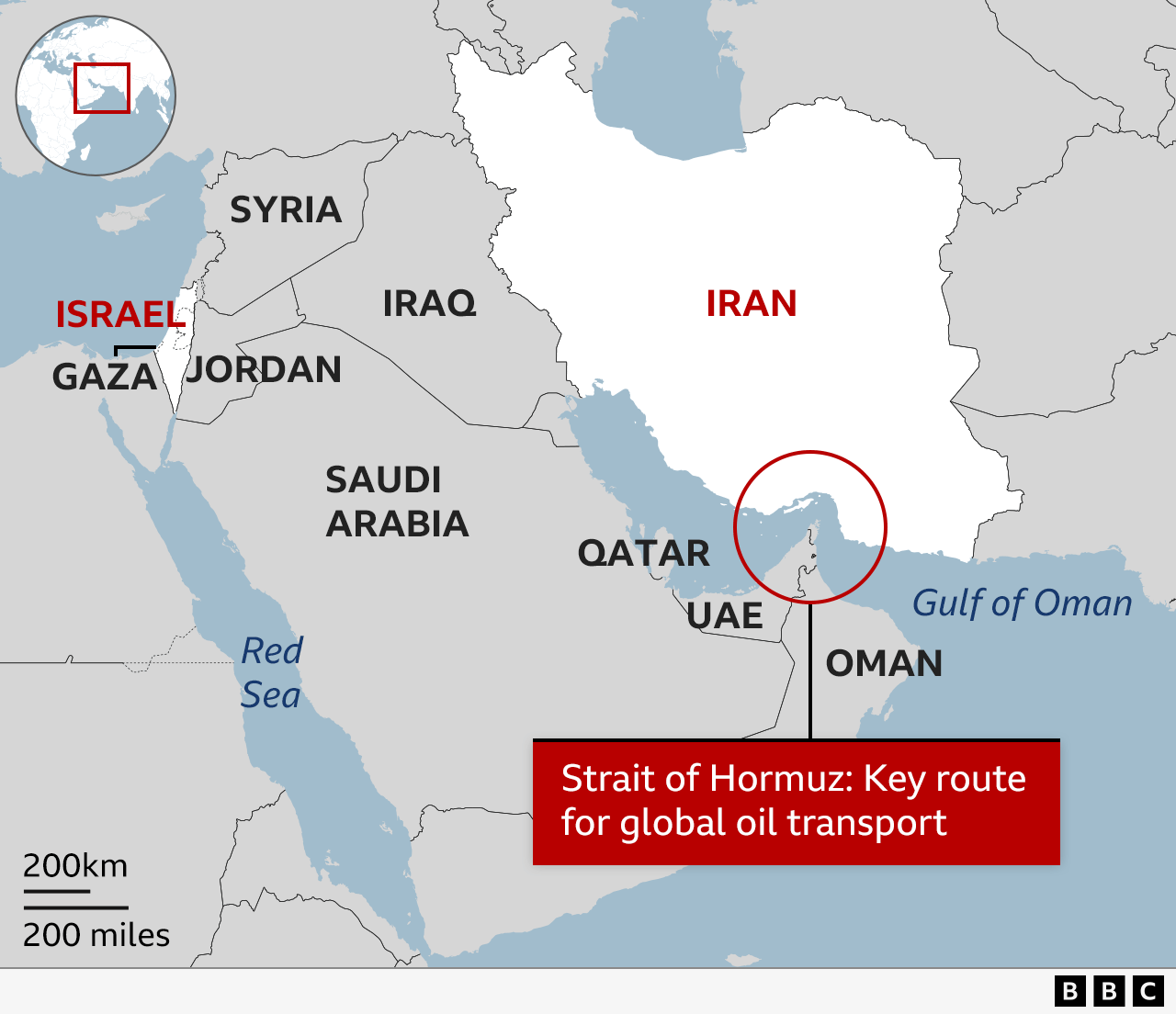
Political developments added another layer of uncertainty. Friday marked Jerome Powell’s final day as Federal Reserve Chair, ahead of Kevin Warsh taking over. Warsh, nominated by Donald Trump, is expected to face immediate market scrutiny over the future direction of interest rate policy, especially as political pressure builds around inflation and growth concerns. Geopolitical tensions further weighed on sentiment. Oil prices surged sharply on supply disruption fears linked to Middle East instability. U.S. crude oil rose 4.2%, or $4.25, to $105.42 per barrel. Brent crude climbed 3.35%, or $3.54, to $109.26 per barrel. The rally was driven by renewed concerns over Iran-related tensions and potential risks to key shipping routes such as the Strait of Hormuz, raising fears of further energy price inflation.
In commodities, gold came under pressure as rising yields and a stronger dollar reduced demand for safe-haven metals. Spot gold fell 2.35% to $4,540.11 an ounce, while U.S. gold futures dropped 3.29% to $4,524.30 an ounce.
Overall, the week marked a clear turning point in global markets—from AI-driven equity enthusiasm to a more defensive environment dominated by inflation fears, rising interest rates, stronger dollar dynamics, and escalating geopolitical risks.