
The first trading week of June started on a bearish note in the face of selective buying and profit taking that led to pullbacks before rebounding on Friday on renewed position taking by market players which signaled near term retracement in a dicey month. The composite Nigerian Exchange’s All-Share Index (NGXASI) recorded four straight sessions of down and one up market, closing the week lower thereby reversing previous weeks’ gain.
For the week, investors traded 3.97 billion shares worth ₦175.66 billion in 343,587 deals, compared with 2.40 billion shares valued at ₦111.48 billion exchanged in 241,313 deals in the previous week.
The Financial Services sector dominated activity, accounting for 2.69 billion shares worth ₦69.98 billion in 134,882 deals, representing 67.83% of total volume and 39.84% of total value traded. The Services sector followed with 323.60 million shares valued at ₦6.44 billion, while the ICT sector recorded 176.04 million shares worth ₦27.89 billion.
The most actively traded stocks by volume were Access Holdings Plc, Abbey Mortgage Bank Plc and Sterling Financial Holdings Company Plc, which jointly accounted for 1.29 billion shares valued at ₦17.56 billion in 17,768 deals. Together, they contributed 32.53% of total traded volume and 10.00% of total market value for the week.
Trading on Monday opened on a bearish noted to halt the previous session gain, as the benchmark NGX All-Share Index declined by 1.13% to 247,560.66 points, breaking down the 250,000 psychological level. Investors lost about ₦1.81 trillion in market value, while market breadth closed negative at 24 gainers against 37 losers. A total of 1.13 billion shares valued at ₦44.28 billion were exchanged in 91,880 deals.
The negative momentum persisted on Tuesday as the NGX All-Share index shed 0.35% to 246,686.66 points, wiping out ₦478.68 billion from market capitalization. The year-to-date return moderated to 58.53%, while market sentiment remained weak with 42 decliners compared to 21 advancers. Investors traded 718.71 million shares worth ₦29.29 billion.
Selling pressure intensified at midweek, dragging the market index NGXASI down by 1.44% to 243,132.61 points and erasing ₦2.28 trillion in market value. Market breadth remained negative at 43 losers versus 15 gainers, while turnover stood at 922.97 million shares valued at ₦42.27 billion.
This downtrend continued on Thursday as the index declined by 0.37% to 242,227.31 points, resulting in a further ₦580.65 billion loss in market capitalization. Market breadth closed at 30 losers against 25 gainers, with investors trading 588.46 million shares worth ₦27.88 billion.
However, the market rebounded on Friday as bargain hunting emerged in selected stocks, even as the rebound was not enough to compensate for the four-day losing streak. The benchmark index advanced by 0.15% to 242,593.31 points at Friday’s session, adding ₦234.73 billion to investors’ wealth and pushing the year-to-date return to 55.90%. Market breadth improved significantly to 39 gainers against 11 losers, while turnover rose to 608.49 million shares valued at ₦32.03 billion.
Week-to-date, the All-Share Index lost 3.11%, better than the NGX 30’s 3.25% slide, or the 3.425% decrease by the Banking Index. The Pension Index lost 3.02% during the week, the Insurance Index fell 1.89%, just as the Consumer Goods Index was down by 2.15%. However, the Oil and Gas Index was worse of with its 5.18% loss.
Year-to-date, the All-Share Index gain dropped to 55.90%, the NGX 30 is up by 54.88%, the Banking Index has increased by 50.25%, the Pension Index increased by 67.76%, the Insurance Index Inclined by 4.19%, the Consumer Goods Index increase by 20.72%. However, the Oil and Gas Index recorded a positive return of 112.33%.
IEI Plc
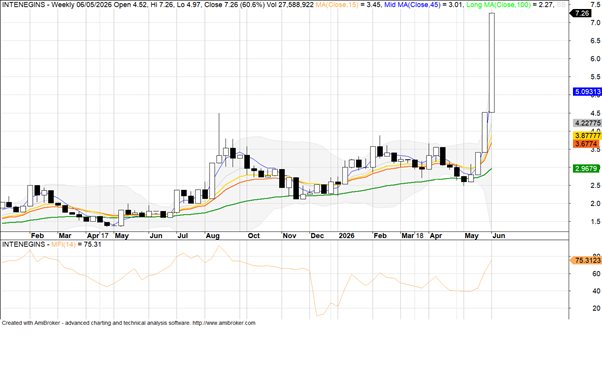
The week’s top-performing stocks were led by International Energy Insurance, which surged 60.62% from ₦4.52 to ₦7.26, gaining ₦2.74 per share. Abbey Mortgage Bank followed with a 47.24% appreciation, rising from ₦6.35 to ₦9.35. Tripple Gee advanced 9.80% to close at ₦4.37 from ₦3.98, while Ikeja Hotel gained 9.45%, moving from ₦40.20 to ₦44.00. RT Briscoe also posted a strong performance, adding 8.86% to settle at ₦14.86 from ₦13.65.
ABC Transport Plc
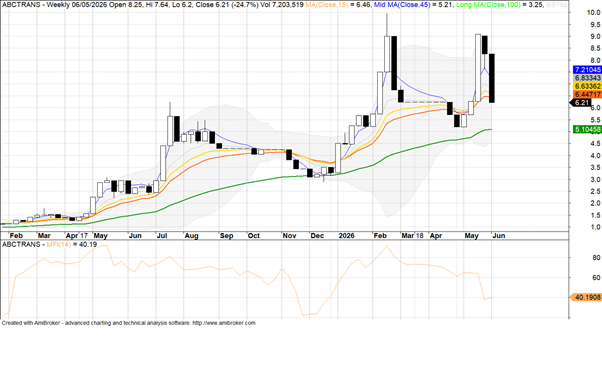
On the downside, Associated Bus Company recorded the steepest decline, shedding 24.73% to close at ₦6.21 from ₦8.25. University Press fell 17.07% to ₦5.10, while Eterna dropped 12.92% to ₦30.00 from ₦34.45. John Holt lost 12.09%, closing at ₦14.90, and First HoldCo declined 11.43% to end the week at ₦62.00 from ₦70.00.
NGX Weekly Comparison: First Week of June vs Previous Week
The Nigerian stock market reversed from a positive performance in the previous week to a sharp decline in the first week of June as profit-taking pressure intensified across major sectors.
The NGX All-Share Index (ASI) fell by 3.11% to 242,593.31 points this week from 250,385.47 points recorded in the previous week. Similarly, the market’s Year-to-Date (YtD) return declined from 60.90% to 55.90%.
Trading activity, however, improved significantly. Total volume traded rose by 65.6% to 3.97 billion shares from 2.40 billion shares, while total value traded increased by 57.6% to ₦175.66 billion from ₦111.48 billion. The number of deals also advanced by 42.4% to 343,587 transactions, compared to 241,313 deals in the previous week.
The Financial Services sector remained the market’s most active segment, accounting for 2.69 billion shares worth ₦69.98 billion (67.83% of volume and 39.84% of value) this week, compared to 1.66 billion shares valued at ₦48.23 billion (69.07% of volume and 43.26% of value) in the preceding week.
The most traded stocks also changed. This week, Access Holdings, Abbey Mortgage Bank and Sterling Financial Holdings accounted for 1.29 billion shares worth ₦17.56 billion, representing 32.53% of total volume and 10.00% of value traded. In the previous week, Fidelity Bank, Access Holdings and The Initiates Plc traded 903.68 million shares valued at ₦19.23 billion, contributing 37.69% of volume and 17.25% of value.
Overall, while the previous week closed with a modest gain of 0.27%, the first week of June witnessed heavy profit-taking that erased over 7,792 points from the benchmark index. Nevertheless, the strong increase in trading volume and Friday’s rebound suggest investors are beginning to take advantage of lower prices in fundamentally sound stocks.
Twenty-three (23) equities appreciated in price during the week lower than thirty-four (34) equities in the previous week. Sixty-five (65) equities depreciated in price, higher than fifty-one (51) equities in the previous week, while fifty-eight (58) equities remained unchanged, lower than sixty-one (61) recorded in the previous week.
Technical Analysis View
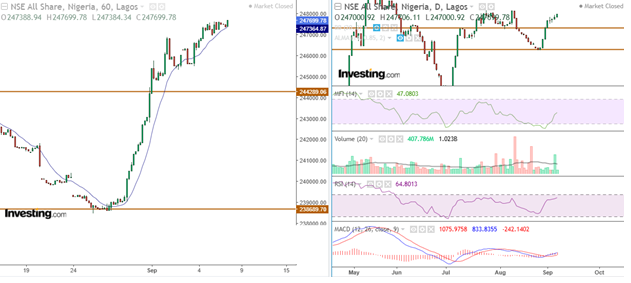
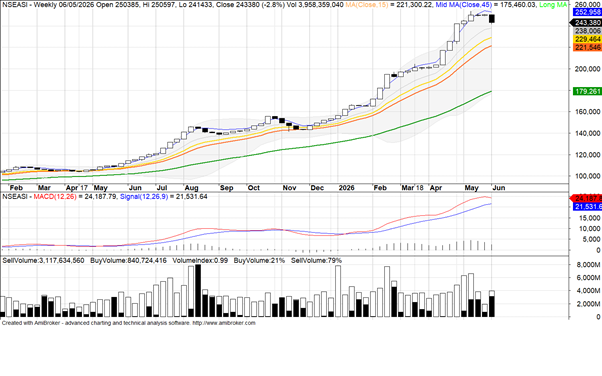
The NGX maintained a clear short-term bearish structure throughout the week, breaking below successive support levels as profit-taking intensified. The index’s inability to sustain gains above the 247,000–248,000 range triggered a deeper correction toward the 242,000 zone.
Momentum indicators suggest persistent selling pressure during mid-week, particularly on Wednesday’s sharp decline, which confirmed strong bearish dominance. However, Friday’s rebound signals early signs of support around the 242,000 level, suggesting possible short-term stabilization.
Despite the late recovery, the index remains below recent highs, indicating that the broader uptrend is currently undergoing a corrective phase rather than a full reversal. Volume patterns also reflect distribution earlier in the week followed by selective accumulation into the close.
Market Outlook:
In the near term, the market is likely to remain range-bound with a mild bearish bias unless sustained buying interest emerges in heavyweight stocks such as banking, telecoms, and industrial names. A firm break below the 242,000-support zone could open the door to further downside pressure, while a consistent hold above this level may encourage renewed bargain hunting in the coming sessions.
Overall, investor sentiment is expected to stay cautious as participants reassess valuations after recent gains, with selective positioning likely to dominate trading activity.
Trending in the Economy: Nigeria’s fiscal deficit narrowed sharply to ₦330 billion in Q3 2025, a huge drop compared to ₦3.17 trillion in the same period of 2024 and also below earlier projections. The Budget Office linked the improvement to stronger revenue performance and more restrained government spending. The deficit-to-GDP ratio came in at 2.29%, staying within the 3% threshold. It was financed through domestic borrowing, privatisation proceeds, and external project loans, though concerns over rising debt levels still linger.
In a separate development, Nigeria recorded $10.37 billion in capital importation in Q1 2026, according to the National Bureau of Statistics. This represents an 83.8% increase year-on-year and a 61% rise from the previous quarter. Portfolio investments dominated inflows at $9.86 billion, while foreign direct investment remained weak at just $135.1 million. The banking sector attracted the largest share of inflows at $7.55 billion, with the United Kingdom and United States emerging as the top sources of foreign capital.
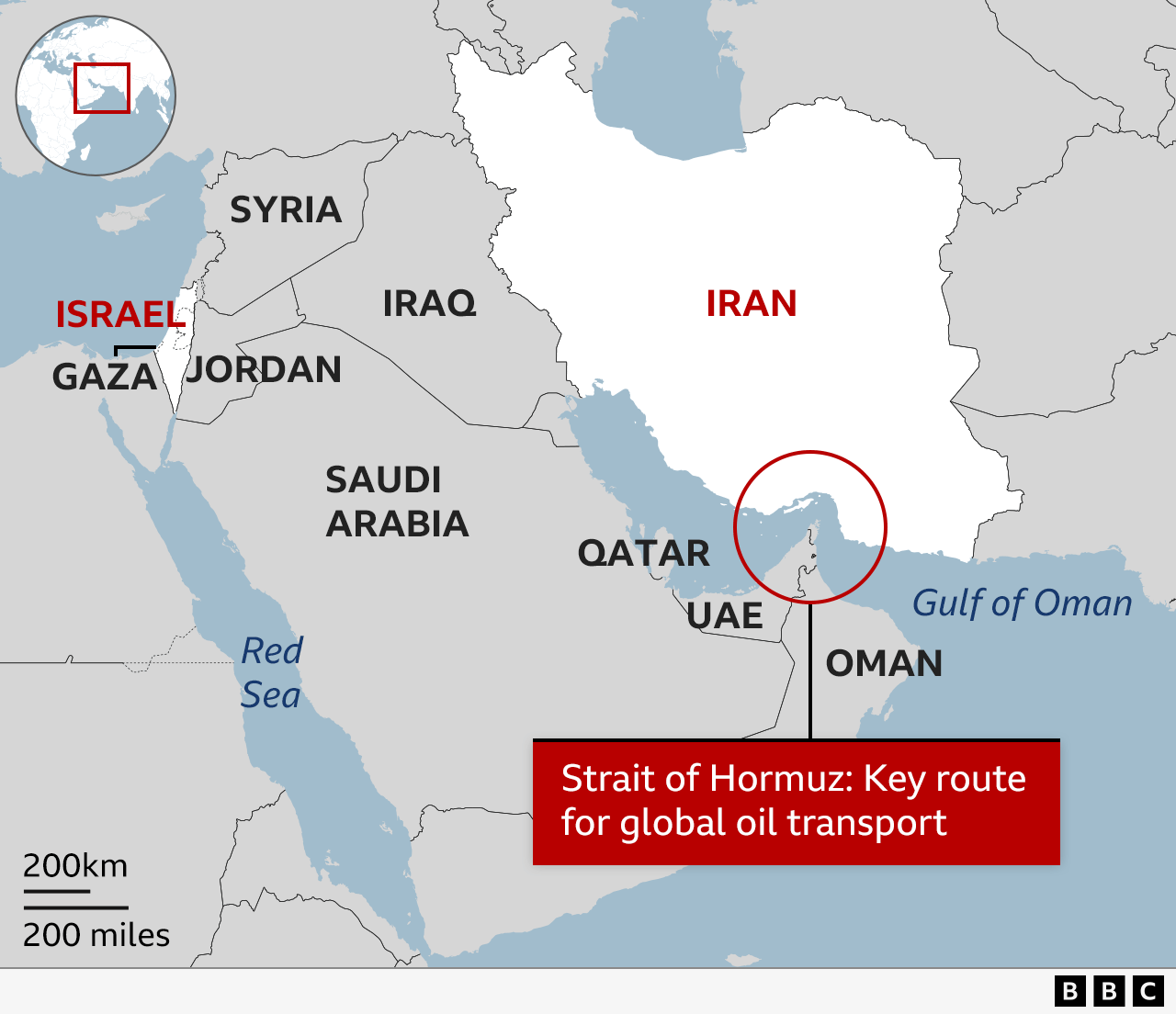
Global Market and Oil: Global markets slumped on Friday after a stronger-than-expected U.S. jobs report strengthened expectations that the Federal Reserve could keep interest rates elevated for longer—or even consider another hike. At the same time, investors turned defensive ahead of the weekend amid rising geopolitical tensions in the Middle East.
Tensions escalated as Iran reiterated its backing for Hezbollah and demanded Israel withdraw from southern Lebanon, further complicating efforts to de-escalate regional conflict. Israel maintained it would not pull out troops, keeping the situation tense and uncertain.
On Wall Street, all three major indexes closed lower, dragged heavily by technology stocks. Nvidia and other AI-related shares led the selloff, while Broadcom dropped nearly 8% after extending losses following its weak earnings update earlier in the week. The Dow Jones Industrial Average fell 1.4%, the S&P 500 dropped 2.64%, and the Nasdaq Composite plunged 4.2%.
The U.S. labor report showed significantly stronger job creation in May than expected, reinforcing confidence in the economy but also boosting concerns about persistent inflation. Treasury yields surged in response, with the 2-year note—closely tied to Fed policy expectations—rising to a 15-month high of 4.147%.
Market analysts noted that the combination of a resilient economy and rising geopolitical risks, particularly in the Gulf, could sustain inflation pressures and limit the Federal Reserve’s room to ease policy. As one strategist noted, it makes rate cuts harder to justify and even raises the possibility of further tightening later in the year, though that is not currently the base expectation.
European equities also closed lower, with the pan-European STOXX 600 index slipping 0.29%. Global stocks tracked by MSCI’s world index fell 2.27%, reflecting broad risk-off sentiment across markets.
In commodities, oil prices dipped after Oman reported that operations at Mina al Fahal port were running normally, following earlier reports of disruptions and halted loadings. Brent crude futures declined 2% to $93.09 per barrel, while U.S. West Texas Intermediate (WTI) fell 2.69% to $90.54 per barrel. Despite Friday’s decline, both benchmarks remained on track for their first weekly gains in three weeks.
In foreign exchange markets, the Japanese yen weakened to around the psychologically key 160 level against the U.S. dollar, last trading down 0.11% at 160.19. Japanese authorities issued renewed warnings about currency weakness, keeping traders alert for possible intervention. Data also showed Japan’s foreign reserves fell by $77 billion in May.
The euro declined 0.73% to $1.1524, while the British pound fell 0.63% to $1.3336. The U.S. dollar index rose 0.62%, supported by safe-haven demand linked to Middle East tensions and stronger economic data.
Cryptocurrencies extended their losses, with Bitcoin falling 3.88% to $61,156.75, heading for a weekly decline of nearly 18%—its steepest since the collapse of FTX in November 2022. Ether also dropped sharply, losing 9.85% to $1,598.01.Gold prices also weakened, falling 3.38% to $4,322.85 per ounce as investors took profits amid a stronger dollar and shifting risk sentiment.
Investdata Q3 Master Class
Theme: NGX Reset: Real Investment & Trading Opportunities For Wealth Creation In Q3
Sub-Topics
1, Understanding The Regulatory Landscape & Growing Digital Ecosystem To Boost Trading/Investment Income, Alhaji Kasimu Garba Kurfi,MD/CEO Apt Securities & Funds Ltd
2, Understanding Market Volatility & Rotation To Boost Bottom line, Mr Kebira Jimoh Aruna, MD/CEO GlobalView Capital Lted
3, Classical Technics For Picking Stocks, Risk Management & Portfolio Construction On NGX, Mr Abdul-Rasheed Momoh, Executive Director Operations, TRW Stockbrokers Ltd
4, Investing In Nigerian’s Economic Heart Beat For Defence & Profit, Mr Ambrose Omordion, CRO. Investdata Consulting Ltd.
The first half of 2026 is gradually winding down, as the nation’s macroeconomic environment shifts on government reforms and NGX reset on regulatory reforms to create opportunities for investors and traders that understand the power of economic cycle and market phases in profitable trading that creates wealth in the journey to financial independence. As building wealth starts with making the money and investing in assets that grow and generate passive income. The changing dynamics of the Nigerian stock market call for continuous learning and action to stay ahead of the market in profits and minimised loss trades.
What does these potend for market players like you? Opportunities. But, that is, if you know where to look, which is why you should join us at the next edition of the Q3 Master Class. It is a 100% virtual (online) meeting on the ZOOM App, to enable you participate from the comfort of your home, anywhere you are across the globe.
This Master Class is for you, because it will help you follow exact steps in real time, using the new strategies by following the current volatility and happenings in the market.
We have put together this event to help traders and investors avoid those needless losses and build a profitable portfolio that guarantees a high Return on Investment, especially in a volatile market and transforming NGX to aligned with international market structure and best practices.
Participants will learn the following
- Cutting-edge strategies for trading stocks on the NGX and other markets
- How classical technical analysis had helped to manage risk in high volatile market
- Insights tailored for all experience levels from beginner to advanced
- How regulatory reforms and changing liquidity flow are creating opportunities to boost your trading profits.
- Actionable trade patterns and candlestick formations that signal real money-making opportunities
- Five hot stocks that beat inflation and delivered over 50% within a short period of 91 days.
- How to buy right on the two sides of equity investing- fundamental vs technical; risk vs profit; buy vs sell; and bears vs bulls.
- Trading opportunities that make the difference in Q3 and last quarter of the year
Date: June 27, 2026
Time: 9AM Prompt
Fee: N100,000 per participant
Venue: ZOOM
However, this is not just an event, it is your opportunity to gain actionable strategies, proven technical tools and market tested confidence from market experts and professionals. Don’t miss this opportunity.
During this practical session our array of top industry experts will reveal profitable trade ideas and opportunities in Q3 to consolidate your gains and ride on earnings session. Already, 2026 has so far proven to be a pivotal year for market players. As such, do not be left behind. Attend and get the insights you need to navigate volatility and seize opportunities. You definitely want to be among the smart traders and investors in Q3 and beyond. So, send “YES” or “STOCKS” to 08028164085 and 08179547605.