
Market Update For June 17, 2026
The Nigerian Exchange (NGX), once again, closed lower on Wednesday, June 17, 2026, extending its bearish run to four consecutive trading sessions as investors continued profit booking in several blue-chip and mid-cap stocks following months of sustained market appreciation. The weakness in equities came despite improved trading activity and continued institutional participation, highlighting a cautious mood among market players seeking to preserve gains accumulated since the start of the year.
The market opened on a relatively mixed note before persistent selling pressure across key sectors overwhelmed pockets of bargain hunting. Investors remained largely focused on profit realization in stocks that had recorded significant price appreciation in recent months, particularly within the banking, industrial, consumer goods and energy sectors. This trend has become increasingly evident as the market navigates a corrective phase after delivering one of its strongest performances in recent years.
Wednesday’s downturn further reflects the ongoing portfolio rebalancing by institutional and retail investors ahead of the half-year earnings season. Many market participants are reassessing their positions amid changing macroeconomic conditions, evolving interest-rate expectations and uncertainty surrounding global commodity markets. While investor confidence in the long-term outlook of the domestic equity market remains largely intact, the current market environment suggests a preference for caution and selective positioning.
The selloff was broad-based, with losses recorded across several sectors and market capitalizations. Notable pressure emerged from highly capitalized counters and fundamentally sound stocks that have historically attracted strong investor interest. Stocks such as GEREGU, OKOMUOIL, REDSTAREX, IMG, TIP, IKEJAHOTEL, MAYBAKER, TRANSCORP, NGXGROUP, FIRSTHOLDCO, STANBIC, WEMABANK, ACCESSCORP, CONOIL, ZENITHBANK and UBA weighed heavily on overall market performance as investors took advantage of previous gains to lock in profits.
The persistent decline in some of these counters underscores the market’s transition from aggressive accumulation to a phase characterized by selective profit-taking and rotational trading. While the correction has weakened short-term momentum, it has also created opportunities for investors seeking entry points into fundamentally attractive stocks at discounted valuations.
Market activity, however, painted a different picture from the negative price movement. Trading volume and value improved significantly compared to the previous session, suggesting that investor participation remains healthy despite the prevailing bearish sentiment. The increase in turnover indicates that funds are still circulating within the equities market rather than exiting entirely, a development that may support a recovery once selling pressure subsides.
The banking sector once again dominated market transactions, reflecting its continued appeal to both institutional and retail investors. The sector remains one of the strongest beneficiaries of ongoing economic reforms, rising interest rates and recapitalization efforts. Banking stocks also continue to attract attention due to their earnings resilience, dividend-paying capacity and relatively attractive valuations compared to other sectors.
Beyond domestic developments, investors also monitored movements in the international oil market, which remains a critical factor for Nigeria’s economic outlook and market sentiment. Crude oil prices rebounded during the session after renewed geopolitical tensions raised concerns about potential supply disruptions.
Brent crude rose by more than 1% to trade around $79.89 per barrel, while U.S. West Texas Intermediate crude advanced to approximately $76.84 per barrel. The gains followed comments by U.S. President Donald Trump suggesting that military action against Iran could resume if diplomatic engagements fail to achieve the desired outcomes.
Although the rebound provided some support for sentiment toward energy-related stocks, gains were tempered by a fresh outlook from the International Energy Agency (IEA), which projected a substantial global oil surplus by 2027. According to the agency, global supply growth is expected to significantly outpace demand growth over the medium term, raising concerns about future price stability.
For Nigeria, developments in the oil market remain particularly important because of their implications for government revenue, foreign exchange inflows, fiscal stability and investor confidence. Sustained strength in crude prices could support economic growth and corporate earnings, while prolonged weakness may create additional pressures on public finances and the broader economy.
The current correction in the equities market is occurring against a backdrop of improving economic fundamentals and ongoing reforms aimed at strengthening the investment environment. Investors continue to evaluate the impact of monetary policy, inflation trends, exchange-rate stability and corporate earnings prospects on market direction.
Despite the recent weakness, the broader outlook for Nigerian equities remains constructive. The market has delivered substantial gains since the beginning of the year, supported by strong corporate earnings, improved liquidity and increased participation from domestic institutional investors. The ongoing correction is therefore viewed by many analysts as a healthy adjustment rather than a reversal of the market’s longer-term upward trend.
Technical Analysis
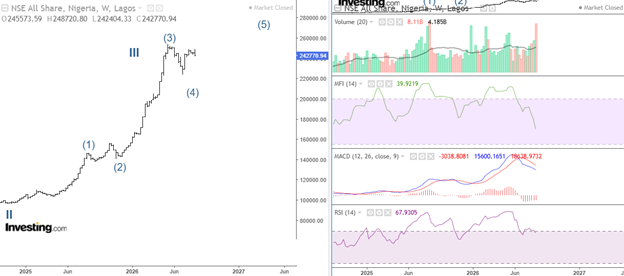
Technically, the NGX remains within a medium- to long-term bullish structure despite the recent pullback. The benchmark index has experienced four consecutive sessions of decline, signaling short-term weakness and increased profit-taking activity. However, the absence of panic selling and the continued growth in transaction volume suggest that the correction remains orderly.
The market’s ability to sustain elevated trading volume while prices decline indicates that investors are actively repositioning portfolios rather than abandoning the market. This pattern is often associated with rotational trading, where capital flows from overextended stocks into fundamentally attractive counters with stronger upside potential.
Market breadth remains significantly negative, confirming that sellers currently maintain control of short-term market direction. Nevertheless, the resilience of trading value and turnover suggests that institutional investors continue to accumulate selected stocks beneath the surface.
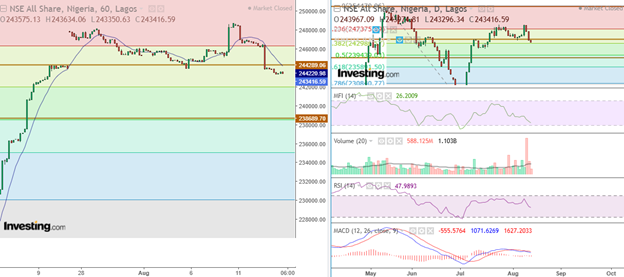
The decline in several large-cap counters has also pushed the market closer to important technical support levels. Should these levels hold, bargain hunters may gradually return to the market, providing the catalyst for a rebound. Conversely, a sustained break below support could extend the corrective phase in the near term.
The banking sector remains one of the strongest pillars supporting the market’s medium-term outlook. Strong earnings expectations, ongoing recapitalization initiatives and attractive dividend prospects continue to make the sector a preferred destination for investors seeking both growth and income.
The industrial goods and energy sectors are also expected to attract attention due to their strategic importance within the economy and their potential to benefit from improved economic activity and commodity price stability.
Market Outlook
Looking ahead, market sentiment is expected to remain mixed as investors balance profit-taking activities against opportunities presented by lower valuations. The commencement of half-year earnings season could provide fresh direction, particularly if companies deliver stronger-than-expected financial results.
Investor attention will also focus on macroeconomic indicators, developments in the fixed-income market, foreign exchange trends and movements in global crude oil prices. These factors will continue to shape risk appetite and influence capital allocation decisions across asset classes.
While short-term volatility may persist, the market’s strong year-to-date performance, improving liquidity conditions and resilient corporate earnings outlook suggest that the broader bullish narrative remains intact. As a result, long-term investors may view the current weakness as an opportunity to accumulate quality stocks with strong fundamentals and attractive growth prospects.
At the close of trading, the NGX All-Share Index (ASI) fell by 0.49% to 240,802.72 points from 241,984.80 points, while market capitalization declined by N758.16 billion. The market’s year-to-date return eased to 54.74%, reflecting the impact of four consecutive sessions of profit-taking. Total volume traded increased by 23.79% to 662.96 million shares, while value traded stood at N39.98 billion across 51,143 deals. ACCESSCORP led volume turnover with 130.26 million shares, representing 19.65% of total market volume, while MTNN accounted for the highest traded value of N8.19 billion, representing 20.48% of total market turnover. JAIZBANK contributed 17.33% of total volume traded, while STERLINGNG accounted for 4.69%. ARADEL and GEREGU followed MTNN among the most actively traded stocks by value. Market breadth closed negative at 13 gainers against 51 losers, confirming the dominance of bearish sentiment. NEIMETH emerged as the day’s top gainer, while GEREGU led the laggards after losing 10.00% to close at N1,019.00, below its reference 52-week low of N1,132.50. Other major decliners included OKOMUOIL (-9.97%), REDSTAREX (-9.95%), IMG (-9.31%), TIP (-7.35%), IKEJAHOTEL (-6.01%), MAYBAKER (-5.99%), TRANSCORP (-4.65%), NGXGROUP (-4.44%), FIRSTHOLDCO (-3.97%), STANBIC (-3.08%), WEMABANK (-2.91%), ACCESSCORP (-1.88%), CONOIL (-1.41%), ZENITHBANK (-0.83%) and UBA (-0.48%), among others.