
Market Update For June 26, 2026
The Nigerian Exchange (NGX) ended the week’s final trading session in negative territory, extending its losing streak to three consecutive sessions as sustained profit-taking in blue-chip and highly capitalised stocks continued to outweigh bargain hunting across selected counters. The bearish close reflects investors’ cautious approach after the market’s remarkable rally earlier in the year, with many opting to lock in profits while awaiting fresh catalysts that could sustain the market’s upward trajectory.
Although buying interest resurfaced in a handful of insurance, healthcare and industrial stocks, it was insufficient to offset the heavy selloffs recorded in banking, consumer goods and oil and gas counters. The broad-based decline further highlights the ongoing portfolio rebalancing by institutional and retail investors ahead of the commencement of the half-year earnings season.
The market has remained under pressure in recent sessions as investors continue to reassess valuations following months of strong price appreciation. With several fundamentally sound stocks trading near record highs before the recent correction, many market participants have chosen to realise gains while keeping funds available for possible re-entry at more attractive prices.
The banking sector, which has been one of the strongest drivers of the market’s rally this year, witnessed renewed selling pressure as investors trimmed positions in some tier-one lenders. Consumer goods stocks also remained weak following declines in Dangote Sugar and Nigerian Breweries, while the oil and gas space came under pressure after ARADEL recorded the maximum daily loss.
Despite the ongoing pullback, analysts maintain that the current weakness does not necessarily signal a reversal of the broader market trend. Rather, they say it reflects a healthy correction after an extended bull-run, allowing prices to adjust while creating fresh opportunities for long-term investors seeking quality companies with resilient earnings prospects.
Trading activity also slowed compared with the previous session, suggesting that many investors adopted a cautious stance while monitoring domestic macroeconomic developments, expectations surrounding corporate earnings, and movements in global commodity prices. The reduction in turnover further indicates that although selling pressure remains dominant, panic selling is largely absent from the market.
Meanwhile, developments in the international oil market added another layer of caution to investor sentiment. Crude oil prices declined by about 3% on Friday as concerns over supply disruptions eased following increased tanker movements through the Strait of Hormuz. Brent crude settled around $72.84 per barrel, while U.S. West Texas Intermediate (WTI) traded at approximately $69.95 per barrel.
The weekly decline leaves Brent down by nearly 10%, while WTI has lost almost 9% over the same period. Market participants attributed the weakness to improving crude supply conditions, including the resumption of oil loading at Saudi Aramco’s Ras Tanura terminal after months of disruption. Analysts also cited weak demand signals from China and growing expectations of a global supply surplus despite lingering geopolitical tensions in the Middle East.
For the Nigerian market, lower crude oil prices remain a key variable to watch, given the country’s dependence on oil exports for foreign exchange earnings and fiscal revenues. While the immediate impact on equities may be limited, sustained weakness in oil prices could influence investor appetite for energy stocks and broader market sentiment over time.
Investor attention is now gradually shifting toward the release of second-quarter and half-year corporate earnings, which are expected to provide fresh direction for the market. Companies with strong earnings growth, healthy cash flows and attractive dividend prospects are likely to continue attracting institutional interest despite the recent correction. Likewise, investors will continue to monitor monetary policy developments, inflation trends, exchange rate stability and foreign portfolio flows for additional clues on market direction.
Technical Analysis and Outlook
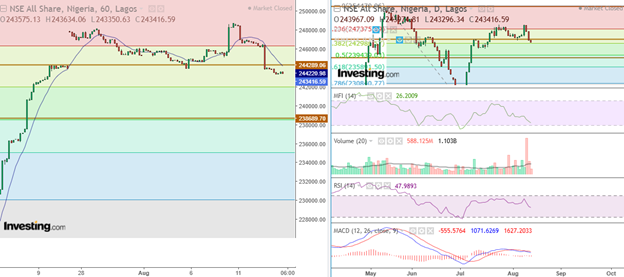
From a technical standpoint, the NGX All-Share Index remains in a corrective phase after reaching successive record highs earlier in the year. The third consecutive bearish close confirms that profit-taking remains the dominant short-term market theme, with momentum indicators showing weakening buying strength.
However, the broader market structure remains constructive as the benchmark index continues to trade comfortably above key medium- and long-term moving averages, indicating that the primary uptrend is still intact. The current retracement appears more like a healthy consolidation than the beginning of a prolonged bearish cycle.
The decline is also expected to improve market valuations, making several fundamentally sound stocks more attractive for medium- to long-term investors. Should bargain hunting intensify around current support levels, the market could witness a technical rebound in the coming sessions. Nevertheless, trading is expected to remain mixed, with profit-taking likely to persist in recently overbought stocks while fresh funds rotate into fundamentally undervalued counters.
Investors are therefore advised to maintain a selective approach by focusing on companies with strong earnings visibility, healthy dividend prospects, robust balance sheets and sustainable growth potential, while taking advantage of price corrections to gradually build long-term positions.
The NGX All-Share Index (ASI) declined by 0.66% to close at 232,049.02 points, down from 233,580.83 points recorded in the previous trading session. The decline erased approximately N982.96 billion from investors’ wealth as market capitalisation closed lower accordingly, while the market’s year-to-date return moderated to 49.12%. Market breadth remained firmly negative, with 13 gainers against 38 losers, reflecting widespread selling pressure across sectors. Trading activity weakened as total volume traded declined 1.26% to 388.69 million shares valued at N18.43 billion in 44,631 deals. Access Holdings led the volume chart with 33.22 million shares, representing 8.55% of total market volume, followed by Wema Bank with 24.33 million shares (6.26%) and DEAP Capital with 24.06 million shares (6.19%). On the value chart, ARADEL accounted for the largest turnover at N4.29 billion, representing 23.29% of total market value traded, while MTN Nigeria and GTCO followed as the second and third highest value movers.
The day’s top gainers were UNIVINSURE, which appreciated by 10.00% to close at N0.99; EUNISELL, up 9.98% to N15.65; NEIMETH, which gained 9.95% to N3.98; LEARN AFRICA, advancing 9.91% to N7.21; and OMATEK, which rose 9.52% to settle at N1.15. On the losers’ chart, ARADEL shed 10.00% to close at N597.60, while FTN Cocoa Processors lost 10.00% to N6.12 and HMCALL also declined 10.00% to N6.75. Ikeja Hotel fell 3.14% to N15.40, Dangote Sugar lost 2.86% to N46.00, while other notable laggards included GTCO (-1.62%), Nigerian Breweries (-1.09%), First HoldCo (-0.66%), Access Holdings (-0.22%), Zenith Bank (-0.04%), alongside more than 30 other declining stocks, reinforcing the broad-based weakness that characterised the session.