
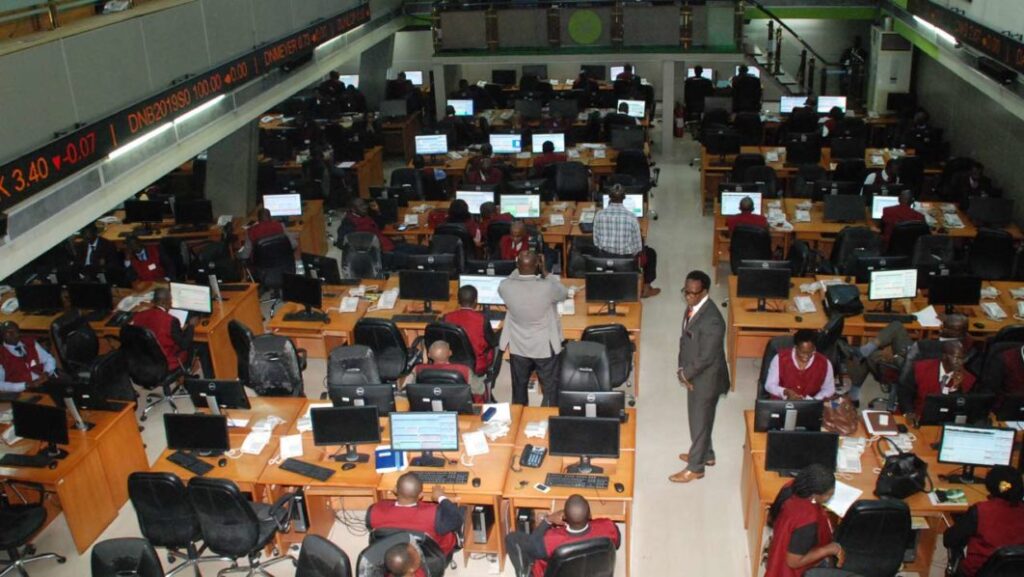
Market Update For July 2, 2026
The Nigerian Exchange (NGX) closed lower again on Thursday, July 2, as sustained profit-taking across key sectors overshadowed bargain hunting and extended the market’s corrective trend. Investors remained cautious, reducing exposure to stocks that had delivered impressive gains in the first half of the year while awaiting the commencement of the half-year earnings reporting season and possible interim dividend announcements.
The bearish mood was largely driven by continued selloffs in banking, industrial, consumer goods and oil & gas stocks, as market participants rebalanced portfolios in response to changing valuations and prevailing macroeconomic conditions. Although bargain hunters selectively accumulated fundamentally strong counters, the volume of sell orders outweighed demand, resulting in another broad-based decline in the benchmark index.
The ongoing pullback comes after the domestic equities market posted one of its strongest first-half performances in recent years, making profit-taking a natural feature of the current market cycle. Investors are also assessing the impact of elevated interest rates, persistent inflation, exchange rate stability and evolving fiscal policies on corporate earnings, while positioning ahead of second-quarter and half-year financial results.
Despite the negative close, trading activity strengthened significantly, reflecting sustained participation by institutional investors and portfolio managers. Total volume traded rose by 75.25% to 855.32 million shares, while the value of transactions settled at ₦28.37 billion across 51,545 deals. The sharp increase in market turnover suggests that while sellers maintained control of price direction, buyers also took advantage of lower prices in fundamentally attractive stocks, particularly those expected to deliver resilient earnings and dividend payouts.
Activity was concentrated in a few highly capitalised and actively traded counters. STERLINGNG maintained its dominance on the volume chart after exchanging 459.59 million shares, representing 53.73% of the total market volume. ZENITHBANK followed with 4.81%, while UNIVINSURE contributed 3.53% of total traded volume. On the value chart, ARADEL emerged as the most actively traded stock with transactions worth ₦4.51 billion, accounting for 15.90% of the day’s turnover. ZENITHBANK and MTNN ranked next in value traded, highlighting continued institutional interest in large-cap counters despite the overall market weakness.
Sector performance remained largely negative, with banking stocks accounting for a significant portion of the market decline. Investors continued to take profits in major financial institutions following months of sustained price appreciation. The industrial goods sector also witnessed notable selloffs, while oil and gas stocks remained under pressure amid the decline in global crude oil prices. Consumer goods stocks equally experienced mild weakness as investors adopted a wait-and-see approach ahead of corporate earnings releases.
The cautious market sentiment reflects investors’ preference for preserving gains while awaiting fresh catalysts capable of sustaining the market’s long-term uptrend. Nonetheless, buying interest in selected low-, medium- and large-cap stocks indicates that long-term investors remain confident in the underlying fundamentals of the domestic market, particularly companies with strong balance sheets, consistent earnings growth and attractive dividend histories.
The global oil market also weighed on sentiment during the session, with crude prices falling to their lowest levels in four months as concerns over supply disruptions eased. Brent crude declined 1.44% to $70.54 per barrel, while U.S. West Texas Intermediate (WTI) crude dropped 1.34% to $67.66 per barrel after both benchmarks touched their weakest levels since late February.
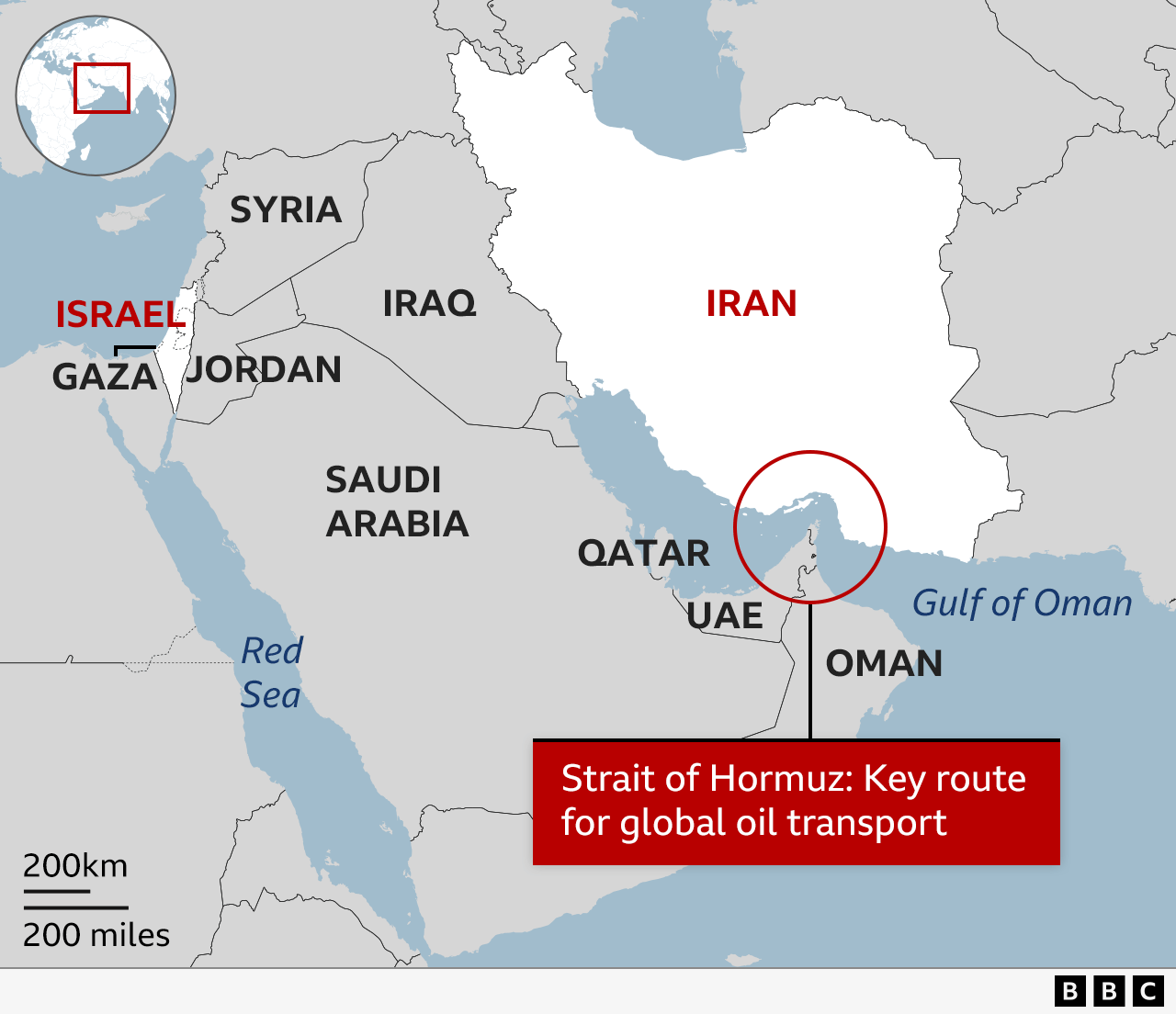
Oil prices came under pressure after Qatar, which is mediating talks between the United States and Iran, disclosed that both countries had made positive progress on issues relating to the memorandum that ended the four-month conflict in June. The development reduced fears of supply disruptions through the strategically important Strait of Hormuz, a critical route for global crude exports. Although negotiators have yet to reach a lasting peace agreement, the market interpreted the progress in discussions as reducing geopolitical risks that had previously supported higher oil prices.
Additional pressure on crude prices came from abundant global supply, continued releases from strategic petroleum reserves and sluggish demand from China, the world’s largest crude importer. Analysts noted that while oil exports through the Strait of Hormuz have remained largely uninterrupted, weaker Chinese demand and comfortable supply levels continue to weigh on market fundamentals. For Nigeria, lower oil prices could moderate government revenue expectations if the weakness persists, although increased crude production may partly offset the impact.
Technical Analysis and Outlook
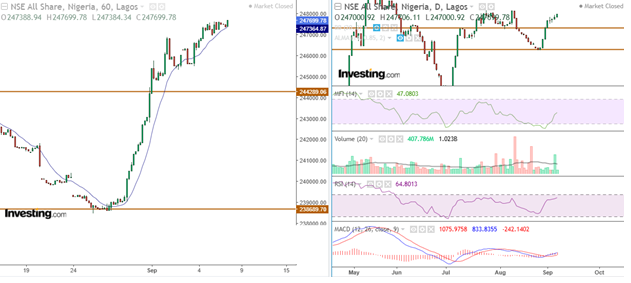
Technically, the NGX remains in a healthy correction after its remarkable first-half rally. The benchmark index has extended its pullback below the 225,000 psychological support level, confirming that profit-taking continues to dominate short-term market direction. However, the significant improvement in trading volume indicates that institutional investors are actively participating in the market and selectively accumulating quality stocks during price weakness.
The Money Flow Index and transaction pattern continue to suggest that liquidity remains within the market, even as investors rotate funds among sectors. This supports the view that the current weakness is primarily a correction rather than a reversal of the broader bullish trend.
Going forward, market sentiment is expected to remain mixed as investors digest macroeconomic data, monitor developments in the global oil market and await half-year corporate earnings. Stocks with strong fundamentals, resilient cash flows, attractive dividend yields and positive earnings outlooks are likely to attract renewed buying interest. While intermittent profit-taking may continue, bargain hunting and earnings expectations should provide support for the market in the coming weeks.
The NGX All-Share Index (ASI) declined by 0.61% to close at 224,321.97 points from 225,690.07 points, while market capitalisation shed approximately ₦877.91 billion, reflecting the broad-based selloff and trimming the market’s year-to-date return to 44.15%. Market breadth closed firmly negative with 12 gainers against 36 losers, highlighting the dominance of bearish sentiment. Market movers showed STERLINGNG as the volume leader with 459.59 million shares (53.73%), while ARADEL recorded the highest value traded at ₦4.51 billion (15.90%).
ZENITHBANK and UNIVINSURE accounted for 4.81% and 3.53% of total traded volume respectively, while ZENITHBANK and MTNN followed ARADEL in value traded. Top Gainers: AUSTINLAZ (+10.00%) to ₦2.20, ABCTRANS (+9.91%) to ₦3.66, LEARNAFRCA (+9.68%) to ₦6.80, ACADEMY (+8.67%) to ₦6.27, ETERNA (+6.73%) to ₦47.55, REGALINS (+5.88%) to ₦0.90, THOMASWY (+4.84%) to ₦2.60, DAARCOMM (+4.55%) to ₦0.69, MEYER (+4.35%) to ₦19.20, and MRS (+3.19%) to ₦245.80. Top Losers: GUINEAINS (-10.00%) to ₦0.81, TIP (-9.79%) to ₦11.06, NEM (-9.25%) to ₦16.20, FCMB (-8.59%) to ₦11.70, FIRSTHOLDCO (-8.22%) to ₦34.05, OANDO (-7.01%) to ₦62.95, WAPCO (-6.45%) to ₦95.00, STERLINGNG (-3.87%) to ₦8.20, ZENITHBANK (-3.52%) to ₦71.25, and TRANSCORP (-1.68%) to ₦68.70.