

Quarter Under Review: -Half Year 2026
Current Share Price: N2,840
Latest Final Dividend: Nil
Latest Interim Dividend: Nil
Estimated Beta Value: 0.23x
Estimated Fair Value: N2,630
Analyst: Jeariogbe Tunde Segun
The Company
Nestlé Nigeria Plc traces its roots in Nigeria to the early 20th century, when Nestlé products were first sold through local importers who sourced them from British trading companies. Distribution became more organized from the 1920s, and in 1961, shortly after Nigeria gained independence, Nestlé Products (Nigeria) Limited was formally established as a locally based subsidiary of the Nestle Group. The company initially focused largely on the importation, distribution and sale of Nestle products, but gradually expanded into local manufacturing as demand for its products increased.
A major milestone came in 1982, when Nestlé commissioned its first major manufacturing plant at Agbara, Ogun State, after commencing production of products such as MAGGI, MILO and CERELAC in the preceding years. The Agbara facility subsequently developed into a major manufacturing complex, while the company expanded with the Flowergate factory in 2011 and the Abaji factory in 2016.
Nestlé Nigeria was listed on the Nigerian Stock Exchange on April 20, 1979, and has since grown into one of Nigeria’s leading food and beverage companies, producing and marketing well-known Afore-mentioned as weel as GOLDEN MORN, NESCAFE and NESTLE PURE LIFE.
Statement of Comprehensive Income
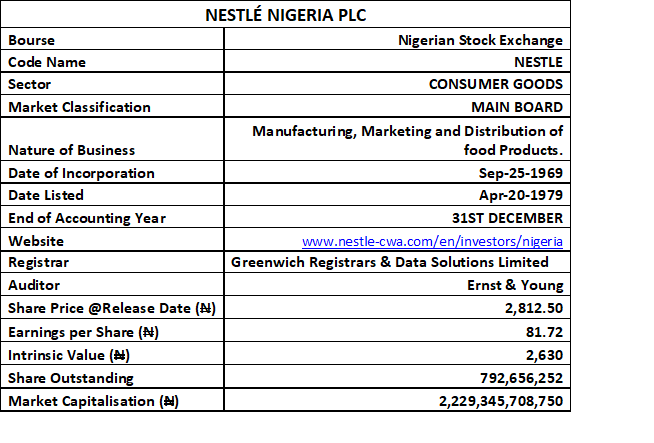
Nestlé Nigeria Plc delivered a strong top-line performance in the first half of 2026, with turnover rising by 12.0% to ₦650.76 billion, from ₦581.12 billion in H1 2025. Cost of sales increased by only 10.1%, slower than revenue growth, resulting in an improved gross margin of approximately 39.7%, compared with 38.7% in the previous year. Operating profit, however, increased by a more modest 8.4% to ₦141.36 billion, as operating expenses surged by 23.8% to ₦117.79 billion. This suggests that while the company is successfully growing sales and maintaining some gross-margin improvement, rising operating costs remain an important concern for investors.
The most encouraging feature of the result is the substantial improvement below the operating line. Net finance cost improved from ₦42.05 billion to ₦14.60 billion, a reduction of about 65.3%, helping profit before tax to jump by 43.4% to ₦126.77 billion. Profit after tax consequently increased by 28.1% to ₦64.78 billion, compared with ₦50.57 billion in H1 2025. The PAT margin consequently improved from approximately 8.7% to 10.0%. This represents a significant recovery in profitability and is consistent with Nestlé Nigeria’s broader return to sustained profitability following the severe foreign-exchange-related losses experienced in earlier periods. The company has now reported its seventh consecutive profitable quarter.
Investment view: POSITIVE, BUT WITH COST-MANAGEMENT WATCH. The H1 2026 numbers indicate that Nestlé Nigeria is moving in the right direction: revenue is growing, gross margin is improving, finance pressures have reduced substantially and earnings are recovering strongly. The major weakness is the 23.8% increase in operating expenses, which is considerably higher than the 12% growth in revenue and has constrained operating-profit growth. For a long-term investor, the company’s strong brands, market position and improving profitability remain attractive qualities, but we strictly recommend cautious move for short term positions.
Statement of Financial Position
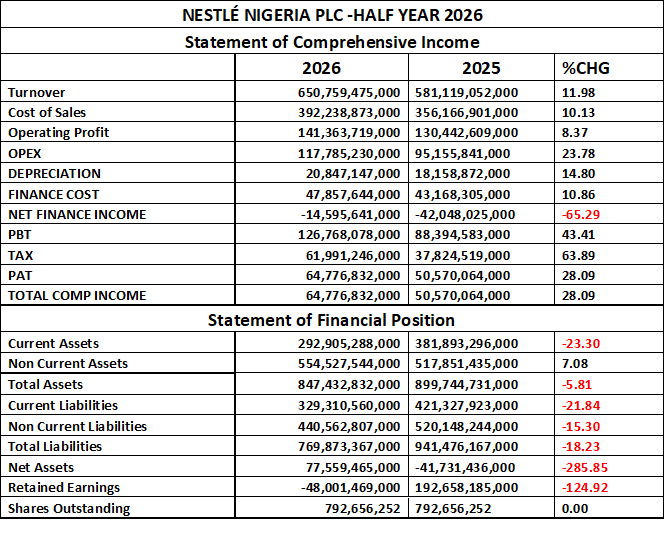
Nestlé Nigeria’s H1 2026 financial position shows a significant improvement in its balance-sheet structure, particularly on the liability side. Total liabilities declined by 18.23% to ₦769.87 billion, from ₦941.48 billion in the comparable period, while current liabilities fell by 21.84% and non-current liabilities by 15.30%. This reduction is positive for investors as it indicates a meaningful deleveraging of the balance sheet and should, over time, reduce financial pressure. However, total assets also declined by 5.81% to ₦847.43 billion, largely reflecting the 23.30% reduction in current assets to ₦292.91 billion. Consequently, the company’s current assets remain below current liabilities, giving an approximate current ratio of 0.89x, which points to relatively tight short-term liquidity.
The most important positive development is the movement from negative net assets in the comparable period to positive net assets of ₦77.56 billionin H1 2026. This represents a substantial balance-sheet recovery, although retained earnings remain negative at ₦48.00 billion, indicating that the company has not completely eliminated the accumulated impact of previous losses.
For investors, the combination of stronger profit reported in H1 2026 and a much lower liability position is encouraging; Nestlé Nigeria’s official financial information also shows a continuing improvement in its equity position during 2026.
Investment view: POSITIVE/RECOVERY, but with caution. The key issues to monitor are liquidity, the pace at which accumulated losses are eliminated, further reduction in borrowings and whether improved earnings translate into stronger shareholders’ equity and sustainable cash generation. The balance sheet is clearly healthier than the comparable period, but the relatively low liquidity ratio means investors should not ignore financial-risk indicators when determining an appropriate entry price.
Financial Strength/Solvency Ratio
Nestle Nigeria’s H1 2026 solvency position shows a significant improvement, although financial leverage remains high. The debt ratio declined from 104.64% in 2025 to 90.85%, indicating that liabilities now represent a smaller proportion of the company’s asset base. More importantly, the company moved from negative equity in 2025 to positive equity of 9.15%, while the debt-to-equity ratio improved from -22.56x to 9.93x. Although 9.93x remains very high and indicates substantial leverage relative to shareholders’ funds, the direction of change is encouraging. This improvement is consistent with Nestlé Nigeria’s reported recovery in its balance sheet and profitability.
From an investment perspective, the key message is that Nestlé Nigeria is moving from a financially stressed position toward balance-sheet recovery, but it has not yet reached a comfortable solvency level. The low 9.15% equity ratio means that only a relatively small portion of assets is financed by shareholders’ equity, leaving the company exposed to financing and interest-rate risks. On the positive side, the beta of 0.23 suggests relatively low historical sensitivity to overall market movements, which can be attractive to investors seeking lower market volatility. Overall, the solvency assessment is IMPROVING/CAUTIOUSLY POSITIVE: investors can take encouragement from the substantial recovery in equity and reduction in the debt ratio, but should continue monitoring leverage, finance costs, retained earnings and cash generation before assigning a strong BUY rating.

Profitability Ratios
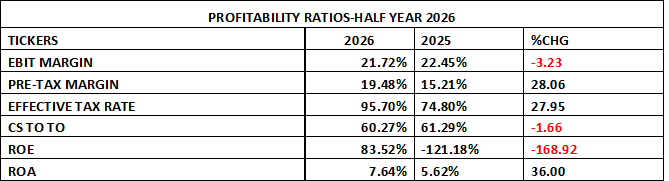
Nestlé Nigeria’s H1 2026 profitability indicators present a mixed but generally improving earnings picture. EBIT margin declined marginally from 22.45% to 21.72%, suggesting that operating profitability remains strong but has come under some pressure from rising operating expenses. However, pre-tax margin improved significantly from 15.21% to 19.48%, reflecting the sharp reduction in net finance costs reported in the period. The cost of sales-to-turnover ratio also improved slightly from 61.29% to 60.27%, indicating better gross-cost efficiency. Most importantly, ROA increased from 5.62% to 7.64%, showing that the company generated more profit from its asset base. This is consistent with the company’s H1 2026 result, in which profit after tax rose by 28% to ₦64.78 billion.
The most striking indicator is ROE of 83.52%, compared with -121.18% in 2025. While this represents a dramatic turnaround, investors should interpret the figure cautiously because Nestlé Nigeria’s shareholders’ equity remains relatively small following the previous period of negative equity. Therefore, a high ROE is partly amplified by the low equity base and should not be interpreted on its own as exceptionally high underlying efficiency. The effective tax rate of 95.70% is also unusually high and warrants close monitoring because it significantly reduces the amount of pre-tax profit available to shareholders. Overall, the profitability assessment is POSITIVE WITH CAUTION: improving ROA, pre-tax margin and earnings indicate a strong recovery, while the slight decline in EBIT margin, very high effective tax rate and elevated ROE caused by a thin equity base remain important risks. For investment purposes, the next key confirmation should be whether Nestlé can sustain earnings growth while rebuilding shareholders’ equity and controlling operating costs.
Efficiency Ratios
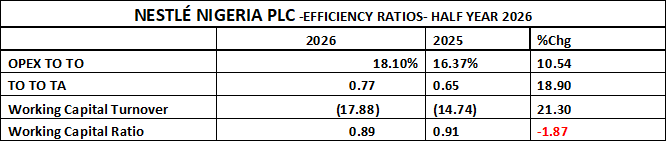
Nestlé Nigeria’s H1 2026 efficiency ratios present a mixed picture, with asset utilization improving but cost efficiency weakening. The OPEX-to-turnover ratio increased from 16.37% to 18.10%, indicating that operating expenses are consuming a larger proportion of revenue. This is a concern because operating expenses grew faster than turnover, potentially limiting further expansion in operating margins. However, turnover-to-total-assets improved from 0.65x to 0.77x, suggesting that the company is generating more revenue from each naira invested in its asset base. This improvement is consistent with the strong 12% revenue growth recorded in H1 2026.
The working-capital ratio declined marginally from 0.91x to 0.89x, remaining below the 1.0x benchmark and indicating that current assets are still insufficient to fully cover current liabilities. The negative working-capital turnover figures should also be interpreted cautiously because they reflect the company’s negative working-capital position rather than poor sales generation alone. Overall, the efficiency assessment is CAUTIOUSLY POSITIVE: stronger asset utilization is encouraging for investors, but the rising OPEX burden and sub-1.0x working-capital ratio remain important risks. Management’s ability to control operating costs, improve liquidity and sustain higher asset productivity will be critical in determining whether the current earnings recovery can translate into stronger long-term shareholder value. Nestle Nigeria’s reported H1 results confirm that profitability and the balance sheet are recovering, but cost and liquidity discipline remain key investment considerations.
Investment/Valuation Ratios
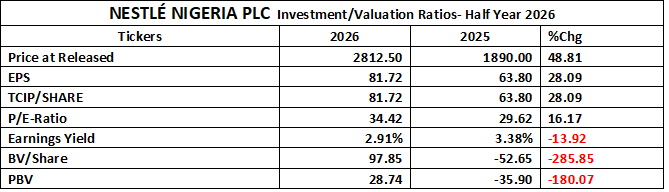
Nestlé Nigeria’s H1 2026 valuation indicators reflect a strong earnings recovery that is already substantially recognized in the share price. At the reported price of ₦2,812.50, EPS increased by 28.09% to ₦81.72, in line with the company’s reported 28% growth in profit after tax. However, the share trades at a relatively high P/E ratio of 34.42x, up from 29.62x, indicating that investors are paying a significant premium for each naira of current earnings. The corresponding earnings yield has fallen from 3.38% to 2.91%, which reinforces the view that the stock is relatively expensive on current earnings. While the earnings momentum is encouraging, the valuation suggests that considerable future growth is already reflected in the market price.
The book value per share has recovered from negative ₦52.65 to positive ₦97.85, while PBV has moved to a very high 28.74x, reflecting the sharp restoration of shareholders’ equity from the previously distressed position. This is a major fundamental improvement, but it also means the stock is trading far above its accounting net asset value. From an investment perspective, therefore, Nestlé Nigeria is fundamentally recovering but valuation is demanding. The appropriate stance is HOLD/ACCUMULATE ON PRICE WEAKNESS, rather than an aggressive BUY at ₦2,812.50. Investors who already hold the stock may retain their positions to benefit from the earnings recovery, while prospective investors should preferably seek a more attractive entry price or stronger future EPS growth to justify the current 34.42x P/E. The company’s improving profitability and balance sheet support the long-term case, but valuation discipline remains critical.
Intrinsic value
Based on the H1 2026 results, Nestlé Nigeria recorded EPS of ₦81.72, representing a 28.1% year-on-year increase. Annualizing the H1 EPS gives approximately ₦163.44, but using the annualized figure without adjustment would be too aggressive because part of the earnings recovery has been supported by the sharp reduction in net finance costs. A normalized EPS range of approximately ₦145–₦155 is therefore considered more appropriate for valuation purposes. Applying a reasonable P/E multiple of 18–20x to normalized earnings produces an intrinsic-value range of approximately ₦2,610–₦3,100 per share, with a central fair value of about ₦2,630 per share. This approach recognizes both the company’s strong earnings recovery and the continuing balance-sheet risks. The H1 results confirm revenue of ₦650.76 billion, PAT of ₦64.78 billion and EPS of ₦81.72.
Final Investment Verdict
Nestlé Nigeria Plc’s H1 2026 performance indicates a substantial fundamental recovery. Revenue increased by 12% to ₦650.76 billion, while profit after tax rose by 28% to ₦64.78 billion and EPS increased to ₦81.72. The balance sheet also improved materially, with net assets returning to positive territory and total liabilities declining by 18.23%. The major concerns remain the relatively weak 0.89x working-capital ratio, high 9.93x debt-to-equity ratio, elevated operating expenses and the fact that the recovery in shareholders’ equity is still at an early stage.
At a market price of ₦2,812.50, the shares trade on approximately 34.42x earnings, giving an earnings yield of only about 2.91%. Although earnings are growing strongly, this valuation already reflects a considerable portion of the expected recovery. As noted above, on a normalized earnings and reasonable valuation-multiple basis, an estimated intrinsic-value range of approximately ₦2,600–₦3,100 per share, with a central fair value around ₦2,630, appears reasonable. Consequently, the stock is assessed as HOLD, rather than BUY or SELL. A stronger BUY case would require either a significant improvement in sustainable earnings, further balance-sheet strengthening, or a more attractive market entry price. In other words, our final rating for Nestlé Nigeria is HOLD.