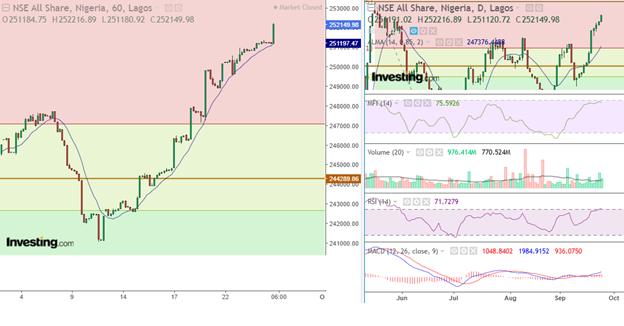


Period Under Preview: HALF YEAR 30TH JUNE, 2026
Current Share Price: N110:00
Price At Release Date: N105:00
Latest Final Dividend: NIL
Latest Interim Dividend: NIL
Estimated Beta Value: 0.99x
Estimated Intrinsic Value: N98.70
Rating: BUY/ACCUMULATE ON PRICE WEAKNESS
Analyst: Jeariogbe Tunde Segun
The Company
First HoldCo Plc, formerly known as FBN Holdings Plc, is a Nigerian financial holding company that emerged from the reorganization of the FirstBank Group. The company was incorporated in Nigeria on 14 October 2010 as part of a strategic move to separate the commercial banking business from the Group’s other financial services activities and create a diversified financial-services holding structure. The reorganization was designed to preserve the strength of the FirstBank franchise while enabling the group to expand beyond traditional commercial banking into areas such as investment banking, asset management, insurance and other financial services.
Following its incorporation, the company was listed on the Nigerian Stock Exchange (now Nigerian Exchange Limited) on 26 November 2012 under the Other Financial Services sector. Through its holding-company structure, First HoldCo has developed a diversified portfolio spanning commercial banking, asset management, capital markets, securities, trusteeship and insurance brokerage. Its flagship banking subsidiary, FirstBank, has remained the core of the Group’s operations, while the broader structure has enabled the organization to provide a wider range of financial products and services across Nigeria and international markets. The Group continues to leverage its long history, extensive customer base and diversified business model to pursue growth and create long-term value for shareholders and other stakeholders.
Statement of Comprehensive Income
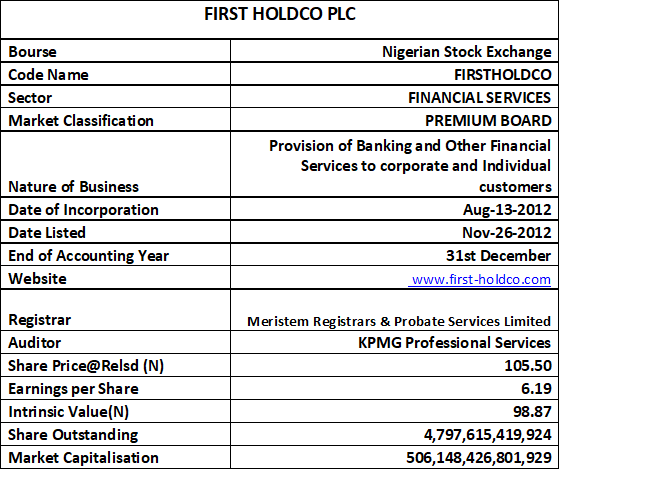
First HoldCo Plc delivered a strong financial performance in the first half of 2026, with Gross Earnings rising by 16.58% to ₦1.931 trillion, compared with ₦1.657 trillion in the corresponding period of 2025. Interest income increased modestly by 2.74% to ₦1.398 trillion, while interest expenses declined by 2.56% to ₦518.924 billion. Despite the increase in gross earnings, Net Interest Income declined by 2.84% to ₦879.126 billion, suggesting that the benefit of higher interest income was partly offset by pressure on the Group’s interest spread and other funding costs.
The Group’s operating cost profile showed some pressure during the period. Operating expenses (OPEX) increased by 9.17% from ₦517.367 billion to ₦564.810 billion, while depreciation rose significantly by 22.06% to ₦43.283 billion. Nevertheless, the Group achieved a substantial improvement in Profit Before Tax (PBT), which increased by 83.50% from ₦356.149 billion in H1 2025 to ₦653.536 billion in H1 2026. Profit After Tax (PAT) also rose strongly by 81.57%, from ₦289.772 billion to ₦526.130 billion, indicating significant improvement in overall profitability despite the higher operating cost base.
A particularly notable feature of the results is the exceptional increase in Total Comprehensive Income, which rose from ₦24.820 billion in H1 2025 to ₦281.374 billion in H1 2026, representing an increase of approximately 1,033.66%. Overall, the results point to a significantly stronger earnings and profitability position for First HoldCo in H1 2026. The combination of 16.58% growth in Gross Earnings, 83.50% growth in PBT and 81.57% growth in PAT reflects substantial improvement in the Group’s bottom-line performance. However, the decline in Net Interest Income and 9.17% increase in OPEX remain areas that require monitoring, as sustained growth in profitability will depend on the Group’s ability to improve operating efficiency and maintain healthy margins.
Statement of Financial Position
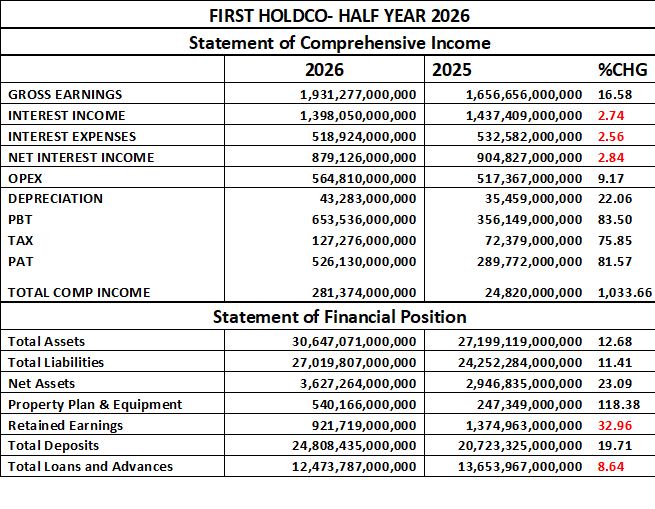
First HoldCo Plc’s statement of financial position reflects a significant expansion in the size of the Group’s balance sheet. Total assets increased by 12.68%, from ₦27.199 trillion at the end of the 2025 full-year to ₦30.647 trillion in 2026, while total liabilities rose by 11.41%, from ₦24.252 trillion to ₦27.020 trillion. Consequently, net assets improved by 23.09%, rising from ₦2.947 trillion to ₦3.627 trillion. This stronger growth in net assets relative to liabilities indicates an improvement in the Group’s overall equity position and provides a stronger capital base to support its operations.
A notable development is the substantial increase in Property, Plant and Equipment (PPE), which grew by 118.38%, from ₦247.349 billion to ₦540.166 billion. This may indicate significant investment in infrastructure, technology, banking facilities or other long-term operating assets. However, retained earnings declined by 32.96%, from ₦1.375 trillion to ₦921.719 billion, despite the Group’s strong profit performance. This reduction warrants attention, as it could reflect dividend distributions, transfers or other equity adjustments during the period. The decline in retained earnings therefore represents an area requiring further examination when assessing the quality and sustainability of the Group’s capital growth.
The Group’s total deposits increased by 19.71%, from ₦20.723 trillion to ₦24.808 trillion, demonstrating a strong growth in its deposit funding base and potentially strengthening its liquidity position. However, total loans and advances declined by 8.64%, from ₦13.654 trillion to ₦12.474 trillion. This combination of rising deposits and declining loans suggests a more conservative lending position and could indicate increased liquidity or reduced credit-risk appetite. Based on these figures, the loan-to-deposit ratio fell from approximately 65.88% in 2025 to 50.28% in 2026, which is positive from a liquidity and risk perspective but may also indicate that the Group is not fully deploying its growing deposit base into interest-earning loans. Overall, the balance sheet remains financially stronger in terms of assets, deposits and net assets, although the decline in loans and retained earnings should be closely monitored.
Financial Strength/Solvency Ratio
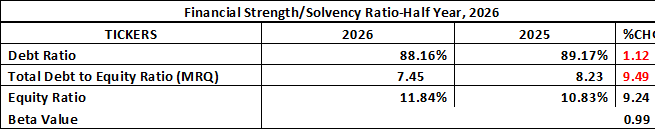
First HoldCo Plc’s financial strength improved moderately in H1 2026. The Debt Ratio declined from 89.17% to 88.16%, while the Equity Ratio increased from 10.83% to 11.84%, indicating a modest strengthening of the Group’s capital position and a reduced dependence on liabilities to finance its assets. More significantly, the Total Debt-to-Equity Ratio improved from 8.23x to 7.45x, suggesting that the Group’s leverage position has reduced. Although the balance sheet remains highly leveraged, as is common for financial institutions with substantial deposit liabilities, the direction of movement in these ratios is positive from an investment perspective.
The Group’s Beta of 0.99 indicates that the stock’s systematic market risk is broadly in line with the overall market, implying neither significantly higher nor lower sensitivity to general market movements. From an investment standpoint, the combination of lower leverage, improved equity ratio and reduced debt-to-equity ratio provides a positive signal regarding financial resilience and solvency. However, the 88.16% debt ratio and 7.45x debt-to-equity ratio remain relatively high, meaning investors should continue to monitor capital adequacy, asset quality and the Group’s ability to manage its large liability base. Overall, the solvency trend is moderately positive, supporting a favorable long-term investment outlook, provided the improvement in capital strength is sustained alongside profitability and asset-quality improvements.
Profitability Ratios
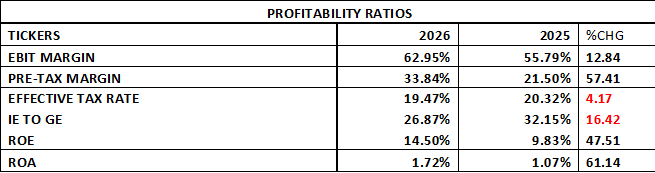
First HoldCo Plc’s profitability in H1 2026 was significantly stronger than the corresponding period of 2025. The EBIT margin improved from 55.79% to 62.95%, representing a 12.84% increase, while the Pre-Tax Margin rose sharply from 21.50% to 33.84%, an improvement of 57.41%. These movements indicate that the Group was able to convert a greater proportion of its gross earnings into operating and pre-tax profits. For an investor, the strong expansion in pre-tax profitability is particularly encouraging, as it demonstrates improved earnings quality and stronger profit generation from the Group’s core operations.
The Effective Tax Rate declined marginally from 20.32% to 19.47%, while the Interest Expense-to-Gross Earnings ratio fell from 32.15% to 26.87%. The lower IE-to-GE ratio is a positive development, indicating that interest expenses consumed a smaller proportion of gross earnings in H1 2026 and thereby provided greater support for profitability. The improvement in interest-cost efficiency is particularly relevant given the Group’s large deposit-funded balance sheet. Together with the higher EBIT and pre-tax margins, these indicators suggest that First HoldCo’s underlying earnings capacity improved during the period.
The returns to shareholders and asset utilization also improved materially. ROE increased from 9.83% in 2025 to 14.50% in 2026, representing a 47.51% improvement, while ROA rose from 1.07% to 1.72%, an increase of 61.14%. This indicates that the Group generated substantially higher returns from both shareholders’ equity and its asset base.
From an investment perspective, the overall profitability picture is strongly positive, with expanding margins, better interest-cost efficiency and significant improvements in ROE and ROA. If sustained, this trend should support stronger shareholder value creation and provide a favorable fundamental outlook for First HoldCo Plc, although investors should continue to monitor asset quality, operating costs and the sustainability of earnings growth.
Efficiency Ratio
First HoldCo Plc’s efficiency ratios show a positive improvement in operating efficiency in H1 2026. The OPEX-to-Gross Earnings ratio declined from 31.23% in 2025 to 29.25% in 2026, indicating that the Group spent a smaller proportion of its gross earnings on operating expenses. This is favorable from an investment perspective, as it suggests improved cost control and stronger operating leverage. At the same time, Gross Earnings-to-Total Assets increased from 6.09% to 6.30%, indicating a modest improvement in the Group’s ability to generate earnings from its asset base. Together, these movements suggest that the Group’s growing asset base is being utilized slightly more efficiently while operating costs are becoming less burdensome relative to earnings.
The Loan-to-Deposit Ratio (LDR) declined significantly from 65.89% to 50.28%, reflecting the substantial growth in deposits relative to loans and advances. This is positive from a liquidity and risk-management perspective, as it provides the Group with a stronger liquidity buffer and reduces pressure from aggressive loan deployment. However, from an earnings perspective, the lower LDR may indicate that a significant portion of the deposit base is not being deployed into interest-earning loans, potentially limiting future net interest income if the trend persists. Overall, the efficiency position is moderately positive for investors, with improved cost efficiency and asset productivity, while the sharp decline in LDR remains an area to monitor. The key investment question is whether First HoldCo can progressively deploy its strong deposit growth into quality, profitable loans without triggering a deterioration in asset quality or the NPL ratio.
Investment /Valuation Ratio
The investment and valuation metrics for FirstHoldCo show a significant improvement in earnings performance during the half-year of 2026. Earnings per share (EPS) increased by 81.57% from 6.37 in 2025 to 11.57 in 2026, indicating a strong expansion in earnings attributable to shareholders. Similarly, total comprehensive income per share (TCIP/share) rose sharply from 0.55 to 6.19, representing a 1,033.66% increase. This substantial growth, alongside the earlier reported improvement in profitability, suggests that the company has strengthened its capacity to generate shareholder value and may be benefiting from improved operating and financial performance.
From a valuation perspective, the P/E ratio increased from 1.37x to 2.28x, while the earnings yield declined from 18.26% to 10.97%. Although the higher P/E indicates that the market is assigning a greater valuation multiple to the company’s earnings, the ratio of 2.28x remains relatively low in absolute terms and could suggest that the shares are still conservatively valued relative to earnings, though this is subject to comparison with industry peers and the prevailing market price. The decline in earnings yield, however, reflects the significant rise in the company’s valuation relative to its earnings and should be monitored by investors when assessing future upside potential.
The book value per share also increased by 23.09%, from 64.80 to 79.76, demonstrating growth in the underlying net asset value attributable to each share. However, the price-to-book value (PBV) rose sharply from 0.54x to 1.32x, meaning the market price has moved from a substantial discount to book value to a premium of approximately 32% over book value. Overall, the valuation picture is fundamentally positive but warrants greater selectivity: strong EPS growth, rising book value and improved profitability are attractive investment signals, while the higher P/E and PBV and lower earnings yield indicate that some of the company’s improved performance may already be reflected in its market valuation. For investment purposes, FirstHoldCo appears fundamentally stronger and potentially attractive for a long-term investor, but the decision to BUY or HOLD should ultimately be supported by its current market price, dividend prospects, asset quality, capital position and intrinsic value estimate.
Final Verdict
Based on the overall analysis of FirstHoldCo’s half-year 2026 performance, I would rate the company 8/10 for investment attractiveness. The investment case is supported by strong earnings momentum, with EPS rising 81.57% to ₦11.57, PBT increasing substantially, ROE improving from 9.83% to 14.50%, and ROA rising from 1.07% to 1.72%. The balance sheet also strengthened, with total assets and net assets growing, while the debt ratio declined from 89.17% to 88.16% and the equity ratio improved from 10.83% to 11.84%. The improvement in the cost-efficiency ratio and the decline in the loan-to-deposit ratio to 50.28% also provide some comfort on operational efficiency and liquidity management.
From a valuation perspective, the 2.28x P/E ratio remains relatively low, while the ₦79.76 book value per share provides a meaningful asset backing. However, the PBV has risen to 1.32x from 0.54x, indicating that the market is now valuing the shares above book value, while the earnings yield has fallen to 10.97%. This suggests that the stock has become more expensive relative to its previous valuation, although the premium may be justified if the current earnings growth is sustainable. I would therefore recommend BUY/ACCUMULATE, particularly for investors with a medium-to long-term horizon, but with a preference for accumulating on price weakness rather than chasing a sharp price rally.
Key risks to monitor include the company’s still-high leverage, the relatively low equity cushion, asset quality and non-performing loans, sustainability of the exceptionally strong earnings growth, and whether the improved ROE can be maintained. Investors should also monitor dividend capacity and the company’s ability to translate earnings growth into consistent cash returns. Overall, First HoldCo presents a favorable risk-reward profile based on the available figures, with strong earnings momentum and improving fundamentals outweighing the valuation concerns at this stage. My recommendation is therefore: BUY/ACCUMULATE ON PRICE WEAKNESS.