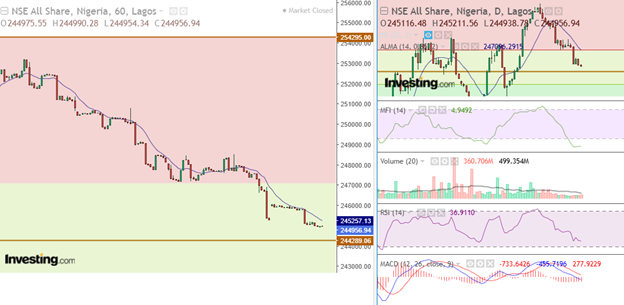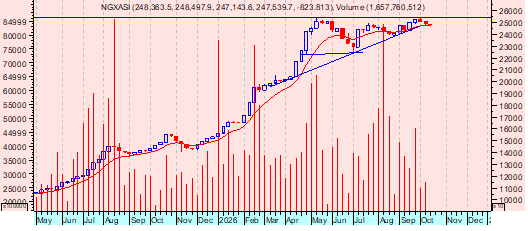


The Nigerian Exchange extended its upward trend for the second consecutive week, as renewed buying interests in selected heavyweight stocks and portfolio reshuffling ahead of the country’s consumer price index reports for the month of August. Investors also continue to position ahead of the planned readmission of Nigerian stock market into FTSE Russell’s frontier index, the mere announcement of which changed the momentum, lifting the NGX’s benchmark All-Share Index (ASI) by 2.36% to 246,992.44 basis points, after testing 247,562.30 points in the week under review. Market capitalisation rose 2.40% to ₦159.56 trillion, while the year-to-date return climbed to 58.72%, after what turned out a bullish week of four trading sessions of up market and one of day of flat market as a result of profit taking. Below is the index action for the period.
NGXASI Daily Index Action
The weekly turnover increased sharply, with investors trading 4.360 billion shares valued at ₦210.331 billion in 223,284 deals, compared with 2.507 billion shares worth ₦123.223 billion in 173,561 deals in the previous week. The Financial Services sector remained the most active, recording 3.580 billion shares worth ₦88.635 billion in 99,488 deals. It accounted for 82.10% of total equity turnover volume and 42.14% of turnover value. Consumer Goods followed with 188.039 million shares valued at ₦15.343 billion in 24,518 deals, while Services recorded 142.292 million shares worth ₦2.020 billion in 14,007 deals. At the stock level, Fortis Global Insurance, UBA and Access Holdings accounted for a combined 2.287 billion shares valued at ₦35.232 billion across 20,975 deals. The three equities represented 52.46% of total equity turnover volume and 16.75% of turnover value.
Market breadth improved week-on-week, with 56 equities gained while 35 stocks declined. Unchanged stocks also stood at 56. Most major indices closed higher, although the NGX Industrial Goods Index and NGX Sovereign Bond Index declined by 0.35% and 0.36%, respectively.
Week-to-date, NGX 30 was up by 2.42%, the Banking Index has increased by 3.58%, the Pension Index increased by 3.66%, the Insurance Index inclined by 3.85%, the Consumer Goods Index increased by 3.52%. However, the Oil and Gas Index recorded a positive return of 9.10%. Year-to-date, the All-Share Index has gained 58.72%, NGX 30 is up by 60.02%, the Banking Index has increased by 73.90%, the Pension Index increased by 81.77%, the Insurance Index declined by 5.74%, the Consumer Goods Index increase by 4.50%. However, the Oil and Gas Index recorded a positive return of 111.86%.
Trading for the week opened on a strong note, with the composite ASI gaining 1.20% to 244,199.39 points. Market capitalisation gained ₦1.91 trillion, while 43 stocks advanced against 16 decliners. IKEJAHOTEL led gainers with a 9.95% increase, while TOTAL recorded the biggest decline. Trading volume rose marginally to 606.19 million shares worth ₦38.70 billion in 53,471 deals. ACCESSCORP led volume with 126.54 million shares, while MTNN recorded the highest traded value at ₦5.72 billion.
On Tuesday, the ASI added 0.77% to close at 246,082.63 points, pushing market capitalisation up by ₦1.22 trillion and YTD return to 58.14%. FTNCOCOA topped the gainers, while TRIPPLEG posted the largest decline. Market breadth remained positive at 40 gainers against 19 losers. Volume increased 7.44% to 651.32 million shares valued at ₦40.77 billion in 43,760 deals. ACCESSCORP again led volume with 129.89 million shares, while MTNN topped traded value at ₦4.69 billion.
At midweek, the market paused as the ASI slipped 0.03% to 246,019.17 points, ending a four-session winning streak to remain above the 246,000 psychological line. Market capitalisation fell by ₦40.99 billion, while YTD return eased to 58.10%. NASCON declined 10.00% to lead decliners, while TRIPPLEG topped the gainers. Breadth remained positive at 34 gainers against 29 losers. Volume dropped 34.47% to 426.84 million shares worth ₦28.44 billion, with ACCESSCORP leading volume and ARADEL recording the highest traded value at ₦4.14 billion.
The market recovered on Thursday, after gaining 0.15%, despite the negative market internal of 22 gainers against 33 losers. Investors traded 434.02 million shares worth ₦29.30 billion in 42,303 deals. SEPLAT gained 10.00%, lifting the Oil & Gas Index by 2.22%, while the Banking Index declined 0.27%. UBA led volume with 113.26 million shares valued at ₦5.23 billion. Among the recently identified FTSE Russell large-cap eligible stocks, ARADEL fell 5.84%, while Zenith Bank, MTNN and FirstHoldCo recorded modest gains.
The last trading session of the week closed positively, with NGXASI gaining 0.25% to 246,992.44 points. Market capitalisation increased by ₦405.67 billion, while YTD return rose to 58.72%. NB advanced 9.93% to lead major gainers, while REDSTAREX and HMCALL recorded the largest declines. Market breadth remained negative at 29 gainers and 31 losers. Trading activity surged, with volume jumping 416.66% to 2.24 billion shares worth ₦73.41 billion in 42,709 deals. FTGINSURE accounted for 1.45 billion shares, while SEPLAT led traded value at ₦32.24 billion.
Royal Exchange Plc
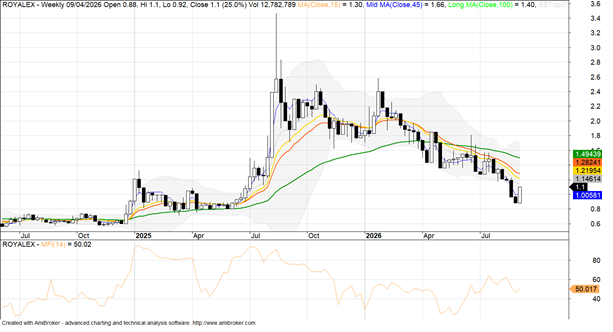
Royal Exchange Plc led the gainers, as its share price rose from ₦0.88 to ₦1.10, a gain of ₦0.22 or 25.00%. Champion Breweries Plc advanced from ₦9.95 to ₦11.95, gaining ₦2.00 or 20.10%, while Nigerian Breweries Plc grew from ₦69.40 to ₦82.45, up ₦13.05 or 18.80%. The share –price of Coronation Insurance Plc increased from ₦2.05 to ₦2.40, gaining ₦0.35 or 17.07%, while McNichols Consolidated Plc moved from ₦4.50 to ₦5.25, up ₦0.75 or 16.67%.
BetaGlass Plc
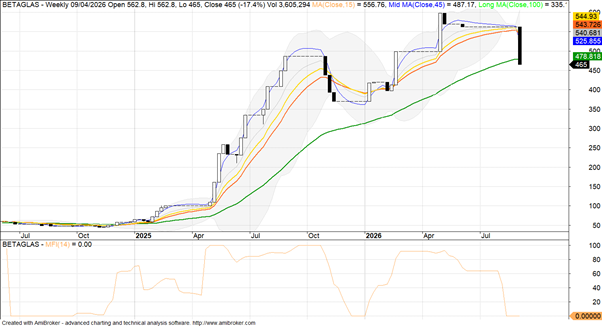
On the decliners’ table, Beta Glass Plc recorded the most significant loss, falling from ₦562.80 to ₦465.00, a ₦97.80 or 17.38% fall. Nascon Allied Industries Plc declined from ₦195.00 to ₦164.00, shedding ₦31.00 or 15.90%. Red Star Express Plc dropped from ₦16.15 to ₦13.95, a loss of ₦2.20 or 13.62%, while R.T. Briscoe (Nigeria) Plc fell from ₦11.40 to ₦9.90, down ₦1.50 or 13.16%. University Press Plc declined from ₦5.70 to ₦5.00, representing a loss of ₦0.70 or 12.28%.
NGX Weekly Comparative Analysis
The Nigerian Exchange strengthened its recovery in the week ended September 4, 2026, with the All-Share Index (ASI) rising 2.36% to 246,992.44 points, compared with a 0.81% gain in the previous week. Market capitalisation increased 2.40% to ₦159.56 trillion from ₦155.83 trillion, while the YTD return improved to 58.72% from 55.06%.
Trading activity also improved sharply. Weekly volume rose to 4.360 billion shares worth ₦210.331 billion in 223,284 deals, compared with 2.507 billion shares valued at ₦123.223 billion in 173,561 deals previously. This represents increases of about 73% in volume, 71% in value and 29% in deals.
Market breadth improved significantly, with 56 gainers compared 24 advancers in the previous week while losers dropped to 35, compared with 55 decliners in the previous week, pointing to broader participation in the rally.
The Financial Services sector remained the most active, recording 3.580 billion shares worth ₦88.635 billion, representing 82.10% of total volume and 42.14% of value traded. Fortis Global Insurance, UBA and Access Holdings jointly accounted for 2.287 billion shares, representing 52.46% of total turnover volume.
Overall, the NGX recorded a stronger performance than the previous week, supported by higher liquidity, improved breadth and continued buying interest in heavyweight stocks. However, profit-taking remains a near-term risk.
Technical Analysis View
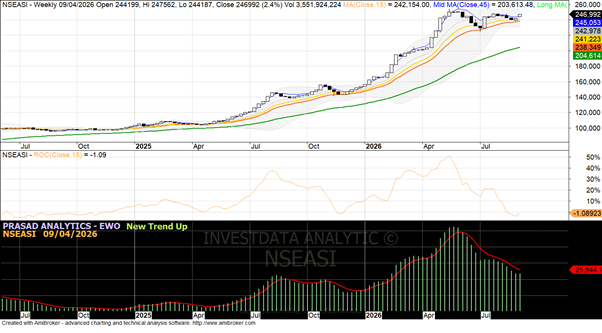
The NGXASI maintained its bullish skabt during the week, rising 2.36% to close at 246,992.44 points. The index finished close to the 247,000-point level, indicating sustained buying interest and keeping the short-term trend positive. The ASI is also approaching the 250,000-point psychological level, while the previous record high of 254,067.42 points remains a major resistance zone.Price action was positive across most sessions, with the index gaining on four of the five trading days. However, the weaker market breadth toward the end of the week suggests that the rally is becoming increasingly concentrated in selected large-cap stocks.
The 247,000-point area is the immediate resistance zone. A decisive break above this level could pave the way toward 250,000 points, followed by the 254,000-point region. On the downside, 246,000 points serves as the first support, while 244,000 points remains a stronger near-term support level. The sharp increase in trading activity, particularly on Friday, also supports the positive market structure. However, the concentration of volume in a few stocks means the surge in activity does not necessarily represent broad-based accumulation.
Market Outlook
The near-term outlook for the NGX remains bullish but selective. Continued demand for heavyweight stocks could keep the ASI on an upward path, although the weak breadth recorded toward the end of the week raises the possibility of short-term profit-taking. A sustained break above 247,000 points would strengthen the bullish momentum and increase the possibility of a move toward 250,000 points. Conversely, failure to clear this resistance could trigger consolidation around the 244,000–247,000-point range. Overall, the market retains a positive bias, but investors are likely to remain selective as the index approaches its previous record high.
Trending in the Economy: Nigeria’s economy grew 4.43% year-on-year in Q2 2026, up from 3.89% in Q1, supported by stronger oil and non-oil sector activity, according to the NBS. Oil production also increased to 1.72 million barrels per day from 1.55 million bpd in Q1, although growth remains below the government’s 7% target for 2027.
Meanwhile, private sector activity strengthened in August, with the Stanbic IBTC PMI rising to 54.3 from 52.5 in July, driven by higher orders and output. However, rising input costs continued to pressure businesses.
Global Market and Oil: U.S. stocks ended lower on Friday as stronger-than-expected employment data reinforced expectations that the Federal Reserve could raise interest rates at its September meeting. The report pushed Treasury yields and the dollar higher, while investors shifted their focus to next week’s inflation figures for further clues on the Fed’s policy direction. The U.S. economy added 162,000 nonfarm jobs in August, significantly above the 56,000 increase economists had expected. July employment was also revised higher to a 21,000 gain, compared with the previously reported 23,000 decline. Despite the stronger hiring numbers, the unemployment rate remained unchanged at 4.1%, suggesting that the labour market continues to show resilience despite earlier signs of slowing momentum.
The stronger employment figures quickly altered expectations for monetary policy. Shortly after the release, interest-rate futures implied about a 65% probability of a September rate hike, up from roughly 55% before the report. By the New York afternoon session, however, those expectations had eased to around 57%, showing that investors remained divided over whether the Fed would tighten policy.
The jobs report also triggered a sharp move in the Treasury market. The two-year Treasury yield, which is particularly sensitive to expectations for Fed policy, climbed 4 basis points to 4.37% and briefly reached 4.4246%, its highest level since January 2025. The 10-year Treasury yield rose nearly 2 basis points to about 4.78%, after touching 4.812% following the employment data.
The rise in yields reflected renewed concerns that a stronger labour market could keep inflation pressures elevated and reduce the urgency for the Fed to cut or maintain rates. Investors are therefore expected to closely monitor the upcoming inflation releases, particularly the consumer price index, before the Federal Reserve’s mid-September policy decision.
Markets will receive the producer price index on Thursday, followed by the consumer price index on Friday. Economists expect annual core CPI inflation to ease to 2.4% in August from 2.5% in July. The inflation readings could prove critical for determining whether the Fed moves ahead with another rate increase. A stronger-than-expected inflation print could reinforce the case for tighter monetary policy, while softer price growth could reduce expectations for a September hike.
Bret Kenwell, U.S. investment analyst at eToro in New York, said the latest employment figures suggest that the labour market remains relatively strong, leaving inflation as a more significant concern for policymakers. Investors are therefore likely to remain cautious until the inflation data provides a clearer picture. The stronger jobs data contributed to a broad selloff across U.S. equities ahead of the three-day holiday weekend.
The Dow Jones Industrial Average fell 271.86 points, or 0.51%, to 53,414.25. The S&P 500 declined 29.11 points, or 0.38%, to 7,718.60, while the Nasdaq Composite dropped 77.07 points, or 0.29%, to 26,506.99. The weakness was broad-based, with investors reassessing equity valuations in light of the prospect of higher interest rates. Higher bond yields can make equities relatively less attractive while also increasing borrowing costs for companies.
The broader global market also weakened. MSCI’s gauge of stocks across the globe fell 1.09 points, or 0.09%, to 1,153.65, while the pan-European STOXX 600 gained 0.12%.
Corporate developments added to the pressure on Wall Street. Adobe shares fell 6.7% after the software company announced that longtime chief executive Shantanu Narayen would step down and be succeeded by company insider Anil Chakravarthy.
The dollar initially jumped sharply following the employment data as traders increased expectations of higher U.S. interest rates. Some of those gains later faded, but the greenback still finished higher.
The dollar index rose 0.21% to 99.17, measuring the U.S. currency against a basket that includes the euro and Japanese yen. The euro weakened 0.12% to $1.1611, reflecting the relative strength of the dollar.
Against the Japanese currency, the dollar gained 0.26% to 156.19 yen. Despite Friday’s move, the yen has strengthened during the week as traders increased expectations that the Bank of Japan could deliver additional or faster interest-rate increases.
The yen is also testing the 155.21 level, which marked its strongest point following last month’s U.S.-Japan currency intervention. A break below that level would take the Japanese currency to its strongest position since May 6.
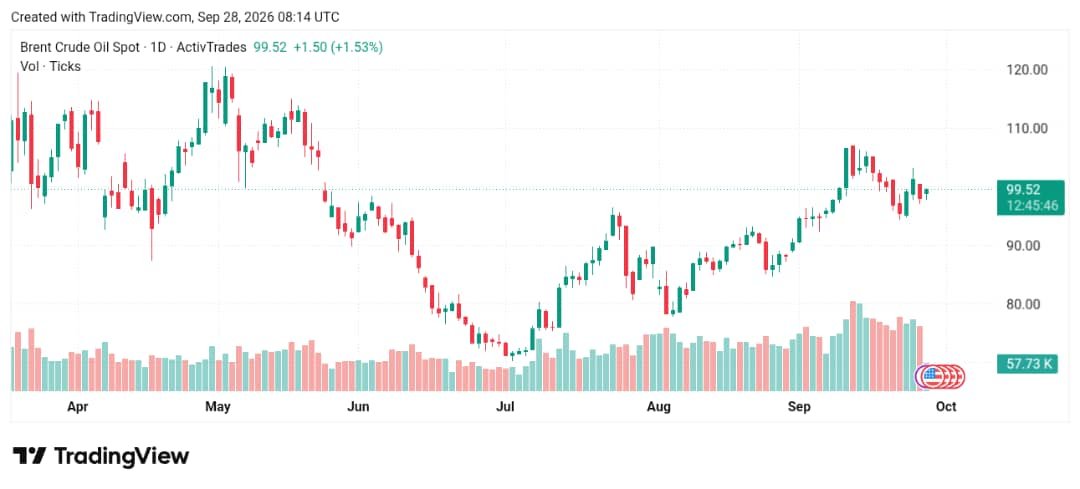
Oil prices also finished higher as renewed attacks linked to the U.S.-Iran conflict intensified concerns about supply disruptions and higher energy costs.
Brent crude futures settled at $92.68 a barrel, gaining 76 cents, or 0.8% on the day. West Texas Intermediate crude futures rose 18 cents, or 0.20%, to $91.48 a barrel. The weekly performance was considerably stronger. Brent crude gained 7.6% for the week, while U.S. crude rose nearly 10% as supply routes in the Middle East remained disrupted by the conflict.
The sharp rise in energy prices adds another complication for central banks because higher oil costs can feed into headline inflation and increase pressure on policymakers to maintain tighter monetary conditions.
Gold prices moved in the opposite direction as higher Treasury yields and a stronger dollar reduced demand for the precious metal. Spot gold fell 1.2% to $4,419.09 an ounce. Rising bond yields increase the opportunity cost of holding non-yielding assets such as gold, while a stronger dollar makes the commodity more expensive for holders of other currencies.
Overall, Friday’s market action reflected renewed concerns about the direction of U.S. monetary policy. The unexpectedly strong 162,000 increase in August payrolls, compared with the 56,000 forecast, has strengthened the case for the Federal Reserve to remain focused on inflation rather than moving quickly toward easier policy. With the two-year yield reaching 4.4246%, the 10-year yield touching 4.812%, and September rate-hike expectations briefly rising to 65%, investors are likely to remain highly sensitive to incoming economic data.
The next major test will come from the producer price report on Thursday and consumer price data on Friday, with markets watching closely for signs that core inflation is moving toward the expected 2.4% annual rate. Until those figures are released, U.S. equities, Treasury yields, the dollar, oil and gold are likely to remain sensitive to changing expectations around the Federal Reserve’s September decision.
INVESTDATA Q4 MASTER CLASS
Theme NEW TRADING OPPORTUNITIES ON THE NGX: MASTERING V0LATILITY, POLITICAL RISKS
Sub-Topics
- The Profitable Trading & Investing Strategies To Play NGX For The Rest Of 2026 And Beyond- Alhaji Garba Kurfi, MD/CEO APT Securities & Funds Ltd)
- Election Cycle & Patterns On The NGX: How To Trade Profitably & Protect Capital- Mr Abdul-Rasheed Oshoma Momoh, Executive Director Operations, TRW Stockbroking Limited
- How To Position & Pick Smart Money Stocks In Q4 And Post Election Rally- Dr Sylvester Anaba (PhD, FCS) , Head Research, United Capital Plc
- Straightforward Sell Or Hold Techniques To Handle & Manage Winning Stocks On NGX-Mr Ambrose Omordion, CRO, InvestData Consulting Ltd
Volatility or market corrections are not losses. They are stock repricing activities. When the market corrects or pulls back, quality companies that were once expensive become affordable with fundamentals remaining intact. That is where long-term wealth starts. Add political risk to that and you get two things: A mix of fear and opportunity.
Fear makes people sell first and ask questions later. Opportunities show up because prices drop below business value and discerning market players buy. In Nigeria, political cycles always create volatility. But they also create entry points. Money doesn’t leave the market forever. It rotates. It waits for clarity, then it rushes back in. So the playbook is simple: Use the correction to build a watchlist of strong companies with real earnings and dividends. Use political risk to buy in phases, or Naira=cost Averaging, not all at once. Scale in as uncertainty peaks. The investors who do well in the NGX are not the ones who avoid corrections and politics. They are the ones who use both to buy quality at a discount. Every correction ends. Political cycles end too. Position now ahead of sentiment flips.
So, are you interested in learning how to safely navigate the financial market in today’s trading and changing investment environment that is clouded with uncertainties, noise and surprises that are driving the volatile markets across the globe plus the election that is close? Despite these headwinds, discerning investors and smart traders on the NGX are positioning for high profits with practical strategies of effective combination of fundamentals, technicals and sentiment analysis. That will be share at the forthcoming InvestData Q4 last Master Class for the year 2026, which we believe is for you. Among others, we know you will learn exact steps in real time using the new strategies by following the current volatility as the election gets closer. Don’t forget that election makes quality stocks available at a discount.
As a result, we have put together this Q4 masterclass to help you identify and buy quality fundamental stocks, avoid those needless losses and build a profitable portfolio with high ROI after the election.