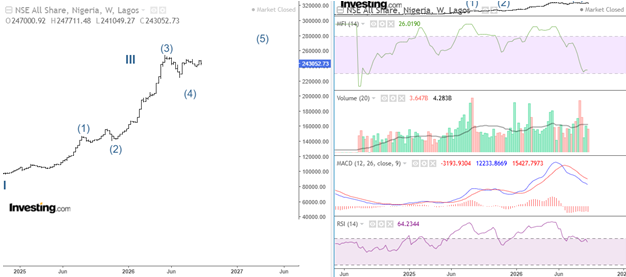

It was a mixed trading week on the Nigerian Exchange, as the benchmark All-Share Index closed lower on a broad-based selling pressure that outweighed gains in selected stocks and sectors. The market recorded three trading sessions of up market and two days of massive selloffs. The pullbacks were short-lived after the index action formed a hammer candlestick that signalled reversal of trend, which needed a confirmation that support shift in index action on Friday but on relatively low traded volume and positive market internals. Below is the index action chart that revealed movement for the week under review
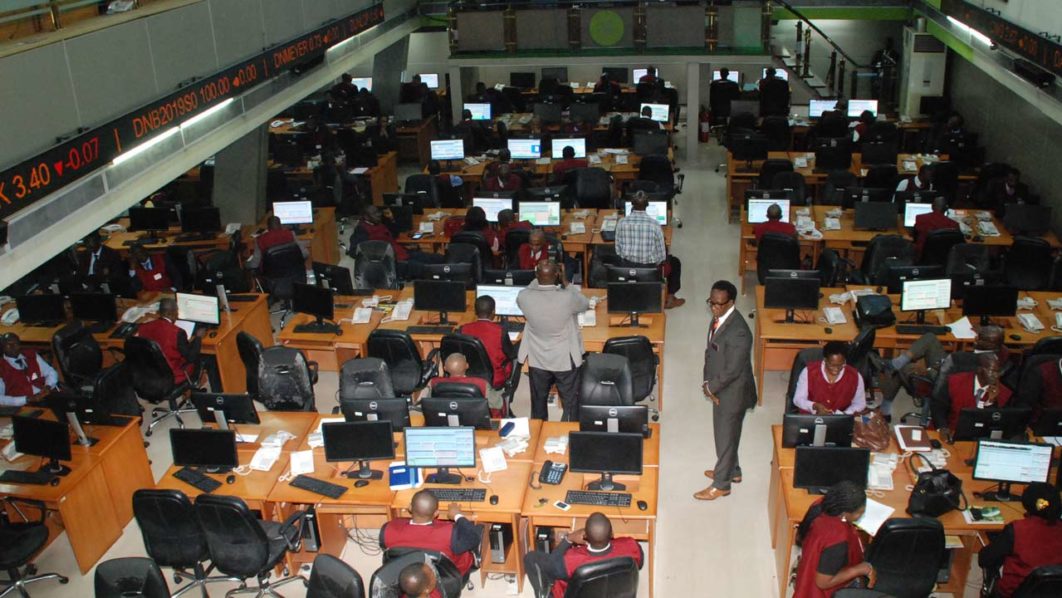
Trading activity was weaker overall. Investors exchanged 3.647 billion shares worth ₦130.151 billion in 244,777 deals, compared with 4.360 billion shares valued at ₦210.331 billion in 223,284 deals in the previous week. This represented a 16.35% decline in volume and a 38.11% fall in transaction value, despite a 9.63% increase in the number of deals.
The Financial Services sector remained the most active, accounting for 2.909 billion shares valued at ₦56.668 billion in 106,662 deals. It contributed 79.76% of total equity turnover volume and 43.54% of turnover value. The Services sector followed with 153.12 million shares worth ₦2.33 billion, while Consumer Goods recorded 116.66 million shares valued at ₦11.04 billion. Fortis Global Insurance, Mutual Benefits Assurance and Sterling Financial Holdings dominated trading, jointly accounting for 1.544 billion shares or 42.33% of total market volume.
Despite the broader decline, some sectors remained resilient. The NGX Oil & Gas Index gained 2.83%, while the Commodity Index advanced 2.19%. The MERI Value Index and AFR Div Yield Index also rose by 0.79% and 0.71%, respectively. Market breadth deteriorated sharply during the week, with only nine stocks gaining compared with 56 in the previous week. Decliners increased to 80 from 35, while 58 stocks closed unchanged. The weak breadth indicates selling pressure was widespread rather than concentrated in a few counters.
The NGX remains under pressure after falling from Monday’s 247,699.78-point level. Although the late-week recovery suggests some buying interest, the weak breadth shows that investors remain cautious. Sustained buying in large-cap stocks and an improvement in market breadth will be important for a stronger recovery, while renewed selling could keep the index under pressure. Overall, the week’s performance points to continued profit-taking and portfolio repositioning after the market’s strong earlier gains. Strength in the Oil & Gas and Commodity segments provided some support, but broader participation is needed to restore positive momentum.
Among the notable gainers were SEPLAT, which hit a new 52-week high, NGXGROUP, WEMABANK, ACCESSCORP and other selected counters. On the losing side, JOHNHOLT, BUACEMENT, CADBURY, NB, FIRSTHOLDCO, CAP, MAYBAKER, JAPAULGOLD, FTNCOCOA, MCNICHOLS, NSLTECH and OMATEK recorded some of the weakest performances.
Week-to-date, the All-Share Index has lost 1.60%, NGX 30 is down by 1.50%, the Banking Index has decreased by 4.07%, the Pension Index decreased by 1.93%, the Insurance Index declined by 5.52%, the Consumer Goods Index decreased by 2.55%. However, the Oil and Gas Index recorded a positive return of 2.83%. Year-to-date, the All-Share Index has gained 56.19%, NGX 30 is up by 57.61%, the Banking Index has increased by 66.82%, the Pension Index increased by 78.27%, the Insurance Index declined by 10.94%, the Consumer Goods Index increase by 1.83%. However, the Oil and Gas Index recorded a positive return of 117.86%.
NGXASI Daily Index Action
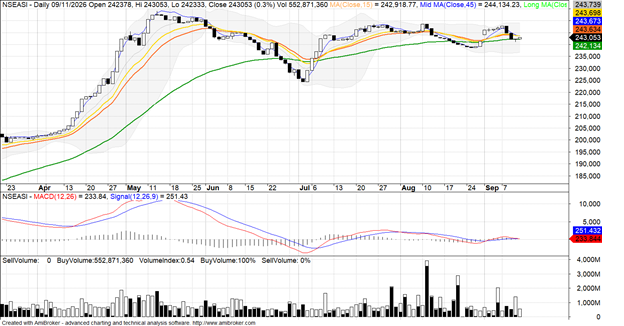
The market opened the week trading on a positive note, with the index rising 0.29% on Monday to 247,699.78 points. Capitalisation increased by about ₦1.04 trillion, lifting the year-to-date return to 59.18%. However, market breadth was already weak, with 43 decliners against 12 gainers.
The trend was halted on Tuesday and midweek due to selling pressure that pulled back the index by 1.17% and 1.05% respectively. The market recorded it strongest selling pressure, with 63 stocks declining against only four gainers. FIRSTHOLDCO fell 9.30%, CAP lost 7.73%, MAYBAKER declined 7.09% and ACCESSCORP dropped 7.06%. On Wednesday, BUACEMENT, CADBURY and NB fell 10.00%, 9.94% and 9.78%, respectively.
The benchmark index recovered marginally in the final two sessions. The index gained 0.06% on Thursday before rising another 0.28% on Friday to close at 243,052.74 points. Friday’s gain lifted market capitalisation by ₦437.40 billion and improved the YTD return to 56.19%.
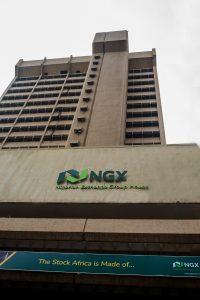
NGXGroup Plc
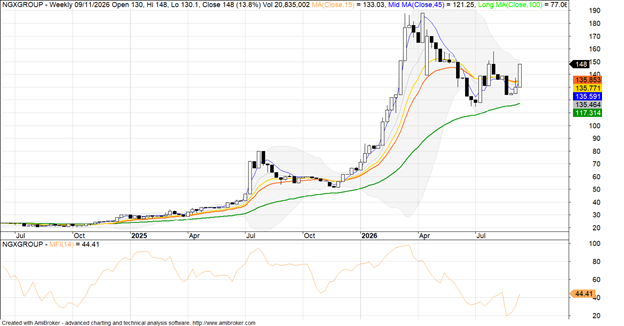
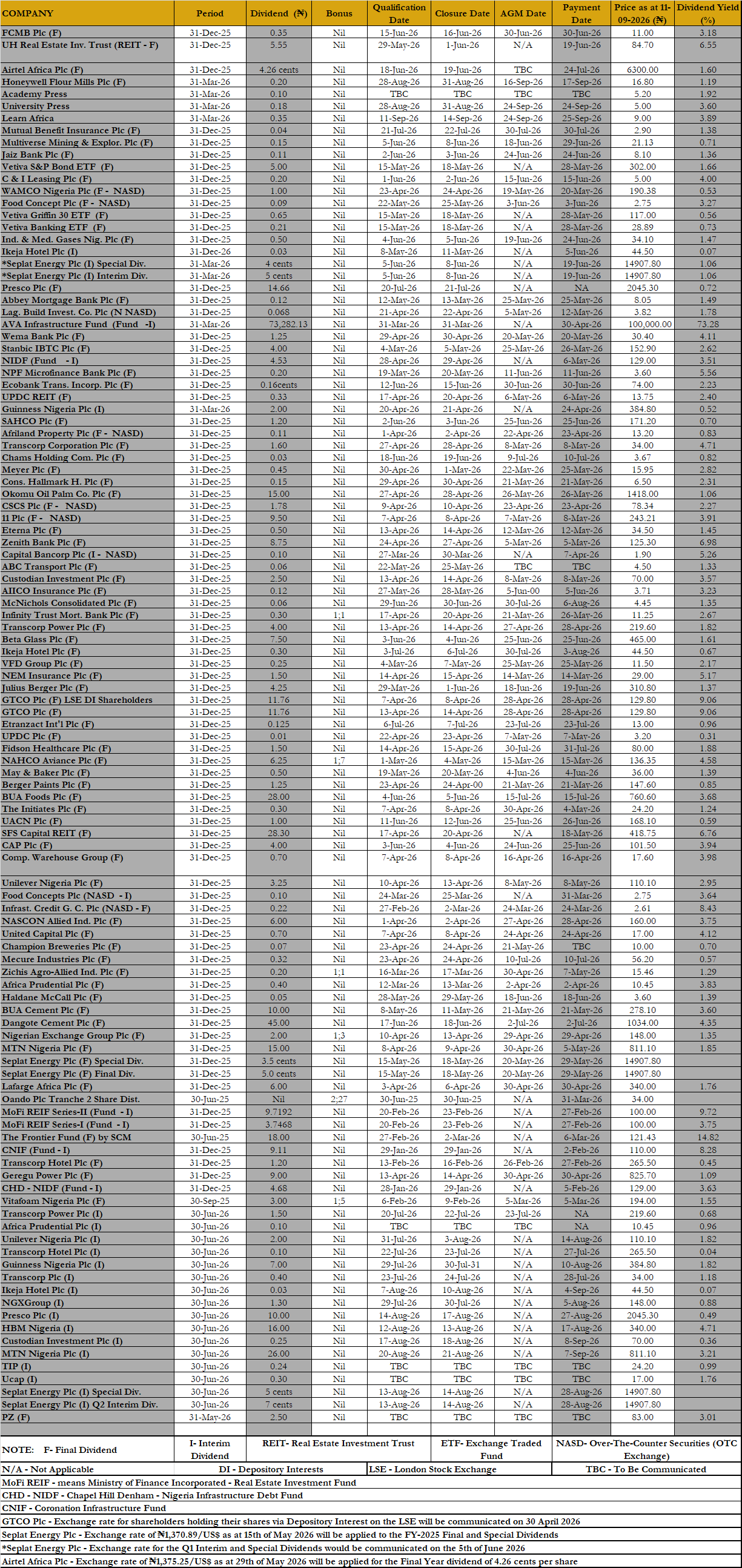
Among the week’s top gainers, Nigerian Exchange Group Plc rose from ₦130.00 to ₦148.00, gaining ₦18.00 or 13.85%; Ellah Lakes Plc advanced from ₦9.00 to ₦10.20, up ₦1.20 or 13.33%; Seplat Energy Plc climbed from ₦13,552.60 to ₦14,907.80, gaining ₦1,355.20 or 10.00%; e-Tranzact International Plc increased from ₦12.30 to ₦13.00, up ₦0.70 or 5.69%; while Ikeja Hotel Plc rose from ₦42.55 to ₦44.50, gaining ₦1.95 or 4.58%.
Fortis Global Insurance Plc
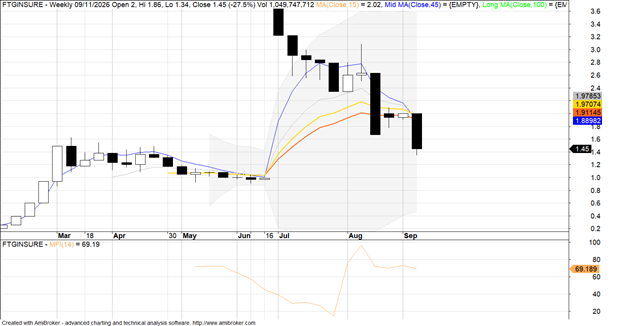
On the losing side, Fortis Global Insurance Plc fell from ₦2.00 to ₦1.45, losing ₦0.55 or 27.50%; Critical Minerals Financing Corp Plc declined from ₦2.64 to ₦2.00, down ₦0.64 or 24.24%; Austin Laz & Company Plc dropped from ₦2.50 to ₦1.99, losing ₦0.51 or 20.40%; Omatek Ventures Plc declined from ₦1.70 to ₦1.37, down ₦0.33 or 19.41%; while Royal Exchange Plc fell from ₦1.10 to ₦0.90, representing a ₦0.20 or 18.18% decline.
NGX Weekly Comparative Analysis
The NGX moved from a strong rally last week to a broad correction this week. The All-Share Index rose 2.36% to 246,992.44 points last week but fell 1.60% to 243,052.74 points this week, while market capitalisation dropped from ₦159.56 trillion to ₦157.59 trillion. Trading activity also weakened. Volume declined from 4.360 billion to 3.647 billion shares, while transaction value fell from ₦210.331 billion to ₦130.151 billion. However, the number of deals increased from 223,284 to 244,777.
Market breadth deteriorated sharply. Last week recorded 56 gainers, 35 losers and 56 unchanged stocks, compared with just 9 gainers, 80 losers and 58 unchanged stocks this week under review. This shows that selling pressure became much broader.
The Financial Services sector remained the most traded, but its volume fell from 3.580 billion shares worth ₦88.635 billion last week to 2.909 billion shares worth ₦56.668 billion this week. Its share of market volume also declined from 82.10% to 79.76%.
At the stock level, Fortis Global Insurance, UBA and Access Holdings dominated trading last week with 2.287 billion shares, representing 52.46% of total volume. This week, Fortis Global Insurance, Mutual Benefits Assurance and Sterling Financial Holdings accounted for 1.544 billion shares, or 42.33%.
Sector performance also changed. Last week, most major indices closed higher, although the Industrial Goods Index fell 0.35% and the Sovereign Bond Index declined 0.36%. This week, the Oil & Gas Index gained 2.83%, the Commodity Index rose 2.19%, while the MERI Value Index and AFR Div Yield Index increased 0.79% and 0.71%, respectively.
Overall, the market shifted from broad-based buying last week to profit-taking and portfolio repositioning this week. The ASI lost 3,939.70 points week-on-week, while the YTD return eased from 58.72% to 56.19%. Although the market recovered 0.06% on Thursday and 0.28% on Friday, the weak breadth and lower turnover value suggest that investors remain cautious.
Technical Analysis View
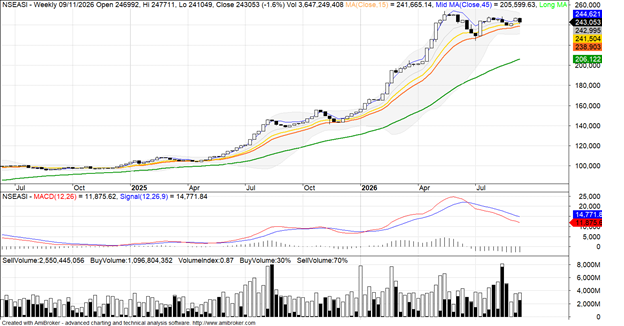
The NGX All-Share Index ended the week at 243,052.74 points after falling 1.60%, signalling a short-term loss of momentum. The index slipped from 247,699.78 points at the start of the week, breaking below the 244,000–245,000 area before staging a modest recovery in the final two sessions. The sharp decline on Tuesday and Wednesday, combined with the rise in the number of declining stocks, points to strong profit-taking and weak market breadth. However, the Friday rebound suggests that buyers are beginning to defend lower levels.
In the short term, 242,000 points remains an important support zone, while the 244,800–247,700 area represents the immediate resistance range. A decisive break above the resistance zone could strengthen the recovery and restore bullish momentum. Conversely, a sustained move below 242,000 points could expose the index to further downside.
Market Outlook
The near-term outlook remains cautious as investors continue to rotate away from some large-cap stocks while selectively buying Oil & Gas, financial and other resilient counters. The strong performance of SEPLAT and gains in selected banking stocks show that pockets of buying interest remain in the market. For the coming week, market direction is likely to depend on whether the NGX can hold above the 242,000-point support level and attract stronger buying volume. An improvement in market breadth, particularly among large-cap stocks, would strengthen the case for a rebound.
However, continued weakness in breadth and renewed selling pressure could push the index below support and extend the current correction. Overall, the market remains cautious in the short term, with a recovery possible if buyers regain control above the immediate resistance zone.
Trending in the Economy: Nigeria’s foreign reserves have climbed to $54.08 billion, their highest level since 2008, according to CBN data. The reserves have increased by $8.52 billion, or 18.7%, from $45.56 billion in January, supported by stronger foreign exchange inflows. The rise in reserves has also boosted the naira, which strengthened to ₦1,315/$, its strongest level in two years.
Meanwhile, Nigeria’s Q2 2026 trade surplus doubled year-on-year to ₦12.60 trillion, driven by stronger exports. Exports rose 27.64% quarter-on-quarter to ₦27.02 trillion, while imports increased 5.91% to ₦14.42 trillion. Crude oil and other petroleum products remained the country’s key export drivers.
Global Market and Oil: Wall Street closed higher on Friday after a volatile week, although the major U.S. stock indexes remained on track for weekly losses as investors weighed rising inflation, elevated Treasury yields, higher oil prices and escalating geopolitical tensions. The market’s Friday rebound was broad-based, with the Dow Jones Industrial Average rising 1.13%, the S&P 500 gaining 1.03% and the Nasdaq Composite advancing 1.15%. MSCI’s gauge of global stocks also increased by 5.66 points, or 0.50%, reflecting a modest improvement in investor sentiment across global markets.
Despite Friday’s gains, the overall market remained cautious after a largely weaker week. Investors were particularly focused on fresh U.S. inflation data and its implications for monetary policy ahead of the Federal Reserve’s meeting next week. The U.S. Consumer Price Index rose 0.4% in August, accelerating from a 0.1% increase in July, according to the Labor Department’s Bureau of Labor Statistics. The stronger reading reinforced concerns that inflationary pressures could remain persistent, especially as energy prices continue to rise.
The data prompted traders to increase their expectations for a 25-basis-point interest rate hike by the Federal Reserve at its two-day meeting next week. Markets now assign about an 85% probability to a quarter-point increase, compared with roughly 67% before the inflation report.
The Federal Reserve is expected to release its latest policy statement on Wednesday, followed by a press conference with Chairman Kevin Warsh. Investors will be watching the decision closely for signals about the future direction of interest rates and the central bank’s assessment of inflation. The renewed inflation concerns have complicated the outlook for U.S. monetary policy. Higher energy prices could keep inflation elevated, making it more difficult for policymakers to ease financial conditions in the near term.
Oil prices were another major focus for investors. Brent crude initially climbed to $109.97 a barrel, its highest level in four months, after surging 6% in the previous session. However, the rally lost momentum as traders took profits, with Brent eventually falling about 2.9% to $104.49 a barrel. Despite Friday’s decline, Brent remained on course for a weekly gain of more than 8%, underlining the strength of the recent rally. Concerns over disruptions to energy supplies and heightened tensions in the Middle East continued to support prices.
Oil flows through the Strait of Hormuz remained restricted as the United States and Iran exchanged attacks, raising concerns about the security of one of the world’s most important energy routes. However, prices eased after reports that foreign ministers in the Middle East were working toward a temporary arrangement to manage shipping through the waterway.
Markets continued to price in the risk of a prolonged conflict. Comments from President Donald Trump that the war could extend beyond the November midterm elections added to concerns that energy disruptions and inflationary pressures could persist. The rise in oil prices has become particularly important for financial markets because sustained energy costs could make it harder for inflation to moderate. This, in turn, could encourage the Federal Reserve to maintain tighter monetary conditions for longer than investors had previously expected.
The inflation report also pushed U.S. Treasury yields higher. The benchmark 10-year Treasury yield was slightly higher at 4.96% on Friday after briefly touching 4.9915% immediately following the inflation data. That marked its highest level in almost three years. Although the yield later eased from its intraday peak, remaining close to 5% highlighted continued concerns about inflation and the possibility of tighter monetary policy. Higher Treasury yields can weigh on equities by increasing borrowing costs and making fixed-income investments relatively more attractive.
The U.S. dollar was largely unchanged at 99.1 after gaining 0.4% against its major peers on Thursday. Expectations of higher U.S. interest rates continued to provide some support for the currency, while broader economic and geopolitical uncertainty limited its movement.
Gold, meanwhile, recovered from a sharp decline in the previous session. The precious metal rose 0.8% to $4,350 an ounce after falling nearly 2% on Thursday, as investors continued to seek protection against inflation, geopolitical uncertainty and market volatility.
Overall, Friday’s recovery in equities provided some relief after a difficult week, but investors remained cautious. The Dow gained 1.13%, the S&P 500 rose 1.03% and the Nasdaq climbed 1.15%, while MSCI’s global equity index added 5.66 points, or 0.50%.
The combination of a 0.4% monthly rise in U.S. consumer prices, Brent crude trading above $100 a barrel, a 10-year Treasury yield near 5% and continued geopolitical tensions leaves markets facing a challenging outlook.
Attention now turns to the Federal Reserve’s policy decision next Wednesday. Beyond the expected rate decision, investors will closely examine the central bank’s comments on inflation, energy prices, economic growth and the future path of interest rates.