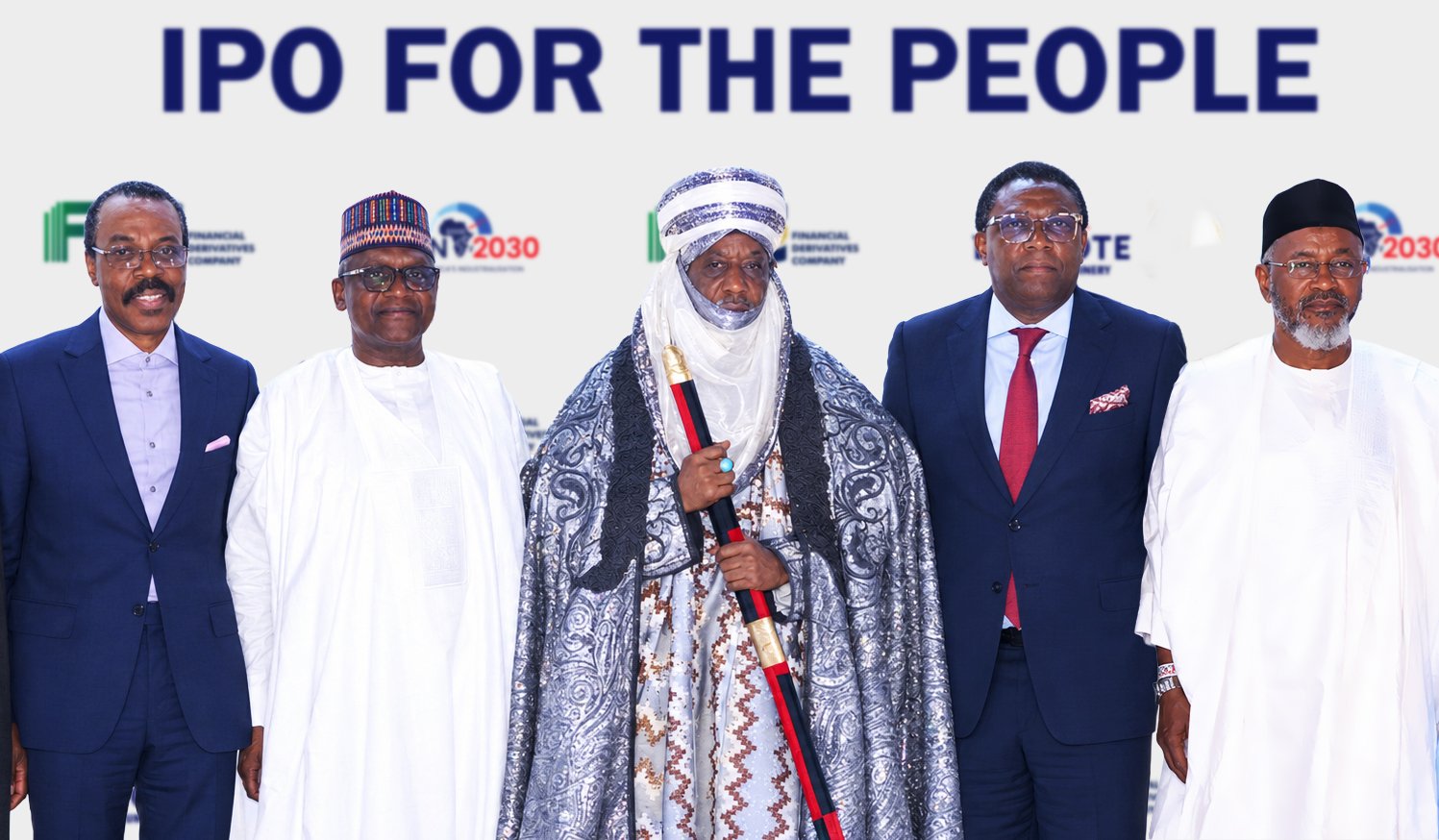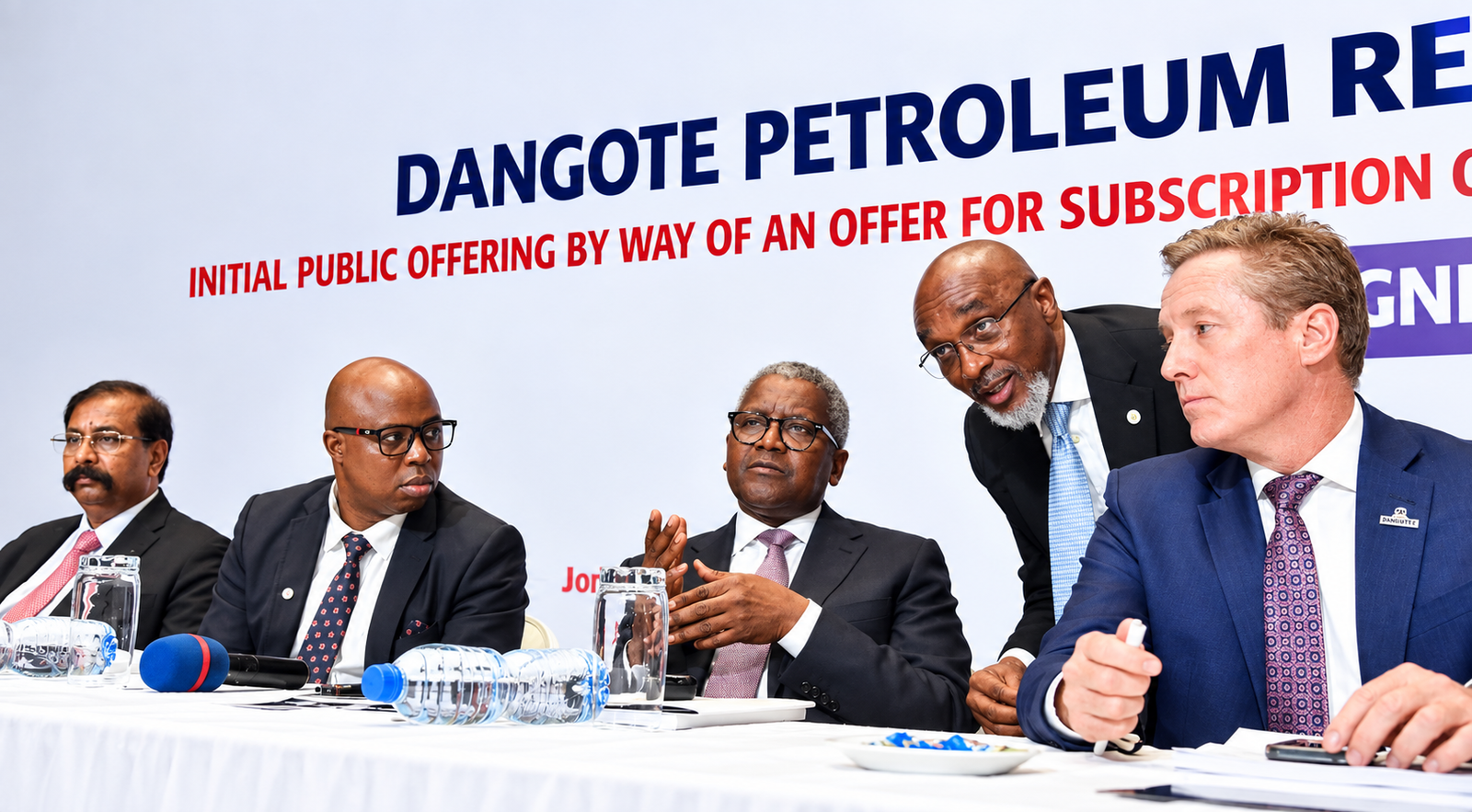

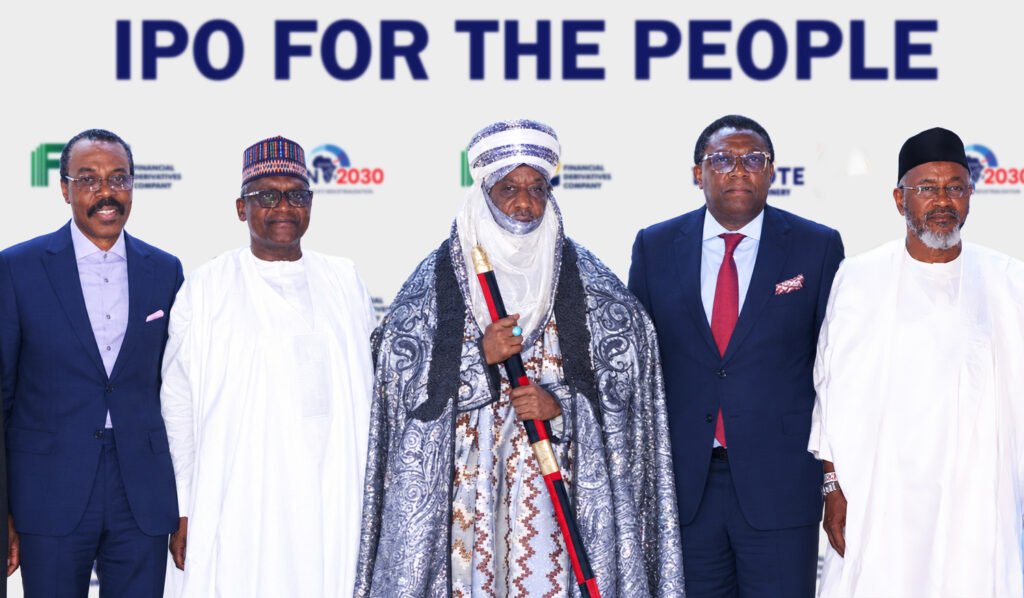
Caption: From left to right, Managing Director/CEO, Financial Derivatives Company, Bismarck Rewane; President/CE, Dangote Industries Limited, Aliko Dangote; Emir of Kano, His Highness, Muhammadu Sanusi II; (Special Guest of Honour & Chairman); CEO, The CFG Advisory, Adetilewa Adebajo (panelist); President of the Supreme Council for Shariah in Nigeria, Prof. Bashir Aliyu Umar (speaker, Sharia perspectives of the IPO); at the Dangote Petroleum Refinery IPO Roadshow tagged “Kano Grand Homecoming” in Kano on Thursday, September 17, 2026.
The Emir of Kano, Muhammadu Sanusi II, on Thursday passionately advocated broad Nigerian participation in the ongoing Initial Public Offering (IPO) of the Dangote Petroleum Refinery and Petrochemicals Limited, describing as a pathway to wealth creation and economic inclusion.
Addressing a gathering of investors, business leaders, professionals and members of the public, at an event tagged: “People’s IPO” roadshow in Kano, the former Governor of the Central Bank of Nigeria (CBN), described the refinery as one of the most significant industrial projects in Africa’s history and urging residents of the commercial city to seize the opportunity and become shareholders.
According to him, equity ownership represents one of the most effective means by which ordinary citizens participate directly in national economic growth and build long-term financial security.
“Kano is a commercial city with a long tradition of trade, investment and entrepreneurship. Our people understand business, and they should understand the value of owning shares in productive enterprises,” he said.
Drawing from personal experience, Sanusi recounted his interactions with Aliko Dangote during his banking career in the late 1990s when Dangote Group was evolving from a trading company into a manufacturing powerhouse.
The Emir revealed that many observers at the time questioned Dangote’s strategy of deploying short-term financing to support long-term industrial investments. However, he noted that what critics considered risky was actually a demonstration of strategic foresight and a deep commitment to transforming Nigeria’s productive capacity.
Recalling the philosophy that drove the company’s industrial expansion, the monarch said the vision was anchored on a simple principle: producing domestically what Nigerians consume daily instead of relying excessively on imports.
“Somebody needs to produce the petrol for your cars, somebody needs to produce the cement for your houses, somebody needs to produce the food that you eat. We are importing these things from Asia, Europe and America. Our strategy is to produce those things here,” he stated.
The Emir described the Dangote Refinery as a game-changing investment that could fundamentally alter the structure of the Nigerian economy by reducing dependence on imported petroleum products and preserving foreign exchange.
Drawing on his experience at the nation’s apex bank, Sanusi explained that Nigeria had historically earned foreign exchange through crude oil exports only to expend a substantial portion of it importing refined fuel.
“What Aliko has done is disrupt that model,” he said.
The emergence of a world-class refinery on Nigerian soil, he stressed, positions the country not merely as an exporter of crude oil but as a major supplier of refined petroleum products to regional and international markets.
As evidence of the refinery’s growing global relevance, he cited reports that European airlines had sourced aviation fuel from the facility during recent supply disruptions linked to tensions around the Strait of Hormuz, underscoring its ability to compete effectively on the global stage.
Sanusi also addressed concerns raised by critics who have accused the refinery of seeking market dominance. The monarch firmly rejected such claims, arguing that competition remains open to anyone willing to undertake the financial and operational challenges associated with large-scale refining.
“There is no monopoly if a monopoly is not protected by law,” he declared.
“Anybody who wants to build a refinery, anybody who wants to raise $22 billion, invest and go through what Aliko went through is welcome to do so.”
The comment drew applause from participants at the roadshow, many of whom viewed the statement as a direct response to persistent criticism of the refinery’s market influence.
The Emir stressed that Nigeria’s economic future depends on encouraging more investments in productive industries capable of creating jobs, generating exports and strengthening local value chains. He warned against a culture that prioritises speculation and the accumulation of overseas assets at the expense of domestic industrial development.
He therefore described the Dangote Refinery IPO as a historic opportunity for millions of Nigerians to own a stake in one of Africa’s most strategic industrial assets.
“It is the shareholders who own it. It is the shareholders who take the returns. It is the shareholders who own the profits,” he said.
While encouraging broad participation, the respected traditional ruler advised prospective investors to approach the market responsibly. He urged citizens to invest only funds they could afford to commit for the long term and not resources earmarked for essential family needs.
In his closing remarks, Sanusi called on Kano residents and Nigerians generally to embrace the capital market and take advantage of the IPO, arguing that widespread ownership would democratise wealth generation and deepen public participation in national economic development.
He said broader participation in the Dangote Refinery IPO would not only reward investors financially but also strengthen local ownership of critical national infrastructure, expand financial inclusion and ensure that the benefits of industrialisation are shared more widely across the country.
“The opportunity is here. The question is whether you will participate,” the Emir told the audience.
The Dangote Petroleum Refinery IPO roadshow, tagged “Kano Grand Homecoming,” brought together leading figures from Nigeria’s business, investment and financial sectors, including Aliko Dangote, President of Dangote Industries Limited; Bismarck Rewane, Managing Director of Financial Derivatives Company; Adetilewa Adebajo, CEO of CFG Advisory; and other capital market stakeholders.