
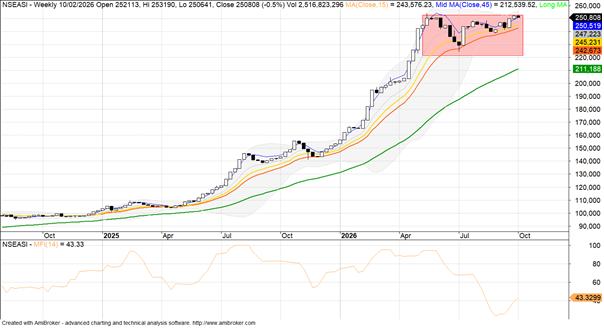
The Nigerian Exchange (NGX) closed the week weaker on Friday after profit-taking in major high cap stocks dragged its benchmark All-Share Index lower, while trading activity slowed following Thursday’s Independence Day holiday. Even then, trading on the first trading day of October as well as the last quarter of 2026 started negative ahead of Q3 earnings inflow.
The Financial Services sector dominated activity with 1.944 billion shares worth ₦77.733 billion in 92,035 deals, representing 61.41% of total volume and 50.14% of turnover value. The Investment sector followed with 409.484 million shares valued at ₦5.40 billion, while ICT recorded 231.705 million shares worth ₦9.606 billion. FIDELITYBK, VFDGROUP and ACCESSCORP jointly accounted for 1.343 billion shares valued at ₦27.580 billion, representing 42.42% of total turnover volume and 17.79% of value.
The NGX ASI ultimately declined 0.52% to 250,808.27 points, while market capitalisation fell 0.50% to ₦162.843 trillion. However, the Main Board, Insurance, Oil & Gas and Growth indices gained 0.08%, 0.61%, 0.05% and 1.85%, respectively. The Commodity Index was flat, while other sectoral indices closed lower.
Market breadth also weakened, with 44 equities gaining compared with 61 in the previous week, while decliners increased to 37 from 32. Unchanged stocks rose slightly to 65 from 63.
Trading for the week started on positive on a note, with the composite NGX All-Share Index (ASI) rising 0.21% to 252,635.11 points. Market capitalisation increased by ₦343.69 billion, while the year-to-date (YTD) return climbed to 62.35%. ETERNA and FIDELITYBK led the gainers with 9.62% and 6.48%, respectively. Investors traded 1.02 billion shares worth ₦39.56 billion in 61,661 deals, with FIDELITYBK accounting for 528 million shares valued at ₦10.63 billion.
The market reversed the gain on Tuesday as the ASI fell 0.29% to 251,913.20 points, with market capitalisation declining by ₦468.63 billion and YTD return easing to 61.88%. UNILEVER led the losers with 8.55%, followed by MAYBAKER, GTCO and BUACEMENT. Trading volume dropped 46.46% to 548.67 million shares worth ₦34.30 billion, while GTCO led activity with 88.73 million shares valued at ₦11.73 billion.
Selling pressure continued on Wednesday, pushing the ASI down 0.28% to 251,211.67 points. Market capitalisation fell by ₦425.73 billion, while YTD return slipped to 61.43%. FIDELITYBK, MTNN and ACCESSCORP recorded the biggest declines. Trading volume rose 88.71% to 1.04 billion shares worth ₦53.64 billion in 44,469 deals. VFDGROUP led volume with 367.32 million shares, while UACN recorded the highest transaction value at ₦21.51 billion.
Following the Independence Day break, the market resumed trading on Friday with another decline. The ASI shed 0.16% to 250,808.27 points, reducing YTD return to 61.17% and market capitalisation by ₦261.92 billion. FIDELITYBK, NGXGROUP and FIRSTHOLDCO led the losses, while market breadth was evenly split at 26 gainers and 26 losers. Investors traded 557.15 million shares worth ₦27.57 billion in 53,450 deals, with ACCESSCORP accounting for 183.56 million shares valued at ₦5.52 billion.
With only four trading sessions during the week, total turnover stood at 3.166 billion shares worth ₦155.023 billion in 206,662 deals, lower than the previous week’s 4.689 billion shares valued at ₦240.824 billion in 261,198 deals.
Week-to-date, the All-Share Index has lost 0.52%, NGX 30 is down by 0.52%, the Banking Index has decreased by 1.33%, the Pension Index decreased by 0.75%, the Insurance Index inclined by 0.61%, the Consumer Goods Index decreased by 0.91%. However, the Oil and Gas Index recorded a positive return of 0.05%. Year-to-date, the All-Share Index has gained 61.17%, NGX 30 is up by 62.71%, the Banking Index has increased by 77.18%, the Pension Index increased by 88.38%, the Insurance Index declined by 7.48%, the Consumer Goods Index increase by 2.05%. However, the Oil and Gas Index recorded a positive return of 133.94%.
ABC Transport Plc
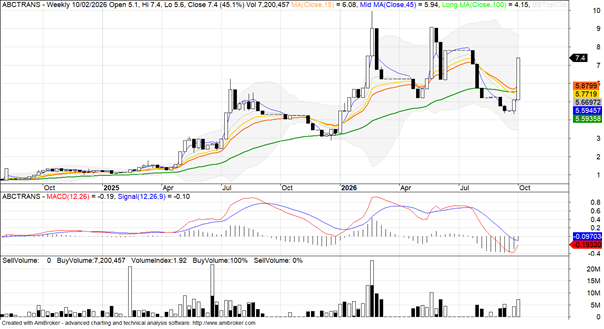
On the gainers’ table, ABC Transport Plc advanced from ₦5.10 to ₦7.40, gaining ₦2.30 or 45.10%. Critical Minerals Financing Corporation Plc rose from ₦3.26 to ₦4.49, up ₦1.23 or 37.73%, while LivingTrust Mortgage Bank Plc increased from ₦2.60 to ₦3.45, representing a ₦0.85 or 32.69% gain. VFD Group Plc climbed from ₦11.40 to ₦13.50, up ₦2.10 or 18.42%, while CWG Plc moved from ₦18.00 to ₦20.75, gaining ₦2.75 or 15.28%.
Sovereign Trust Insurance Plc
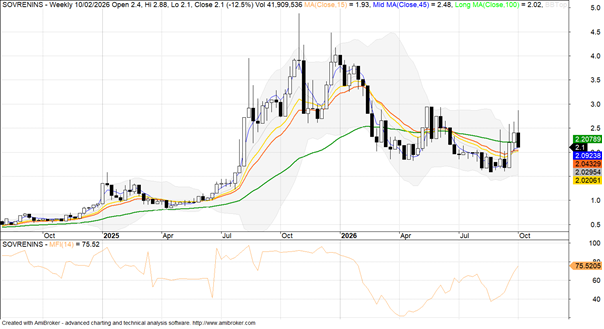
On the decliners’ side, Sovereign Trust Insurance Plc fell from ₦2.40 to ₦2.10, losing ₦0.30 or 12.50%. e-Tranzact International Plc dropped from ₦12.50 to ₦11.00, down ₦1.50 or 12.00%, while Learn Africa Plc declined from ₦8.60 to ₦7.65, shedding ₦0.95 or 11.05%. PZ Cussons Nigeria Plc lost ₦7.40 or 10.03%, closing at ₦66.40 from ₦73.80, while Fortis Global Insurance Plc declined from ₦2.00 to ₦1.81, representing a ₦0.19 or 9.50% loss.
NGX Weekly Comparative Analysis
The NGX reversed last week’s gains this week as profit-taking and the Independence Day holiday reduced market activity. The All-Share Index (ASI) fell 0.52% to 250,808.27 points, compared with a 0.92% gain to 252,113.41 points last week. Market capitalisation dropped to ₦162.843 trillion from ₦163.66 trillion, while YTD return eased to 61.17% from 62.01%.
Trading activity also declined, with 3.166 billion shares worth ₦155.023 billion traded in 206,662 deals, compared with 4.689 billion shares worth ₦240.824 billion in 261,198 deals last week. This represents declines of 32.46% in volume, 35.63% in value and 20.88% in deals.
The Financial Services sector remained dominant, recording 1.944 billion shares worth ₦77.733 billion in 92,035 deals, representing 61.41% of total volume and 50.14% of turnover value. The Investment sector followed with 409.484 million shares worth ₦5.400 billion, while ICT recorded 231.705 million shares worth ₦9.606 billion.
FIDELITYBK, VFDGROUP and ACCESSCORP accounted for 1.343 billion shares worth ₦27.580 billion, representing 42.42% of total volume and 17.79% of total value.
Market breadth weakened, with 44 gainers and 37 losers, compared with 61 gainers and 32 losers last week. Unchanged stocks increased to 65 from 63.
Sector performance was mixed, with the Main Board (+0.08%), Insurance (+0.61%), Oil & Gas (+0.05%) and Growth (+1.85%) indices gaining. The Commodity Index was flat, while other sectoral indices declined.
Overall, the market shifted from last week’s positive momentum to profit-taking and cautious trading, with the benchmark index NGXASI ending 1,305.14 points below last week’s close.
Technical Analysis View
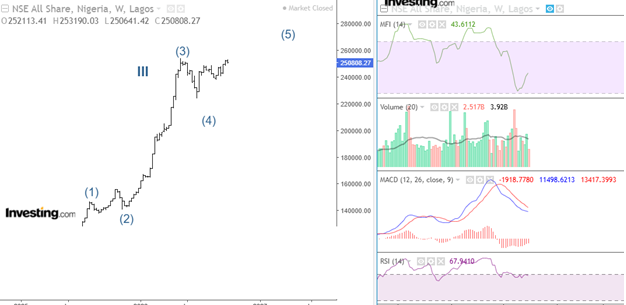
The NGX All-Share Index ended the week at 250,808.27 points, losing 0.52% as selling pressure persisted across key large-cap stocks. After starting the week with a gain and reaching an intra-week high of 252,635.11 points, the index reversed direction and recorded losses in the remaining sessions.
The price action suggests that the market is undergoing a period of short-term consolidation following its strong upward run. The 250,000-point level has become an important support area, as the index closed slightly above it despite the week’s selling pressure. Sustaining this level could help limit further losses and encourage investors to reposition in selected stocks.
A break below the 250,000-point support, particularly on increased volume, could signal stronger bearish pressure and open the way for a deeper correction. On the other hand, a recovery above the 252,600-point resistance would improve the short-term technical structure and could shift attention towards the 254,000-point area.
Market breadth provides a mixed signal. Although 44 stocks advanced during the week, 37 declined, indicating that buying interest remained present but was not strong enough to prevent losses in the broader index. The high number of unchanged stocks also points to a cautious approach among investors.
Trading activity was relatively subdued, with total weekly volume falling to 3.166 billion shares from 4.689 billion shares in the previous week. Turnover value also declined to ₦155.023 billion from ₦240.824 billion. While the shorter trading week contributed to the reduction, the decline in activity also reflects a more measured trading environment as investors reassess recent gains.
The Financial Services sector remained the market’s main activity driver, accounting for 61.41% of total equity turnover volume. The heavy participation in FIDELITYBK, VFDGROUP and ACCESSCORP suggests that movements in highly liquid financial stocks could remain important to the index in the coming sessions.
Market Outlook: The near-term outlook remains cautious as the market attempts to find a stable footing around the 250,000-point level. Investors may continue to lock in profits in stocks that have recorded significant gains, while bargain hunters could emerge around technically attractive and fundamentally strong counters.
A sustained hold above 250,000 points could support a period of consolidation and create room for a rebound towards 252,600 points. However, renewed selling pressure and a decisive break below the psychological support could extend the correction. For now, market direction is likely to remain driven by stock-specific developments, liquidity, earnings expectations and the level of participation in heavyweight counters.
Trending in the Economy: Nigeria’s external debt rose to $54.5 billion by June 2026, up from $43.1 billion when President Bola Tinubu took office. The increase was largely driven by World Bank loans, Eurobond issuances and syndicated financing. Domestic debt also climbed to N91.59 trillion, taking total public debt to N166.79 trillion from N159.35 trillion in March. The Federal Government accounted for N152.77 trillion of the total.
Meanwhile, NNPC Limited’s profit after tax jumped 33% to N7.2 trillion in 2025, despite a 24% decline in revenue to N34.5 trillion. EBITDA rose 22% to N18 trillion, while operating cash flow increased 16% to N12.8 trillion. The company declared a N5.8 trillion dividend, up 35%, as crude and condensate production averaged 1.77 million barrels per day.
Global Market and Oil: US equities recovered from early losses on Thursday as a retreat in Treasury yields helped ease pressure on stocks after a sharp rise in bond yields had unsettled markets. The S&P 500 rebounded from a two-week low, while investors continued to assess fresh economic data, inflation risks and the Federal Reserve’s likely interest-rate path. The initial weakness in stocks followed data showing that the US economy and labour market remained relatively resilient. Weekly initial jobless claims fell to 197,000, below economists’ forecast of 200,000, adding to evidence that labour-market conditions remained firm ahead of the government’s monthly payrolls report on Friday.
At the same time, the Institute for Supply Management’s manufacturing PMI edged down to 54.5 in September from 54.6 in August. Although the decline was modest, an increase in input prices raised concerns that persistent inflation could limit the Federal Reserve’s ability to ease monetary policy and could eventually require additional rate increases.
The bond market was a major source of volatility during the session. The benchmark 10-year US Treasury yield climbed to a 24-year high, extending a powerful increase that had already taken the yield to levels not seen in more than two decades. The 10-year note had also recorded its largest quarterly gain since 1994 at the end of September.
Higher bond yields initially weighed on equities because rising borrowing costs can reduce the attractiveness of stocks and place pressure on corporate valuations. The move was particularly significant for growth and technology companies, whose valuations are generally more sensitive to changes in interest rates.
However, Treasury yields later reversed direction as investors stepped in to buy bonds. The change accelerated after Federal Reserve Vice Chair Philip Jefferson indicated that policymakers could afford to remain patient before considering another rate increase, following the central bank’s 25-basis-point hike in September.
The shift in bond-market sentiment helped Wall Street recover. The two-year Treasury yield, which is closely linked to expectations for Federal Reserve policy, declined by about 10 basis points, putting it on course for its largest one-day fall since August 2025.
The Dow Jones Industrial Average rose 20.69 points, or 0.04%, to 50,926.74. The S&P 500 gained 14.94 points, or 0.20%, to 7,666.48, while the Nasdaq Composite advanced 10.53 points, or 0.04%, to 26,871.60.
Energy Sector Leads the Market
The energy sector was the strongest performer among the 11 major S&P 500 sectors, gaining 1.9% as crude oil prices initially moved higher. Oil prices were supported by news that China had suspended fuel exports, raising concerns that global energy supplies could become tighter.
The technology sector also performed well, rising 0.8%, while software stocks advanced 1%. The gains followed stronger-than-expected results from Accenture, whose shares closed at their highest level since March 6 after the company forecast full-year revenue growth above market expectations.
Micron Technology was another major technology performer, rising 3%. The company benefited from a better-than-expected revenue outlook and $32 billion in customer commitments under its supply agreements, strengthening investor confidence in demand linked to artificial intelligence and semiconductor products.
Despite the recovery, concerns over valuations remained. Investors continued to balance expectations for further gains in equities against the impact of higher interest rates and bond yields. The combination of firm economic activity, elevated inflation pressures and uncertainty over monetary policy has increased the potential for greater volatility across both stocks and bonds.
Fed Rate Expectations Shift
Market expectations for another Federal Reserve rate increase weakened further following softer-than-expected inflation data released on Wednesday. According to CME FedWatch, traders were pricing in a 28.2% probability of at least a 25-basis-point rate increase, compared with 68.6% one week earlier. The sharp change reflected reduced expectations that the Fed would raise rates at its October meeting.
However, policymakers remained divided over the outlook. Minneapolis Federal Reserve President Neel Kashkari said additional rate increases could still be necessary to restrain economic activity going into 2027. At the same time, he said he was uncertain whether the next move should come as early as October.
These left investors focused on upcoming economic indicators for further clues about the Fed’s next decision, particularly the labour-market report due on Friday.
Market Breadth Remains Mixed
Market breadth was modestly positive despite the volatility during the session. On the New York Stock Exchange, advancing stocks outnumbered declining stocks by a 1.234-to-1 ratio, while the Nasdaq recorded a 1.04-to-1 advance-to-decline ratio.
However, the number of stocks reaching new lows remained notable. The S&P 500 recorded four new 52-week highs and 41 new lows, while the Nasdaq Composite posted 41 new highs and 287 new lows.
Trading activity remained strong, with total volume across US exchanges reaching 17.25 billion shares, slightly above the 17.19 billion average recorded over the previous 20 trading sessions.
Oil Prices Reverse Sharply Lower
The energy market experienced a significant reversal on Friday, with crude prices falling more than $3 a barrel after reports that European countries were considering additional releases of diesel and crude stockpiles. The potential stockpile releases eased concerns about tight global energy supplies and put downward pressure on both crude and refined-product prices.
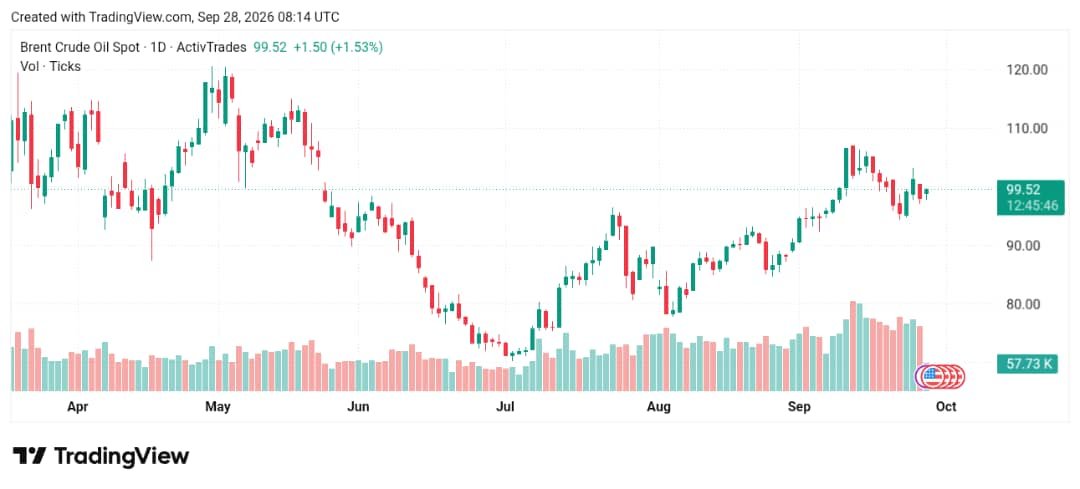
Brent crude declined $3.06, or 3%, to $99.25 a barrel at 1409 GMT, while West Texas Intermediate fell $3.95, or 4.25%, to $88.92 a barrel. Both benchmarks were heading for weekly declines. Brent was down about 4.7% for the week, while WTI had fallen around 3.7%.
European gasoil futures, an important benchmark for diesel prices, also weakened sharply, falling approximately 4.3% to $1,386.75 per metric ton. The decline followed reports that European Union countries were discussing the possibility of releasing fuel and crude reserves to ease what had been described as acute market tightness. The measures could also help address concerns over a potential US diesel export ban.
Overall, global markets remained caught between resilient economic activity and persistent inflation risks on one side, and expectations of a more patient Federal Reserve on the other. The reversal in Treasury yields provided some relief for US equities, while the sharp fall in oil prices later in the week helped ease some of the immediate inflation pressure facing global markets.