
Market Update For October 23, 2026
The Nigerian equities market returned to positive territory on Friday, October 23, 2026, ending a two-session losing streak as renewed buying interest in selected stocks lifted the benchmark index. The recovery reflected improved demand for equities, particularly stocks attracting fresh interest from investors seeking opportunities amid price adjustments and changing market conditions. However, the inability of advancing stocks to outnumber decliners suggested that the rebound remained selective rather than a broad-based recovery across the market.
The session’s performance highlighted the continuing balance between bargain hunting and profit-taking as investors reassessed their portfolios following recent losses. While gains in selected equities supported the overall market, weakness in several other stocks showed that caution remained an important feature of trading activity.
The market’s direction in the coming sessions will depend on whether the renewed buying interest can extend beyond a handful of actively traded stocks. Investors are likely to monitor corporate earnings, dividend expectations, monetary policy developments, liquidity conditions and the broader economic outlook as they position their portfolios for the remainder of the year.
Despite the latest recovery, the market has yet to establish a clear indication that the recent selling pressure has fully subsided. Sustained gains, supported by improving market breadth and stronger participation across sectors, would provide a more convincing signal of a lasting improvement in sentiment.
The rebound on Friday provided some relief following two consecutive sessions of losses, with the benchmark index gaining 0.92% as selected equities attracted renewed demand. The improvement demonstrated that investors remained willing to take positions in stocks offering perceived value, even as broader market sentiment remained uneven.
The Nigerian equities market has continued to attract attention from investors seeking returns amid changing economic conditions, evolving monetary policy expectations and developments in the domestic business environment. However, investment decisions have become increasingly dependent on individual company fundamentals, earnings prospects, dividend policies and prevailing share prices.
The latest session reflected this selective approach. Rather than witnessing a uniform rise across listed equities, the market recorded gains in some stocks alongside declines in others. This divergence suggests that investors are increasingly differentiating between companies based on their perceived growth prospects, financial performance and valuation levels.
Market breadth remained an important indicator of the underlying mood. Although the All-Share Index closed higher, the number of declining stocks exceeded advancing stocks. This suggests that the index’s performance was supported by gains in selected equities, while selling pressure persisted across other counters.
A positive index close accompanied by negative breadth does not necessarily signal an imminent reversal. However, it highlights the need to examine the distribution of gains and losses rather than relying exclusively on the benchmark index. A more sustained recovery would ideally feature a broader increase in advancing stocks, improved participation across sectors and continued demand for fundamentally sound companies.
Trading activity strengthened during Friday’s session, with 353.88 million shares valued at ₦22.30 billion exchanged in 33,539 deals. The level of turnover indicated continued participation by investors as they responded to price movements and adjusted their holdings.
However, trading volume and transaction value provide different perspectives on market activity. Volume measures the number of shares exchanged, while transaction value reflects the amount of money committed to those trades. Comparing the two can help identify whether activity is concentrated in lower-priced equities or involves substantial capital allocation to higher-value stocks.
LIVESTOCK recorded the highest trading volume, with 46.84 million shares changing hands. Its position at the top of the volume chart indicated considerable trading interest, although the stock’s sharp price decline showed that active trading did not translate into positive price performance.
ARADEL, meanwhile, recorded the highest transaction value, reflecting the concentration of substantial trading value in the stock. The activity demonstrated the importance of monitoring individual equities that account for a significant proportion of daily turnover.
Nevertheless, concentrated trading activity should not automatically be interpreted as evidence of improving market confidence. High volume can accompany accumulation, distribution, profit-taking or reactions to company-specific developments. The direction of the share price, the consistency of turnover and the broader market trend remain important considerations when assessing the significance of such activity.
For investors, the latest trading pattern reinforces the importance of examining liquidity alongside company fundamentals. Stocks with stronger liquidity may offer greater flexibility when entering or exiting positions, although liquidity alone does not determine investment quality or guarantee positive returns.
The session’s gainers and losers reflected the mixed nature of investor positioning. GUINEAINS led the gainers, while FIRSTHOLDCO, CORNERST, UPDC and WEMABANK also recorded advances. On the other hand, LIVESTOCK, TRIPPLEG, UPDCREIT, HBMNG and NEIMETH recorded notable declines.
The price movements highlight the need to distinguish between short-term market momentum and the underlying financial performance of individual companies. A sharp increase in a stock’s price may reflect renewed demand, speculative activity, changing expectations or a response to company-specific information. Similarly, a significant decline may result from profit-taking, valuation concerns or other developments affecting investor sentiment.
Investors should therefore avoid making decisions based solely on a stock’s position among the day’s top gainers or losers. A more comprehensive assessment should consider earnings growth, revenue quality, debt levels, cash flow, dividend sustainability and the company’s competitive position.
For financial services stocks, changes in interest rates, credit quality, deposit costs and the performance of investment portfolios can influence earnings expectations. For industrial and consumer-facing companies, production costs, purchasing power, access to foreign exchange and demand conditions remain important factors.
Real estate investment securities may also respond differently to changing interest rates and fixed-income yields. When yields on government securities become attractive, some investors may reduce exposure to equities and real estate investment trusts in favour of more predictable income-generating instruments. Conversely, expectations of lower interest rates may improve the relative appeal of dividend-paying stocks and other risk assets.
These differences help explain why the market can record an overall gain even when a larger number of stocks decline. Investors are not necessarily responding to the same factors across all sectors, and the performance of the benchmark index may not fully represent the experience of individual portfolios.
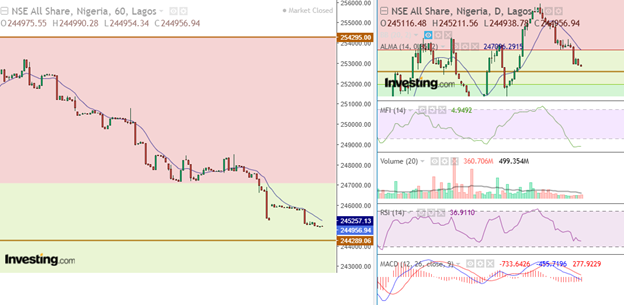
Technical Analysis
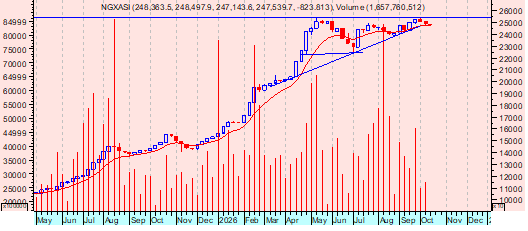
From a technical perspective, the All-Share Index’s 0.92% advance represents a recovery from the previous sessions’ weakness. The move suggests that buyers were willing to re-enter selected positions after recent price declines, potentially providing short-term support for the broader market.
However, one positive session is insufficient to establish a sustained bullish trend. Technical confirmation would require the index to maintain its upward movement in subsequent sessions, supported by stronger market breadth and continued trading participation.
The negative breadth recorded on Friday remains a key consideration. With 28 decliners against 26 advancers, selling pressure continued to affect a considerable number of listed equities despite the benchmark’s advance. If this pattern persists, the market could remain vulnerable to renewed weakness, particularly if gains in heavyweight stocks lose momentum.
Conversely, an improvement in breadth, accompanied by sustained gains in the ASI, would suggest that buying interest is spreading across the market. Such a development would provide stronger evidence that the recovery is becoming more established.
Investors should also monitor trading turnover and the behaviour of stocks that have recently experienced sharp price movements. Rising prices supported by stronger participation may indicate improving demand, while advances accompanied by weak participation could prove less durable. These signals should be considered alongside company fundamentals and prevailing economic conditions.
Without additional information on moving averages, momentum indicators, recent support and resistance levels, and the index’s latest trading range, it would be premature to assign precise technical targets or declare a confirmed trend reversal.
Market Outlook:
The near-term outlook for the Nigerian equities market remains cautiously positive following Friday’s recovery, although the negative market breadth suggests that investors should remain alert to further volatility.
The sustainability of the rebound will depend on whether buying interest continues in heavyweight stocks and extends to other segments of the market. Improved participation across sectors would strengthen the case for a broader recovery, while renewed declines in actively traded equities could weaken the index’s upward momentum.
Corporate earnings and dividend announcements are likely to remain important drivers of individual stock performance. Companies demonstrating stronger revenue growth, improved operating margins, manageable debt and healthy cash flows may attract greater investor interest, particularly where valuations remain reasonable relative to earnings prospects.
Monetary policy will also influence the relative attractiveness of equities. Changes in interest rates affect borrowing costs, consumer spending, corporate financing and the returns available on fixed-income securities. Where fixed-income yields remain competitive, investors may demand stronger earnings and dividend prospects before increasing their equity exposure.
Foreign portfolio flows, exchange-rate developments and domestic liquidity conditions will be additional factors to watch. Improvements in macroeconomic stability could support investor confidence, while uncertainty around inflation, foreign-exchange availability or corporate profitability could encourage more defensive positioning.
In the current environment, a selective investment strategy appears appropriate. Investors may focus on companies with sound fundamentals, sustainable earnings, credible growth opportunities and attractive valuations rather than chasing stocks solely because they have recorded sharp daily gains.
Risk management will remain important, particularly for investors considering stocks experiencing unusually high trading volumes or substantial price movements. Diversification, disciplined entry points and a clear investment horizon can help reduce the risk of making decisions driven by short-term market excitement.
Overall, the market’s latest recovery is encouraging, but confirmation of a sustained bullish phase will require continued index gains, stronger breadth and consistent investor participation.
Oil Market
International crude oil prices advanced on Friday as escalating attacks involving Saudi Arabia and Yemen’s Houthi movement heightened concerns about potential disruptions to energy supplies from the Middle East.
Brent crude futures gained $1.71, or 1.5%, to $114.99 per barrel by 1300 GMT, after touching $115.16 earlier in the session. The intraday high represented Brent’s strongest level since May 4. US West Texas Intermediate crude also advanced, rising $1.80, or 1.8%, to $101.27 per barrel.
The gains reflected renewed concern about the security of regional oil infrastructure and the potential consequences of further escalation. Saudi Arabia is one of the world’s largest oil exporters, making developments affecting its production facilities, export infrastructure and regional supply routes particularly important to global energy markets.
Reports that Saudi Aramco ordered the evacuation of its headquarters in Dhahran added to market concerns as fighting intensified. Reports of an oil spill in the United Arab Emirates also contributed to uncertainty surrounding regional energy infrastructure.
Brent was on course for a weekly increase of 4.4%, marking its third consecutive weekly gain. WTI, however, was positioned to finish the week 0.4% lower, demonstrating that the two benchmarks were responding differently to supply expectations and market conditions.
The latest price movement underscores the sensitivity of oil markets to geopolitical developments. When traders anticipate possible supply disruptions, prices can rise as markets account for the risk that fewer barrels may be available to meet global demand. The scale and duration of such movements ultimately depend on whether actual supply losses occur, how long disruptions persist and whether other producers can compensate for reduced output.
Friday’s session offered a positive development for the Nigerian equities market after two consecutive days of losses. However, the combination of a higher benchmark index and negative market breadth suggests that investors have not yet demonstrated broad-based confidence across the market.
The next phase of trading will be important in determining whether the recovery can be sustained. Continued gains in the ASI, improved breadth and consistent participation would strengthen the outlook, while renewed selling pressure could leave the market vulnerable to further fluctuations.
Investors should remain focused on company fundamentals, valuation, earnings quality and dividend prospects while monitoring changes in monetary policy, domestic liquidity and global commodity prices. Although stronger oil prices could support Nigeria’s external earnings, their broader impact will depend on domestic production and the transmission of additional revenue into the economy.
Market Summary and Performance: The NGX All-Share Index (ASI) gained 2,265.33 points, or 0.92%, to close at 247,222.27 points on Friday, October 23, 2026, compared with 244,956.94 points in the previous session. Market capitalisation increased by approximately ₦1.47 trillion to ₦160.52 trillion, while the year-to-date return stood at 58.87%. Despite the positive performance, market breadth remained negative, with 26 advancers, 28 decliners and 92 unchanged stocks. Total trading volume stood at 353.88 million shares, valued at ₦22.30 billion in 33,539 deals. LIVESTOCK led volume with 46.84 million shares, while ARADEL recorded the highest transaction value. Top Gainers: GUINEAINS (+9.41% to ₦0.93), FIRSTHOLDCO (+6.87% to ₦140.00), CORNERST (+4.35% to ₦4.80), UPDC (+4.17% to ₦3.75) and WEMABANK (+3.45% to ₦30.00). Top Losers: LIVESTOCK (-9.79% to ₦17.05), TRIPPLEG (-8.74% to ₦2.82), UPDCREIT (-8.14% to ₦17.50), HBMNG (-7.65% to ₦350.00) and NEIMETH (-6.58% to ₦7.10).