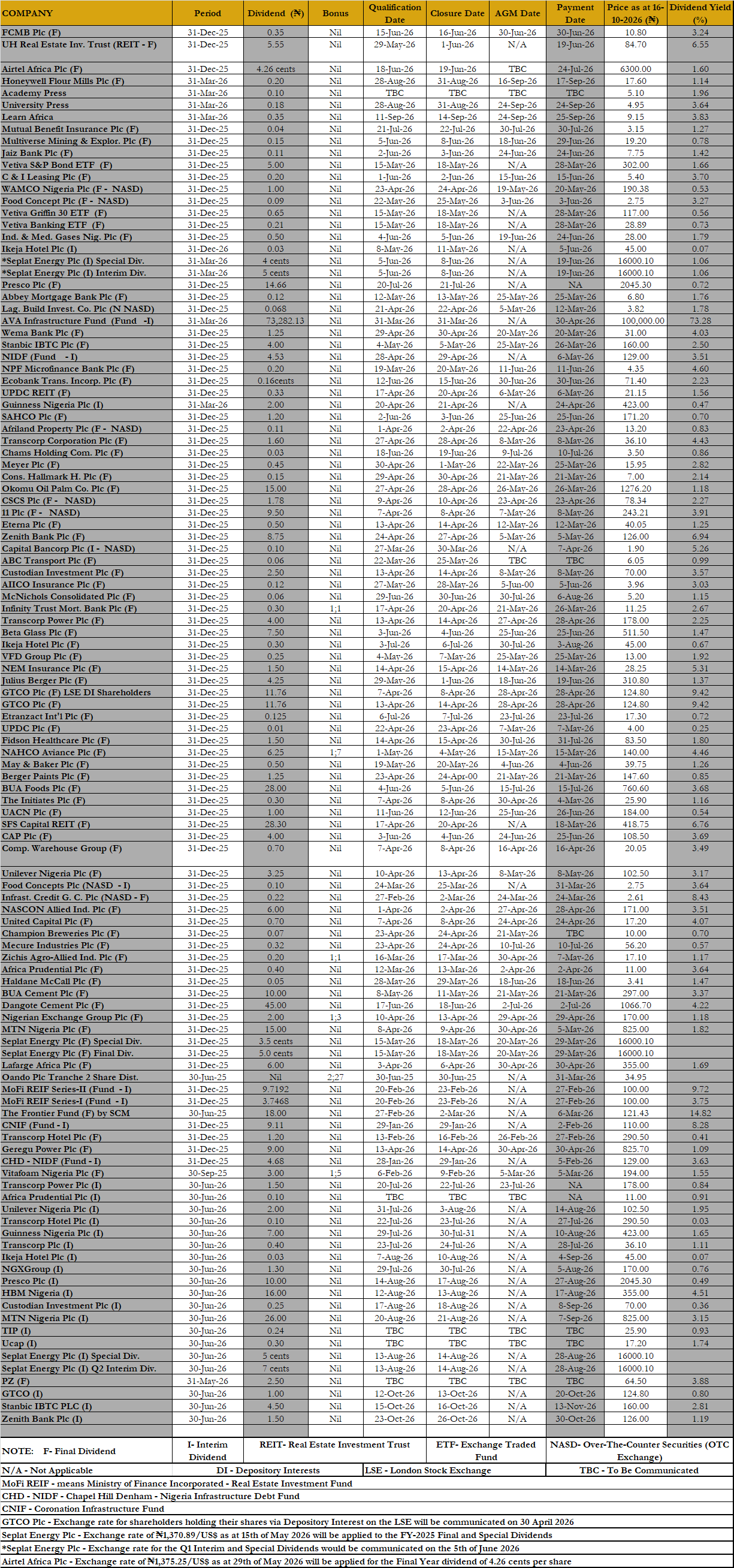

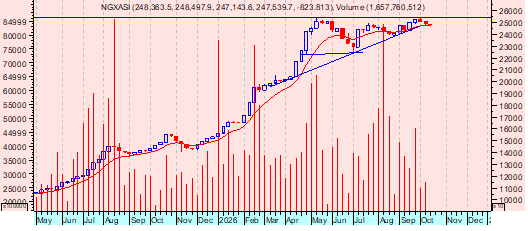
The Nigerian equities market recorded a mixed trend in the week under review, with the composite All-Share index closing in the red for three trading sessions and green in two to finish the period lower. This extended the market’s negative outing for a third consecutive week on sector rotation and profit-taking in some selected stocks, a situation that weighed on the market. The NGXASI fell 0.33% to 247,539.73 points, while market capitalisation stood at ₦160.725 trillion. Despite the decline, market breadth improved for the week, with more stocks advancing than declining.
Trading activity weakened during the week, with investors exchanging 1.659 billion shares valued at ₦98.088 billion in 184,632 deals, compared with 2.715 billion shares worth ₦158.280 billion in 209,986 deals in the preceding week.
The Financial Services Industry dominated trading, recording 1.083 billion shares worth ₦48.967 billion in 86,994 deals, representing 65.31% of total volume and 49.92% of turnover value. Agriculture ranked second with 129.650 million shares valued at ₦2.182 billion in 8,650 deals, while ICT followed with 87.909 million shares worth ₦6.964 billion in 19,017 deals. Access Holdings Plc, United Bank for Africa Plc and Livestock Feeds Plc led individual stocks by volume, with a combined 413.964 million shares valued at ₦12.158 billion traded in 18,365 deals. Their transactions accounted for 24.96% of total equity turnover volume and 12.40% of turnover value.
Despite the benchmark’s decline, seven indices advanced. Led by the Oil and Gas Index which gained 3.13%, followed by the Commodity Index at 2.36%, Lotus II Index at 0.88%, and Main Board Index at 0.50%. The Growth Index rose 0.07%, Consumer Goods gained 0.09%, while Industrial Goods edged up 0.004%. The Sovereign Bond Index closed unchanged, while all other indices declined. Market breadth improved significantly, with 50 equities appreciating against 30 decliners. A total of 66 equities closed unchanged, down from 68 previously, indicating broader buying interest despite the negative performance of the benchmark index.
Week-to-date, NGX 30 is down by 0.41%, the Banking Index has decreased by 3.15%, the Pension Index decreased by 0.70%, the Insurance Index declined by 0.14%, the Consumer Goods Index increased by 0.09%. However, the Oil and Gas Index recorded a positive return of 3.13%. Year-to-date, the All-Share Index has gained 59.07%, NGX 30 is up by 60.44%, the Banking Index has increased by 67.07%, the Pension Index increased by 81.16%, the Insurance Index declined by 9.23%, the Consumer Goods Index increase by 1.55%. However, the Oil and Gas Index recorded a positive return of 131.96%.
NGXASI Daily Index Action
The week’s trading started on a negative note, halting the previous session’s recovery, as the index closed 0.25% lower at 247,736.24 basis points, which reduced year-to-date return to 59.20%. Market capitalisation fell by ₦407.30 billion. OANDO led the losers with a 7.56% drop, followed by ACCESSCORP (-4.24%) and ZENITHBANK (-4.23%). Market breadth was negative, with 31 losers against 26 gainers. Trading volume rose 25.88% to 405.39 million shares worth ₦19.87 billion in 52,977 deals.
On Tuesday, the ASI shed 0.09% to close at 247,513.63 points, while its year-to-date return declined to 59.06%. Market capitalisation stood at ₦160.71 trillion. WEMABANK led the decliners with a 2.58% loss, while ETRANZACT topped the gainers. Market breadth was positive, with 24 gainers against 21 losers. Trading volume declined 2.76% to 394.20 million shares valued at ₦21.38 billion in 38,707 deals. ACCESSCORP recorded the highest volume, while GTCO led by value with ₦3.13 billion.
At the midweek’s session, there was a mild recovery as the ASI inched up by 0.06% to close at 247,673.65 points, lifting its year-to-date return to 59.16%. Market capitalisation increased by ₦103.90 billion to ₦160.81 trillion. AFRIPRUD led the gainers with a 5.88% appreciation, while market breadth remained positive at 34 gainers against 25 losers. Trading volume fell 20.12% to 314.90 million shares worth ₦28.59 billion in 30,922 deals. ACCESSCORP recorded the highest volume, while SEPLAT led by value with ₦14.46 billion.
The rebound was extended to Thursday, when the NGXASI rose marginally again by 0.01% to 247,707.13 points, improving its year-to-date return to 59.18%. Market capitalisation increased by ₦21.74 billion. CWG led the gainers with a 9.86% rise, although market breadth turned negative, with 33 losers against 28 gainers. Trading volume declined 8.96% to 286.68 million shares valued at ₦15.25 billion in 30,186 deals. UBA recorded the highest volume, while GTCO led by traded value with ₦2.44 billion.
The market reversed its two-session recovery on Friday when the benchmark index NGXASI fell 0.07% to 247,539.73 points, reducing its year-to-date return to 59.07%. Market capitalisation declined by ₦108.70 billion to ₦160.725 trillion. UPDCREIT led the losers with a 10.00% drop, while market breadth recorded 26 decliners against 23 gainers. Trading volume fell 10.10% to 257.73 million shares worth ₦13.07 billion in 32,032 deals. UBA led by volume, while ZENITHBANK recorded the highest traded value at ₦2.09 billion.
Livestock Feeds Plc
Livestock Feeds Plc emerged as the week’s top gainer, advancing by ₦5.85, or 44.49%, from an opening price of ₦13.15 to close at ₦19.00. E-Tranzact International Plc followed, gaining ₦5.20, or 42.98%, from ₦12.10 to ₦17.30. Multi-Trex Integrated Foods Plc rose by ₦0.18, or 42.86%, from ₦0.42 to ₦0.60, while Austin Laz & Company Plc gained ₦0.72, or 32.73%, from ₦2.20 to ₦2.92. Omatek Ventures Plc completed the top five gainers, appreciating by ₦0.26, or 19.40%, from ₦1.34 to ₦1.60.
UPDC REITs
On the losing side, UPDC Real Estate Investment Trust recorded the largest decline, shedding ₦2.85, or 11.88%, from ₦24.00 to ₦21.15. Nigerian Enamelware Plc fell by ₦4.05, or 9.95%, from ₦40.70 to ₦36.65, while NASCON Allied Industries Plc lost ₦17.90, or 9.48%, to close at ₦171.00 from ₦188.90. Trans-Nationwide Express Plc declined by ₦0.27, or 9.09%, from ₦2.97 to ₦2.70, while LivingTrust Mortgage Bank Plc dropped by ₦0.27, or 8.44%, from ₦3.20 to ₦2.93.
NGX Weekly Comparative Analysis
The Nigerian Exchange extended its bearish performance in the week ended October 16, 2026, as profit-taking continued to weigh on selected stocks, although the pace of decline moderated. The NGX All-Share Index (ASI) fell by 0.33% to 247,539.73 points, compared with a 0.97% decline to 248,363.55 points in the preceding week. Market capitalisation declined to ₦160.725 trillion from ₦161.260 trillion, representing a loss of approximately ₦535 billion, compared with a much steeper reduction in the previous week.
The market’s year-to-date return eased to 59.07% from 59.60%, reflecting a continued moderation in cumulative gains. However, the smaller weekly decline suggests that selling pressure weakened relative to the previous week, when the market recorded losses across most trading sessions before a modest Friday recovery. In the latest week, the market experienced two consecutive sessions of marginal gains on Wednesday and Thursday before reversing on Friday.
Trading activity weakened significantly during the week. Total volume declined by 38.89% to 1.659 billion shares from 2.715 billion shares in the previous week. Transaction value fell by 38.02% to ₦98.088 billion from ₦158.280 billion, while the number of deals decreased by 12.07% to 184,632 from 209,986. The decline across all three indicators points to reduced trading participation and lower turnover compared with the preceding week.
The Financial Services Industry remained the dominant contributor to market activity, accounting for 1.083 billion shares valued at ₦48.967 billion, representing 65.31% of total volume and 49.92% of transaction value. However, this was lower than the previous week’s 2.005 billion shares worth ₦82.924 billion, which represented 73.84% of total volume and 52.39% of turnover value. Agriculture ranked second in the latest week, with 129.650 million shares valued at ₦2.182 billion, while ICT recorded 87.909 million shares worth ₦6.964 billion.
Trading in major equities also moderated. Access Holdings Plc, United Bank for Africa Plc and Livestock Feeds Plc jointly recorded 413.964 million shares valued at ₦12.158 billion in 18,365 deals during the latest week. Their transactions represented 24.96% of total volume and 12.40% of turnover value. In contrast, Access Holdings, Zenith Bank and United Bank for Africa accounted for 1.020 billion shares worth ₦50.520 billion in the previous week, representing 37.56% of total volume and 31.92% of transaction value. The change in the most actively traded stocks also reflects a reduction in the concentration of turnover among the leading equities.
Market breadth improved considerably despite the benchmark’s continued decline. The latest week recorded 50 gainers against 30 losers, compared with 24 gainers and 54 losers in the preceding week. The number of unchanged stocks declined slightly to 66 from 68. This improvement suggests that buying interest broadened across the market, even as losses in selected large-cap stocks continued to weigh on the ASI.
Sectoral performance also showed signs of resilience. Seven indices advanced during the latest week, led by the Oil and Gas Index, which gained 3.13%, and the Commodity Index, which rose 2.36%. The Lotus II Index advanced 0.88%, while the Main Board Index gained 0.50%. Consumer Goods rose 0.09%, the Growth Index added 0.07%, and Industrial Goods edged up 0.004%. The Sovereign Bond Index closed unchanged, while the remaining indices declined. This contrasted with the previous week, when the NGX Industrial Goods Index, which gained 0.02%, was the only index reported to have closed in positive territory.
Overall, the Nigerian equities market remained under pressure during the week ended October 16, 2026, but the magnitude of its decline moderated from 0.97% to 0.33%. Market breadth improved, and selected sectoral indices recorded gains, indicating stronger buying interest in some equities. Nevertheless, the substantial reduction in trading volume, transaction value and deal count highlights weaker market activity. With profit-taking still influencing price movements, the market’s near-term direction will likely depend on renewed investor demand, performance in large-cap stocks and the ability of advancing sectors to sustain their momentum.
Technical Analysis View
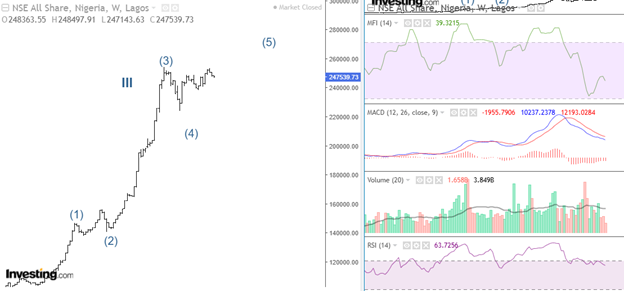
The Nigerian equities market ended the week on a bearish note, with the NGX All-Share Index declining 0.33% to close at 247,539.73 points. The index’s retreat from Thursday’s 247,707.13 points suggests that selling pressure remains present, despite modest gains recorded earlier in the week. The decline also reflects investors’ continued profit-taking following the market’s substantial year-to-date appreciation of 59.07%. Market internals improved, with 50 stocks advancing against 30 decliners, indicating underlying buying interest in selected equities. However, the significant decline in weekly trading volume and turnover suggests weaker market participation. The divergence between the benchmark index and market breadth points to a mixed market structure, with gains in some stocks offset by losses in others.
The composite index NGXASI’s ability to sustain support around the 247,000-point region will be important in determining its near-term direction. A recovery above 248,000 points could strengthen bullish sentiment, while sustained selling pressure below the current level could expose the market to further weakness. Trading volume and the performance of large-cap stocks will remain important indicators of the strength of any potential recovery.
Market Outlook
The outlook for the Nigerian equities market remains cautious, with the possibility of further profit-taking competing with bargain-hunting opportunities in fundamentally sound stocks. Investors are likely to remain selective, focusing on corporate earnings, dividend prospects, valuation, and macroeconomic developments. A sustained recovery would require stronger buying interest in large-cap stocks, improved trading activity, and continued positive market breadth. Conversely, persistent selling pressure and weak turnover could limit gains and keep the benchmark under pressure.
Overall, the market may experience mixed trading in the near term as investors reposition their portfolios. Attention will remain on banking, oil and gas, and other liquid stocks, while developments in inflation, interest rates, and corporate earnings could influence sentiment.
Trending in the Economy: The Federal Government spent ₦7.7tn on debt servicing in the first half of 2026, exceeding its ₦6.2tn revenue, according to the World Bank. Capital expenditure fell to ₦700bn, while public debt reached ₦177tn in 2025. The bank urged the government to improve revenue generation and lower borrowing costs to free up funds for development.
Nigeria’s headline inflation eased to 14.63% in September 2026 from 15.39% in August, according to the NBS. Month-on-month inflation slowed to 0.06% from 0.71%, supported by falling food prices. Food inflation declined to -1.55%, while annual core inflation dropped to 12.95%. However, monthly core inflation rose to 1.11% from -0.06%, indicating renewed underlying price pressures.
Global Market and Oil: U.S. equities ended lower on Friday, as selling pressure in artificial intelligence (AI) and technology stocks weighed on the major indices. The S&P 500 fell 1.09% to close at 7,659.44 points, while the Nasdaq Composite declined 2.14% to 26,140.03 points. The Dow Jones Industrial Average lost 0.34% to settle at 52,002.41 points.
Technology stocks led the decline as investors reassessed valuations and the outlook for companies heavily exposed to AI spending. CoreWeave plunged 11.91% to $61.39, extending its losses over five sessions to approximately 25%. Broadcom fell 4.52% to $328.75, Meta Platforms declined 3.72% to $709.325, Netflix dropped 2.86% to $70.53, and Tesla shed 2.13% to $354.72. Procter & Gamble gained 1.45% to $159.33, while Walt Disney slipped 0.08% to $110.57.
The weakness extended across the semiconductor sector, with the Philadelphia Semiconductor Index falling sharply as investors continued to question whether the expected returns from AI-related investments would justify current valuations. The communication services and information technology sectors of the S&P 500 declined 2.52% and 2.38%, respectively.
Despite Friday’s losses, the weekly performance of the major indices was mixed. The Nasdaq fell approximately 4.5% for the week, while the S&P 500 declined 1.9% and the Russell 2000 lost 3.0%. The Dow, however, advanced 0.7%. Year to date, the Nasdaq remained up 12.5%, followed by the S&P 500 at 11.9%, the Russell 2000 at 9.6%, and the Dow at 8.2%.
Market breadth reflected the pressure on individual stocks. The S&P 500 recorded 19 new 52-week highs and one new low, while the Nasdaq registered 51 new highs and 353 new lows.
Investors are also monitoring developments around Anthropic, as reports of discussions about a lower valuation for its planned initial public offering have raised questions about the pricing of private AI companies. Attention is turning to the upcoming corporate earnings season, with Tesla, Meta Platforms and Procter & Gamble scheduled to report results. Analysts expect quarterly earnings growth of more than 30%, largely supported by major technology companies and continued investment in artificial intelligence.
Monetary policy remains another important consideration. The Federal Reserve is widely expected to leave interest rates unchanged at its October meeting. Barclays has revised its outlook and now anticipates 25-basis-point rate increases in December and January, reflecting concerns about inflationary pressures. Kevin Warsh has also expressed optimism about the resilience of the U.S. economy.
European equities closed higher on Friday, with the STOXX 600 gaining 0.7% to 644.74 points. The index rose more than 2% for the week, recording its strongest weekly performance since late June. Nordex surged 12.3% to €39.14, while Aixtron advanced 6.0%. Schneider Electric declined 1.82% to €253.30, while Nestlé gained 1.7% following an upgrade from JPMorgan.
The healthcare sector slipped 0.3%, retreating after gains of 4.6% over the preceding two sessions.
Corporate earnings expectations supported the broader market outlook. Analysts expect third-quarter earnings among STOXX 600 companies to rise 20.7% year on year, while revenues are projected to increase 11%. Energy companies are expected to record earnings growth of 124%, while the technology sector is forecast to expand by 32.7%. Consumer cyclical earnings, however, are projected to decline 2.6%.
Investors are preparing for results from major European companies, including SAP, ABB and Barclays, next week. Their reports could provide further insight into corporate demand, profitability and the impact of higher costs. Inflation remains a key concern for policymakers. Eurozone annual inflation reached 3.8% in September, well above the European Central Bank’s 2% target. Following 50 basis points of interest-rate increases in 2026, which brought the policy rate to 2.50%, investors are anticipating another 25-basis-point increase in December.
The combination of inflationary pressures, interest-rate expectations and corporate earnings will remain central to European market performance in the coming weeks. Oil prices climbed sharply on Friday as escalating geopolitical tensions and concerns about potential supply disruptions lifted energy markets. Brent crude futures advanced 3.7%, gaining $3.94 to settle at $109.86 per barrel, their highest level since May 19. U.S. West Texas Intermediate crude rose 3.5%, or $3.44, to $101.41 per barrel, marking its highest level since September 17.
For the week, Brent crude gained 4.9%, while WTI advanced 10.4%, reflecting heightened concerns about the security of global oil supplies. Market sentiment was influenced by tensions in the Middle East, risks surrounding the Strait of Hormuz and threats to energy infrastructure. The Strait of Hormuz is a critical shipping route through which a substantial portion of global oil supplies passes, making any disruption a major concern for energy markets.
Additional pressure came from developments in Russia. The Ryazan refinery suspended a primary crude distillation unit following a drone attack, raising concerns about potential disruptions to refining capacity. Saudi Arabia also reported intercepting a ballistic missile directed towards Yanbu, although no damage was reported. Investors remain concerned that further escalation could threaten regional oil production, transportation and export infrastructure.
Supply-management efforts have also attracted attention. The International Energy Agency agreed to release more than 20 million barrels of fuel, while the United States sought proposals for an exchange involving up to 17 million barrels of crude oil from its Strategic Petroleum Reserve.
Despite these measures, the latest price movements indicate that geopolitical risks remain a major influence on the oil market. Further escalation could sustain upward pressure on crude prices, while a reduction in tensions or additional supply could ease the rally.
Global Market Outlook
Global financial markets are entering the coming week with different forces shaping investor sentiment. In the United States, pressure on AI and technology stocks has highlighted concerns about valuations and the sustainability of earnings growth. Upcoming corporate results and the Federal Reserve’s policy outlook will be important drivers of trading activity.
European equities have benefited from a strong weekly performance, but persistent inflation and interest-rate uncertainty could limit further gains. Meanwhile, the sharp rise in oil prices presents an additional challenge for policymakers, as higher energy costs could reinforce inflationary pressures and complicate the outlook for monetary easing. Investors are likely to remain sensitive to corporate earnings, central-bank signals and geopolitical developments as they assess the direction of global markets