
Market Update For October 15, 2026
The Nigerian equities market sustained its recovery on Thursday, October 15, 2026, as selective buying interest in banking, energy and other actively traded stocks lifted the benchmark All-Share Index (ASI) marginally higher. The market’s performance reflected cautious investor positioning, with gains in selected equities providing support despite continued profit-taking in other stocks.
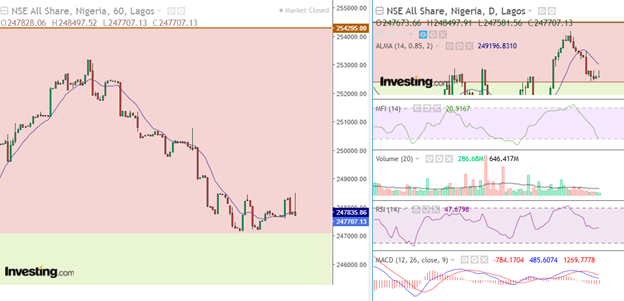
The ASI advanced by 33.48 points, representing a 0.01% increase, to close at 247,707.13 points, compared with 247,673.65 points recorded in the previous session. The marginal appreciation extended the market’s recovery, although the limited gain suggested that investors remained cautious about increasing their exposure to equities at current price levels.
The market’s year-to-date return rose to 59.18%, highlighting the substantial appreciation recorded since the beginning of the year. However, the latest performance indicates that sustaining the market’s upward trajectory may require stronger participation from investors, improved market breadth and increased demand across more sectors.
Market capitalisation also advanced by ₦21.74 billion to close at ₦160.83 trillion, reflecting the modest increase in the overall value of listed equities. Despite the improvement, trading remained selective, as investors continued to reposition their portfolios in response to individual stock valuations, corporate earnings prospects and prevailing economic conditions.
The session’s performance was supported by buying interest in stocks such as CWG, LIVESTOCK, ARADEL, INTBREW, JAIZBANK, AIICO, AFRIPRUD, ETI, OANDO, FIRSTHOLDCO, FIDELITYBK and UBA. Gains across these counters helped sustain the benchmark’s positive close, although losses in several other equities limited the extent of the market’s appreciation.
The mixed performance suggests that investors are increasingly differentiating between stocks based on their individual prospects rather than participating in a broad-based rally. This pattern may continue in the near term as market participants assess earnings expectations, dividend potential, valuation levels and the outlook for interest rates and inflation.
Trading activity weakened during Thursday’s session, indicating a moderation in market participation despite the benchmark’s marginal advance. Total traded volume declined by 8.96% to 286.68 million shares, compared with the previous session, while the value of transactions reached ₦15.25 billion across 30,186 deals.
The decline in volume suggests that investors adopted a more measured approach to trading, with activity concentrated in selected stocks. Although the market recorded a positive close, the reduction in turnover indicates that the advance was not accompanied by stronger overall trading participation.
UBA dominated trading by volume, with 36.37 million shares exchanged, representing 12.69% of total market volume. Its position among the most actively traded stocks highlights continued investor interest in the banking sector, which remains an important component of activity on the Nigerian Exchange.
GTCO recorded the highest transaction value at approximately ₦2.44 billion, accounting for 15.98% of total traded value. The stock’s contribution underscores the importance of large-cap banking equities in determining market turnover and attracting institutional and retail investor interest.
ACCESSCORP also featured prominently among the most actively traded stocks by volume, while ARADEL and ZENITHBANK followed GTCO among the leading stocks by transaction value.
The concentration of trading in banking and selected energy stocks suggests that investors continued to favour relatively prominent market counters. Such activity can support liquidity in individual equities, although a sustained market recovery would benefit from broader participation across consumer goods, industrial, insurance and other listed sectors.
The decline in trading volume also raises questions about the strength of the latest advance. While a positive close indicates that buying interest remained sufficient to lift the benchmark, stronger turnover would provide additional evidence that investors are becoming more confident about the market’s near-term direction.
The market’s performance reflected a combination of selective buying and profit-taking, with individual stocks responding differently to prevailing investment considerations.
CWG, LIVESTOCK, ARADEL, INTBREW, JAIZBANK, AIICO, AFRIPRUD, ETI, OANDO, FIRSTHOLDCO, FIDELITYBK and UBA were among the stocks supporting the market through their positive price movements.
The performance of banking stocks was particularly relevant, given the sector’s influence on market activity and investor positioning. Gains in JAIZBANK, ETI, FIDELITYBK and UBA helped sustain buying interest in the financial services space, while GTCO and ZENITHBANK remained important contributors to trading value.
Investor interest in banking stocks may continue to reflect expectations about earnings performance, asset quality, dividend prospects and the implications of monetary policy for lending activities and investment returns. However, the performance of individual banks is likely to remain differentiated by their financial results, capital positions and market valuations.
Energy-related equities also attracted attention, with ARADEL and OANDO recording gains. Their performance comes against the backdrop of elevated international oil prices and continuing uncertainty surrounding global supply, shipping costs and geopolitical developments.
Higher crude oil prices can support revenue expectations for upstream producers, although the benefits depend on production levels, operating costs, foreign exchange conditions and other company-specific factors. For downstream businesses, changes in crude prices and refined-product costs can have different implications for margins, working capital and consumer demand.
Consumer-related stocks also showed mixed performance. While LIVESTOCK and INTBREW recorded gains, NASCON and ELLAHLAKES featured among the session’s notable decliners. This divergence highlights the importance of company-specific fundamentals, pricing power, operating costs and consumer purchasing capacity in determining equity performance.
The broader market therefore remains characterised by selective opportunities, with investors balancing potential capital appreciation against valuation risks and the possibility of further price corrections.
Market breadth offered a mixed picture of investor sentiment during the session. The supplied market reports presented slightly different breadth figures: one recorded 28 advancing stocks against 33 decliners, while another reported 29 gainers and 28 losers, with 89 stocks closing unchanged.
Despite the discrepancy, the figures point to a market in which gains and losses were closely balanced, rather than one experiencing a decisive, broad-based advance.
The near-even distribution of price movements suggests that the benchmark’s appreciation was supported by selected stocks rather than a widespread improvement in sentiment across the exchange. This distinction is important because an index can rise even when a considerable number of listed equities decline, particularly when gains occur in stocks with substantial market influence.
Where advancing stocks consistently outnumber declining stocks, market breadth can provide additional confirmation of an upward trend. Conversely, persistent weakness in breadth may indicate that the benchmark’s gains are concentrated in a limited number of counters and that the wider market remains vulnerable to profit-taking.
Investors will therefore need to monitor the relationship between index performance, market breadth and trading volume in subsequent sessions. An improvement across these indicators would strengthen the case for a more sustainable recovery, while continued divergence could signal that the market is struggling to establish a firm upward direction.
Oil Market
Developments in the international oil market remained an important consideration for Nigerian investors on Thursday, as crude prices moved in opposite directions amid changing expectations about supply, shipping conditions and US policy towards Russian oil-related trade.
Brent crude, the international benchmark, declined by 1.42% to $104.55 per barrel, while US West Texas Intermediate (WTI) rose by 0.76% to $95.81 per barrel during the reported trading period.
Brent’s decline followed renewed attention to possible US measures to ease restrictions affecting tankers associated with Russia’s so-called shadow fleet. Any relaxation could improve vessel availability and reduce transportation costs and war-risk premiums that have contributed to higher freight rates.
The discussions came days after President Donald Trump temporarily lifted sanctions on Russian diesel fuel in an effort to ease pressure on global fuel prices. The possibility of further adjustments to restrictions on oil-related shipping and trade has introduced another source of uncertainty into the energy market.
WTI, meanwhile, advanced amid expectations of a substantial drawdown in US crude inventories. A decline in inventories can signal stronger demand or tighter supply conditions, although the actual market impact depends on the scale of the drawdown and other developments affecting production and consumption.
For Nigeria, movements in international crude prices have implications for government revenue, foreign exchange inflows and the broader macroeconomic environment. Higher prices may support export earnings, but the benefits depend on domestic production levels, operating costs and the volume of crude available for export.
On the equities market, oil-price movements may influence investor sentiment towards energy stocks, particularly companies exposed to exploration, production, refining and petroleum distribution. However, crude prices alone do not determine share-price performance, as company earnings, production efficiency, financing costs and operational risks remain important considerations.
The mixed movement in Brent and WTI also reinforces the need for investors to distinguish between developments in international benchmarks and the specific fundamentals of Nigerian-listed energy companies.
Beyond daily price movements, the outlook for Nigerian equities remains closely linked to domestic macroeconomic conditions, monetary policy, corporate earnings and investor confidence.
Interest rates remain an important factor in asset allocation decisions because they influence the relative attractiveness of equities, fixed-income securities and other investment instruments. When yields on government securities are attractive, some investors may prefer relatively predictable fixed-income returns to the uncertainty associated with equity investments.
Conversely, expectations of improving corporate earnings, easing inflationary pressures or more favourable monetary conditions may encourage renewed demand for stocks, particularly companies with strong balance sheets and sustainable cash flows.
Inflation and consumer purchasing power are also important considerations for listed companies. Businesses operating in consumer-facing sectors may continue to contend with elevated input costs and pressure on household spending, making pricing power and cost management important determinants of profitability.
For banks, investors will continue to assess earnings quality, loan growth, asset quality and capital adequacy. For industrial and consumer companies, attention is likely to remain on production costs, demand conditions, margins and the ability to pass higher costs on to customers.
The market’s substantial year-to-date appreciation may also encourage profit-taking in stocks that have recorded strong gains. As valuations adjust, investors may become increasingly selective, favouring companies whose earnings prospects and financial strength support their current share prices.
Against this backdrop, disciplined stock selection and a focus on fundamentals remain important. Investors may benefit from assessing companies individually rather than relying solely on the direction of the benchmark index.
Technical Analysis and Market Outlook
From a technical perspective, the ASI’s marginal advance to 247,707.13 points indicates an attempt to maintain its recovery, but the small gain suggests that bullish momentum remains limited.
The market is trading below the psychologically significant 250,000-point level, which represents an important resistance area to monitor. A sustained move above this threshold, supported by stronger turnover and improving market breadth, could reinforce positive sentiment and create room for further upward movement.
On the downside, the 247,000-point region represents a near-term support area to watch. A sustained hold above this level could help the market consolidate its recent gains and build a base for a stronger recovery. However, a decisive break below support could expose the index to renewed selling pressure as investors reduce positions or lock in profits.
These levels are indicative reference points rather than confirmed technical signals. Subsequent price action, trading volume and the behaviour of leading stocks will be important in determining whether the market can sustain its recovery.
The outlook for the next trading session remains cautiously positive but vulnerable to renewed volatility. Continued buying interest in banking, energy and other fundamentally strong stocks could support the benchmark, while a further decline in trading activity or worsening market breadth may limit gains.
Investors should monitor the ASI’s response around nearby support and resistance levels, alongside changes in turnover and the distribution of advancing and declining stocks. A coordinated improvement across these indicators would provide stronger confirmation of a sustained recovery than a marginal index gain alone.
The market is also likely to remain sensitive to global oil-price movements, domestic monetary conditions, corporate disclosures and developments affecting investor confidence. In this environment, a selective investment approach focused on valuations, earnings quality, dividend prospects and balance-sheet strength remains appropriate.
Market Summary: The Nigerian Exchange closed marginally higher on Thursday, October 15, 2026, as the All-Share Index gained 33.48 points, or 0.01%, to close at 247,707.13 points, while market capitalisation increased by ₦21.74 billion to ₦160.83 trillion. The market’s year-to-date return rose to 59.18%. Total traded volume declined by 8.96% to 286.68 million shares, valued at ₦15.25 billion across 30,186 deals. UBA led trading volume with 36.37 million shares, while GTCO recorded the highest transaction value at ₦2.44 billion. Market breadth was mixed across the supplied reports, with one recording 28 advancers and 33 decliners, while the other reported 29 gainers and 28 losers, alongside 89 unchanged stocks. Market movers included CWG, LIVESTOCK, ARADEL, INTBREW, JAIZBANK, AIICO, AFRIPRUD, ETI, OANDO, FIRSTHOLDCO, FIDELITYBK and UBA. Top gainers: MULTITREX (+10.00%) to ₦0.55, ZICHIS (+10.00%) to ₦17.93, AUSTINLAZ (+9.92%) to ₦2.66, CWG (+9.86%) to ₦20.05 and OMATEK (+9.77%) to ₦1.46. Top losers: NASCON (-9.48%) to ₦171.00, GUINEAINS (-9.00%) to ₦0.91, THOMASWY (-6.38%) to ₦2.20, DAARCOMM (-6.37%) to ₦1.47 and ELLAHLAKES (-5.03%) to ₦7.55.