

It was a bearish week on the Nigerian Exchange as profit-taking and other market dynamics weighed on share prices, pushing the composite NGX All-Share Index and market capitalisation lower by 0.97%. Despite a seeming recovery on Friday, selling pressure dominated most of the week’s sessions, while market breadth weakened as decliners outnumbered advancers during the period. The daily index action below revealed the trend.
NGX recovered slightly on the last trading day of the week, as the market gained 0.13% to close at 248,363.55 points, ending a seven-session losing streak. Market capitalisation increased by ₦208.46 billion to ₦161.26 trillion, while YTD return improved to 59.60%. CAP advanced 8.50% and OANDO gained 6.90% to lead the gainers. However, market breadth remained negative, with 31 decliners against 22 advancers. Trading volume declined 34.57% to 322.04 million shares valued at approximately ₦20.50 billion, with ZENITHBANK leading trading activity.
Throughout the week, investors exchanged 2.715 billion shares valued at ₦158.280 billion in 209,986 deals, compared with 3.166 billion shares worth ₦155.023 billion across 206,662 deals in the previous week. Trading volume declined by approximately 14.23%, while transaction value increased by 2.10% and the number of deals rose by 1.61%, indicating a higher average transaction value despite reduced share turnover.
The Financial Services sector dominated trading, accounting for 2.005 billion shares valued at ₦82.924 billion in 94,483 deals. The sector contributed 73.84% of total equity turnover volume and 52.39% of transaction value. Consumer Goods ranked second, with 152.345 million shares worth ₦11.425 billion in 20,926 deals, while ICT recorded 117.296 million shares valued at ₦15.256 billion across 22,556 deals.
Access Holdings, Zenith Bank and United Bank for Africa remained among the most actively traded equities, jointly recording 1.020 billion shares worth ₦50.520 billion in 29,382 deals. Their combined transactions accounted for 37.56% of total equity turnover volume and 31.92% of turnover value, highlighting the continued dominance of major banking stocks in overall market activity.
Market breadth weakened as 24 equities appreciated in price against 54 decliners, while 68 stocks closed unchanged. Most sectoral indices ended lower, with the NGX Industrial Goods Index recording a marginal gain of 0.02%, making it the only sectoral index to close in positive territory. Persistent profit-taking, weaker market breadth and reduced trading volume underscored cautious investor sentiment, although the final session’s rebound suggested renewed buying interest in selected equities.
Week-to-date, NGX 30 was down by 0.99%, the Banking Index has decreased by 2.64%, the Pension Index decreased by 2.12%, the Insurance Index declined by 1.74%, the Consumer Goods Index decreased by 0.58%. However, the Oil and Gas Index recorded a negative return of 3.85%. Year-to-date, the All-Share Index has gained 59.60%, NGX 30 is up by 61.10%, the Banking Index has increased by 72.50%, the Pension Index increased by 82.43%, the Insurance Index declined by 9.10%, the Consumer Goods Index increase by 1.46%. However, the Oil and Gas Index recorded a positive return of 124.92%.
NGXASI Daily Index Action
Trading for the week opened weak and lower, as the Benchmark index ASI declined by 0.06% to 250,667.86 points extending the previous session negative position. Year-to-date (YTD) return eased to 61.08%, while market capitalisation fell by ₦91.16 billion. AFRIPRUD and NESTLE led the losers, shedding 7.31% and 5.17%, respectively, while SOVRENINS topped the gainers. Market breadth was negative, with 35 decliners against 28 advancers. Trading volume increased by 57.10% to 875.28 million shares valued at ₦40.88 billion across 53,887 deals, with ACCESSCORP dominating market activity.
The bearish sentiment persisted on Tuesday, October 6, as continued profit-taking pushed the ASI down 0.16% to 250,237.50 points. YTD return declined to 60.83%, while market capitalisation shed ₦256.05 billion. FIRSTHOLDCO fell 5.10%, UNILEVER lost 4.06%, and FIDSON declined 3.53%, while TRIPPLEG led the gainers. Market breadth remained negative, with 34 decliners against 26 advancers. Trading volume dropped 33.82% to 579.25 million shares worth ₦36.07 billion in 41,072 deals. ACCESSCORP led by volume, while ARADEL recorded the highest traded value at ₦7.63 billion.
At midweek, the market extended its decline as the NGXASI slipped 0.07% to 250,096.75 points. YTD return eased to 60.72%, while market capitalisation declined by ₦110.16 billion. OANDO and WEMABANK led the losers, falling 3.23% and 3.02%, respectively, while TRIPPLEG topped the gainers. Market breadth remained weak, with 36 decliners against 26 advancers. Trading volume fell 22.85% to 446.91 million shares valued at ₦22.92 billion across 38,808 deals, with ZENITHBANK leading trading by both volume and value.
Selling pressure intensified on Thursday, October 8, as the market recorded its steepest daily decline of the week. The ASI plunged 0.82%, while market capitalisation lost approximately ₦1.33 trillion. The decline pushed YTD return down to 59.40%, reflecting the impact of continued profit-taking. ARADEL and ETERNA led the losers, shedding 10.00% each, while ETRANZACT topped the gainers. Market breadth remained negative, with 32 declining stocks against 26 advancers. Trading volume rose 10.14% to 492.23 million shares valued at ₦38.02 billion in 38,711 deals, with ZENITHBANK dominating market activity.
Livestock Feeds Plc
Among the top-performing stocks, Livestock Feeds Plc led the gainers, rising by ₦4.25 or 47.75% from an opening price of ₦8.90 to close at ₦13.15. Tripple Gee and Company Plc advanced by ₦0.76 or 32.62%, moving from ₦2.33 to ₦3.09, while Guinea Insurance Plc gained ₦0.21 or 29.17%, rising from ₦0.72 to ₦0.93. Learn Africa Plc appreciated by ₦1.50 or 19.61%, closing at ₦9.15 from ₦7.65, while Multi-Trex Integrated Foods Plc advanced by ₦0.06 or 16.67%, moving from ₦0.36 to ₦0.42.
CMFC Plc
On the losing side, Critical Minerals Financing Corp Plc recorded the steepest decline, shedding ₦0.91 or 20.27% to close at ₦3.58 from ₦4.49. ABC Transport Plc fell by ₦1.35 or 18.24%, declining from ₦7.40 to ₦6.05, while Japaul Gold & Ventures Plc lost ₦0.32 or 11.11%, closing at ₦2.56 from ₦2.88. Fidelity Bank Plc declined by ₦2.50 or 10.64%, moving from ₦23.50 to ₦21.00, while Aradel Holdings Plc shed ₦153.00 or 10.00%, falling from ₦1,530.00 to ₦1,377.00.
NGX Weekly Comparative Analysis
The Nigerian Exchange Limited (NGX) recorded a second consecutive week of losses as sustained profit-taking weakened market performance during the week ended October 9, 2026. The All-Share Index (ASI) declined 0.97% to 248,363.55 points, compared with a 0.52% loss to 250,808.27 points in the previous week. Market capitalisation fell to ₦161.260 trillion from ₦162.843 trillion, representing a decline of approximately ₦1.583 trillion. Year-to-date (YTD) return also dropped to 59.60% from 61.17%.
Trading Activity: Total turnover declined to 2.715 billion shares valued at ₦158.280 billion in 209,986 deals, from 3.166 billion shares worth ₦155.023 billion in 206,662 deals in the previous week. Trading volume fell 14.23%, while transaction value increased 2.10% and deals rose 1.61%, indicating higher transaction value despite lower share turnover.
Most Traded Equities: Access Holdings, Zenith Bank and United Bank for Africa jointly recorded 1.020 billion shares worth ₦50.520 billion in 29,382 deals, representing 37.56% of total volume and 31.92% of transaction value. In the previous week, Fidelity Bank, VFD Group and Access Holdings traded 1.343 billion shares valued at ₦27.580 billion, accounting for 42.42% of volume and 17.79% of value.
Market Breadth and Sectoral Indices: Market breadth weakened, with 24 gainers, 54 decliners and 68 unchanged stocks, compared with 44 gainers, 37 decliners and 65 unchanged stocks in the previous week. The NGX Industrial Goods Index was the only sectoral index to advance, gaining 0.02%. Previously, the Main Board, Insurance, Oil & Gas and Growth indices rose 0.08%, 0.61%, 0.05% and 1.85%, respectively, while the Commodity Index remained unchanged and other sectoral indices closed lower.
Technical Analysis View
The Nigerian equities market remained under bearish pressure during the week ended October 9, 2026, as persistent profit-taking pushed the NGX All-Share Index (ASI) lower for most of the trading sessions. The index declined from 250,667.86 points on Monday to 248,363.55 points on Friday, reflecting weakening short-term momentum despite the modest recovery recorded in the final session.
The sustained decline suggests that selling pressure remains dominant, with investors locking in profits following the market’s earlier gains. The Friday rebound of 0.13% offered limited relief, as market breadth remained negative, indicating that buying interest had yet to spread across the broader market.
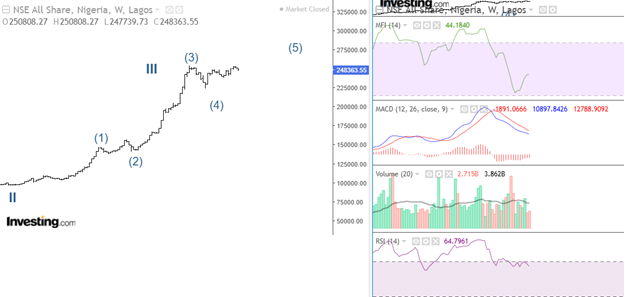
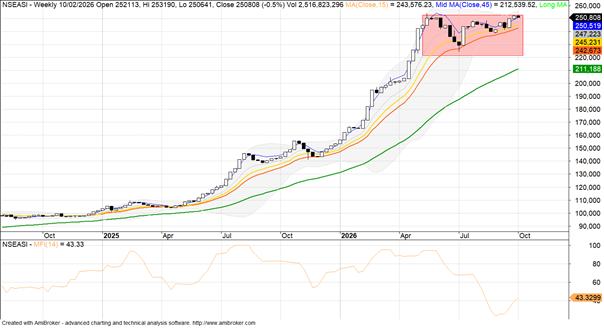
Technically, the ASI is approaching the 248,000-point psychological support zone, where renewed buying interest could help stabilise prices. A sustained break below this level could expose the market to further weakness, while a recovery above 250,000 points would provide an early indication of improving momentum. However, the index needs to regain higher resistance levels before a more convincing bullish trend can emerge. The Relative Strength Index (RSI) and other momentum indicators would need to be assessed using the latest daily chart to confirm whether the market is approaching oversold territory. However, the combination of consecutive losses, negative market breadth and the sharp Thursday sell-off suggests that downside risks remain elevated.
Market Outlook
The NGX is likely to begin the new trading week under cautious sentiment as investors assess opportunities following the recent pullback. Friday’s recovery provides some encouragement, but the negative market breadth suggests that buying interest remains selective rather than broad-based. The market’s substantial year-to-date gain of 59.60% may also encourage further profit-taking as investors rebalance their portfolios. In the near term, the 248,000-point area is a key psychological support zone, while 250,000 points represents the first major level the index needs to reclaim to improve short-term sentiment. A sustained recovery above this level could open the way for a retest of 250,800–252,000 points. Conversely, a decisive break below 248,000 points could expose the market to additional selling pressure.
Investors are advised to prioritise fundamentally strong stocks with attractive valuations, sustainable earnings and reliable dividend prospects, while avoiding aggressive buying until the market shows clearer signs of stabilisation. Selective accumulation on price weakness may offer opportunities, but confirmation from improved market breadth and stronger trading activity would provide a more convincing signal of recovery.
Overall, the short-term outlook remains cautious to bearish, although selective rebounds are possible. The market’s direction will depend on whether renewed buying interest can absorb profit-taking and restore positive momentum.
Note: The support and resistance levels above are indicative levels based on the supplied closing figures and recent price action, not confirmed chart-derived technical levels. RSI, MACD and moving-average readings would require the relevant historical price series to calculate accurately.
Trending in the Economy:
Nigeria moved up four places to eighth in Bloomberg’s 2026 Investment Risk-O-Meter, overtaking Rwanda, Tanzania, Kenya and Namibia. The improvement reflects economic and fiscal reforms, including fuel subsidy removal, foreign exchange liberalisation and electricity tariff adjustments. GDP grew by 3.85% in 2025 and 3.89% in Q1 2026, although rising public debt remains a concern.
Meanwhile, Nigeria’s Business Confidence Index fell to 13.4 points in September from 14.8 in August, according to the CBN. Despite the decline, business sentiment remained positive, while the composite Purchasing Managers’ Index (PMI) rose to 53.0 points, indicating continued expansion. However, insecurity, multiple taxation and high interest rates continue to weigh on business activity.
Global Market and Oil:
Global financial markets ended the week on a positive note as investors assessed corporate earnings prospects, elevated borrowing costs and uncertainty surrounding the global economic outlook. Equities advanced across the United States, Europe and parts of Asia, although concerns about inflation, government debt and the concentration of gains in technology stocks continued to shape market sentiment.
In the United States, the S&P 500 and Nasdaq Composite each gained 0.6% on Friday, while the Dow Jones Industrial Average rose 0.8%. The Russell 2000 also advanced by 0.5%. The three major US benchmarks recorded weekly gains, supported by renewed buying interest in selected stocks and expectations that upcoming corporate earnings could provide further direction.
The S&P 500 closed at 7,811.54 points, up 46.18 points, while the Nasdaq Composite gained 172.83 points to 27,366.17. The Dow Jones Industrial Average added 423.31 points to 51,654.95, and the Russell 2000 rose 12.85 points to 2,806.98.
For the week, the S&P 500 advanced 1.2%, the Dow gained 0.9%, and the Nasdaq increased by 0.6%. The Russell 2000, however, declined by 0.9%, highlighting the uneven performance across market segments. Technology stocks remained an important driver of the broader market, but investors continued to monitor the narrow participation in the US equity rally. The strong performance of large technology companies has supported major indices, although disappointing earnings or weaker growth expectations could trigger renewed selling pressure.
Attention is shifting towards the upcoming earnings season, with Goldman Sachs, JPMorgan Chase, Wells Fargo and other major financial institutions scheduled to release results. Investors will assess their earnings performance, lending activity, credit quality and outlook for the broader economy.
The US Treasury market recorded modest movements on Friday following a volatile week in which longer-term borrowing costs reached elevated levels. The yield on the benchmark 10-year US Treasury rose by 2.8 basis points to approximately 5.261%, after reaching a 24-year high earlier in the week. Despite Friday’s increase, the yield declined by 3.5 basis points over the week, marking its largest weekly fall in approximately two months. The 30-year Treasury yield remained elevated at around 5.607%, reflecting persistent concerns about inflation, government borrowing requirements and the cost of financing long-term investment. Higher bond yields can weigh on equity valuations by increasing the discount rate applied to future corporate earnings. They also raise borrowing costs for governments, businesses and households, potentially slowing investment and consumer spending.
The pressure is particularly relevant to technology companies investing heavily in artificial intelligence infrastructure. Large-scale spending on data centres, semiconductor production and computing capacity requires substantial financing, making projects more expensive when interest rates remain high. Although the decline in Treasury yields over the week offered some relief, the broader interest-rate outlook remains uncertain. Investors continue to assess the relationship between energy prices, inflation expectations and the likely direction of monetary policy.
European stocks recorded stronger gains, with the regional market advancing approximately 1% on Friday. Buying interest improved despite continued concerns about borrowing costs, government finances and the economic outlook.
French government debt remained a major focus as investors evaluated the country’s fiscal position and political uncertainty ahead of the 2027 presidential election. France’s 10-year government bond yield stood near 4.994%, while the yield spread between French and German 10-year bonds remained around 138 basis points.
The spread reflects the additional return investors demand to hold French government debt compared with German government bonds, which serve as a regional benchmark. Persistent fiscal deficits and uncertainty over future economic policies could keep French borrowing costs elevated.
European government bond yields were generally lower across several markets, providing some support for risk assets. However, the longer-term outlook remains challenged by energy costs, public debt levels and expectations about future interest-rate decisions. The combination of elevated borrowing costs and increased government financing needs also raises concerns about the cost of funding major infrastructure and technology investments. Companies seeking to expand their operations may face tighter financial conditions if yields remain high.
Asian equities recorded a mixed session as investors balanced improving sentiment in global stocks against continuing uncertainty surrounding energy supplies and economic growth. The MSCI Asia-Pacific index excluding Japan rose approximately 0.6%, while Japan’s Nikkei 225 finished close to unchanged.
Market sentiment across the region remained sensitive to developments in oil prices, international trade and the outlook for Chinese demand. Expectations that China would resume refined fuel exports following its Golden Week holiday added another factor to the regional energy outlook.
For economies that rely heavily on imported oil, sustained increases in crude prices could put pressure on trade balances, currencies and domestic inflation. Conversely, a more stable energy market could reduce cost pressures for manufacturers, transport operators and other energy-intensive businesses. Investors are also monitoring the impact of global interest-rate movements on capital flows into Asian markets. Higher US Treasury yields can make dollar-denominated assets more attractive, potentially placing pressure on emerging-market currencies and increasing the cost of external borrowing.
Telecommunications stocks were among the notable decliners after SpaceX agreed to acquire low-band spectrum assets, raising questions about the competitive outlook for established wireless operators. T-Mobile shares fell 13.3%, while AT&T declined 9.8% and Verizon Communications lost 8.7%. The proposed transaction remains subject to approval from the Federal Communications Commission.
The development renewed concerns about the competitive position of traditional telecommunications operators and the potential impact of satellite-based connectivity on the industry. Investors are assessing whether new spectrum ownership and satellite technology could alter market dynamics, increase competition or put additional pressure on established operators’ long-term revenue expectations. The weakness in telecommunications stocks contrasted with gains elsewhere in the market. Crown Castle advanced 15.6%, while American Tower rose 9.3%. Humana also recorded a strong performance, gaining 11.6%.
These divergent movements highlighted the importance of company-specific developments and sector fundamentals in determining equity performance, even when broader market sentiment is positive.
Technology shares declined by approximately 0.4% as investors reassessed the outlook for artificial intelligence spending, revenue growth and the financing requirements of major technology companies. Concerns surrounding the pace of revenue expansion at OpenAI added to uncertainty about the commercial returns from substantial investments across the AI industry. Annualised revenue for September was estimated at nearly $50 billion, while some earlier expectations had pointed towards a significantly stronger trajectory. Other projections suggested annualised revenue could reach or exceed $70 billion by year-end.
The differences in these expectations illustrate the challenges investors face when valuing companies operating in a rapidly developing industry. Although demand for AI services and computing capacity remains significant, the sustainability of revenue growth and the ability to generate profits at scale remain important considerations.
Major companies, including SpaceX, Broadcom and Oracle, are expected to remain central to discussions around AI infrastructure and semiconductor demand. Their investment plans and financing requirements could influence valuations across technology, telecommunications and related industries.
Rising borrowing costs add another layer of uncertainty. The construction of data centres, expansion of computing capacity and procurement of advanced chips require substantial capital expenditure. If financing costs remain elevated, companies may face pressure to demonstrate that their investments can generate sufficient returns. The market’s response suggests that investors are becoming more selective, placing greater emphasis on financial performance, cash flow generation and the commercial value of AI investments rather than growth expectations alone.
Currency markets remained under pressure, with the euro heading for a fifth consecutive weekly decline. Earlier in the week, the single currency touched approximately $1.1161, its weakest level in around 17 months. The euro’s performance reflected differences in economic expectations, interest-rate outlooks and investor positioning across major currency markets. Persistent energy costs and concerns about European fiscal conditions also contributed to the cautious outlook.
Global investment fund flows showed continued demand for liquidity and fixed-income assets. Money-market funds attracted approximately $153.81 billion in the week ended October 7, their largest weekly inflow since May 6. Global equity funds received only $560 million, the smallest weekly inflow in three weeks. The figures suggest that investors remained cautious despite the recovery in major stock indices.
European equity funds attracted $6.19 billion, while Asian equity funds recorded inflows of $6.16 billion. US equity funds, however, experienced outflows of $5.11 billion. Sector allocations also reflected changing investor preferences. Technology funds attracted $5.37 billion, followed by utilities with $1.10 billion and industrials with $1.03 billion. Financial-sector funds recorded outflows of $3.47 billion.
Global bond funds received approximately $26.03 billion, while precious-metals funds attracted $1.41 billion for a fourth consecutive week. Emerging-market bond funds recorded inflows of $1.48 billion, whereas emerging-market equity funds experienced outflows of $752 million for a fifth consecutive week. These movements indicate that investors are balancing opportunities for capital appreciation against the need to preserve liquidity and manage market risk. Strong money-market inflows suggest that some participants prefer to retain flexibility while assessing the direction of interest rates, corporate earnings and geopolitical developments.
Gold strengthened by 1.5% to approximately $4,193 per ounce, supported by continued demand for defensive assets amid uncertainty surrounding economic growth, borrowing costs and geopolitical risks.
Global Market Outlook
Global markets enter the coming week with several factors likely to determine investor positioning. Corporate earnings from major US banks will provide an early indication of financial-sector performance and the resilience of economic activity. Investors will also assess lending conditions, credit risks and management expectations for the remainder of the year. Government bond yields will remain important for equity valuations, particularly among technology companies with substantial future investment requirements. Elevated borrowing costs could limit valuation expansion even where revenue growth remains strong.
The technology sector will face closer scrutiny as investors seek clearer evidence that artificial intelligence spending is translating into sustainable earnings and cash flows. Companies with strong balance sheets, consistent revenue growth and credible profitability prospects may be better positioned to withstand volatility.
Currency movements and global investment flows will also provide insight into investor confidence. Continued demand for money-market and bond funds, alongside relatively modest inflows into equity funds, suggests that market participants remain cautious despite recent gains in major indices. Overall, global equities continue to offer opportunities, but uncertainty surrounding corporate earnings, borrowing costs and geopolitical developments could sustain volatility. Investors are likely to remain selective, favouring companies with sound financial positions and sustainable earnings prospects while monitoring developments that could alter the global economic outlook.
Oil markets will remain a major influence on global financial conditions. Brent crude and West Texas Intermediate initially weakened following easing concerns about an immediate escalation between the United States and Iran, before recovering to settle approximately 0.4% higher. During the session, Brent fell by $1.10, or 1.1%, to around $103.18 per barrel, while WTI declined by 49 cents, or 0.5%, to approximately $91. Brent retained a weekly gain after rising about 4% on Thursday, while WTI recorded a slight weekly decline. Expectations of additional diesel supplies and China’s resumption of refined fuel exports could help ease supply pressures, although the outlook remains sensitive to geopolitical developments. The Strait of Hormuz, which handled roughly 20% of global oil and fuel flows before the conflict, remains a critical shipping route. Any prolonged disruption could increase crude prices, transportation costs and inflationary pressures, while a sustained improvement in supply conditions could support energy-importing economies and businesses facing elevated operating expenses.