
Market Update For October 5, 2026
The Nigerian equities market began the new trading week on a cautious note as investors continued to lock in profits from recent gains, particularly across several large-cap stocks. The softer performance came as the market entered the final quarter of the year with the benchmark index still trading at elevated levels following its strong year-to-date rally.
Selling pressure was concentrated in several blue-chip and highly liquid counters, including AFRIPRUD, NESTLE, AIICO, CADBURY, INTBREW, OANDO, NB, TRANSCORP, UBA and GTCO. The weakness in these stocks weighed on overall sentiment, although buying interest in selected mid- and small-cap counters helped limit the decline in the broader market.
The session also showed a divergence between the benchmark and individual stock performance. While the ASI recorded only a marginal decline, more stocks closed lower than higher, indicating that the underlying market tone was weaker than the headline index suggested. This could point to increased portfolio rotation as investors take profits from stocks that have enjoyed strong gains and reposition into counters with better near-term prospects.
Trading activity remained strong, suggesting that investors were still actively repositioning rather than exiting the market. ACCESSCORP dominated activity, accounting for more than half of total traded volume. The concentration of transactions in highly liquid banking stocks also underlined the continued importance of the financial services sector to market liquidity.
Selected mid- and small-cap stocks, however, continued to attract buying interest. TRIPPLEG, LEARNAFRCA, LIVESTOCK, NEIMETH and CHAMS recorded notable gains, showing that investors are still willing to take positions in stocks offering potential for further appreciation despite the broader profit-taking trend.
Oil Market
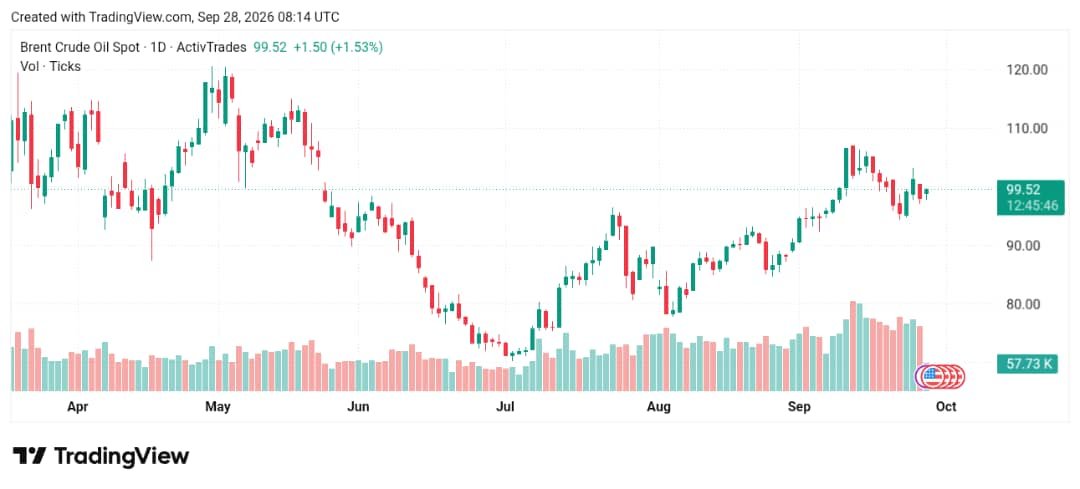
The international oil market started the week under pressure as rising Middle East crude exports and the planned release of strategic reserves by the Group of Seven eased some immediate supply concerns. Brent crude futures fell $1.10, or 1.08%, to $101.15 per barrel, while US West Texas Intermediate declined 89 cents, or 0.98%, to $90.22.
The G7 has agreed to release 100 million barrels of crude and diesel from emergency reserves over four months, with a substantial portion of diesel supplies expected to be released early. The move is aimed at easing tight energy markets and improving the availability of refined products.
Supply conditions have also improved in the Middle East, with regional crude exports averaging 18.3 million barrels per day on September 30. Exports exceeded pre-war levels on 14 days in September, compared with an average of about 18 million barrels per day in the 12 months before the conflict.
Despite the improvement in crude flows, the global oil market remains vulnerable to further disruptions. At least seven tanker attacks were reported during the first week of October, while the Strait of Hormuz continues to carry roughly 20% of global crude and LNG supplies.
OPEC+ also remains a major factor in the outlook. The group agreed to keep November production targets unchanged, while its seven core members produced about 25 million barrels per day in August, an increase of 630,000 barrels per day from July but still around 5 million barrels per day below pre-war levels.
For Nigeria, crude prices remain critical to government revenue, foreign exchange earnings and external liquidity. With Brent still above $100 per barrel, elevated prices could support Nigeria’s external position, although prolonged geopolitical disruptions could increase shipping and energy costs. Conversely, a sustained decline in crude prices could reduce the revenue benefits for oil-producing economies.
Technical Analysis and Outlook
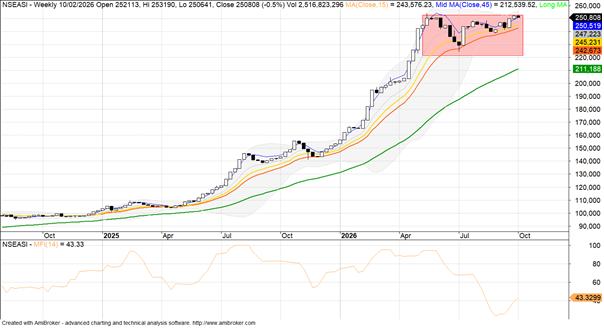
Technically, the NGX All-Share Index remains in a medium-term bullish trend, although Monday’s decline and negative breadth indicate that profit-taking is becoming more visible. The market’s strong year-to-date performance could encourage investors to continue locking in gains, particularly in stocks that have recorded significant appreciation.
The 250,000 level remains the key immediate support for the ASI. Holding above this level would preserve the broader bullish structure and could provide a base for renewed buying. However, a decisive break below 250,000 could trigger deeper consolidation as selling pressure increases.
On the upside, the 252,000–253,000 region remains the immediate resistance zone. A sustained break above this area, supported by stronger volume and improving breadth, would strengthen the bullish outlook and potentially open the way towards fresh highs.
Market breadth will remain important in the coming sessions. If the ASI stabilises or advances while decliners continue to outnumber gainers, it could indicate that the rally is becoming increasingly concentrated. A broader recovery across large-cap and sector-leading stocks would provide stronger confirmation of renewed market momentum.
The final quarter is also expected to bring greater attention to third-quarter earnings, dividend expectations, interest rates and corporate guidance. Strong earnings could provide fresh catalysts for fundamentally sound stocks, while disappointing results or stretched valuations could increase profit-taking.
Overall, the near-term outlook remains cautiously bullish, although consolidation and sector rotation are likely to persist. The market’s ability to defend the 250,000 support level while attracting broader participation will be crucial in determining whether the recent rally resumes or develops into a deeper correction.
The NGX All-Share Index closed at 250,667.86 points, down 140.41 points or 0.06%, while market capitalisation declined by ₦91.16 billion to ₦162.75 trillion. The market’s YTD return eased to 61.08%. Market breadth was negative, with 27 gainers against 34 decliners, while 85 stocks remained unchanged. Total traded volume stood at 875.26 million shares, valued at ₦40.87 billion, across 53,797 deals. ACCESSCORP led activity with 440.65 million shares worth ₦13.23 billion, representing 50.34% of total volume and 32.36% of traded value, while CMFC and UBA also featured prominently by volume and ARADEL and NESTLE by value. The top gainers were TRIPPLEG (+9.87% to ₦2.56), LEARNAFRCA (+9.80% to ₦8.40), LIVESTOCK (+9.55% to ₦9.75), NEIMETH (+8.72% to ₦8.10) and CHAMS (+6.19% to ₦3.43), while the biggest losers were ABCTRANS (-9.46% to ₦6.70), CORNERST (-8.57% to ₦4.80), JAPAULGOLD (-6.94% to ₦2.68), AFRIPRUD (-6.39% to ₦10.25) and WAPIC (-6.36% to ₦2.21).