
Market Update For October 6, 2026
The Nigerian equities’ market extended its recent decline on Tuesday as renewed profit-taking in several large-cap stocks kept investors on the defensive. The session reflected a cautious mood across the market, with investors appearing more willing to secure gains accumulated during the strong rally rather than take on additional positions at elevated price levels.
The selling pressure was concentrated in a number of highly traded and large-cap counters, reinforcing the view that investors are becoming increasingly selective. FIRSTHOLDCO, UNILEVER, FIDSON, ETI, OANDO, STANBIC, NGXGROUP and ACCESSCORP were among the notable stocks that came under pressure during the session.
Despite the decline, the market’s movement remained relatively measured. The benchmark index has continued to trade around elevated levels after delivering substantial gains in 2026, leaving investors with significant accumulated profits. This has created room for periodic profit-taking, particularly in stocks that have experienced strong price appreciation.
The latest performance therefore appears more consistent with a market consolidation than a broad-based reversal. Investors are increasingly weighing the sustainability of current valuations against the strength of corporate earnings and the prevailing macroeconomic environment.
The recent weakness in the equities market highlights the challenge facing investors after an extended period of strong gains. With the NGX All-Share Index still recording a YTD return above 60%, portfolio managers and retail investors have greater incentives to lock in profits, particularly where valuations have moved ahead of underlying earnings growth.
This behaviour can create short-term pressure even when the medium-term fundamentals of the market remain supportive. As profit-taking spreads across leading stocks, investors may begin to rotate funds into counters that have lagged the broader market or offer relatively attractive valuations.
The performance of large-cap stocks remains particularly important because of their significant influence on the index. Weakness in these counters can weigh on the benchmark even when activity in smaller and mid-cap stocks remains positive.
The session also showed that market participation remains uneven. While some stocks continued to attract buying interest and recorded strong gains, the number of decliners exceeded advancers, indicating that the negative sentiment was broader than the movement in the headline index alone suggested.
Although overall market activity moderated, trading remained relatively strong, reflecting continued investor participation. ACCESSCORP dominated volume during the session, while ARADEL remained one of the most actively traded stocks by value.
The concentration of activity in a few counters indicates that investors continue to favour liquid names, particularly stocks capable of absorbing sizeable transactions without significant difficulty. High trading volumes in leading banking and energy-related counters also point to continued institutional and retail interest despite the broader cautious tone.
The relatively high value traded suggests that investors are still actively repositioning portfolios rather than withdrawing completely from the market. This distinction is important because a decline accompanied by healthy turnover can indicate portfolio rotation and profit-taking rather than widespread risk aversion.
Oil Market
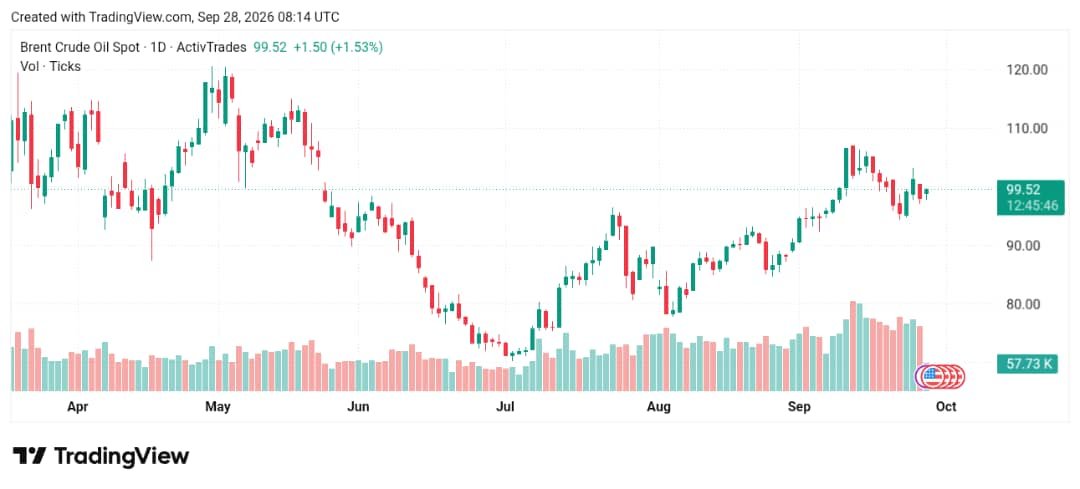
Developments in the international oil market also provided an important backdrop for Nigerian investors. Crude prices fell by nearly 2% as concerns over global supply eased following increased Middle Eastern exports and the Group of Seven’s decision to release emergency crude and diesel reserves.
Brent crude declined 1.8% to $98.48 per barrel, while West Texas Intermediate fell 1.6% to $88.01. Brent’s retreat below the $100 mark represents a moderation in the supply-risk premium that had previously supported higher prices.
For Nigeria, the direction of crude prices remains critical given the importance of oil to government revenue, foreign exchange earnings and external liquidity. Sustained weakness in crude could potentially reduce some of the optimism around Nigeria’s external position, although the impact would depend on production levels, export volumes and other sources of foreign exchange.
On the other hand, oil prices remaining close to the $100 level continue to provide a relatively supportive environment for Nigeria compared with periods of significantly lower crude prices. Investors will therefore continue to monitor the balance between global supply risks and demand expectations.
Technical Analysis
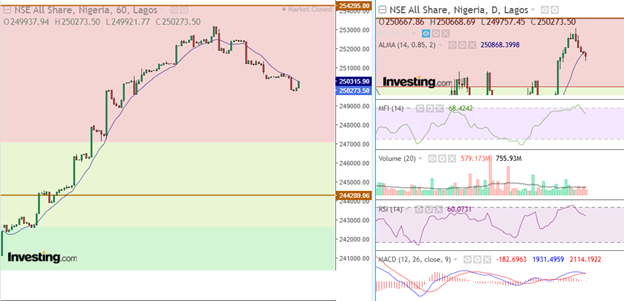
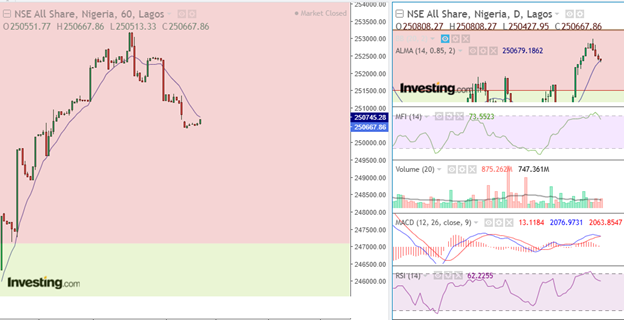
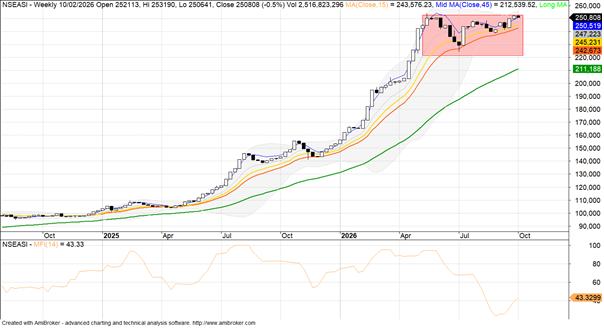
From a technical perspective, the NGX All-Share Index remains in a consolidation phase after struggling to maintain momentum around the 252,000–253,000 region.
The 250,000 level has now become an important psychological support for the market. The ability of the index to hold above this level could determine whether the current weakness remains a short-term correction or develops into a deeper decline.
A sustained break below 250,000 could expose the index to additional selling pressure as traders adjust positions and short-term investors become more cautious. Conversely, a strong rebound from this level would signal renewed buying interest and could put the 252,000–253,000 resistance area back in focus.
Momentum indicators would need to improve alongside price action for the market to establish another strong upward move. Until that happens, the index could continue to experience volatile and range-bound trading as investors balance profit-taking against bargain-hunting opportunities.
The current technical structure suggests that the market needs a fresh catalyst to break decisively out of its consolidation range. Stronger-than-expected corporate earnings, improved liquidity conditions or renewed institutional demand could provide such a catalyst.
Market Outlook
The short-term outlook for Nigerian equities remains cautious, with profit-taking likely to persist in stocks that have recorded substantial gains. However, the broader market trend remains supported by the sizeable year-to-date appreciation and continued investor participation.
Rather than a uniform sell-off, the market is likely to experience increased rotation between sectors and individual stocks. Investors may increasingly favour companies with strong earnings visibility, healthy balance sheets, sustainable dividends and relatively attractive valuations.
The banking sector will remain important to overall market direction because of the heavy weighting of major financial stocks on the NGX. Energy and industrial stocks could also influence sentiment depending on commodity prices, corporate earnings and broader economic developments.
The direction of interest rates and liquidity conditions will remain another major factor. Changes in monetary conditions can influence the attractiveness of equities relative to fixed-income instruments and determine the amount of liquidity available for risk assets.
With the market still carrying a substantial YTD gain, investors may remain disciplined in adding new positions, particularly where prices have moved significantly ahead of fundamentals. This could keep volatility elevated as investors take profits in outperforming counters and redirect funds toward stocks with stronger medium-term prospects.
Overall, the market appears to be entering a period where stock selection could become more important than broad market exposure. The ability of individual companies to deliver earnings growth and maintain attractive valuations could increasingly determine performance as the initial momentum from the broader market rally moderates.
At the close of trading, the NGX All-Share Index (ASI) declined by 0.16% to 250,273.50 points, while market capitalisation fell by ₦256.05 billion to ₦162.50 trillion. The market’s performance remained positive on a year-to-date basis, with the YTD return easing to 60.83%. Trading activity stood at ₦36.06 billion, with 579.17 million shares exchanged in 40,979 deals. Market breadth was negative, with 27 stocks advancing, 37 declining and 82 unchanged, reflecting the wider selling pressure despite the relatively modest movement in the benchmark. Market movers were led by ACCESSCORP, which recorded 192.58 million shares, while ARADEL led by value with approximately ₦7.63 billion in transactions. Top gainers: TRIPPLEG (+9.77%) to ₦2.81, LIVESTOCK (+9.74%) to ₦10.70, NPFMCRFBK (+9.52%) to ₦4.60, WAPIC (+7.69%) to ₦2.38 and GUINEAINS (+7.35%) to ₦0.73. Top losers: ABCTRANS (-9.70%) to ₦6.05, FTNCOCOA (-9.07%) to ₦7.62, CWG (-7.23%) to ₦19.25, VFDGROUP (-6.34%) to ₦12.55 and NEIMETH (-6.17%) to ₦7.60.