
Market Update For October 8, 2026
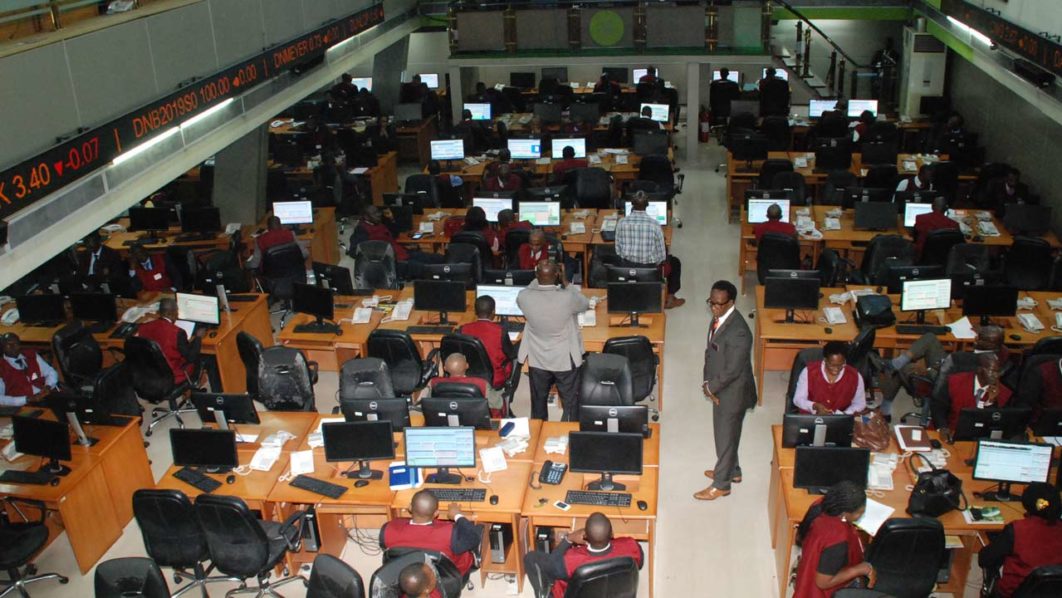
The Nigerian equities market extended its decline on Thursday as renewed profit-taking across several large-cap stocks intensified selling pressure and pushed the benchmark NGX All-Share Index below the 250,000-point mark.
The session reinforced the cautious tone that has gradually emerged in the domestic equities market following the strong rally recorded over the year. Investors appeared increasingly focused on securing accumulated gains, particularly in stocks that have experienced significant price appreciation, resulting in broader pressure across key market segments.
The latest decline suggests that investors are becoming more selective as they reassess valuations and the near-term earnings outlook of listed companies. While the market continues to record a strong year-to-date return, the recent weakness indicates that some investors are becoming less willing to chase prices at elevated levels.
Large-cap stocks were among the major contributors to the downturn. ARADEL and ETERNA recorded the maximum permitted decline of 10.00% each, while FIDELITYBK, MTNN and STANBIC also recorded notable losses. Other major decliners included TIP, PZ, TRANSCORP and UBA.
The weakness across several highly capitalised counters had a significant impact on the broader index, reinforcing the sensitivity of the market to movements in large stocks. The performance also reflected a shift in investor behaviour from aggressive buying towards portfolio rebalancing and profit-taking.
Despite the decline in prices, trading activity remained relatively robust, suggesting that market participants were still actively positioning their portfolios. Total transactions remained substantial, with banking stocks once again accounting for a significant portion of market activity.
ZENITHBANK was one of the most actively traded stocks during the session, while PRESCO recorded the highest transaction value. The continued activity in major banking and industrial names indicates that institutional and retail investors remain engaged despite the prevailing selling pressure.
The market’s performance also comes at a time when investors are assessing the impact of Nigeria’s evolving macroeconomic environment. Lower interest rates following the recent monetary policy easing by the Central Bank of Nigeria have created expectations of improved liquidity and potentially stronger corporate activity. However, investors are still balancing the benefits of easier monetary conditions against inflation, currency and valuation risks.
The decline in the equity market therefore does not necessarily signal a broad loss of confidence. Rather, it could represent a period of consolidation following the substantial gains recorded earlier in the year. Investors may be waiting for stronger earnings signals, corporate announcements and other catalysts before committing fresh funds at current price levels.
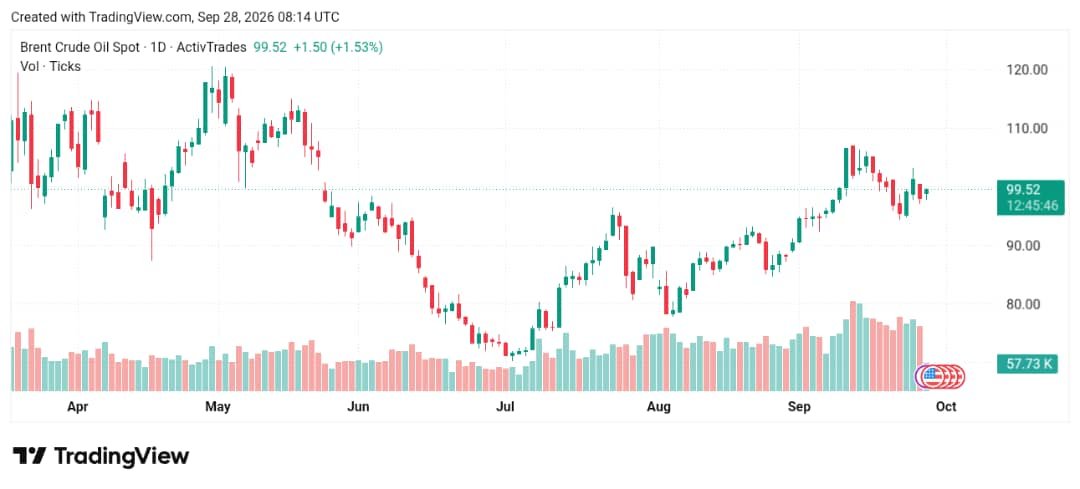
The performance of the oil market offered some positive news for Nigeria’s broader economic outlook. Crude prices rose sharply on Thursday as renewed geopolitical tensions increased concerns about supply disruptions in the Middle East.
Brent crude gained 4.54% to $104.75 per barrel, while West Texas Intermediate climbed 4.53% to $92.28. Both benchmarks had risen by more than $5 earlier in the session before trimming part of their gains.
The rally was driven largely by concerns over shipping around the Gulf and Strait of Hormuz, where renewed attacks on vessels have raised questions about the stability of oil transportation through one of the world’s most important energy corridors. The threat to US offshore production from a hurricane also added to supply concerns.
Higher crude prices could be supportive for Nigeria if the strength persists, given the country’s dependence on oil revenues and foreign exchange earnings. Improved oil receipts could strengthen government revenue, support external reserves and provide additional stability for the domestic currency.
However, the benefits may depend on how long prices remain elevated and whether higher energy costs translate into renewed global inflationary pressures. A prolonged oil price shock could influence monetary policy expectations globally and potentially increase volatility across emerging and frontier markets.
For Nigerian equities, the combination of higher oil prices and domestic monetary easing could provide a supportive medium-term backdrop. Nevertheless, investors are likely to remain focused on company-specific fundamentals, earnings growth and valuation before increasing exposure.
Technical Analysis
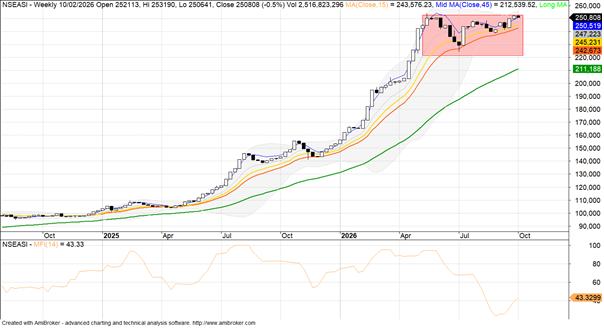
From a technical perspective, the ASI’s fall below the 250,000-point level is an important development for short-term market direction. The psychological threshold had served as a key reference point for investors, and its breach indicates that selling pressure has gained strength.
The index’s inability to hold above the level could encourage additional profit-taking if bearish sentiment persists. A continuation of the decline would bring lower support zones into focus, while a rebound above 250,000 points would be required to signal renewed buying interest.
Market breadth also remains important. Persistent negative breadth would suggest that the weakness is becoming increasingly broad-based rather than being driven solely by a few large-cap stocks. Conversely, a return to stronger breadth, accompanied by improved volume and recovery in banking and other heavyweight stocks, could signal that the market is beginning to stabilise.
The current price action therefore calls for caution rather than panic. Given the market’s significant gains this year, some level of correction is not unusual. The key issue for investors will be whether the market can establish a fresh support base without triggering a more aggressive reversal.
Outlook
The short-term outlook remains cautious as investors continue to lock in profits and reassess the sustainability of the market rally. Further weakness in large-cap stocks could keep the ASI under pressure in the next few sessions, particularly if market breadth remains negative.
However, the medium-term outlook remains supported by improving macroeconomic conditions, the potential benefits of lower interest rates and stronger oil prices. Corporate earnings and company fundamentals will likely become increasingly important as investors search for stocks capable of delivering sustainable returns rather than relying solely on market momentum.
Investors are therefore expected to maintain a selective approach, with attention likely to remain on companies with strong earnings, healthy balance sheets, attractive valuations and resilient cash flows.
The NGX All-Share Index fell 2,054.25 points, or 0.82%, to 248,042.50 points, while market capitalisation declined by ₦1.33 trillion to ₦161.05 trillion. The market’s year-to-date return eased to 59.40%. Market breadth remained negative, with 37 stocks declining against 28 gainers, while 81 stocks closed unchanged. Total volume stood at 492.14 million shares, valued at ₦37.94 billion, across 38,644 deals. ZENITHBANK led trading volume with 47.80 million shares, while PRESCO recorded the highest transaction value. Among the gainers, ETRANZACT advanced 10.00% to ₦12.10, followed by LIVESTOCK (+9.09%), GUINEAINSURANCE (+8.97%), LEARNAFRICA (+8.93%) and MULTITREX (+7.69%). On the losers’ chart, ARADEL and ETERNA declined 10.00% each, while CUTIX (-9.02%), NPF MICROFINANCE BANK (-8.70%) and CHAMPION (-8.68%) recorded notable losses.