
Market Update For October 12, 2026
The Nigerian bourse returned to negative territory on Monday, October 12, 2026, on renewed profit-taking in heavyweight stocks, particularly banking and oil stocks, dragging the composite NGX All-Share Index (ASI) lower. The decline reversed the previous session’s gain, reflecting the previous cautious investor sentiment as market participants continue to secure profits following the market’s substantial appreciation since the beginning of the year.
The index shed 0.25% to close at 247,736.24 points, while market capitalisation declined by N407.30 billion to approximately N160.85 trillion. The market’s year-to-date return moderated to 59.20%, highlighting the extent of gains retained despite the latest decline. Although the market remains significantly higher on a year-to-date basis, renewed selling pressure suggests that investors are becoming increasingly selective in their portfolio positioning.
The session’s performance was largely influenced by losses in large-cap stocks, with OANDO, ACCESSCORP, ZENITHBANK, FIDELITYBK, FIRSTHOLDCO and STERLINGNG among the major decliners. The weakness in these stocks underscored the influence of profit-taking on the market’s direction, particularly as investors reassessed their exposure to counters that have contributed to the market’s strong performance in recent months.
The Nigerian Exchange has benefited from improved investor participation and sustained interest in selected equities during the year. However, the substantial gains recorded across the market have also increased the likelihood of periodic corrections as investors seek to preserve accumulated returns. Monday’s decline reflects this balancing act between the search for further capital appreciation and the need to manage portfolio risk amid changing market conditions.
The return of selling pressure in heavyweight stocks also highlights the importance of sectoral performance in determining the direction of the benchmark index. While several medium- and small-cap stocks recorded significant gains during the session, the declines in influential banking and oil and gas counters outweighed the positive contributions from these advancing stocks.
The banking sector remained a major source of selling pressure, as investors reduced their exposure to several prominent financial services stocks. ACCESSCORP declined by 4.24%, while ZENITHBANK fell 4.23%. FIDELITYBK lost 2.62%, FIRSTHOLDCO declined 2.54%, STERLINGNG dropped 1.30%, WEMABANK shed 1.12%, UBA fell 0.81% and GTCO eased 0.38%.
The broad-based weakness across these stocks suggests that profit-taking was not limited to a single banking counter. Instead, investors appeared to be reducing positions across several major names, contributing to the negative performance of the wider market.
The banking sector remains an important component of the Nigerian equities market, given the influence of listed lenders on market capitalisation, trading activity and overall investor sentiment. Consequently, sustained weakness in the sector can place pressure on the benchmark index even when selected stocks in other sectors are attracting buying interest.
Investors will continue to monitor the earnings outlook of listed banks, dividend prospects, asset quality and the implications of monetary policy developments for their operating performance. The Central Bank of Nigeria’s September decision to reduce the Monetary Policy Rate from 27.50% to 23.00% could also influence market expectations regarding funding costs, credit demand and investment returns. However, the ultimate impact will depend on how lower policy rates translate into lending conditions, deposit costs and banks’ net interest margins.
The broader investment environment also remains important. Changes in fixed-income yields can affect the relative attractiveness of equities, particularly for institutional investors comparing potential stock market returns with returns available from government securities and other interest-bearing instruments.
Where fixed-income investments continue to offer competitive returns, some investors may remain cautious about increasing exposure to equities, especially following significant price appreciation. Conversely, expectations of improved corporate earnings, attractive dividends and further monetary easing could support renewed demand for fundamentally strong stocks.
For the banking sector, the immediate direction of share prices will therefore depend on a combination of company-specific fundamentals, investor positioning and broader market conditions. Monday’s losses highlight the risk of further volatility, although the declines alone do not establish a deterioration in the underlying fundamentals of the affected companies.
The oil and gas sector also contributed to the market’s bearish close, with OANDO recording one of the session’s steepest losses among actively traded large-cap stocks. The counter declined by approximately 7.55% to N33.65, reflecting substantial selling pressure despite the increase in international crude oil prices.
The divergence between OANDO’s share price and the direction of global oil prices highlights the fact that movements in individual equities do not always mirror changes in their underlying commodity markets. Company-specific developments, financial performance, investor expectations, liquidity and prevailing market sentiment can all influence share price movements.
For Nigerian oil and gas stocks, the relationship between crude oil prices and equity performance is also shaped by domestic production, operating costs, foreign exchange exposure, capital expenditure and the financial structure of individual companies.
Rising international oil prices could improve the revenue outlook for some companies in the sector, particularly those with meaningful exposure to crude production. However, the extent to which higher prices translate into stronger earnings depends on production volumes, operating efficiency and the ability to manage associated costs.
For investors, this makes it important to distinguish between the immediate impact of oil price movements and the longer-term earnings outlook of individual listed companies. A sustained increase in crude prices may improve sector sentiment, but it does not automatically guarantee an equivalent rise in the share prices of all oil-related businesses.
Monday’s decline in OANDO also contributed to the market’s negative tone, reinforcing the importance of stock-specific analysis when assessing opportunities in the oil and gas sector.
Selective Buying Supports Gains in Healthcare, Real Estate and Consumer Goods
Despite the broader market decline, buying interest remained strong in selected stocks across healthcare, construction and real estate, consumer goods and agriculture. The performance of these counters demonstrated that investors continued to identify opportunities even as the benchmark index retreated.
NEIMETH led the gainers, appreciating by 10.00% to close at N7.70. UPDCREIT also advanced by 10.00% to N26.40, while GUINNESS gained 9.93% to N423.00. LIVESTOCK rose 9.89% to N14.45, and MULTITREX appreciated by 9.52% to N0.46.
The strength in NEIMETH suggests renewed demand for the healthcare stock, although the sustainability of its price appreciation will depend on subsequent trading activity and the company’s underlying performance. Similarly, the gains in GUINNESS and MULTITREX indicate that selected consumer goods stocks continued to attract buyers despite the cautious market environment.
UPDCREIT and LIVESTOCK also traded at new 52-week highs of N26.40 and N14.45, respectively. These price levels indicate that the stocks reached their highest trading prices over the preceding year, attracting attention from investors monitoring market momentum and sectoral opportunities.
However, trading at a 52-week high does not necessarily mean that a stock is overvalued or that its price will continue to rise. Investors must still consider earnings prospects, asset quality where applicable, financial strength, liquidity and the sustainability of the factors supporting demand.
The performance of these advancing stocks also illustrates the importance of looking beyond the benchmark index when evaluating the market. Although the ASI declined, individual investors holding stocks that advanced during the session may have recorded positive portfolio performance.
Nevertheless, the gains in selected stocks were insufficient to offset the broader selling pressure, particularly in large-cap banking and oil and gas names.
Market breadth remained negative, with 31 stocks closing lower against 26 gainers. The difference between advancing and declining stocks indicates that losses extended across a number of counters, although the gap was not particularly wide.
Negative breadth, when accompanied by a decline in the benchmark index, generally reflects a market in which selling pressure exceeds buying interest. However, the strength of that signal depends on the magnitude of individual price movements, the market capitalisation of the affected stocks and the level of trading activity.
In Monday’s session, the weakness in several influential banking stocks and OANDO contributed to the decline in the ASI, while strong gains in NEIMETH, UPDCREIT, GUINNESS, LIVESTOCK and MULTITREX provided limited support.
Among the decliners, SUNUASSUR recorded the steepest percentage loss, falling 9.85% to N2.93. STERLINGNG declined 9.09% to N70.00, while OANDO and FIRSTHOLDCO each lost approximately 7.55%, closing at N33.65 and N132.80, respectively. LIVINGTRUST fell 6.25% to N3.00.
Other notable decliners included ACCESSCORP, ZENITHBANK, FIDELITYBK, WEMABANK, TIP, UBA, PZ and DANGSUGAR, reflecting weakness across financial services, oil and gas, consumer goods and other segments.
The distribution of losses suggests that investors were taking profits across several counters rather than focusing exclusively on one sector. Such movements can occur when market participants reassess valuations after a sustained rally or seek to rebalance portfolios in response to changing investment expectations.
Going forward, improvements in market breadth could provide a more convincing indication of a recovery, particularly if gains extend beyond a small group of stocks. Conversely, persistent negative breadth could signal continued caution, even if the benchmark index experiences occasional rebounds.
Trading activity improved during the session, with total traded volume increasing by 25.88% to 405.39 million shares. These transactions were valued at N19.87 billion and executed through 52,977 deals, indicating that market participants remained active despite the decline in share prices.
The increase in volume suggests that investors continued to reposition their portfolios, with transactions concentrated in selected banking and other actively traded stocks. However, higher turnover during a declining session does not, by itself, establish whether institutional investors are accumulating shares or whether existing holders are distributing positions.
ACCESSCORP led the volume chart with 33.28 million shares traded, accounting for 8.21% of total market volume. Its position at the top of the volume ranking highlights continued investor activity in the banking stock despite its 4.24% decline.
ZENITHBANK recorded the highest transaction value at N3.63 billion, representing 18.29% of total traded value. The volume of funds exchanged in the stock underscores its importance to daily market activity and investor positioning.
JAIZBANK also featured prominently, accounting for 6.81% of total traded volume, while ARADEL and FIRSTHOLDCO ranked among the leading stocks by traded value after ZENITHBANK.
The combination of higher volume and a lower benchmark index suggests that selling and portfolio adjustments were significant features of the session. Nevertheless, further sessions will be needed to determine whether the increased activity represents a temporary response to profit-taking or a more sustained shift in investor sentiment.
A recovery accompanied by strong turnover and improving breadth would suggest that buyers are returning with greater conviction. On the other hand, continued declines alongside elevated trading activity could indicate persistent distribution and a need for investors to exercise greater caution.
The direction of the Nigerian equities market remains closely linked to monetary policy, inflation, exchange-rate conditions, fixed-income yields and the outlook for corporate earnings.
The CBN’s September reduction in the Monetary Policy Rate from 27.50% to 23.00% represented a shift in the policy environment, although monetary conditions remain relatively tight. The implications for the equities market will depend on how the rate adjustment affects borrowing costs, business investment, consumer spending and the returns available on alternative financial assets.
A gradual easing of monetary conditions could support economic activity and improve the outlook for companies that depend on credit to finance operations and expansion. It could also influence investors’ allocation decisions between equities and fixed-income securities.
However, the impact is unlikely to be uniform across the market. Companies with high debt exposure may respond differently from those with strong cash positions, while businesses facing significant import costs or foreign exchange risks may continue to experience pressure on margins.
Inflation also remains an important consideration for investment decisions. Changes in consumer prices affect purchasing power, operating costs and the ability of companies to pass higher expenses on to customers. For consumer-facing businesses, the strength of demand and the cost of maintaining sales volumes will remain central to earnings performance.
Investors will therefore continue to assess the interaction between monetary policy, inflation, currency movements and corporate financial results when making investment decisions. These factors may influence the relative attractiveness of individual sectors and determine where fresh buying interest emerges.
Against this backdrop, the market’s substantial year-to-date appreciation calls for careful stock selection. While strong returns may continue to attract investors, elevated prices can also increase the risk of corrections when expectations become less favourable or profit-taking intensifies.
A disciplined investment approach that considers financial performance, valuation, cash flow, dividend sustainability and risk exposure may prove more effective than pursuing stocks solely because they have recorded recent price increases.
Technical Analysis and Market Outlook
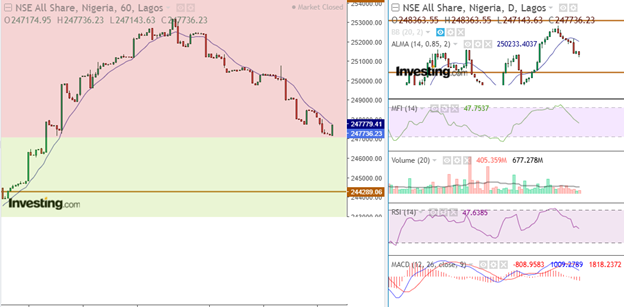
The NGX All-Share Index closed at 247,736.24 points after declining by 0.25%, indicating that selling pressure resurfaced following the previous session’s recovery. The decline suggests that the market is still attempting to establish a more stable direction amid profit-taking in heavyweight stocks.
From a technical perspective, the immediate focus is whether the index can attract sufficient buying interest to stabilise around current levels. A sustained recovery would require improved participation from large-cap stocks, particularly banking counters whose movements carry considerable influence on the overall market.
The negative market breadth provides an additional reason for caution, as the number of declining stocks exceeded advancing stocks. Although the difference was relatively modest, the combination of a lower ASI and broad-based weakness suggests that demand remains uneven across the market.
Trading volume will also be important in assessing the sustainability of any recovery. A rebound supported by stronger buying activity and improving market breadth would provide a more constructive signal than a short-lived advance driven by a limited number of counters.
Conversely, further declines in heavyweight stocks, accompanied by persistent negative breadth, could prolong the market’s consolidation. Investors should therefore avoid assuming that a single positive session would necessarily signal a return to a sustained upward trend.
The market’s near-term direction is likely to depend on corporate earnings expectations, dividend considerations, monetary policy developments and the relative attractiveness of equities compared with fixed-income investments. Global developments, particularly movements in crude oil prices and geopolitical risks, could also influence sentiment towards Nigerian stocks, especially companies with direct exposure to the energy sector.
For short-term traders, price action, turnover and changes in market breadth will remain important indicators of momentum. Long-term investors may place greater emphasis on business fundamentals, earnings growth, financial strength and valuation.
The strong year-to-date return of 59.20% indicates that the market has retained substantial gains despite Monday’s decline. However, the performance also underscores the importance of risk management, as investors seek to balance the potential for further appreciation against the possibility of intermittent corrections.
Overall, the outlook remains cautious in the immediate term, with selective opportunities likely to persist in stocks attracting sustained demand. A recovery in large-cap banking stocks could help stabilise the benchmark index, while continued selling pressure in heavyweight counters may extend the current period of consolidation.
Global Oil Market
Global oil prices advanced to near two-week highs on Monday as attacks on Saudi Arabia heightened concerns about possible supply disruptions, outweighing expectations of additional Russian diesel supplies and a potential easing of energy-related tensions between Russia and Ukraine. Brent crude futures rose $2.07, or 2.0%, to $106.79 per barrel by 13:21 GMT, marking their highest level since September 29. US West Texas Intermediate crude gained $1.69, or 1.8%, to $93.54 per barrel. The rally followed attacks on Riyadh, including a Saturday strike on the Saudi capital’s international airport claimed by Iran-aligned Houthi forces, which reportedly killed 13 people and injured more than 300, with further attacks recorded on Sunday. The developments heightened concerns about regional security and the potential implications for energy supplies, supporting prices despite expectations of additional Russian diesel exports and a possible energy ceasefire between Russia and Ukraine. For Nigeria, sustained strength in crude oil prices could improve export earnings and government revenue, provided domestic production and export volumes remain supportive. Higher prices could also influence foreign exchange inflows and fiscal planning, although the ultimate benefits will depend on production performance, domestic energy requirements and government expenditure. The direction of oil prices will therefore remain sensitive to geopolitical developments, supply disruptions, global demand and the availability of alternative sources of energy.
Market Summary: The NGX All-Share Index (ASI) declined by 0.25% to 247,736.24 points, while market capitalisation shed N407.30 billion to approximately N160.85 trillion, reducing the market’s year-to-date return to 59.20%. Trading activity strengthened, with total volume rising by 25.88% to 405.39 million shares, valued at N19.87 billion across 52,977 deals. Market performance remained bearish, with 31 decliners against 26 gainers, reflecting sustained profit-taking in banking and oil and gas stocks. Major market movers on the downside included OANDO, ACCESSCORP, ZENITHBANK, FIDELITYBK and FIRSTHOLDCO. The top five gainers were NEIMETH (+10.00%) at N7.70, UPDCREIT (+10.00%) at N26.40, GUINNESS (+9.93%) at N423.00, LIVESTOCK (+9.89%) at N14.45 and MULTITREX (+9.52%) at N0.46. The top five losers were SUNUASSUR (-9.85%) at N2.93, STERLINGNG (-9.09%) at N70.00, OANDO (-7.55%) at N33.65, FIRSTHOLDCO (-7.55%) at N132.80 and LIVINGTRUST (-6.25%) at N3.00.