
Market Update For October 16, 2026
The Nigerian equities market closed in negative territory on Friday, October 16, 2026, as profit-taking in selected banking and large-cap stocks reversed gains recorded over the previous two sessions. The downturn reflected renewed selling pressure in key counters, as investors adjusted their positions following recent market gains. However, advances in several stocks helped limit the overall decline, highlighting the mixed sentiment that continued to shape trading on the Nigerian Exchange (NGX).
The market’s performance reflected a cautious investment climate, with participants balancing opportunities in fundamentally attractive stocks against the need to secure profits. Although the benchmark index recorded only a marginal decline, losses in selected heavyweight equities weighed on the overall market, reinforcing the influence of large-cap stocks on daily market direction. The retreat also highlighted the possibility of further consolidation as investors reassess valuations and await fresh catalysts to determine their next investment decisions.
Despite Friday’s decline, the equities market maintained a strong year-to-date performance, supported by the substantial gains accumulated over the course of 2026. Nevertheless, the latest pullback suggests that the market may experience intermittent bouts of profit-taking, particularly in stocks that have recorded significant price appreciation. The ability of buyers to absorb selling pressure in leading counters will therefore remain important in determining whether the market can regain upward momentum in the coming sessions.
The banking sector remained a major source of downward pressure during the session, as investors sold selected financial stocks. GTCO declined by 2.27%, STANBIC fell by 2.14%, while ZENITHBANK shed 1.33%. STERLINGNG and UBA also recorded losses of 0.59% and 0.35%, respectively.
The declines in these stocks weighed on market sentiment, given their prominence in the financial services sector and their influence on overall trading activity. The performance of banking equities remains particularly important to the direction of the NGX, as investors closely monitor financial results, dividend prospects, asset quality, interest income and the broader operating environment.
Profit-taking in these counters may reflect efforts by investors to lock in gains after previous advances rather than a broad-based withdrawal from the equities market. However, sustained selling pressure could limit further appreciation in the affected stocks, particularly if buyers remain cautious at prevailing price levels.
The performance of banking stocks will also depend on expectations surrounding interest rates, liquidity conditions and the broader macroeconomic environment. Changes in monetary policy can influence banks’ funding costs, investment income and lending activities, making the sector sensitive to developments in inflation and financial market conditions.
For investors, the latest losses reinforce the importance of evaluating individual stocks on their fundamentals rather than relying solely on the overall direction of the market. Companies with resilient earnings, sound balance sheets and sustainable dividend policies may continue to attract interest, even during periods of broader market weakness.
Despite the market’s negative close, buying interest remained evident in several stocks, suggesting that investors continued to identify opportunities across the exchange. THOMASWY led the gainers with a 10.00% advance, followed by ETRANZACT, which rose by 9.84%. AUSTINLAZ gained 9.77%, while OMATEK appreciated by 9.59%.
MULTITREX also recorded a notable performance, rising by 9.09% to close at ₦0.60 from ₦0.55, establishing a new 52-week high. The advance highlighted continued demand for the stock, even as the broader market came under pressure.
The gains recorded by these counters demonstrate that the market’s performance was not uniformly negative. Rather, investors appeared to be repositioning across individual stocks, with some benefiting from renewed buying interest while others experienced selling pressure.
However, strong daily advances do not necessarily indicate that a stock’s upward movement will continue. Investors still need to consider liquidity, earnings prospects, valuation and the sustainability of price movements before making investment decisions. This is particularly relevant for stocks experiencing sharp gains within a single trading session.
On the downside, UPDCREIT recorded the steepest decline, falling by 10.00%. TRANSEXPR shed 9.09%, ROYALEX lost 6.48%, NPFMCRFBK declined by 5.43%, while ZICHIS dropped by 4.63%.
The substantial losses in these counters highlighted the uneven distribution of selling pressure across the market. While the overall index declined only marginally, individual stocks experienced much sharper price movements, reinforcing the importance of stock-specific analysis in portfolio management.
Trading activity moderated during the session, with total volume declining by 10.10% to approximately 257.67 million shares. The shares were valued at about ₦13.04 billion across 31,972 deals, indicating a reduction in market turnover compared with the preceding session.
The decline in trading volume suggests that market participants adopted a more measured approach as the market reversed its recent gains. Lower activity during a declining session may reflect reduced participation, although trading volume alone is insufficient to establish whether investors are becoming more bearish. The direction of prices, the distribution of transactions and subsequent trading sessions will provide a clearer indication of market sentiment.
UBA led the volume chart, with 28.29 million shares traded, accounting for approximately 10.98% of the session’s reported volume. ZENITHBANK recorded the highest transaction value at ₦2.09 billion, representing approximately 16.02% of the reported total value. GTCO and ARADEL also featured prominently among the most actively traded stocks by value.
The concentration of activity in leading banking stocks underscores their importance to the liquidity of the Nigerian equities market. These counters often attract substantial investor attention because of their market presence, trading depth and relevance to the broader financial system.
However, the combination of lower trading volume and losses in selected large-cap stocks suggests that investors may be waiting for stronger signals before committing additional funds. A recovery supported by increased turnover would provide a more convincing indication of renewed buying interest than a price rebound accompanied by weak activity.
Conversely, a further decline accompanied by rising volume could suggest that selling pressure is becoming more pronounced. Investors will therefore need to monitor both price movements and trading activity to assess the strength of the market’s next move.
Oil Market
In the commodities market, crude oil prices remained relatively stable on Friday but were heading for weekly gains amid uncertainty over global supplies and a larger-than-expected drawdown in US crude inventories.
Brent crude futures traded around $105.92 per barrel, while US West Texas Intermediate (WTI) stood at $97.75 per barrel. The relatively steady performance reflected competing forces, as concerns about potential supply disruptions supported prices while developments in refined petroleum product markets moderated gains.
Persistent uncertainty surrounding the Middle East remained a key factor influencing sentiment, particularly following attacks on vessels in and around the Strait of Hormuz. The waterway is an important route for global energy shipments, and any disruption could affect crude oil transportation, shipping costs and supply expectations.
The larger-than-expected drawdown in US crude inventories also provided support for prices. WTI had gained more than 3% in the previous session following the inventory report, while production shut-ins associated with hurricane-related disruptions contributed to concerns about near-term supply.
However, the outlook for refined petroleum products was less supportive. The planned release of additional diesel supplies by the International Energy Agency weighed on European diesel margins, illustrating how developments in individual energy markets can diverge even when crude oil prices remain elevated.
For Nigeria, movements in international oil prices carry significant implications for government revenue, foreign exchange earnings and external reserves. Higher crude prices can improve revenue prospects, but the extent of the benefit depends on domestic production, export volumes, operating costs and fiscal management.
Elevated energy prices may also create inflationary pressures globally, with potential consequences for transportation, production and the cost of imported goods. These developments could influence central bank decisions and investor expectations across emerging and frontier markets.
Although crude oil prices do not directly determine the daily direction of Nigerian equities, changes in energy markets can affect the macroeconomic environment in which listed companies operate. Investors will therefore continue to monitor global oil prices alongside domestic inflation, interest rates, foreign exchange conditions and corporate earnings.
Technical Analysis and Outlook
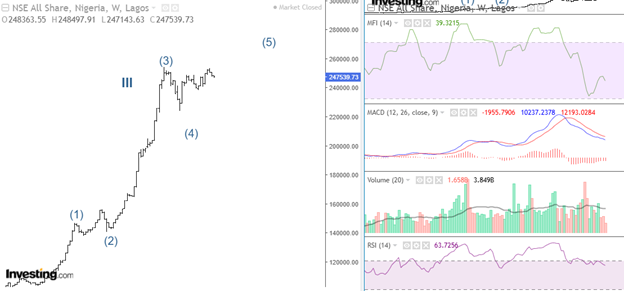
The Nigerian equities market’s decline on Friday indicates a pause in the recent recovery, as profit-taking in selected heavyweight stocks outweighed gains recorded in other counters. The All-Share Index lost 167.40 points, representing a decline of approximately 0.07%, to close at 247,539.73 points.
The relatively small percentage decline suggests that the overall market correction was limited during the session. However, the weakness in banking stocks and other large-cap counters highlights the importance of renewed buying interest in determining the benchmark index’s near-term direction.
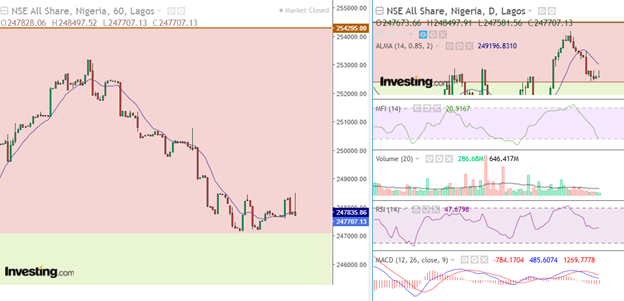
From a technical perspective, the market appears to be entering a period of consolidation following its recent gains. Consolidation can provide an opportunity for investors to reassess positions and for prices to establish a more stable trading range. However, the duration and direction of this phase will depend on whether demand is strong enough to absorb further profit-taking.
The 247,000-point area will be an important level to monitor in the near term. The index’s ability to remain above this region could help stabilise sentiment, while sustained selling pressure may expose the market to further weakness. A recovery would need to be supported by stronger buying interest and improved participation across heavyweight stocks to demonstrate that bullish momentum is returning.
Market breadth will also remain an important indicator. A sustained improvement in the number of advancing stocks, particularly when accompanied by rising turnover, would suggest that buying interest is spreading beyond a limited group of counters. Conversely, persistent weakness in market breadth could indicate that the market’s underlying momentum is deteriorating, even if the benchmark index records only modest daily losses.
Trading volume will provide an additional signal. An increase in activity alongside rising prices would strengthen the case for a recovery, while higher volume during a decline could indicate intensifying selling pressure. Investors should therefore avoid interpreting a single session’s movement in isolation and instead assess price action over several trading sessions.
In the coming week, the market’s direction is likely to depend on investor sentiment, corporate earnings expectations, liquidity conditions and developments in the broader economy. Banking stocks will remain important to the outlook, given their contribution to trading activity and influence on the benchmark index. Demand for fundamentally strong companies may provide support, although investors could remain selective while reassessing valuations after the substantial gains recorded this year.
The market’s strong year-to-date return provides evidence of its considerable advance in 2026, but it also increases the possibility of intermittent profit-taking as investors seek to preserve accumulated gains. A sustained recovery will require renewed demand across major stocks, while continued selling in heavyweight counters could prolong the consolidation phase.
Overall, the near-term outlook remains cautious as the market balances profit-taking against selective bargain-hunting. Investors may benefit from prioritising companies with sustainable earnings, sound financial positions and reasonable valuations while monitoring technical signals and changes in trading activity. A return to broad-based buying could restore upward momentum, but further weakness in large-cap stocks may keep the index under pressure.
The Nigerian Exchange All-Share Index (ASI) declined by 0.07% to close at 247,539.73 points from 247,707.13 points, while market capitalisation fell by ₦108.70 billion to ₦160.73 trillion, reducing the year-to-date return to 59.07%. Trading activity weakened, with approximately 257.67 million shares valued at ₦13.04 billion exchanged in 31,972 deals. UBA led trading by volume with 28.29 million shares, while ZENITHBANK recorded the highest transaction value at ₦2.09 billion. Market breadth figures in the supplied reports were inconsistent: one set recorded 23 advancers against 26 decliners, while another showed 28 gainers, 25 losers and 93 unchanged stocks. Major market movers included GTCO, STANBIC, ZENITHBANK, STERLINGNG, UBA and UPDCREIT on the downside, while MULTITREX reached a new 52-week high. The top gainers were THOMASWY, up 10.00% to ₦2.42; ETRANZACT, up 9.84% to ₦17.30; AUSTINLAZ, up 9.77% to ₦2.92; OMATEK, up 9.59% to ₦1.60; and MULTITREX, up 9.09% to ₦0.60. On the losers’ chart, UPDCREIT fell 10.00% to ₦21.15, TRANSEXPR declined 9.09% to ₦2.70, ROYALEX lost 6.48% to ₦1.01, NPFMCRFBK shed 5.43% to ₦4.35, and ZICHIS dropped 4.63% to ₦17.10.