
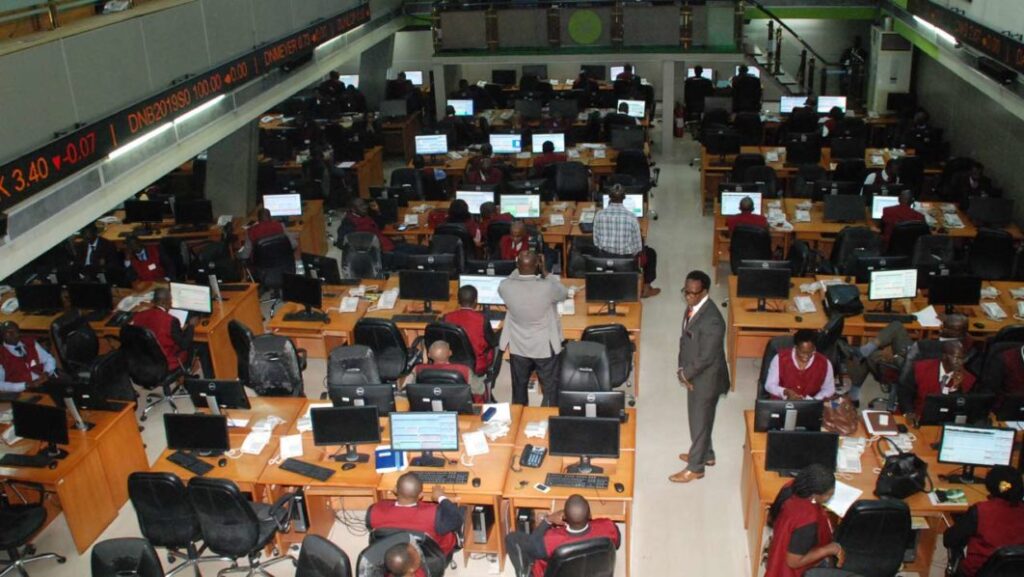
Market Update For October 20, 2026
The Nigerian equities market returned to positive territory on Tuesday, October 20, 2026, as renewed buying interest in selected stocks supported a modest recovery following the previous session’s sell-off. The rebound reflected improved sentiment across parts of the market, although the relatively moderate advance suggested that investors remained cautious amid ongoing profit-taking and uncertainty over the sustainability of the recovery.
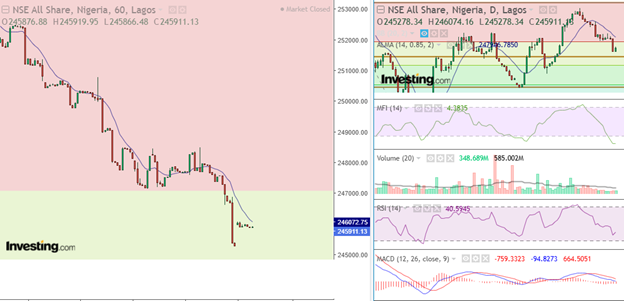
The Nigerian Exchange Limited (NGX) All-Share Index (ASI) gained 632.79 points, representing a 0.26% increase, to close at 245,911.13 points, compared with 245,278.34 points recorded on Monday. The recovery lifted the market’s year-to-date return to 58.03%, reflecting the substantial appreciation in listed equities since the beginning of the year despite intermittent corrections.
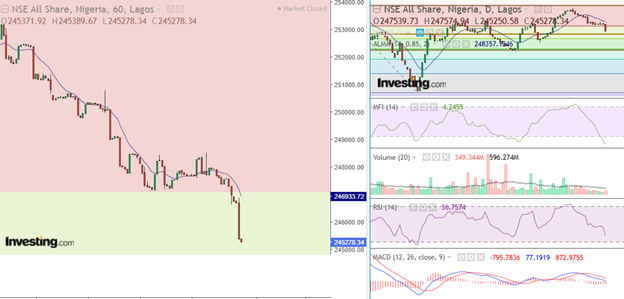
Market capitalisation also increased by ₦410.86 billion to ₦159.67 trillion, indicating an improvement in the aggregate value of listed equities. The positive close followed Monday’s significant decline, when the ASI shed 2,261.39 points, or 0.91%, while market capitalisation contracted by approximately ₦1.47 trillion to ₦159.26 trillion.
Tuesday’s performance suggests that some investors returned to the market to take advantage of lower share prices following the previous session’s losses. However, the recovery was relatively modest compared with Monday’s decline, indicating that buying interest has yet to establish sufficient strength to confirm a sustained upward movement.
The market’s direction in the coming sessions will therefore depend on whether investors continue to accumulate fundamentally sound stocks or resume profit-taking after the brief recovery. While the positive close offers some encouragement, sustained gains will require broader participation across sectors and stronger trading activity.
The rebound was supported by renewed demand for selected equities, particularly stocks that attracted buying interest following recent price adjustments. Gains across several counters helped lift the benchmark index, although performance remained mixed across the market.
NASCON, HBMNG, UNILEVER, CUSTODIAN, WEMABANK and OANDO featured among the stocks identified in the supplied market report as recording positive price movements. Their performance reflected the continued availability of opportunities in individual equities, even as investors remained selective in their allocation decisions.
The gains in consumer goods and industrial stocks suggest that investors were willing to increase exposure to companies they considered attractive at prevailing prices. However, the performance of individual stocks does not necessarily indicate a broad improvement in sector fundamentals, as short-term price movements may also reflect technical trading, liquidity conditions and stock-specific developments.
For the broader market, the key question is whether the recovery can extend beyond selected counters. A more convincing improvement would involve sustained demand across banking, consumer goods, industrial, insurance and other listed companies, accompanied by a consistent increase in the number of advancing stocks.
Such a development would indicate that investor confidence is improving and that the rebound is supported by broader market participation rather than concentrated buying in a limited number of equities.
Conversely, if gains remain restricted to a few stocks, the benchmark could struggle to maintain its upward direction. Under such conditions, renewed selling in heavily weighted equities could offset advances elsewhere and expose the market to further volatility.
The current environment therefore calls for close monitoring of price movements, trading volumes and market breadth to determine whether the latest recovery represents the beginning of a more sustained advance or merely a temporary pause in the recent correction.
Trading activity remained an important consideration during Tuesday’s session, as investors continued to reposition their portfolios amid mixed market signals.
The supplied figures showed that approximately 348.69 million shares were traded in 32,588 deals, with a reported transaction value of ₦25.84 billion. UBA led trading volume with 48.14 million shares exchanged, highlighting its prominence in market activity during the session, while ARADEL recorded the highest transaction value.
The concentration of trading activity in selected stocks suggests that investors continued to focus on specific opportunities rather than distribute their investments evenly across the market.
High trading volume can reflect different market conditions depending on whether transactions are driven by buying or selling pressure. Consequently, the volume recorded in an individual stock should be assessed alongside its price movement and broader trading pattern before drawing conclusions about investor sentiment.
For the market as a whole, the relationship between turnover and price performance will remain important in determining the strength of the rebound. A sustained increase in the ASI accompanied by stronger trading activity would provide firmer evidence of improving confidence.
On the other hand, a price recovery accompanied by subdued volume could indicate that investors remain reluctant to commit additional funds, potentially limiting the market’s ability to extend its gains.
The relatively cautious trading environment may also reflect the need for investors to reassess the valuations of stocks that have recorded substantial appreciation this year. With the market’s year-to-date return remaining elevated, some participants may prefer to secure profits while waiting for more attractive entry points.
This does not necessarily signal a reversal in the market’s broader direction. Rather, it highlights the possibility of intermittent corrections as investors balance profit-taking against expectations of further earnings growth and dividend payments.
Market breadth remained a useful indicator of the quality of Tuesday’s recovery. The positive close suggested that buying interest outweighed selling pressure in the reported market summary, although the available figures on advancing and declining stocks were inconsistent.
One set of supplied figures recorded 31 advancing stocks against 24 decliners, while another reported 28 gainers and 21 losers. Both sets indicated a positive balance between advancing and declining equities, but the discrepancy means that the final breadth figures should be verified against the official NGX market report before publication.
Positive breadth generally indicates that gains are extending across a reasonable number of stocks, rather than being driven exclusively by a few large companies. This can provide a stronger foundation for a market recovery, particularly when supported by improving trading volume.
However, breadth alone does not determine the direction of the benchmark index. Stocks with relatively large index weights can exert a disproportionate influence on the ASI, meaning that the index may rise even when several listed companies record losses.
Investors must therefore assess market breadth alongside the performance of major stocks, sectoral trends and trading activity to develop a more complete understanding of market conditions.
The latest session suggests that buyers were willing to return to selected equities following Monday’s decline. Whether that interest develops into a more durable trend will depend on the consistency of market participation over subsequent sessions.
Oil Market
Crude oil prices strengthened on Tuesday amid heightened geopolitical uncertainty in the Middle East.
Brent crude futures climbed to $111.75 per barrel, their highest level since May, before trading at $111.20, up $1.65, or 1.5%. US West Texas Intermediate (WTI) crude also advanced, reaching $110 per barrel before trading at $109.08, representing an increase of $5.42, or 5.2%.
The increase in oil prices reflected growing concerns about possible disruptions to global supply following reports of attacks on Saudi energy infrastructure and other targets, as well as reports of vessel attacks in the Gulf.
Yemen’s Iran-aligned Houthi group claimed on Monday that it had launched attacks on Saudi energy, airport and military facilities. The reported targets included an Aramco facility in Yanbu, the Shaybah oilfield, King Khalid International Airport in Riyadh and Abha airport.
Saudi authorities had not immediately confirmed the claims, and the reports could not be independently verified. Nevertheless, the developments heightened uncertainty surrounding the regional security situation and increased concerns about the safety of energy infrastructure and transportation routes.
Oil prices are particularly sensitive to geopolitical developments when traders believe that an escalation could affect production, exports or the movement of crude through important shipping routes. Even when an immediate supply disruption has not been confirmed, the possibility of reduced availability can push prices higher as market participants adjust their expectations.
The latest rally illustrates how quickly geopolitical developments can influence global energy prices and broader financial market sentiment. Sustained increases in crude oil prices can affect inflation expectations, transportation costs, corporate operating expenses and the outlook for oil-exporting economies.
For Nigeria, the implications are particularly important because crude oil remains a significant source of export earnings and government revenue.
Higher crude oil prices could provide some support for Nigeria’s external position if the increase translates into stronger export receipts and domestic production remains stable. Improved oil earnings could strengthen foreign exchange inflows, support government revenue and reduce some pressure on the country’s external accounts.
However, the benefits depend on several factors, including domestic crude production, export volumes, operational efficiency and the cost of meeting domestic petroleum requirements.
A rise in international prices does not automatically translate into a proportionate increase in government revenue. Production disruptions, higher operating costs and other sector-specific constraints can limit the benefits available to an oil-producing economy.
The domestic impact also extends beyond government finances. Higher global energy prices can increase inflationary pressures, particularly through transportation, manufacturing and distribution costs. The extent of this effect depends on domestic fuel prices, exchange-rate movements and the structure of the local energy market.
These considerations are important for the equities market because changes in oil prices and inflation expectations can influence corporate earnings, interest-rate expectations and investor appetite for risk.
Companies with significant exposure to energy production may benefit from stronger commodity prices, depending on their production levels, costs and financial obligations. By contrast, businesses that rely heavily on transportation, imported inputs or energy-intensive operations could face higher operating expenses.
Financial institutions may also experience indirect effects through changes in borrowers’ repayment capacity, business activity and the broader economic environment. Consumer-facing companies could face pressure if higher living costs reduce household purchasing power.
Consequently, investors will need to assess the implications of rising oil prices at the company level rather than assume that all Nigerian equities will benefit equally.
Technical Analysis
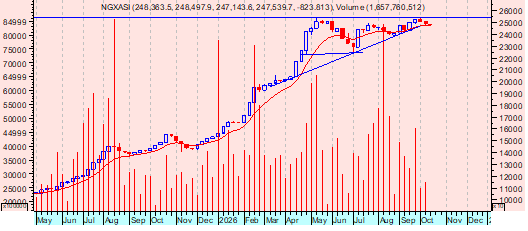
From a technical perspective, Tuesday’s 0.26% advance indicates a modest recovery following the previous session’s decline. The ASI regained 632.79 points, suggesting that buyers returned to selected stocks after Monday’s significant sell-off.
However, the rebound remains relatively limited when measured against the preceding decline. Monday’s loss of 2,261.39 points was substantially larger than Tuesday’s gain, meaning that the market has recovered only part of the ground lost during the previous session.
This comparison highlights the importance of distinguishing between a short-term rebound and a confirmed change in market direction.
A sustained recovery would require the ASI to record further gains over subsequent sessions, supported by stronger trading volume and improving market breadth. Consistent advances would suggest that buyers are gaining control and that demand is becoming more established across the market.
Conversely, a return to negative sessions accompanied by weak breadth could indicate that selling pressure remains significant. In that situation, Tuesday’s advance may be interpreted as a temporary recovery within a more volatile trading environment.
Trading volume will be particularly important in assessing the strength of the next market move. Rising prices supported by higher turnover would suggest stronger participation, while advances on declining activity could point to a lack of conviction among investors.
Market breadth will provide another important signal. A sustained increase in advancing stocks would indicate that the recovery is broadening, whereas renewed dominance by declining equities could weaken the market’s overall direction.
The ASI’s year-to-date return of 58.03% also suggests that profit-taking could remain a feature of trading. Investors who entered positions at lower prices may choose to realise gains, particularly when valuations appear stretched or uncertainty increases.
Such selling does not necessarily invalidate the market’s broader performance, but it can contribute to short-term volatility and create opportunities for investors with a longer investment horizon.
Without additional information on moving averages, momentum indicators and recent support and resistance levels, a more precise technical assessment would be premature. The available price data nevertheless point to a market attempting to stabilise after a significant decline.
Market Outlook:
The immediate outlook for the NGX will depend on whether the latest recovery attracts additional buying interest or gives way to renewed profit-taking.
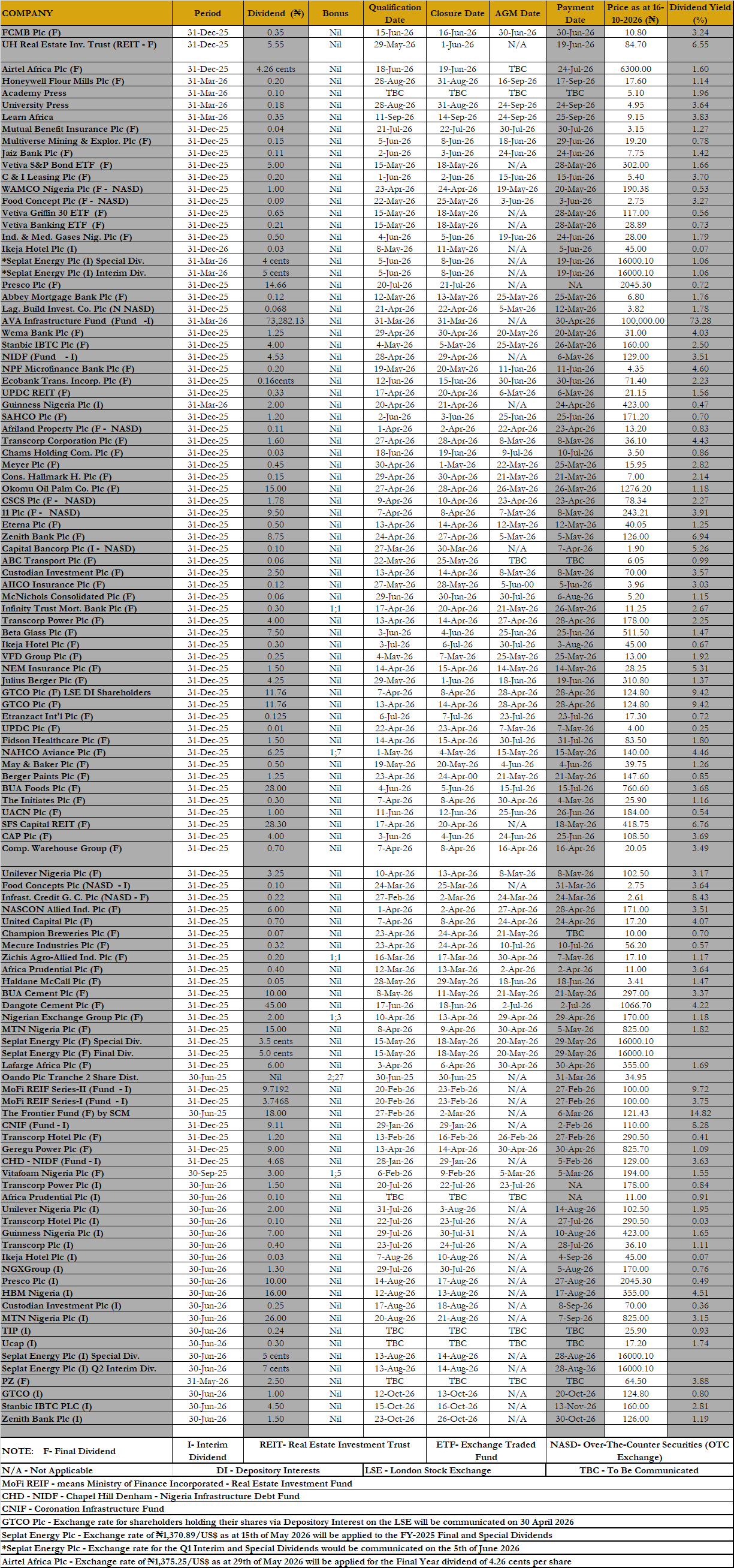
In the near term, investors are likely to monitor corporate earnings, dividend expectations, valuation levels and developments in the domestic macroeconomic environment. These factors will influence how market participants assess the relative attractiveness of equities against alternative investment opportunities.
Companies with consistent earnings, strong cash flows, manageable debt and sustainable dividend policies could remain attractive to investors seeking a combination of capital appreciation and income. However, even fundamentally sound companies can experience share-price declines when market sentiment weakens or valuations become less attractive.
Investors should therefore avoid making decisions solely on the basis of one session’s performance. A more reliable assessment requires examining company fundamentals, historical financial performance, future earnings prospects and prevailing market prices.
The banking sector will remain important to overall market direction because of the role of major banking stocks in trading activity and investor portfolios. Consumer goods and industrial stocks will also warrant attention as participants assess the impact of inflation, operating costs and household demand on corporate profitability.
Developments in the oil market may influence sentiment towards energy-related companies and Nigeria’s broader economic outlook. However, investors should distinguish between the potential benefits of higher crude oil prices and the operational realities facing individual companies.
Overall, Tuesday’s rebound provides a measure of relief after the previous session’s losses, but the market still needs stronger confirmation before a sustained recovery can be established. Improved breadth, stronger turnover and continued gains across major sectors would support a more positive outlook, while renewed selling pressure could prolong the period of consolidation.
The preferred approach in the current environment is to remain selective, prioritising companies with sound fundamentals and reasonable valuations while monitoring changes in market liquidity, investor sentiment and macroeconomic conditions.
Market Summary for Tuesday, October 20, 2026: The NGX All-Share Index gained 632.79 points, or 0.26%, to close at 245,911.13 points, while market capitalisation increased by ₦410.86 billion to ₦159.67 trillion. The market’s year-to-date return stood at 58.03%. Trading activity recorded approximately 348.69 million shares valued at ₦25.84 billion in 32,588 deals. Market breadth was positive, although the supplied reports differed on the exact number of advancing and declining stocks. UBA led trading volume with 48.14 million shares, while ARADEL recorded the highest transaction value. The top gainers were AUSTINLAZ (+9.97% to ₦3.53), ABCTRANS (+9.92% to ₦6.65), CUTIX (+9.91% to ₦2.33), THOMASWY (+9.77% to ₦2.92) and CAVERTON (+9.76% to ₦4.50). The top losers were LIVESTOCK (-9.76% to ₦17.10), GUINEAINS (-7.78% to ₦0.83), NPFMCRFBK (-5.75% to ₦4.10), MBENEFIT (-4.69% to ₦3.05) and AIICO (-3.06% to ₦3.80).