
Market Update For November 5, 2026
The Nigerian equities market reversed its recent positive momentum on Thursday, November 5, 2026, as renewed profit-taking and aggressive sell-offs in heavyweight stocks pushed the benchmark index lower, erasing ₦3.28 trillion from the market’s total value in one fell swoop. The drop is the biggest percentage signle day drop in the NGXASI behind the 5.01% slump of Tuesday, November 11, 2025, arising from a wave of aggressive profit-taking and investor panic that wiped 7,454.60 basis points and a staggering ₦4.64 trillion off the market capitalisation.
Thursday’s decline interrupted two consecutive sessions of gains, reflecting a shift in investor sentiment as market participants took advantage of previous price appreciation to reduce their equity exposure.
The renewed selling pressure was particularly evident in the industrial, consumer goods and financial services segments, where losses in selected large-cap stocks weighed heavily on the broader market. Although some mid- and small-cap equities maintained their upward momentum, the gains were insufficient to offset the impact of declines in highly capitalised stocks.
The market’s reversal also highlights the fragile nature of the recent recovery, particularly as investors continue to navigate elevated share prices, changing portfolio positions and expectations surrounding corporate earnings. The session’s performance suggests that market participants are becoming more selective, with buying interest increasingly concentrated in stocks offering relatively attractive entry points and positive price momentum.
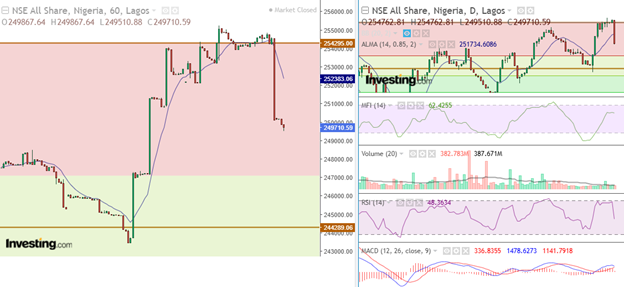
The NGX All-Share Index (ASI) declined by 5,052.22 points, closing at 249,710.59 points compared with 254,762.81 points recorded in the previous trading session. The decline translated into a ₦3.28 trillion reduction in market capitalisation, which settled at ₦162.13 trillion from the previous session’s level. Consequently, the market’s year-to-date return moderated to 60.47%, indicating that despite Thursday’s correction, the equities market continues to maintain substantial gains accumulated since the beginning of the year.
The retreat below the 250,000-point psychological threshold is particularly significant from a market sentiment perspective. Having recently recovered above this level, the index’s inability to sustain its position suggests that profit-taking remains a major influence on short-term market direction. The development also raises the possibility of further consolidation as investors reassess valuations and determine whether the recent decline presents an opportunity for fresh accumulation or signals a broader change in market momentum.
The day’s losses were largely influenced by sell-offs in heavyweight stocks like DANGCEM and PRESCO which recorded the maximum daily decline of 10.00% each. Their performances contributed to the weakness in the broader market, particularly as investors reduced exposure to stocks that had attracted significant trading interest.
UACN followed with a 7.85% decline, while HBMNG shed 7.71% and ETERNA lost 6.49%. Other notable decliners included NB, which fell by 2.50%, FIRSTHOLDCO, down 2.40%, and NGXGROUP, which declined by 2.24%. STANBIC and GTCO recorded losses of 0.85% and 0.81%, respectively, while OANDO, UBA and TRANSCORP also closed lower.
The weakness in banking and industrial stocks further reflected the cautious mood among investors. Although the declines in some financial services stocks were relatively moderate, their contribution to the overall market performance reinforced the negative direction of the benchmark index.
The performance of these heavyweight counters remains important because of their influence on market capitalisation and index movements. Consequently, sustained selling pressure in highly capitalised equities could continue to restrict the market’s ability to recover, even where buying interest improves across other segments.
For investors, the latest correction reinforces the importance of distinguishing between stocks experiencing temporary profit-taking and those facing more fundamental valuation or earnings concerns. While a decline in share prices can create opportunities for accumulation, the sustainability of any recovery will depend on the underlying financial performance and investment prospects of individual companies.
Despite the broad market weakness, some equities attracted renewed buying interest, demonstrating that investors have not completely withdrawn from the market. Rather, trading activity suggests a shift towards selective positioning, with market participants continuing to identify opportunities in stocks showing stronger price momentum.
CWG led the gainers with a 9.94% appreciation to close at ₦17.15. ABBEYBANK followed with a 9.84% increase to ₦6.70, while HONYFLOUR gained 9.82% to settle at ₦26.85. ETRANZACT advanced by 9.71% to ₦18.65, while CAVERTON appreciated by 8.96% to close at ₦3.65.
HONYFLOUR’s performance was particularly notable as the stock traded at a new 52-week high of ₦26.85, indicating sustained buying interest and positive price momentum. However, investors will need to monitor whether the stock can maintain its upward movement or experience profit-taking following its recent appreciation.
On the downside, WAPIC and LASACO recorded fresh price lows of ₦2.00 and ₦1.60, respectively. Their performances, alongside the declines in other equities, highlighted the uneven distribution of investor demand across the exchange.
The divergence between advancing and declining stocks suggests that the market is increasingly being driven by stock-specific developments rather than a uniform upward movement across listed equities. This environment places greater importance on company fundamentals, earnings quality, liquidity and valuation when making investment decisions.
Trading activity reflected significant concentration in selected equities, particularly FIRSTHOLDCO, which dominated the day’s reported volume and value contributions.
The detailed turnover breakdown showed that 856.28 million shares valued at ₦74.09 billion were exchanged in 33,540 deals. FIRSTHOLDCO accounted for 478.42 million shares, representing 55.87% of total volume, while transactions in the stock were valued at ₦44.94 billion, equivalent to 60.66% of total traded value.
ACCESSCORP and CHAMS also featured prominently among the leading stocks by volume, while UACN and STANBIC followed FIRSTHOLDCO in traded value. The concentration of transactions in a few counters suggests that significant liquidity remained directed towards selected equities despite the negative market direction.
The activity in FIRSTHOLDCO is particularly noteworthy given the stock’s position as the largest contributor to both volume and value. However, high turnover during a bearish session does not necessarily indicate accumulation, as the final direction of institutional positioning depends on the balance between buying and selling transactions.
More broadly, the concentration of market activity in a limited number of equities suggests that liquidity remains unevenly distributed across the exchange. This could leave less actively traded stocks more vulnerable to price swings, particularly during periods of heightened uncertainty.
Investors will therefore need to monitor not only the direction of the All-Share Index but also the distribution of trading volume and value across sectors and individual stocks. An improvement in turnover accompanied by stronger market breadth would provide a more convincing indication of renewed demand.
The market’s breadth deteriorated during Thursday’s session, providing further evidence of the weakening sentiment across listed equities. A total of 40 stocks closed lower against 22 gainers, while 84 equities remained unchanged.
The negative breadth indicates that selling pressure extended beyond the largest companies, affecting a wider section of the market. It also represented a deterioration from Wednesday’s trading session, when 30 equities advanced against 26 decliners.
The widening gap between declining and advancing stocks suggests that investors were increasingly inclined to reduce positions rather than pursue fresh buying opportunities. This is particularly relevant because a market correction supported by widespread declines often carries greater significance than one driven by a few isolated heavyweight stocks.
Although the number of unchanged equities indicates that some investors remained on the sidelines, the dominance of declining stocks points to a cautious trading environment. A sustained improvement in market breadth will be necessary to confirm that the market has regained sufficient buying support to resume its upward movement.
Technical Analysis:
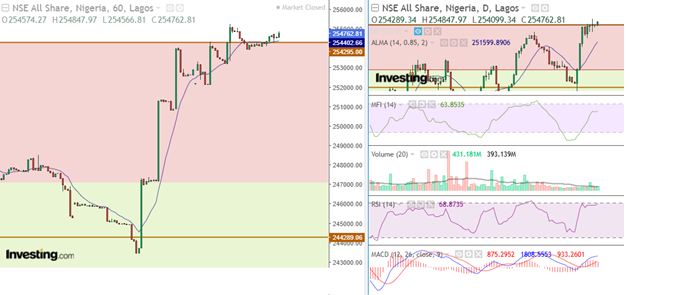
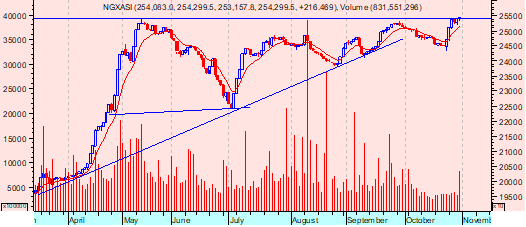
From a technical perspective, Thursday’s 1.98% decline represents a significant setback to the market’s short-term recovery. The All-Share Index retreated from 254,762.81 points to 249,710.59 points, falling below the psychologically important 250,000-point level.
The inability of the index to sustain its recent upward movement suggests that sellers are becoming increasingly active around prevailing market levels. The negative breadth further supports this position, indicating that the correction was relatively broad-based rather than limited to a few large-cap counters.
The 250,000-point region now represents an important level for the market to reclaim. A sustained recovery above this threshold could help restore confidence and create room for another attempt towards the previous trading range. However, continued weakness below this level could expose the index to further downside pressure as investors reassess their positions.
The market’s immediate technical direction will also depend on the performance of heavyweight stocks, particularly those with significant influence on the All-Share Index. A recovery in DANGCEM, UACN, PRESCO and major financial services counters would provide meaningful support for the benchmark index.
Trading volume will remain another important consideration. A decline accompanied by substantial turnover may indicate strong distribution, while a subsequent recovery supported by increased buying activity could suggest that investors are beginning to absorb available supply.
The Relative Strength Index, Moving Average Convergence Divergence and other momentum indicators will also be useful in assessing whether the current correction is developing into a more prolonged bearish phase or represents a temporary pause within the broader upward trend.
Market Outlook
The near-term outlook for the Nigerian equities market remains cautious following Thursday’s sharp reversal. While the market continues to enjoy a strong year-to-date return, the latest decline highlights the possibility of further volatility as investors take profits and reposition portfolios.
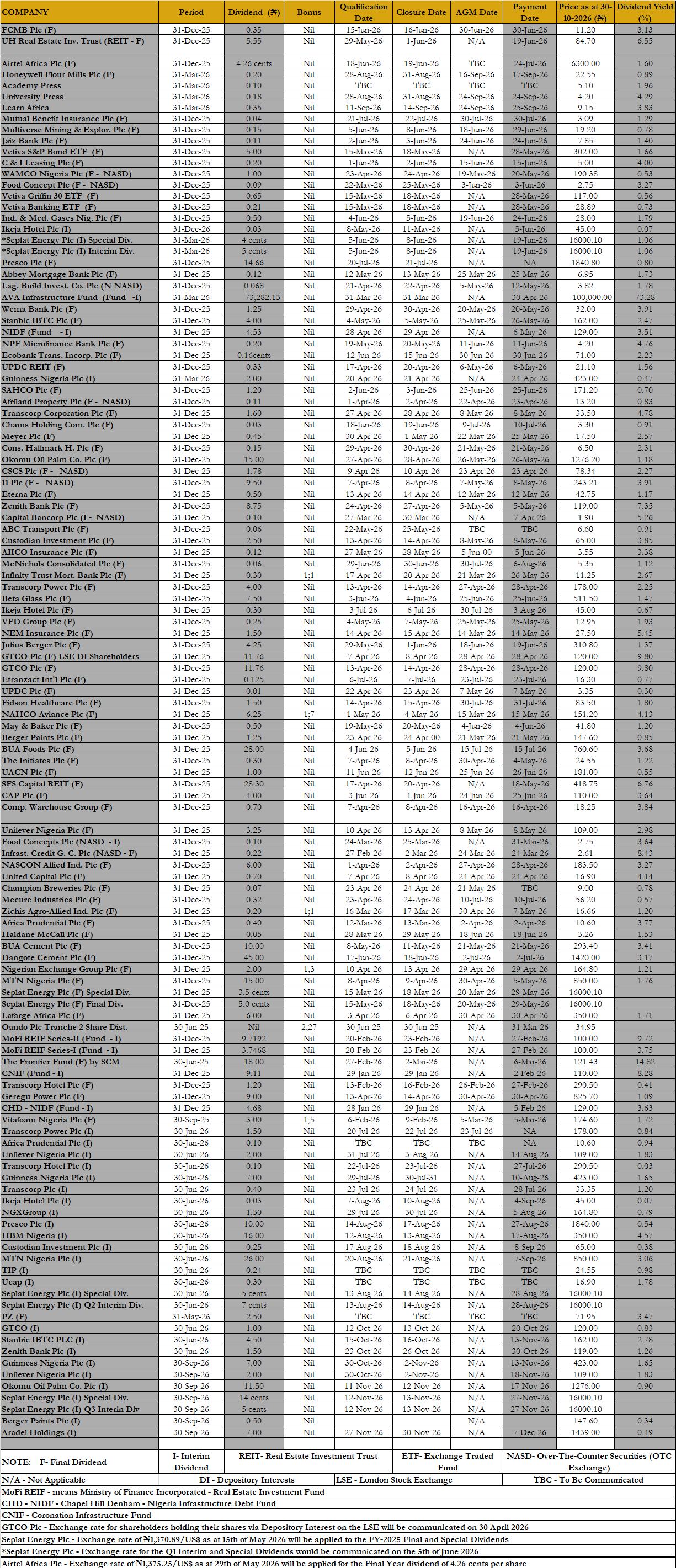
Attention will likely remain focused on heavyweight equities, corporate earnings releases, dividend expectations and developments affecting domestic liquidity. The banking sector will also remain important to market direction, given the influence of major financial institutions on trading activity and market capitalisation.
Stocks with strong earnings prospects, sustainable dividend policies and attractive valuations may continue to attract investor interest. However, equities that have recorded significant price appreciation without corresponding improvements in fundamentals could face additional profit-taking.
The current environment also reinforces the importance of monitoring the relationship between market breadth and index performance. A recovery driven by a handful of heavyweight stocks may not necessarily represent a broad improvement in investor confidence. Stronger participation across sectors would provide a more sustainable foundation for renewed market appreciation.
Overall, Thursday’s performance reflects a return of caution to the Nigerian equities market after its recent recovery. Although the correction has reduced some of the market’s accumulated gains, the year-to-date performance remains firmly positive. The ability of the ASI to reclaim the 250,000-point level, alongside improved market breadth and renewed demand for fundamentally sound equities, will be central to determining the market’s next direction.
Oil Market
In the international commodities market, crude oil prices recovered on Thursday after recording substantial losses in the previous session, as investors reassessed geopolitical developments surrounding the US-Israeli conflict with Iran and the potential implications for global energy supplies.
Brent crude futures rose by $2.94, representing a 3.11% increase, to $97.56 per barrel as of 1417 GMT. US West Texas Intermediate crude futures also advanced by $1.73, or 1.96%, to $89.85 per barrel.
The recovery followed a sharp decline of more than 8% in both benchmarks during the previous trading session, which pushed prices to their lowest settlement levels since August 31. The rebound suggests that geopolitical uncertainty continues to provide support for crude prices despite recent downward pressure.
Investors remained concerned about the unresolved conflict in the Middle East and the possibility of disruptions to oil production and transportation routes. The uncertainty surrounding Washington’s next move also contributed to market volatility.
The conflict with Iran, launched by the United States alongside Israel in February, and its impact on fuel prices became major issues in the US midterm elections. President Donald Trump’s Republican Party suffered significant losses, with higher energy costs among the concerns influencing voters.
The latest recovery in crude prices reflects the market’s sensitivity to geopolitical developments, although the direction of prices will continue to depend on the duration of the conflict, supply conditions and expectations for global oil demand.
For oil-dependent economies, including Nigeria, movements in crude prices remain important to foreign exchange earnings, fiscal revenue and external reserve accumulation. However, the domestic benefits of higher international prices will also depend on production levels, export volumes and the country’s ability to translate improved prices into stronger government revenue.
Thursday’s trading session therefore presented a mixed picture across financial and commodity markets, with Nigerian equities facing renewed selling pressure while international crude benchmarks recovered from their previous losses.
NGX Market Summary
The Nigerian Exchange closed Thursday’s session on a bearish note, with the All-Share Index shedding 5,052.22 points, or 1.98%, to settle at 249,710.59 points, while market capitalisation declined by ₦3.28 trillion to ₦162.13 trillion. Reported turnover in the detailed market breakdown stood at 856.28 million shares valued at ₦74.09 billion across 33,540 deals, while the year-to-date return moderated to 60.47%. Market breadth was negative, with 40 decliners against 22 advancers, while 84 equities closed unchanged. FIRSTHOLDCO dominated trading by volume and value, accounting for 478.42 million shares worth ₦44.94 billion, while ACCESSCORP and CHAMS also featured among the most actively traded stocks. Top gainers: CWG (+9.94%) to ₦17.15, ABBEYBANK (+9.84%) to ₦6.70, HONYFLOUR (+9.82%) to ₦26.85, ETRANZACT (+9.71%) to ₦18.65 and CAVERTON (+8.96%) to ₦3.65. Top losers: DANGCEM (-10.00%) to ₦1,341.00, PRESCO (-10.00%) to ₦1,656.80, WAPIC (-9.91%) to ₦2.00, AUSTINLAZ (-8.57%) to ₦2.24 and LASACO (-8.57%) to ₦1.60.