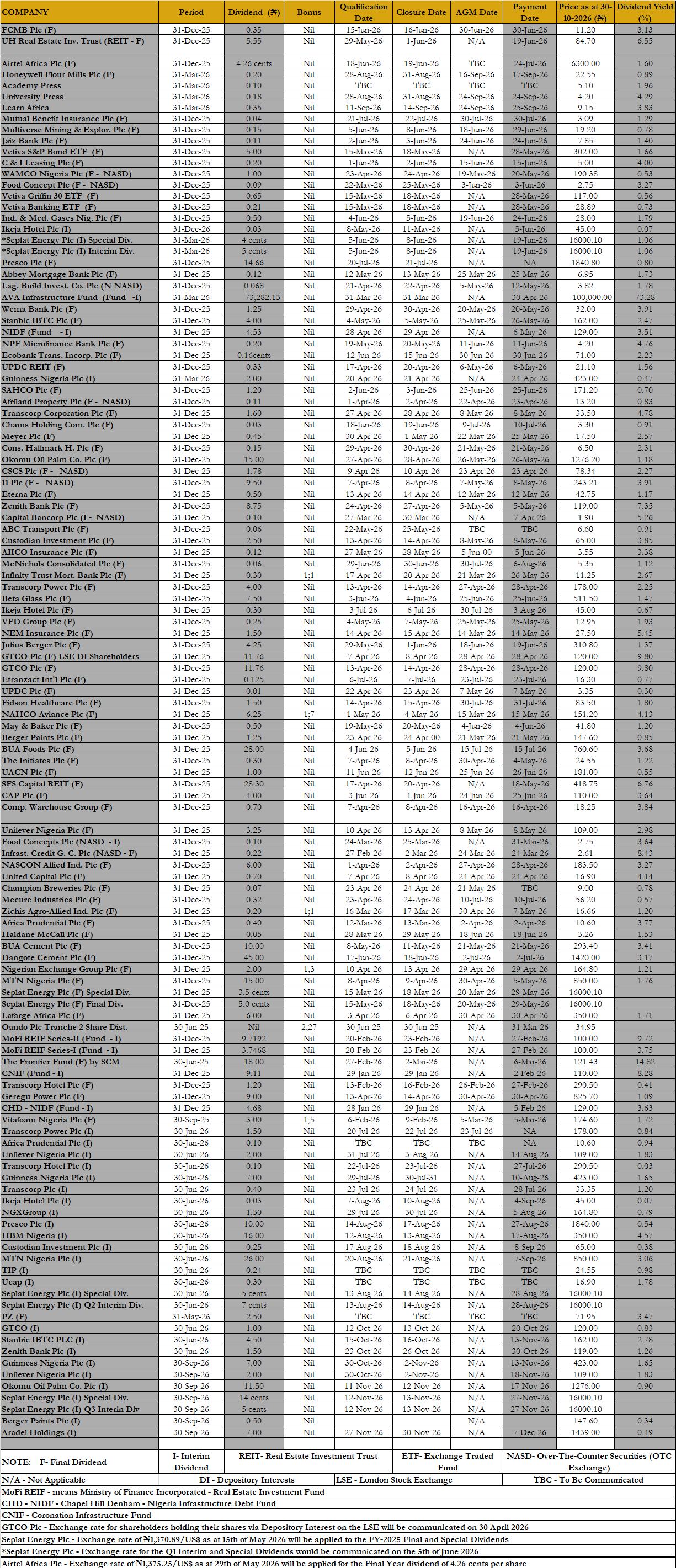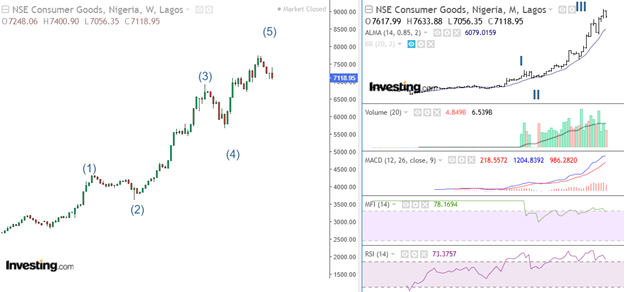

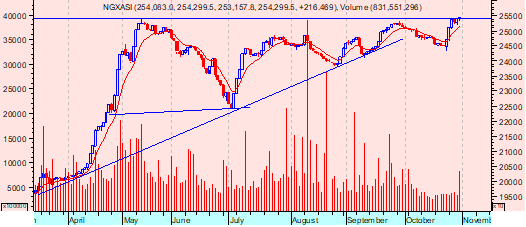
The last full trading week of October on the Nigerian Exchange was bullish, halting four consecutive weeks of decline after forming a reversal hammer candlestick in the face of positive corporate numbers hitting the market and continued buying interests in the shares of Dangote Cement. This supported the rebound despite the negative market internals, bullish momentum and intermittent profit-taking across some equities. The daily index’s action below revealed how the market performed throughout the period under review.
NGXASI Daily Index Action
Trading for the week started on a positive, with the composite NGX All-Share Index advanced 1.65%, closing at 251,290.54 basis points, adding approximately ₦2.64 trillion to the market capitalisation. Year-to-date (YTD) return rose to 61.48%, just as DANGCEM led the gainers with 10.00%, while ABCTRANS recorded the biggest loss. Market breadth was negative, with 24 gainers against 30 losers. Trading volume declined 46.13% to 329.53 million shares worth ₦25.45 billion in 43,700 deals.
The trend was sustained on Tuesday, with the benchmark index gaining 1.07% to close at 253,990.06 points. Market capitalisation increased by ₦1.75 trillion, while YTD return improved to 63.22%. UPDCREIT topped the gainers, while PRESCO led the losers. Market breadth remained negative at 20 gainers against 36 losers. However, trading activity surged as 5.23 billion shares valued at ₦441.44 billion changed hands, representing a 1,488.13% increase in volume. FIRSTHOLDCO dominated transactions, accounting for 93.19% of total volume.
The market pulled back on Wednesday as profit-taking in selected stocks pushed the ASI down 0.44% to 252,882.78 points, wiping ₦718.95 billion off market capitalisation. YTD return moderated to 62.51%. SOVRENINS led the gainers, while FIRSTHOLDCO recorded the largest decline. Market breadth improved to 30 gainers against 25 losers. Trading volume dropped 92.28% to 404.11 million shares valued at ₦27.91 billion.
Buying interest returned on Thursday, lifting the ASI by 0.47% to 254,083.02 points and adding ₦779.31 billion to market capitalisation. YTD return increased to 63.28%. ETRANZACT led the gainers, while FIRSTHOLDCO remained among the biggest losers. Market breadth was positive, with 27 gainers against 26 losers. DANGCEM also reached a new 52-week high of ₦1,420.00. Trading volume rose 61.90% to 654.28 million shares worth ₦57.36 billion, with FIRSTHOLDCO accounting for 52.55% of total volume.
The market closed the week positive on Friday when the ASI advanced 0.09% on Friday to 254,299.49 points. Market capitalisation increased by ₦140.55 billion to ₦165.114 trillion, while YTD return climbed to 63.42%. HONYFLOUR led the gainers with a 10.00% increase, while CAVERTON recorded the steepest decline. Market breadth remained negative, with 25 gainers against 32 losers. Trading volume rose 52.47% to 997.57 million shares valued at ₦85.81 billion, with FIRSTHOLDCO accounting for 58.18% of total volume.
Overall, trading activity strengthened considerably during the week, with investors exchanging 7.619 billion shares valued at ₦637.826 billion in 192,138 deals, against 2.024 billion shares worth ₦110.773 billion in 173,113 deals recorded in the previous week.
The Financial Services Industry dominated the week’s transactions, accounting for 6.990 billion shares valued at ₦573.492 billion in 85,998 deals. This represented 91.75% of total volume and 89.91% of transaction value. Consumer Goods ranked second with 164.650 million shares worth ₦7.201 billion in 20,297 deals, while the Services Industry followed with 93.278 million shares valued at ₦1.567 billion in 9,932 deals.
Trading was heavily concentrated in First Holdco Plc, Guaranty Trust Holding Company Plc and United Bank for Africa Plc. The three equities recorded a combined turnover of 6.096 billion shares worth ₦544.438 billion in 27,001 deals, accounting for 80.02% of total equity volume and 85.36% of transaction value.
Despite the mixed daily sessions, the broader market maintained its upward trajectory. The ASI and market capitalisation appreciated by 2.86% during the week to close at 254,299.49 points and ₦165.114 trillion, respectively. However, sectoral performance was uneven, with the Main Board, Consumer Goods, Banking, Insurance, Growth and Commodity indices declining by 0.11%, 1.70%, 3.42%, 2.13%, 0.02% and 1.02%, respectively, while the remaining indices closed higher.
Market breadth showed a mixed but improving picture. A total of 33 equities appreciated in price, compared with 20 in the previous week, while 48 stocks declined against 55 previously. Unchanged stocks fell to 65 from 71, suggesting improved participation and stronger buying interest across selected counters.
Overall, the NGX All-Share Index gained 2.86% to close at 254,299.49 points, while market capitalisation rose to ₦165.114 trillion. Year-to-date return settled at 63.42%. Despite negative breadth in some sessions, the market recorded improved trading activity, with 7.619 billion shares worth ₦637.826 billion exchanged in 192,138 deals. FIRSTHOLDCO, GTCO and UBA dominated turnover, while DANGCEM, HONYFLOUR and UPDCREIT featured among the notable gainers during the week.
Week-to-date, the All-Share Index has gained 2.86%, NGX 30 is up by 3.03%, the Banking Index has decreased by 3.42%, the Pension Index increased by 0.14%, the Insurance Index declined by 2.13%, the Consumer Goods Index decreased by 0.02%. However, the Oil and Gas Index recorded a positive return of 0.82%. Year-to-date, the All-Share Index has gained 63.42%, NGX 30 is up by 65.29%, the Banking Index has increased by 60.27%, the Pension Index increased by 80.14%, the Insurance Index declined by 13.64%, the Consumer Goods Index increase by 0.97%. However, the Oil and Gas Index recorded a positive return of 127.90%.
Dangote Cement Plc
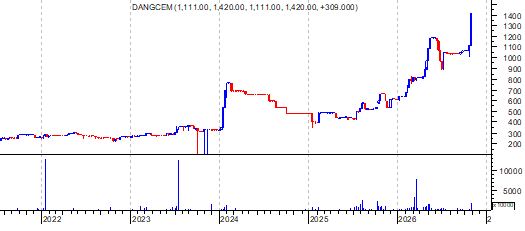
Dangote Cement Plc led the gainers, rising from an opening price of ₦1,111.00 to ₦1,420.00, representing an increase of ₦309.00 or 27.81%. Honeywell Flour Mill Plc followed, advancing from ₦17.90 to ₦22.55, up ₦4.65 or 25.98%. UPDC Real Estate Investment Trust gained ₦3.60, rising from ₦17.50 to ₦21.10, representing a 20.57% appreciation. Sovereign Trust Insurance Plc advanced by ₦0.40, from ₦1.95 to ₦2.35, gaining 20.51%, while Eterna Plc increased by ₦3.85, from ₦38.90 to ₦42.75, representing a 9.90% gain.
Caverton Plc
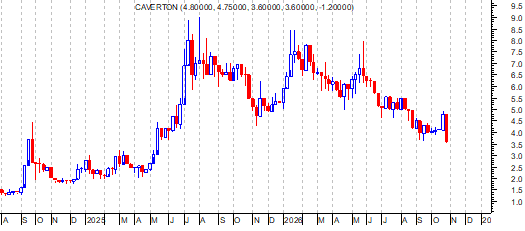
On the decliners’ chart, Caverton Offshore Support Group Plc recorded the steepest loss, falling from ₦4.80 to ₦3.60, representing a decline of ₦1.20 or 25.00%. Livestock Feeds Plc followed, shedding ₦3.75 to close at ₦13.30 from ₦17.05, translating to a 21.99% decline. Austin Laz & Company Plc dropped by ₦0.50, from ₦2.85 to ₦2.35, representing a 17.54% loss. First Holdco Plc declined by ₦24.95, from ₦144.10 to ₦119.15, shedding 17.31%, while Guinea Insurance Plc lost ₦0.16 to close at ₦0.77 from ₦0.93, representing a 17.20% decline.
NGX Weekly Comparative Analysis
The Nigerian equities market rebounded strongly in the week ended October 30, 2026, reversing the previous week’s 0.13% decline as renewed buying interest lifted the NGX All-Share Index (ASI) by 2.86%. The index gained 7,077.22 points to close at 254,299.49 points, compared with 247,222.27 points in the preceding week. Market capitalisation increased by ₦4.595 trillion to ₦165.114 trillion from ₦160.519 trillion, while year-to-date return improved to 63.42% from 58.87%.
Trading activity strengthened significantly, with investors exchanging 7.619 billion shares valued at ₦637.826 billion in 192,138 deals, compared with 2.024 billion shares worth ₦110.773 billion in 173,113 deals previously. This represented increases of 276.63% in volume, 475.73% in value and 10.99% in deals.
The Financial Services Industry dominated transactions, accounting for 6.990 billion shares worth ₦573.492 billion, representing 91.75% of total volume and 89.91% of transaction value. Consumer Goods followed with 164.650 million shares valued at ₦7.201 billion, while Services recorded 93.278 million shares worth ₦1.567 billion. FIRSTHOLDCO, GTCO and UBA jointly traded 6.096 billion shares valued at ₦544.438 billion, accounting for 80.02% of total volume and 85.36% of transaction value. This compared with MULTITREX, ZENITHBANK and LIVESTOCK FEEDS, which accounted for 25.76% of volume and 17.24% of value in the previous week.
Market breadth improved, with 33 equities gained against 20 in the previous week, while declining stocks decreased to 48 from 55. Unchanged stocks also fell to 65 from 71. However, sectoral performance remained mixed. The Main Board, Consumer Goods, Banking, Insurance, Growth and Commodity indices declined by 0.11%, 1.70%, 3.42%, 2.13%, 0.02% and 1.02%, respectively. In the previous week, Industrial Goods gained 1.95%, Premium rose 0.80%, Consumer Goods and Growth advanced 0.04% each, while Pension Broad gained 0.03%.
Daily performance was stronger during the current week, with the market recording gains in four of five sessions. This contrasted with the previous week, when losses across the first four sessions outweighed Friday’s recovery. DANGCEM, HONYFLOUR and UPDCREIT featured among the notable gainers during the current week, while FIRSTHOLDCO, GTCO and UBA dominated trading activity. DANGCEM also reached a 52-week high of ₦1,420.00.
Overall, the NGX recorded a significant recovery, with the ASI gaining 2.86% against the previous week’s 0.13% decline. Market capitalisation rose to ₦165.114 trillion, while turnover increased substantially to 7.619 billion shares worth ₦637.826 billion. Improved market breadth, stronger trading activity and renewed buying interest supported the rally, although heavy concentration in financial stocks and weakness across some sectoral indices indicated that the recovery remained selective.
Technical Analysis View
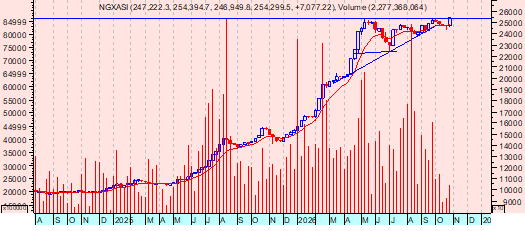
The Nigerian equities market maintained its bullish structure during the week, with the NGX All-Share Index advancing 2.86% to close at 254,299.49 points. The recovery reflected renewed buying interest in selected large-cap stocks, particularly within the Financial Services sector, which dominated trading activity. Although the market experienced intermittent profit-taking, especially on Wednesday, the subsequent recovery in the final two sessions suggests that buyers remain active and willing to support prices at lower levels.
From a technical perspective, the index is showing signs of sustained upward momentum after recovering from recent losses. Its ability to close above the 250,000-point psychological threshold strengthens the positive short-term outlook and keeps the broader bullish trend intact. However, the market’s inability to record consistently positive breadth indicates that the rally remains selective, with gains concentrated in a relatively small number of heavyweight stocks. This divergence between index performance and broader market participation suggests that underlying market strength is yet to become widespread.
Trading activity also improved significantly, with turnover rising sharply compared with the previous week. However, the concentration of volume and value in FIRSTHOLDCO, GTCO and UBA suggests that institutional positioning, portfolio rebalancing and speculative transactions played a significant role in shaping market performance. Sustained participation across other sectors and mid-cap stocks will be important in confirming the strength of the ongoing rally.
Going into the new trading week, the 255,000-point level represents an immediate resistance zone, with a decisive break potentially opening the way for further upward movement towards the 260,000-point mark. On the downside, the 250,000-point psychological level remains an important support zone, while a break below it could expose the market to deeper profit-taking around 245,000 points.
Market direction will largely depend on the sustainability of buying interest in blue-chip stocks, investors’ appetite for risk, corporate earnings expectations and prevailing macroeconomic conditions. Improved liquidity and continued demand for fundamentally strong equities could provide further support for the market, although elevated valuations in selected counters may encourage profit-taking.
Market Outlook
Overall, the outlook remains cautiously bullish, with investors expected to maintain selective positioning while taking advantage of opportunities in stocks with strong earnings potential, attractive valuations and consistent dividend prospects. Nevertheless, sustained market breadth and broader sector participation will be necessary to support a more durable rally and prevent the market’s upward movement from becoming overly dependent on a few heavyweight stocks.
Trending in the Economy: Nigeria’s diaspora remittance inflows increased 33% year-on-year to a record $1.57 billion in Q2 2026, according to the CBN. June accounted for the highest monthly inflow of $580.16 million, as tighter regulations seek to strengthen transparency in the sector.
President Bola Tinubu has asked the National Assembly to approve a $21.69 billion external borrowing plan for 2026–2027 to finance infrastructure, agriculture, healthcare, security and job creation. He said the loans would help close the infrastructure gap and support economic growth.
Global Market and Oil: Global financial markets came under renewed pressure on Friday as a sharp selloff in technology stocks dragged major equity indices lower, reflecting growing investor concerns over the rising cost of artificial intelligence (AI) development and uncertainty about the returns on massive investments in the sector. The weakness pushed MSCI’s global equity index down 1.51%, or 17.15 points, to 1,115.47, while investors increased exposure to safer assets, particularly US government bonds.
The latest decline was driven largely by disappointing market reactions to earnings reports from major technology companies, with investors increasingly questioning whether the substantial capital being committed to AI infrastructure, data centres and related developments would translate into sustainable earnings and cash flows.
Intel suffered the heaviest losses among major technology stocks, plunging 28.6% after its latest results highlighted significant cash consumption associated with its investment plans. The chipmaker also warned that demand for personal computers had weakened, adding that the slowdown could extend into next year. The development raised fresh concerns about the outlook for the semiconductor industry, which has benefited considerably from the global rush to develop AI capabilities.
Amazon shares declined 1.4% as investors assessed the company’s substantial AI-related spending and its impact on cash generation. Alphabet, Google’s parent company, also lost 1.4% on Friday, extending its 12.6% decline recorded in the previous session. The company’s latest financial results showed that aggressive AI investments had pushed its cash flow into negative territory, reinforcing concerns about the financial burden of maintaining its competitive position in the rapidly expanding AI market.
The losses reflected a broader reassessment of valuations across the technology sector following a prolonged rally in AI-related stocks. Investors who had previously supported the sector on expectations of strong future earnings are becoming more cautious as capital expenditure continues to rise without immediate evidence of corresponding returns.
Market participants also pointed to profit-taking after the exceptional gains recorded by technology companies. With valuations having advanced significantly, even relatively modest concerns about earnings quality, cash generation and future spending have triggered substantial selling pressure.
The selloff extended beyond individual companies to the wider semiconductor industry. The Philadelphia Semiconductor Index fell more than 7% after touching its lowest level since May, recording its biggest single-day decline since late June. The S&P 500 technology sector index also dropped 4.2%, its weakest daily performance since early June.
The weakness in technology stocks weighed heavily on the broader US market. The Dow Jones Industrial Average declined 572.25 points, representing a 1.09% loss, to close at 51,770.31. The S&P 500 shed 140.32 points, or 1.82%, to settle at 7,580.07, while the technology-heavy Nasdaq Composite suffered the largest decline, falling 747.73 points, or 2.86%, to 25,437.00.
Globally, MSCI’s broad index of equities across developed and emerging markets dropped 1.51% to 1,115.47 points, while Europe’s STOXX 600 closed 0.36% lower. The broad-based weakness highlighted how developments in the US technology sector continue to influence investor sentiment across international markets.
According to market observers, the combination of elevated AI expenditure, weakening cash flows and uncertainty over the timing of investment returns has become a major concern for equity investors. The growing preference for companies with stronger balance sheets, predictable earnings and more stable cash generation suggests a possible shift in market positioning away from high-growth technology stocks.
The cautious mood also reflected additional concerns about rising crude oil prices and geopolitical developments in the Middle East. Continued attacks and threats to energy infrastructure have increased uncertainty over global oil supplies, while concerns about a reported security breach involving Binance, the world’s largest cryptocurrency exchange, added to pressure across digital assets. As investors reduced exposure to riskier investments, consumer staples and utilities attracted buying interest. These sectors are generally considered more defensive because demand for their products and services tends to remain relatively stable during periods of economic and financial uncertainty.
Energy stocks, however, emerged as the strongest-performing sector on Wall Street. The sector benefited from higher crude oil prices and encouraging earnings reports from Exxon Mobil and Chevron. Both companies recorded strong profits, supported by improved refining margins amid supply disruptions arising from Ukrainian attacks on Russian refineries and the ongoing Iran conflict.
In the fixed-income market, US Treasury securities rallied as investors sought protection against further equity market losses. The increased demand pushed bond prices higher and yields lower, reflecting the traditional movement between these assets during periods of heightened market uncertainty.
The yield on the benchmark 10-year US Treasury note declined 5.8 basis points to 4.931%, putting it on course for its largest monthly decline in almost three years. The
30-year Treasury yield also fell 1.97 basis points to 5.3093%, while the two-year note yield dropped 6.64 basis points to 4.59%.
The decline in the two-year yield was particularly significant because it closely reflects market expectations regarding the Federal Reserve’s monetary policy direction. Lower yields indicate increased demand for government debt and changing expectations about future interest rates, although the latest movement was also influenced by investors seeking safe-haven assets amid the equity selloff.
In the foreign exchange market, the Japanese yen strengthened for a third consecutive trading session against the US dollar after the Bank of Japan maintained its benchmark interest rate but revised its inflation forecast upwards. The renewed weakness in technology stocks also encouraged investors to seek protection in currencies traditionally viewed as safe havens.
The US dollar index, which measures the greenback against a basket of major currencies, edged up 0.04% to 101.92. The euro weakened 0.13% against the dollar to $1.1163, while the dollar declined 0.1% against the Japanese yen to 157.54.
Cryptocurrency markets also experienced losses as investors reduced exposure to volatile assets. Bitcoin declined 2.49% to $76,877.30, while Ethereum fell 1.01% to $2,236.76. The weakness reflected the broader risk-off sentiment across financial markets, alongside concerns surrounding the reported security breach at Binance.
Meanwhile, crude oil prices extended their rally, settling at their highest levels in six months as traders assessed the possibility of further escalation in the Iran conflict following the US midterm elections scheduled for Tuesday. The conflict, which had continued for eight months without a resolution, remained a major source of uncertainty for global energy markets.
Supply concerns intensified after a tanker was attacked in the Strait of Hormuz on Friday. The strategic waterway is a critical route for international oil shipments, making any disruption to shipping activities a potential threat to global energy supply and prices. The latest attack reinforced concerns that prolonged geopolitical tensions could restrict crude oil movements and keep energy prices elevated. Traders also remained alert to the possibility of further disruptions involving major oil-producing countries and critical shipping routes.
US West Texas Intermediate crude rose by $2.12, representing a 2.08% gain, to settle at $104.12 per barrel. International benchmark Brent crude advanced by $2.76, or 2.4%, to close at $117.63 per barrel.
Overall, Friday’s market performance reflected a growing divide in investor positioning, with concerns about the sustainability of AI-driven valuations triggering heavy selling in technology stocks while demand for government bonds and defensive equities increased. At the same time, rising geopolitical risks continued to support crude oil prices, creating additional uncertainty for inflation, global monetary policy and financial market stability.
The immediate direction of global equities is likely to depend on whether technology companies can demonstrate that their substantial AI investments are translating into stronger revenue, profitability and sustainable cash flows. Until investors gain greater confidence in the financial returns from these investments, elevated capital expenditure and stretched valuations could continue to expose the technology sector to sharp corrections.