
Market Update For November 6, 2026
The Nigerian equities market sustained its downward trajectory on Friday, November 6, 2026, as renewed selling pressure in heavyweight stocks, particularly across the banking and consumer goods sectors, weakened overall market performance. The decline extended the losses recorded in the previous session, reflecting cautious investor positioning and continued profit-taking following the market’s strong performance in recent months.
Although buying interest persisted in selected equities, the gains were insufficient to offset losses in several influential stocks. The market’s performance highlighted the growing divergence between stocks attracting fresh demand and those experiencing valuation-driven corrections as investors reassessed their positions ahead of the new trading week.
The selling pressure was particularly evident in PZ, CUSTODIAN, HBMNG, ZENITHBANK, GTCO, MTNN and DANGSUGAR, among others. These stocks weighed on the broader market, with losses in major banking and consumer-related counters contributing to the benchmark index’s decline. The weakness in ZENITHBANK, GTCO and ACCESSCORP also reflected cautious sentiment towards some of the market’s most actively traded financial stocks.
However, the session was not entirely characterised by negative sentiment. CHAMPION and WAPIC recorded strong gains, while HONYFLOUR continued its upward movement, reaching a fresh 52-week high of ₦29.50. The performance of these stocks suggests that investors remain willing to take positions in selected equities with favourable price momentum, even as broader market sentiment becomes more cautious.
The market’s positive breadth, despite the decline in the benchmark index, also suggests that losses were concentrated in selected heavyweight stocks rather than spread uniformly across the market. This divergence is important because it indicates that underlying demand remains present in parts of the market, although the weakness in large-cap counters continues to influence the overall direction of the All-Share Index.
Trading activity weakened during the session, pointing to reduced participation and a more cautious approach among investors. Total volume declined to 369.92 million shares, while transaction value stood at ₦26.04 billion across 32,351 deals. This represented a significant moderation in market activity compared with the previous session, suggesting that investors were less aggressive in executing transactions amid the prevailing uncertainty.
GTCO maintained its position as the most actively traded stock by volume and value, with 41.02 million shares exchanged, representing a notable share of total market turnover. Transactions in the stock were valued at approximately ₦4.92 billion, accounting for a substantial portion of the day’s traded value.
HONYFLOUR and UBA also featured prominently in volume transactions, while ZENITHBANK and NESTLE followed GTCO among the leading stocks by value. The concentration of trading activity in these equities highlights the continued importance of banking and consumer-related stocks in shaping market liquidity and investor participation.
The decline in trading activity alongside the negative index performance suggests that investors are becoming more selective rather than engaging in widespread portfolio adjustments. However, sustained weakness in market turnover could limit the pace of recovery if stronger institutional demand does not return in subsequent sessions.
Oil Market
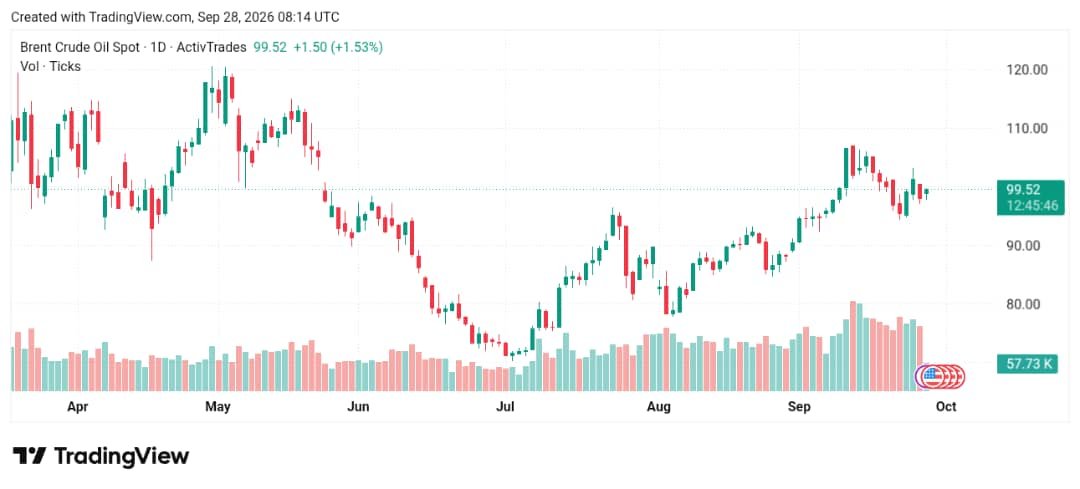
In the international oil market, crude prices remained volatile on Friday as investors weighed the possibility of easing geopolitical tensions in the Middle East against continued security threats to energy shipments.
Brent crude futures for January delivery traded around $98.55 per barrel, while US West Texas Intermediate (WTI) futures stood at $91.09 per barrel. Despite the modest intraday recovery, both benchmarks remained on course for substantial weekly losses, with Brent heading towards a decline of approximately 16% and WTI facing a potential 13% drop.
The sharp correction in crude prices followed political developments in the United States, where losses suffered by President Donald Trump’s Republican Party in the midterm elections raised expectations of a possible shift towards de-escalation in the US-Israeli conflict involving Iran.
A reduction in geopolitical tensions could create room for additional crude exports from the Middle East, easing supply concerns and placing further pressure on international oil prices. However, continued attacks on vessels in the region remain a significant risk, providing some support to prices and preventing a more sustained downward movement.
For Nigeria, the direction of global oil prices remains important for foreign exchange inflows, government revenue and overall macroeconomic stability. A prolonged decline in crude prices could weaken export earnings and complicate fiscal projections, particularly if lower prices coincide with production challenges. On the other hand, improved regional stability could support global supply conditions and reduce some of the inflationary pressures associated with elevated energy costs.
The developments in the oil market therefore remain an important external factor for investors assessing Nigeria’s economic outlook and the earnings prospects of companies exposed to energy prices, foreign exchange movements and domestic consumption.
Technical Analysis and Market Outlook
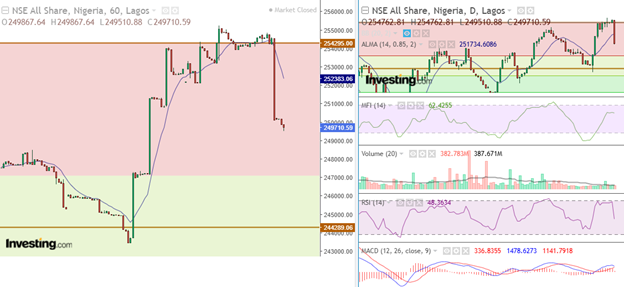
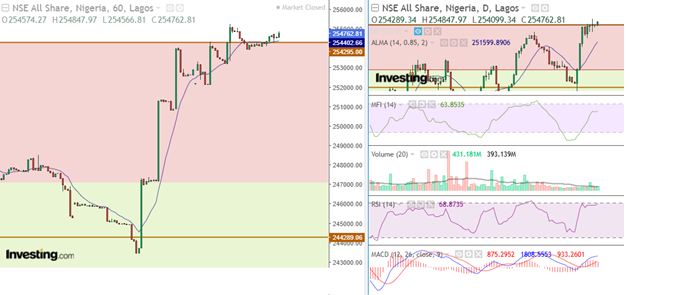
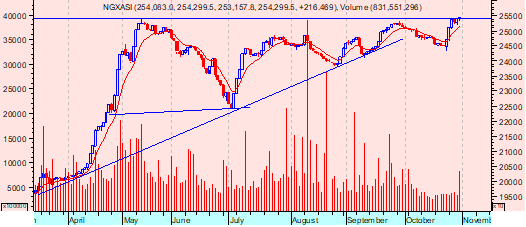
From a technical perspective, the NGX All-Share Index is showing signs of short-term weakness after retreating from the 254,000-point region. The latest decline extends the market’s recent correction and suggests that selling pressure is gradually influencing price direction, particularly among heavyweight stocks that previously supported the market’s upward movement.
The inability of the index to sustain its position above the 250,000-point psychological threshold raises the possibility of further consolidation as investors continue to lock in profits and reassess valuations. The 248,000-point region remains an important near-term support zone, while the 250,000-point level represents the immediate resistance area that the market needs to reclaim to improve its short-term technical outlook.
A sustained movement below the 248,000-point support could expose the market to additional downside pressure, particularly if losses in banking and other large-cap stocks intensify. Conversely, a recovery above 250,000 points, supported by improved turnover and stronger buying interest, could signal a return of bullish momentum and provide room for a retest of higher resistance levels.
Market breadth offers a somewhat encouraging signal, as the number of advancing stocks exceeded declining equities despite the negative performance of the benchmark index. This suggests that demand has not completely disappeared and that opportunities remain in selected counters. Nevertheless, the weakness in influential stocks indicates that the market has yet to establish a convincing recovery pattern.
The reduction in trading volume is another factor requiring attention. For a sustainable recovery to develop, increased participation and stronger demand from institutional and retail investors will be necessary. A rebound driven by low trading activity may struggle to gain momentum, particularly if investors remain cautious about valuations and the direction of domestic economic conditions.
Going into the new trading week, the market is likely to remain sensitive to profit-taking, corporate earnings expectations, monetary policy developments and movements in global commodity prices. Investors may continue to favour fundamentally sound companies with strong earnings visibility, attractive valuations and consistent dividend records, while avoiding excessive exposure to stocks experiencing persistent selling pressure.
Overall, the market’s underlying structure remains supported by its strong year-to-date appreciation, but recent losses point to increasing caution after the significant rally recorded earlier in the year. The immediate direction will depend on whether buyers can defend the 248,000-point support region and restore the index above 250,000 points. Until stronger buying interest emerges, a cautious and selective investment strategy remains appropriate.
Market Summary
The NGX All-Share Index declined by 833.37 points (-0.33%) to close at 248,877.22 points, while market capitalisation shed ₦541.10 billion to ₦161.59 trillion. The market’s year-to-date return moderated to 59.93%. Trading activity weakened, with 369.92 million shares valued at ₦26.04 billion exchanged in 32,351 deals. Market breadth remained positive, with 31 stocks advancing, 26 declining and 89 closing unchanged. GTCO led trading by volume with 41.02 million shares, while market movements were influenced by losses in PZ, CUSTODIAN, HBMNG, ZENITHBANK, GTCO, MTNN and DANGSUGAR, alongside gains in selected equities. Top gainers: CHAMPION (+10.00%) to ₦8.80, WAPIC (+10.00%) to ₦2.20, HONYFLOUR (+9.87%) to ₦29.50, SOVRENINS (+9.55%) to ₦1.95 and MANSARD (+9.26%) to ₦11.80. Top losers: PZ (-9.94%) to ₦64.80, ABCTRANS (-8.06%) to ₦5.70, AFRIPRUD (-6.07%) to ₦10.05, TANTALIZER (-5.26%) to ₦3.60 and UPL (-5.15%) to ₦4.60.