

Period Under Preview: -Full Year 2025
Current Share Price: N2.95
Latest Final Dividend: 0.04 (2024)
Latest Interim Dividend: Nil
Estimated Beta Value: 0.88x
Estimated Fair Value: N1.85
Rating: HOLD/SPECULATIVE BUY
Analyst: Jeariogbe Tunde Segun
The Company
Japaul Gold & Ventures Plc was incorporated on June 29, 1994 as a private limited liability company and commenced business operations in January 1997. The company initially operated primarily as an oil and maritime services provider, supporting the oil and gas industry through offshore logistics, vessel chartering, marine support services, and related activities. Over time, it expanded into dredging, quarrying, and other engineering-related services, establishing subsidiaries such as Japaul Shipping & Offshore Services Limited, Japaul Mines & Products Limited, and Japaul Dredging Services Limited.
As the oil and gas services environment became increasingly challenging, particularly amid weaker patronage from international oil companies, Japaul embarked on a strategic diversification programme. The company identified Nigeria’s solid minerals sector as a significant growth opportunity and began shifting its focus toward the exploration and development of gold and other mineral resources. In 2020, shareholders approved the change of name from Japaul Oil & Maritime Services Plc to Japaul Gold & Ventures Plc, reflecting the company’s new strategic direction toward natural resource exploration, mining, processing, and related ventures.
Today, Japaul Gold & Ventures operates as a diversified natural resources and maritime services group, with interests spanning mining, dredging, offshore services, quarrying, and related activities. Its mining portfolio includes interests in minerals such as gold, lithium, lead, zinc, and copper, while its dredging and offshore businesses continue to provide services to the marine and oil and gas companies. The company’s strategic transformation represents an effort to reduce its historical dependence on oil and maritime services and position the business to benefit from Nigeria’s growing interest in solid minerals and natural-resource development.
Statement of Comprehensive Income
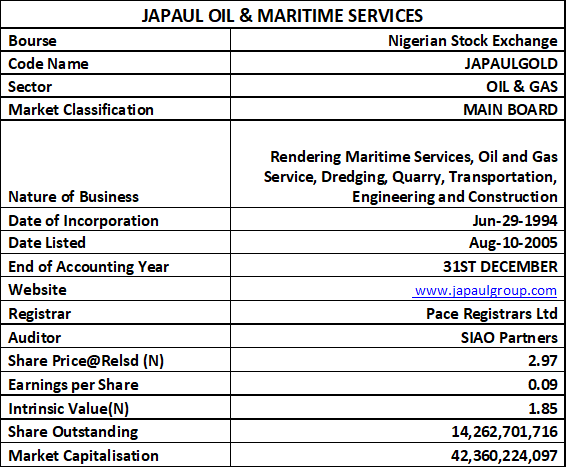
Japaul Oil & Maritime Services Plc recorded a strong 28.07% increase in turnover, rising from ₦4.10 billion in 2024 to ₦5.25 billion in 2025. Cost of sales also increased by 15.80% to ₦2.27 billion, but the slower growth in cost of sales relative to revenue supported an improvement in operating profit, which stood at ₦1.42 billion in 2025. This suggests that the company maintained reasonable gross operating efficiency despite the challenging operating environment.
However, the company’s cost structure presents a key investment concern. Operating expenses increased significantly by 87.68%, from ₦885.31 million to ₦1.66 billion, effectively absorbing much of the benefit from the higher revenue and gross operating performance. In addition, the company incurred ₦120.33 million in finance costs in 2025 compared with zero in the previous year. Consequently, profit before tax declined by 13.19% to ₦1.30 billion, while profit after tax fell by 11.09% to ₦1.22 billion, despite the substantial growth in turnover.
From an investment perspective, the results present a mixed outlook. The strong revenue growth and improvement in operating profit are positive indicators, demonstrating the company’s ability to expand its business activities and generate operating earnings. Nevertheless, the sharp rise in operating expenses and the emergence of finance costs resulted in an 11.09% decline in profit after tax, indicating pressure on overall profitability.
Investors should therefore monitor whether management can control operating expenses, improve cost efficiency, and sustain revenue growth. Overall, the company shows positive business growth but weakening bottom-line performance, making cost management and future earnings growth critical factors in assessing its investment attractiveness.
Statement of Financial Position
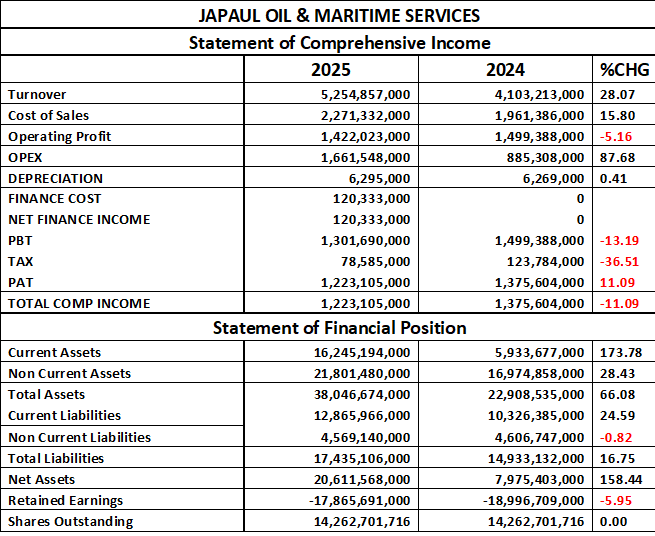
The statement of financial position shows a significant expansion in Japaul Oil & Maritime Services Plc’s asset base during the period under review. Current assets increased substantially by 173.78%, from ₦5.93 billion to ₦16.25 billion, while non-current assets grew by 28.43% to ₦21.80 billion. Consequently, total assets increased by 66.08%, reaching ₦38.05 billion. This strong growth in assets is positive from an investment perspective, as it indicates an expansion of the company’s resource base and potentially provides a stronger platform for future business growth.
On the liabilities side, current liabilities increased by 24.59% to ₦12.87 billion, while non-current liabilities declined marginally by 0.82% to ₦4.57 billion. Despite the rise in current obligations, total liabilities increased by a relatively moderate 16.75% to ₦17.44 billion, significantly below the 66.08% growth in total assets. As a result, net assets rose sharply by 158.44%, from ₦7.98 billion to ₦20.61 billion. This indicates an improvement in the company’s underlying asset position and suggests that asset growth has outpaced the growth in liabilities, which is generally favorable for investors.
However, the balance sheet still presents a major concern in the form of negative retained earnings of ₦17.87 billion, although this represents a 5.95% improvement from the previous year’s negative ₦19.00 billion. The negative retained earnings indicate that the company has accumulated historical losses, which could constrain its ability to pay dividends and may require sustained future profitability to rebuild shareholders’ equity. With shares outstanding unchanged at approximately 14.26 billion, investors should therefore focus on whether the company’s expanding asset base can translate into sustainable cash flows and profits. Overall, the financial position is improving strongly in terms of asset growth and net assets, but the substantial negative retained earnings remains a significant risk.
Financial Strength/Solvency Ratio
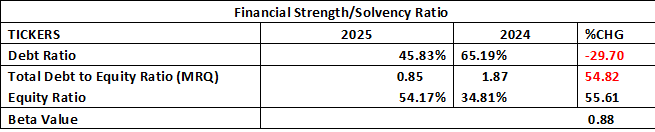
The financial strength ratios indicate a significant improvement in Japaul Oil & Maritime Services Plc’s solvency position in 2025. The debt ratio declined from 65.19% to 45.83%, representing a 29.70% reduction, while the total debt-to-equity ratio fell sharply from 1.87 to 0.85. This suggests that the company has substantially reduced its reliance on debt financing relative to its equity base, thereby lowering financial leverage and potentially reducing the risk associated with excessive borrowing. At the same time, the equity ratio increased from 34.81% to 54.17%, indicating that a larger proportion of the company’s assets is now financed by shareholders’ equity rather than liabilities.
From an investment perspective, these developments are positive indicators of improving financial stability and balance-sheet strength. The debt-to-equity ratio of 0.85 means the company’s debt is now below its equity base, which represents a considerable improvement over the previous year’s 1.87. The reported beta of 0.88 also suggests that the stock has historically exhibited slightly lower market sensitivity than the broader market, although beta should be interpreted alongside the company’s liquidity, profitability, and stock-market trading conditions. Overall, the ratios point to lower leverage and stronger capitalization, which is favorable for long-term investors, although the company’s ability to consistently generate profits and cash flows remains important in determining the sustainability of this improved financial position.
Profitability Ratios
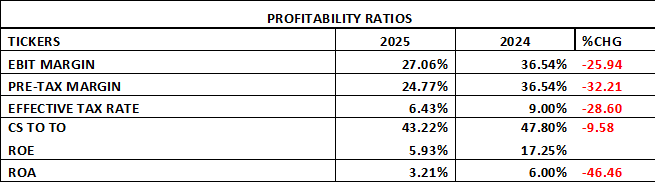
The profitability ratios indicate a weakening in Japaul Oil & Maritime Services Plc’s profitability performance in 2025 compared with the previous year. EBIT margin declined from 36.54% in 2024 to 27.06% in 2025, while pre-tax margin fell from 36.54% to 24.77%. Although the company remained profitable, the decline in both margins suggests that a larger proportion of revenue was absorbed by operating and other costs. The cost of sales-to-turnover ratio also improved from 47.80% to 43.22%, indicating better direct cost efficiency, but this positive development was outweighed by the significant increase in operating expenses.
The company’s returns to shareholders and asset owners also weakened considerably during the period. ROE declined from 17.25% to 5.93%, indicating that the company generated significantly less profit from shareholders’ equity in 2025. Similarly, ROA fell from 6.00% to 3.21%, suggesting that the expanding asset base was not being converted into earnings as efficiently as in the previous year. The effective tax rate also declined from 9.00% to 6.43%, which provided some support to net earnings, but this benefit was insufficient to offset the broader deterioration in operating profitability.
From an investment perspective, the company remains profitable and has demonstrated improved cost of sales efficiency, but the substantial decline in EBIT margin, pre-tax margin, ROE, and ROA raises concerns about the sustainability and quality of earnings. Investors should pay close attention to management’s ability to control operating expenses and improve returns on the company’s growing asset and equity base. Overall, the 2025 profitability position is weaker than 2024, and while the business may have long-term growth potential, investors would be better served by seeking evidence of a sustained recovery in margins and returns before taking an aggressive investment position.
Efficiency Ratios
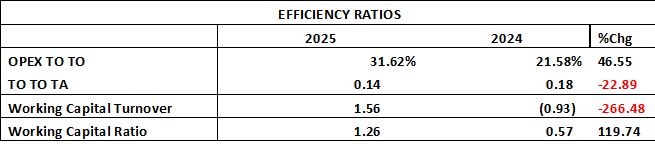
The efficiency ratios present a mixed performance for Japaul Oil & Maritime Services Plc in 2025. Operating expenses to turnover increased significantly from 21.58% in 2024 to 31.62%, representing a 46.55% rise, indicating that operating costs consumed a larger proportion of revenue and putting pressure on profitability. Similarly, turnover to total assets declined from 0.18 to 0.14, suggesting that the company’s significantly expanded asset base, generated lower revenue per unit of assets compared with the previous year. This indicates a need for management to improve asset utilization and exercise tighter control over operating expenses.
On the positive side, the working capital ratio improved strongly from 0.57 to 1.26, while working capital turnover improved from a negative (0.93) to 1.56. The working capital ratio above 1 indicates that current assets exceeded current liabilities, pointing to an improvement in the company’s short-term liquidity position. From an investment perspective, the improved liquidity and positive working capital turnover are encouraging, but the rising operating expense burden and declining asset efficiency remain a concern. Overall, the company shows better short-term financial efficiency and liquidity, but weaker operating cost efficiency and asset utilization, making effective cost management and improved returns from its growing asset base important factors for future investment performance.
Investment/Valuation Ratios
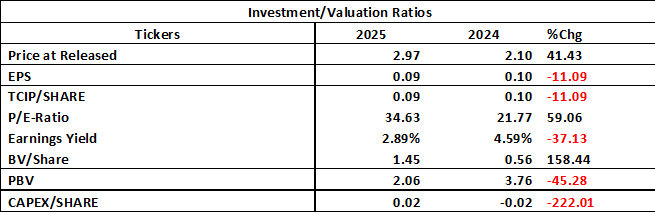
The investment and valuation ratios indicate that Japaul Oil & Maritime Services Plc experienced a significant increase in its market price, rising from ₦2.10 in 2024 to ₦2.97 in 2025, representing a 41.43% appreciation. However, this increase was not supported by stronger earnings, as EPS declined by 11.09% from ₦0.10 to ₦0.09. Consequently, the P/E ratio increased substantially from 21.77x to 34.63x, while earnings yield declined from 4.59% to 2.89%. This suggests that investors are paying a considerably higher price for each unit of the company’s earnings, making the stock appear more expensive on an earnings basis despite the decline in profitability.
The company’s book value per share improved significantly by 158.44%, increasing from ₦0.56 to ₦1.45 each, reflecting the strong growth in net assets reported during the year. At the same time, the price-to-book ratio declined from 3.76x to 2.06x, suggesting that the stock became less expensive relative to its underlying book value, despite the rise in its market price. This is a positive development from a valuation perspective, although a PBV above 2x still indicates that the market price carries a substantial premium over the company’s accounting net asset value. The capital expenditure per share also improved from a negative ₦0.02 to ₦0.02, although this metric should be interpreted carefully because the prior-year negative figure may reflect the accounting presentation of capital expenditure rather than a conventional investment return measure.
From an investment perspective, the valuation picture is mixed. The strong increase in book value per share and the decline in PBV are encouraging, while the higher share price indicates improved market sentiment. However, the 34.63x P/E ratio and low 2.89% earnings yield suggest that the stock’s market valuation is relatively high compared with its current earnings capacity. Given the decline in EPS and profitability ratios, investors should be cautious about assuming that the higher share price is fully supported by underlying earnings growth. Overall, the stock may offer long-term value if the company can convert its growing asset base into stronger and more sustainable earnings.
Dividend Information
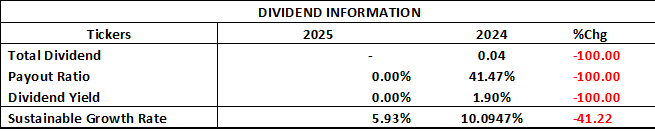
The dividend information presents a weak income-investment outlook for Japaul Oil & Maritime Services Plc in 2025, as the company did not declare any dividend compared with ₦0.04 per share in 2024. Consequently, the payout ratio declined from 41.47% to 0%, while dividend yield fell from 1.90% to 0%, meaning investors received no direct cash return from dividends during the year. The sustainable growth rate also declined from 10.09% to 5.93%, reflecting the weaker return on equity and reduced capacity for internally supported growth. From an investment perspective, the stock is therefore more suitable for investors seeking potential capital appreciation and long-term business growth rather than immediate dividend income, although the absence of dividend payments and declining sustainable growth rate remain important considerations when assessing its overall investment attractiveness.
Valuation
Our estimated intrinsic value is approximately ₦1.85 per share, giving an estimated downside of about 38% from ₦2.97 each. On this basis, the stock appears overvalued on current earnings and book-value fundamentals. However, this valuation does not fully capture the potential value of future gold, lithium, and other mineral assets, which could be substantial, if successfully developed and commercialized. Therefore, in this report, we would place a speculative long-term valuation range of ₦1.85–₦2.50, with the upper end dependent on successful execution of its mining strategy.
We expect investors to become more positive if Japaul can demonstrate sustained growth in PAT, recover ROE toward double digits, control operating expenses, and begin generating significant cash flows from its mining assets. For a value investor, we would prefer an entry price around ₦1.50–₦1.90, which would provide a more reasonable margin of safety based on the current earnings and book value. At ₦2.97, investors are paying a significant premium for future growth expectations, so the investment case depends heavily on whether the company’s mining strategy can deliver substantially higher earnings in the coming years.
Final Verdict on Japaul Gold & Ventures Plc
Based on the 2025 financial information, Japaul Gold & Ventures Plc presents a mixed investment outlook. The company recorded strong 28.07% revenue growth, substantial expansion in total assets, a 158.44% increase in net assets, and a major improvement in its financial leverage position. The debt ratio fell from 65.19% to 45.83%, while the debt-to-equity ratio declined from 1.87x to 0.85x. The equity ratio also improved significantly to 54.17%, and the working capital ratio rose to 1.26x. These developments indicate a stronger balance sheet, improved solvency, and better short-term liquidity, which are important positives for long-term investors.
However, the company’s earnings quality and profitability remain the major concerns. Despite the increase in turnover, profit after tax declined by 11.09%, while EBIT margin fell from 36.54% to 27.06%. ROE dropped sharply from 17.25% to 5.93%, and ROA declined from 6.00% to 3.21%. Operating expenses increased by 87.68%, significantly faster than revenue, while EPS declined from ₦0.10 to ₦0.09. Furthermore, the P/E ratio increased to a relatively high 34.63x, accompanied by a low earnings yield of 2.89%. The company also paid no dividend in 2025, compared with ₦0.04 per share in 2024. These factors suggest that the 41.43% increase in the share price was not matched by corresponding growth in earnings.
Investment Recommendation: HOLD / SPECULATIVE BUY
Our overall rating on Japaul Gold & Ventures Plc is HOLD, with a speculative BUY consideration for investors with a high risk tolerance and a long-term investment horizon. The company’s improving balance sheet, growing asset base, lower leverage, and exposure to the potentially attractive solid minerals sector provide a basis for future growth. However, the current earnings weakness, declining returns on equity and assets, rising operating expenses, high P/E valuation, negative retained earnings, and suspension of dividend income make an aggressive BUY recommendation inappropriate at this stage. Existing shareholders may HOLD, while prospective investors should preferably accumulate gradually at attractive prices rather than chase the stock, pending evidence of stronger earnings, improved margins, better ROE/ROA, and a return to sustainable dividend payments.
Key investment catalyst that the company should concentrate on is the successful expansion of its gold and other solid-mineral operations, if they are successful at this, it will lead to stronger and more sustainable earnings.
Nevertheless, the key investment risk is that the company’s expanding asset base may fail to translate into adequate earnings and cash flows, while high operating costs and the relatively high P/E ratio could limit future share-price upside.
In conclusion, Japaul Gold is a company with improving financial strength but currently weaker earnings quality. We would therefore recommend a HOLD rather than SELL, because the balance-sheet transformation and strategic exposure to mining provide meaningful future upside potential. However, we would not rate it a strong BUY at present until profitability and shareholder returns demonstrate a sustained recovery.