

Sovereign Trust Insurance was incorporated on February 26, 1980, but commenced operations as a reorganised non-life insurer in January 1995, following the acquisition and recapitalisation of Grand Union Assurance Limited. It was listed on the Nigerian Stock Exchange, now NGX, on November 29, 2006.
Current price: N2.13
Rating: Buy
Price projection: N4 and N5
Technical Analysis
In this report, we shall use the following tools and analysis methods:
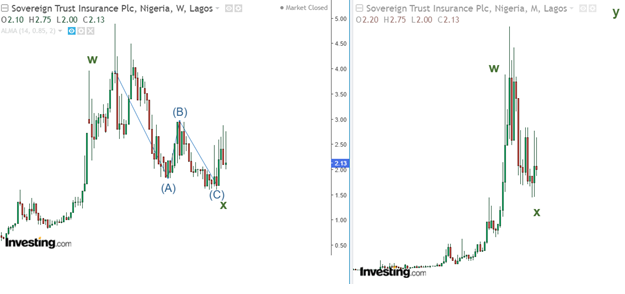
Elliott’s wave theory to understand the overall market sentiment
Fibonacci tools to determine support and resistance levels
The Relative Strength Index and volume to evaluate the market’s strength
The Money Flow Index to determine the market liquidity
Moving average and MACD to understand the nature of the trend
Top-down analysis to know the best investment position
Elliott wave analysis
Weekly chart: Market overview
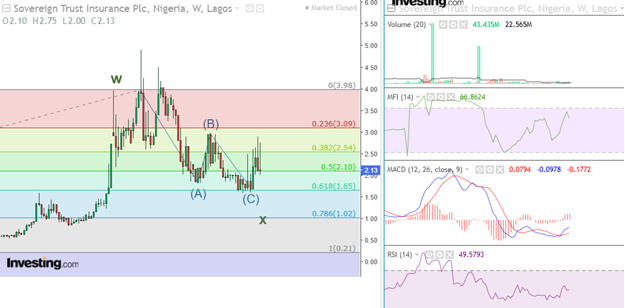
SOVRENINS retraced to the 0.618 Fibonnaci level and met strong support at N1.65. At this level, the stock commenced its recovery phase with strong volume, liquidity, and momentum.
Daily chart: Trading opportunity
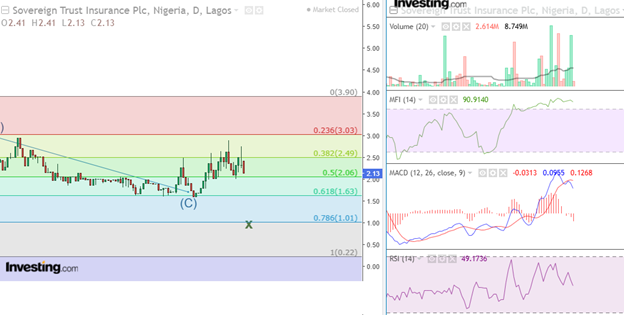
On the daily chart, Sovereign Trust Insurance consolidated due to consistent profit-taking. This performance offers trading opportunities as the stock’s liquidity and momentum remain strong. Given this performance, investors should watch N1.50 and N2 as potential support levels, with prices projected at N4 and N5.
SWOT Analysis
Sovereign Trust Insurance’s SWOT profile reflects a company with a significantly stronger balance sheet and meaningful growth opportunities, but whose earnings quality remains the critical issue for investors.
The successful recapitalisation removes a major regulatory constraint and gives the insurer greater capacity to underwrite larger risks, compete for corporate business and participate in Nigeria’s expanding insurance market.
However, H1 2026 revealed a sharp weakness in core underwriting profitability, with investment income contributing more strongly to earnings than insurance operations. The key question going forward is therefore whether management can convert the enlarged capital base into stronger recurring underwriting profits and higher returns on equity.
If it succeeds, SOVRENINS could enter a new earnings-growth phase; if underwriting margins remain weak, the enlarged capital base could dilute returns and limit valuation upside.