
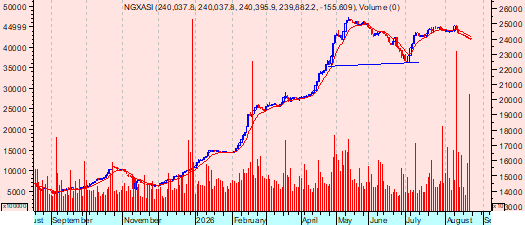
It was another bearish week as the Nigerian Exchange (NGX) extended its downtrend for a second successive week on sustained profit-taking and portfolio repositioning which weighed on equity prices. At the same time, the ensuing low valuation created entering opportunities into value stocks, sectors and companies with upside potentials on prevailing policies and economic reforms.
For the week, investors traded 6.242 billion shares worth ₦157.764 billion in 186,496 deals, compared with the 12.153 billion shares valued at ₦176.058 billion that were crossed in 224,146 deals in the previous week. The Financial Services Industry dominated activity with 5.594 billion shares worth ₦56.431 billion in 82,300 deals, accounting for 89.62% of total equity volume and 35.77% of turnover value. The ICT Industry followed with 143.704 million shares valued at ₦29.793 billion in 23,740 deals, while the Services Industry recorded 138.672 million shares worth ₦1.751 billion in 11,438 deals.
Insurance companies topped the activities chart, as Fortis Global Insurance, Lasaco Assurance and Consolidated Hallmark Holdings led trading by volume, combining for 4.168 billion shares worth ₦9.249 billion in 1,660 deals. Their combined activity represented 66.77% of total equity volume and 5.86% of turnover value.
Overall, the NGX recorded losses throughout the sessions, with only 18 equities gaining during the week compared with 26 previously. A total of 59 stocks declined, unchanged from the previous week, while 70 equities closed flat against 62 previously. Most sectoral indices ended lower, with the NGX Consumer Goods Index the only major exception, gaining 0.05%, while the NGX Sovereign Bond Index remained flat. The combination of persistent selling pressure, weak breadth and lower turnover kept market sentiment bearish throughout the week.
Week-to-date, the All-Share Index lost 1.35%, just as the NGX-30 index; while the Oil and Gas Index recorded a negative return of 4.64%; ahead of the Insurance Index’s 3.75% loss; followed by the Banking Index’s 2.92% loss; while the Pension Index closed 2.03% lower. The Consumer Goods Index increased by 0.05%.
Year-to-date, the All-Share Index has gained 53.81%, NGX 30 is up by 54.65%, the Banking Index has increased by 63.18%, the Pension Index increased by 72.82%, the Insurance Index declined by 8.65%, the Consumer Goods Index increase by 1.62%. However, the Oil and Gas Index recorded a positive return of 85.76%.
The NGX All-Share Index declined 1.35%, closing the week at 239,351.16bps, after recording five straight trading sessions of bear run and negative market breadth, which similarly reflected on the market capitalisation as it fell by 1.33% to ₦154.534 trillion. Year-To-Date return eased to 53.81%.
The daily index action below summarizes the week’s activities.
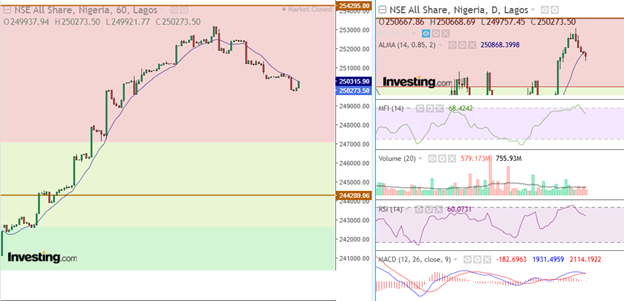
NGXASI Daily Index Action (See opening chart)
Trading for the week began with the index on Monday closing 0.07% lower to 242,454.65 points. Market capitalisation dropped ₦106.24 billion, while the YTD return slipped to 55.81%. Market breadth was weak, with 36 losers against 19 gainers. NEM led the decliners with an 8.83% decline, while TRANSEXPR topped the gainers. CUTIX also fell below its 52-week low to ₦2.29. Trading volume declined 5.89% to 1.33 billion shares worth ₦22.93 billion in 45,494 deals. LASACO led volume with 730.69 million shares, while MTNN recorded the highest traded value at ₦7.30 billion.
On Tuesday, the bearish trend intensified as the ASI dropped 0.35% to 241,611.23 points. Market capitalisation declined ₦544.48 billion, while YTD return eased to 55.26%. The market recorded 37 losers against 22 gainers, with FIDELITYBANK falling 6.59% to lead decliners, while HMCALL topped the gainers. CHELLARAM, AVACAP and SUNUASSUR also touched new 52-week lows. Trading volume plunged 67.69% to 429.84 million shares valued at ₦27.48 billion. STERLINGNG led volume with 51.57 million shares, while MTNN recorded the highest value at ₦9.76 billion.
The market remained under pressure at midweek, with the ASI losing 0.36% to 240,750.47 points. Market capitalisation fell ₦555.68 billion, while YTD return declined to 54.71%. Market breadth was balanced at 27 gainers and 27 losers, with ARADEL leading decliners after falling 10.00%, while HMCALL again topped the gainers. Four stocks also recorded new 52-week lows. Trading activity recovered sharply, with volume rising 177.65% to 1.19 billion shares worth ₦37.82 billion. FTGINSURE dominated volume with 610.68 million shares, while MTNN led traded value at ₦8.12 billion.
Selling pressure and profit taking continued on Thursday, as the ASI fell another 0.30% to 240,037.80 points. Market capitalisation declined ₦440.33 billion, while YTD return eased to 54.25%. Market breadth weakened to 28 losers against 14 gainers. ARADEL dropped 5.40%, OANDO fell 3.68% and UBA declined 2.17%, while HMCALL remained the top gainer. AVACAP, ROYALEX and OANDO also traded below their 52-week lows. Trading activity surged 140.65% to 2.87 billion shares worth ₦33.99 billion in 34,725 deals. FTGINSURE accounted for 2.56 billion shares, while ARADEL recorded the highest traded value at ₦6.23 billion.
The last trading day of the week was not left out with another 0.29% decline in the ASI to 239,351.16 points. Market capitalisation fell ₦443.32 billion, while YTD return dropped to 53.81%. Market breadth remained negative, with 25 losers against 22 gainers. DANGSUGAR led the decliners with a 2.79% loss, while RTBRISCOE emerged as the top gainer. AFRIPRUD, SUNUASSUR and ROYALEX also fell below their 52-week lows. Trading volume plunged 85.49% to 416.67 million shares, while turnover stood at ₦35.63 billion. STERLINGNG led volume with 47.75 million shares, while SEPLAT recorded the highest traded value at ₦8.43 billion.
Haldane McCall Plc
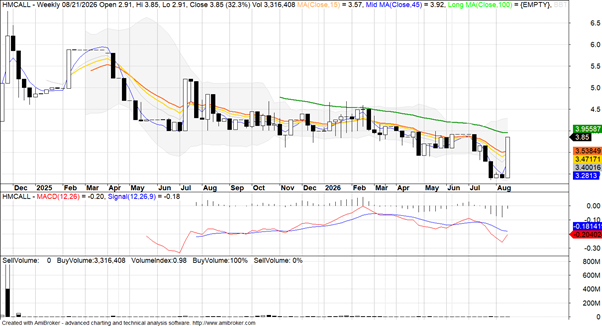
Among the gainers, Haldane McCall Plc rose from ₦2.91 to ₦3.85, gaining ₦0.94 or 32.30%. Trans-Nationwide Express Plc advanced from ₦2.84 to ₦3.30, up ₦0.46 or 16.20%. Dangote Sugar Refinery Plc increased from ₦64.55 to ₦67.90, representing a ₦3.35 or 5.19% gain. Cadbury Nigeria Plc climbed from ₦62.00 to ₦64.90, gaining ₦2.90 or 4.68%, while UACN Plc rose from ₦170.00 to ₦177.85, up ₦7.85 or 4.62%.
International Energy Insurance Plc
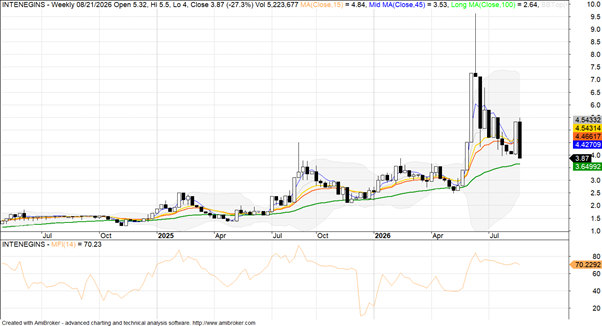
On the losing side, International Energy Insurance Plc dropped from ₦5.32 to ₦3.87, shedding ₦1.45 or 27.26%. Fortis Global Insurance Plc declined from ₦2.63 to ₦2.00, representing a ₦0.63 or 23.95% loss. Royal Exchange Plc fell from ₦1.19 to ₦0.97, down ₦0.22 or 18.49%. Red Star Express Plc declined from ₦18.00 to ₦14.70, losing ₦3.30 or 18.33%, while UPDC Plc dropped from ₦3.75 to ₦3.35, representing a ₦0.40 or 10.67% decline.
NGX Week-on-Week Comparative Analysis
The NGX had a weaker performance this week as sustained profit-taking pushed the All-Share Index (ASI) down 1.35% to 239,351.16 points, compared with a 1.20% decline to 242,619.20 points last week. Market capitalisation fell 1.33% to ₦154.534 trillion, from ₦156.624 trillion, while YTD return dropped from 55.91% to 53.81%.
Trading activity also declined. Weekly volume fell 48.64% to 6.242 billion shares, while turnover value dropped 10.39% to ₦157.764 billion. Deals declined from 224,146 to 186,496.
Market breadth weakened, with only 18 gainers compared with 26 last week, while decliners remained at 59. Unchanged stocks increased from 62 to 70. The Financial Services sector remained the most traded, accounting for 89.62% of total volume.
In all, the market was more bearish this week, recording losses in all five trading sessions compared with one gain last week. The ASI has now moved below the 240,000-point level, keeping the short-term outlook negative. A recovery above 242,000–245,000 points would be needed to improve sentiment, while further weakness could expose the index to additional losses.
Technical Analysis View
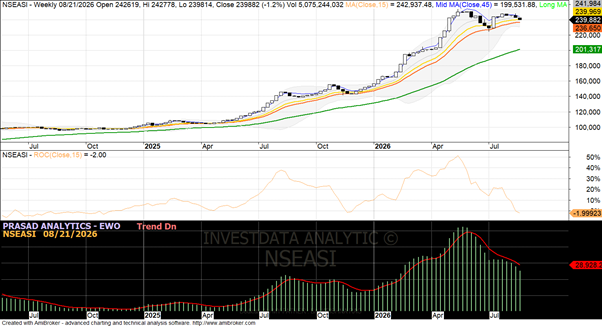
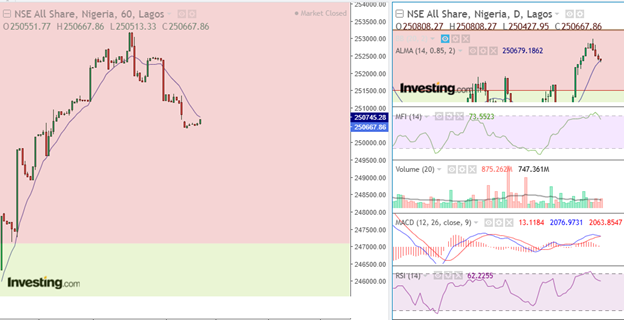
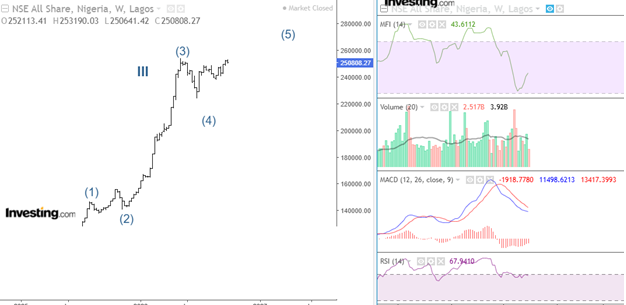
Technically, the NGX All-Share Index remains in a short-term corrective phase, having declined for five consecutive sessions from 242,454.65 points on Monday to 239,351.16 points on Friday. The 1.35% weekly loss confirms continued selling pressure, while the failure to hold above the 240,000-point area leaves the index vulnerable to further weakness. The market’s recent decline also fits the broader corrective trend observed in August.
The 239,000-point zone is now an important near-term support area. A sustained break below this level could expose the index to deeper losses, while a recovery above 240,000 points would provide the first indication that selling pressure is easing. On the upside, 242,000–243,000 points represent the immediate resistance zone, with a stronger recovery likely to require a move back above 245,000 points.
Momentum remains weak, as reflected by the five consecutive daily declines and the deterioration in market breadth. Only 18 stocks gained during the week, compared with 59 decliners, indicating that weakness was relatively broad. However, the sharp swings in daily trading volume suggest that selling has not been uniform and that selective accumulation could emerge if the index stabilises around current levels.
Market Outlook
The outlook for the coming week remains cautious to bearish unless the ASI can reclaim the 240,000–242,000-point region. Investors may continue to favour fundamentally strong stocks while profit-taking persists in recently outperforming counters. A rebound supported by stronger market breadth and improved turnover would strengthen the case for a short term recovery, while another close below 239,000 points would increase the risk of an extended correction.
Trending in the Economy: Nigeria’s FX sales surged 291% to $953.41 million in March 2026, up from $244.13 million in February and $58.93 million in January. Spot FX accounted for $950.10 million, while $3.31 million went to MDAs, making March the highest monthly sales level since April 2025. Meanwhile, autonomous sources contributed 64.94% of Nigeria’s FX inflows in 2025, totaling $72.91 billion. Nigeria’s headline inflation eased to 15.43% in July 2026 from 15.91% in June, according to the NBS. Month-on-month inflation also slowed to 1.57%, while core inflation fell to 14.97%. However, monthly food inflation climbed to 5.56%, showing that food prices remain a key source of pressure despite the overall decline in inflation.
Global Market and Oil: U.S. stocks rebounded on Friday, August 21, but the major indexes still closed the week lower as investors remained cautious over Treasury yields, inflation risks and uncertainty surrounding the Iran conflict. The S&P 500 and Nasdaq ended three-week winning streaks, while the Dow recorded its second straight weekly decline.
The Dow Jones Industrial Average gained 517.80 points, or 0.98%, to 53,277.01. The S&P 500 rose 33.21 points, or 0.43%, to 7,674.37, while the Nasdaq Composite advanced 113.29 points, or 0.44%, to 26,180.46. The Russell 2000 also gained 25.44 points, or 0.85%, to 3,017.87. For the week, the S&P 500 fell 1.43%, the Nasdaq declined 2.05%, the Dow dropped 0.85%, while the Russell 2000 lost 1.65%, its biggest weekly decline since the week beginning June 1.
Bond yields remained a major influence on market sentiment. Rising Treasury yields increased concerns about borrowing costs and pressured equities, although sentiment improved after Treasury Secretary Scott Bessent indicated that the government could expand its Treasury buyback programme. Economic data provided some relief, showing that U.S. services activity recorded its strongest growth in nearly two years in August. The improvement helped offset weaker manufacturing activity, which was affected by reduced inventory building and supply disruptions linked to the Iran conflict.
Most S&P 500 sectors advanced on Friday. Materials led with a 2.2% gain, followed by healthcare at 1.3% and financials at 1.0%. Utilities was the weakest sector, falling 2.3%, while energy declined 0.2%. Among individual stocks, Ross Stores gained 4.4% after raising its annual profit forecast and reporting better-than-expected quarterly results. Robinhood jumped 13.7%, Coinbase rose 8.2%, and Strategy gained 6% as Bitcoin advanced 6.4% to its highest level since mid-May.
Market breadth was positive. On the NYSE, advancing stocks outnumbered decliners by 1.68-to-1, with 214 new highs and 118 new lows. On the Nasdaq, 3,186 stocks advanced against 1,725 decliners, producing a 1.85-to-1 advance-decline ratio. The S&P 500 recorded 13 new 52-week highs and four new lows, while the Nasdaq posted 91 new highs and 76 new lows. Total trading volume across U.S. exchanges stood at 14.91 billion shares, below the 20-session average of 16.62 billion.
Oil prices remained elevated amid renewed U.S. threats of tougher sanctions against Iran and concerns over disruptions to Middle East supplies. Brent crude rose 20 cents, or 0.21%, to $93.98 per barrel, while WTI gained 7 cents, or 0.08%, to $86.90. For the week, Brent climbed 6.39% and WTI gained 5.66%, with both benchmarks recording their second consecutive weekly gains.
Investors will next focus on Nvidia’s earnings, alongside results from Intuit, Salesforce and CrowdStrike. Attention will also turn to the July Personal Consumption Expenditures price index, the Federal Reserve’s preferred inflation gauge, and Fed Chair Kevin Warsh’s speech at the Jackson Hole symposium.
Outlook: U.S. equities remain supported by strong corporate earnings and resilient economic activity, but elevated Treasury yields, higher oil prices and geopolitical tensions could keep volatility high. Market direction will largely depend on incoming inflation data, corporate earnings and developments in the Iran conflict.