
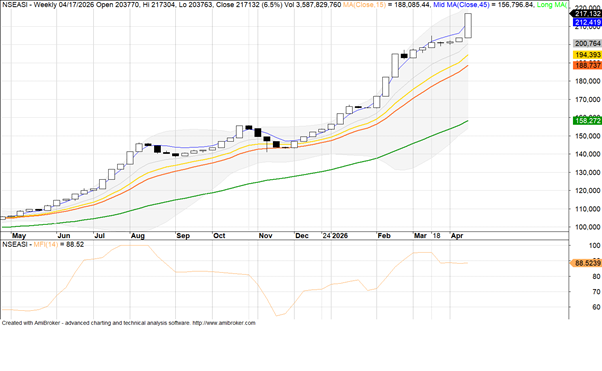
It was another bullish week on the Nigerian Exchange, as the sectoral indexes sustained a powerful uptrend, extending three consecutive weeks of gains on the strength of strong demand for large-cap stocks and blue chips. These lifted the composite NGX All-Share index and market capitalisation to yet another all-time high.
During the week, total turnover volume rose to 3.588bn shares valued at ₦195.31bn in 254,553 deals, compared to 3.361bn shares worth ₦151.95bn in the previous week. The Financial Services sector dominated activity, accounting for nearly 70% of traded volume, with Sterling Financial Holdings, Access Holdings, and Zenith Bank leading the charts.
Overall, the NGX All-Share Index closed the week up 6.57% at 217,167.57 points, while market capitalisation advanced 6.60% to ₦139.83trn. Gains were broad-based across sectors, except for mild declines in Insurance and Growth indices, underscoring sustained bullish sentiment in the market.
Week-on-week also, the NGX 30 chalked 6.99%, the Banking Index increased by 11.85%, the Pension Index was up by 10.31%, while the Insurance Index declined by 0.04%. Consumer Goods Index increased by 3.39, even as the Oil and Gas Index recorded a positive return of 17.59%.
Year-to-date, the All-Share Index has gained 39.56%, NGX 30 is up by 39.56%, the Banking Index has increased by 49.13%, the Pension Index increased by 54.67%, the Insurance Index inclined by 0.50%, the Consumer Goods Index increase by 12.39%.
Trading for the week began on a positive note with investors showing buying interests in NGXGROUP, GUINNESS, STANBIC, and ZENITHBANK pushing the All-Share Index up 0.34% to 204,458.86 points. Market value rose to ₦131.61trn, though trading volume slipped to 470.01m shares.
Momentum strengthened on Tuesday as the ASI advanced 0.67% to 205,831.38 points, adding ₦883.47bn in value. Gains in ETI, STANBIC, NGXGROUP, SEPLAT, and ZENITHBANK supported a strong market breadth of 41 gainers versus 21 losers, while activity also improved to 569.31m shares.
At the midweek, the bullish sentiment accelerated further, with the ASI jumping 1.69% to 209,317.41 points, just as market capitalisation climbed to ₦134.77trn. Strong demand for ARADEL, AIRTELAFRI, STANBIC, ZENITHBANK, and GTCO drove performance, while volume climbed to 706.39m shares.
On Thursday, the rally continued for the eighth straight session when the index got a 1.23% leap to 211,901.01 points, lifting market value to ₦136.44trn. Buying in ARADEL, ETI, DANGSUGAR, MTNN, and ZENITHBANK sustained momentum, although trading volume dipped slightly.
The week also closed strong on Friday with a 2.49% surge to 217,167.57 points, pushing market capitalisation to ₦139.83trn and YTD return to 39.56%. Heavy demand for NAHCO, ETI, ACCESSCORP, MTNN, and ZENITHBANK drove a sharp spike in trading volume to 1.26bn shares worth ₦54.35bn.
Trans-Nationwide Express Chart
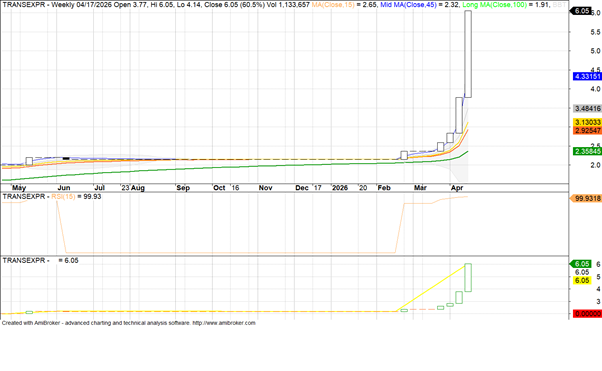
Top gainers: The share price of Trans-Nationwide Express, a Nigerian logistics and courier company, surged from ₦3.77 to ₦6.05, gaining ₦2.28 or +60.48%, followed by Ecobank Transnational’s ruse from ₦46.00 to ₦67.30, adding ₦21.30 or +46.30%. Stanbic IBTC climbed from ₦138.00 to ₦188.55, up ₦50.55 or +36.63%. Royal Exchange advanced from ₦1.43 to ₦1.85, gaining ₦0.42 or +29.37%, while Aradel Holdings moved from ₦1,279.00 to ₦1,649.00, rising ₦370.00 or +28.93%.
Wapic Chart
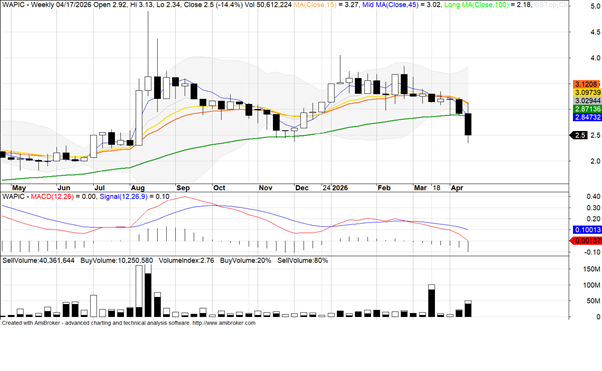
Top losers: Coronation Insurance, a leading Nigerian insurance firm, fell from ₦2.92 to ₦2.50, losing ₦0.42 or -14.38%. Ikeja Hotel dropped from ₦39.00 to ₦33.40, down ₦5.60 or -14.36%. International Energy Insurance declined from ₦3.55 to ₦3.06, shedding ₦0.49 or -13.80%. Academy Press slipped from ₦8.75 to ₦7.65, losing ₦1.10 or -12.57%, while Honeywell Flour Mill eased from ₦21.35 to ₦19.00, down ₦2.35 or -11.01%.
Technical Analysis View:
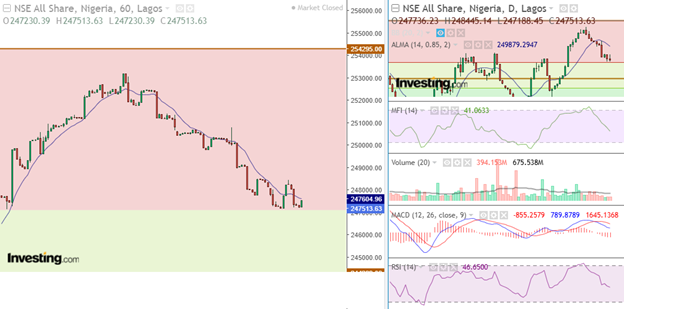
The NGX All-Share Index maintained a strong bullish structure, breaking above key psychological and resistance levels around 210,000 and closing firmly near 217,000. The sustained rally reflects increasing market confidence, with the index trading well above its short- and medium-term moving averages.
Momentum indicators remain positive, suggesting strong accumulation across large-cap stocks, particularly in the banking and energy sectors. The consistent formation of higher highs and higher lows reinforces the ongoing uptrend, while improving market breadth signals broad participation.
However, the sharp rally and extended gains over nine sessions suggest the market may be approaching overbought territory, increasing the likelihood of short-term profit-taking or mild consolidation.
Market Outlook:
The market bias remains bullish in the near term, supported by strong liquidity, institutional interest, and positive sentiment in fundamentally sound stocks. If buying momentum is sustained, the ASI could test the 220,000 psychological level.
That said, intermittent pullbacks are likely as investors take profits, especially in recently rallied counters. Market participants are expected to remain selective, focusing on fundamentally strong and undervalued stocks, while monitoring macroeconomic signals and interest rate direction.Overall, the trend remains upward, but with increasing caution as the market enters a potentially overbought phase.
Trending in the Economy: Nigeria will slash import tariffs on selected goods from July 1 to help ease price pressures. Duties will be cut to 40% on passenger vehicles, 47.5% on rice, 55–57.5% on raw sugar, and 28.75% on palm oil, while electric vehicles and industrial equipment will attract zero duty.
Although inflation moderated to 15.06% in February from roughly 33% in 2024, energy costs remain elevated, with petrol around ₦1,330 per litre and diesel near ₦1,550. Latest figures show inflation edged higher to 15.38% in March, breaking an 11-month cooling trend. The uptick reflects rising transport and fuel costs due to global oil disruptions, alongside increased food prices, which pushed food inflation to 14.31%. Month-on-month, inflation accelerated to 4.18%, signalling renewed short-term cost pressures.
Global Market and Oil: Global financial markets surged on Friday as easing geopolitical tensions in the Middle East triggered a broad risk-on rally across equities, bonds, and currencies. Investor sentiment improved after a ceasefire agreement between Israel and Lebanon, alongside assurances from Iran that the Strait of Hormuz — a critical artery for global energy supply — would remain open.
Iran’s Foreign Minister, Abbas Araqchi, confirmed that commercial shipping would continue to move freely through the strait for the duration of the 10-day truce brokered by the United States. The development significantly reduced fears of supply disruptions in global oil markets. Adding to the optimism, U.S. President Donald Trump said he expects a deal to end the conflict soon and indicated that Washington could work with Iran to recover its enriched uranium — one of the key sticking points in ongoing negotiations.
Against this backdrop, Wall Street extended its rally, with major indices closing at record highs. The S&P 500 advanced 1.2% to settle at 7,126.06, while the Nasdaq Composite gained 1.52% to close at 24,468.48 — both marking their third consecutive record finishes. The Dow Jones Industrial Average jumped 1.79% to 49,447.43, its highest close since late February. Market breadth remained strong, with gains cutting across sectors, and the small-cap Russell 2000 outperforming its large-cap peers to also post a record closing high.
The rally in equities was largely driven by declining energy prices, which tend to have a more pronounced positive effect on smaller companies with tighter operating margins. Analysts noted that the market is increasingly pricing in a de-escalation of tensions between the U.S. and Iran, reducing the geopolitical risk premium that had previously weighed on sentiment.
Sectoral performance reflected this shift. Airline stocks such as American Airlines and United Airlines recorded strong gains, benefiting from expectations of lower jet fuel costs. On the other hand, energy majors moved lower in line with falling crude prices, as Exxon Mobil declined 3.6% and Chevron dropped 2.2%. In the tech space, Netflix stood out on the downside, with its shares plunging more than 9% after the company issued a weaker-than-expected growth forecast and announced that co-founder and chairman Reed Hastings would step down.
In the fixed-income market, U.S. Treasuries rallied as investors dialed back inflation expectations. The benchmark 10-year Treasury yield fell by 6.5 basis points to 4.246%, touching its lowest level since mid-March. Similarly, the 2-year yield, which is more sensitive to Federal Reserve policy expectations, declined by 7.8 basis points to 3.7%. The bond market reaction reflects growing confidence that easing geopolitical tensions and lower energy prices could reduce the need for further aggressive monetary tightening.
Currency markets also mirrored the shift in sentiment. The U.S. dollar weakened to multi-week lows as demand for safe-haven assets declined. The dollar index slipped 0.02% to 98.19, after earlier falling to 97.632 — its lowest level in seven weeks. Analysts attributed the decline to an unwinding of the geopolitical risk premium that had supported the greenback during the height of the crisis.
In the oil market, prices recorded a sharp pullback as supply fears eased. Brent crude futures dropped 9% to settle at $90.38 per barrel, after hitting an intraday low of $86.09. U.S. West Texas Intermediate (WTI) crude fell even more steeply, shedding 11.45% to close at $83.85 per barrel. Despite the significant decline, both benchmarks remain above pre-war levels of around $70 per barrel, although they are well below the late March highs when Brent approached $120 per barrel.