
Quarter Under Preview: -HALF YEAR 2026
Current Share Price: N129.00
Latest Final Dividend: N8.75
Latest Interim Dividend: N1.50
Estimated Beta Value: 0.75x
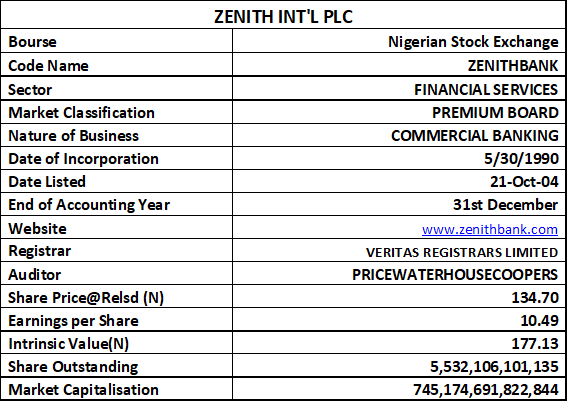
Estimated Fair Value: N177.13
Ratings: Hold
Analyst: Jeariogbe Tunde Segun
The Company
Historical Background of Zenith Bank Plc
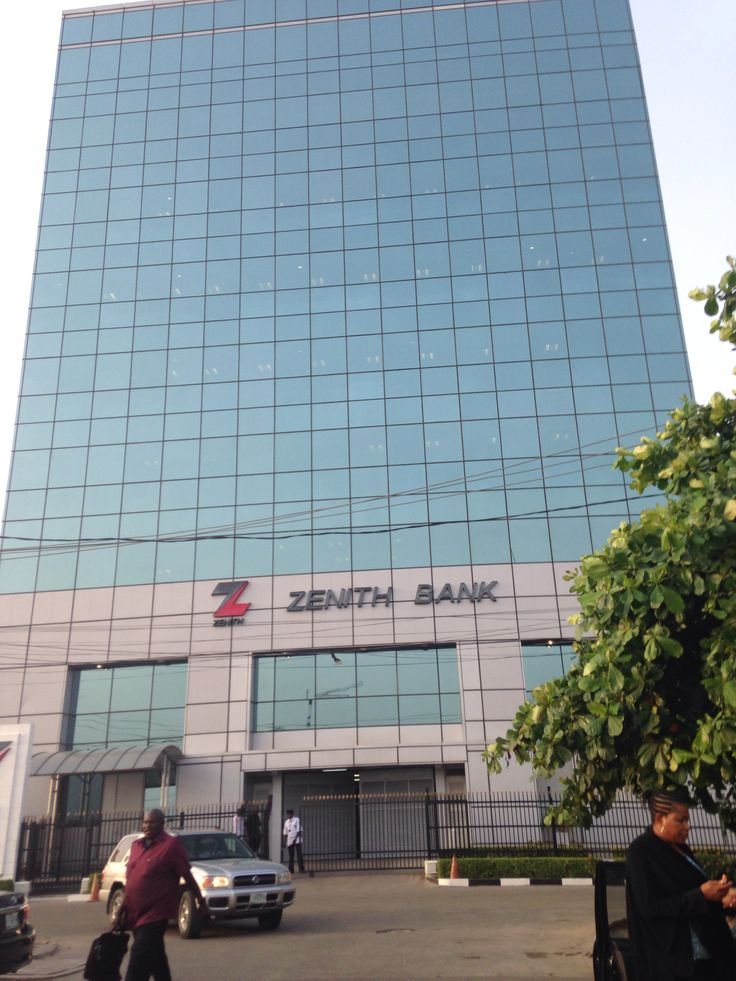
Zenith Bank Plc, one of Nigeria’s leading financial institutions, was established in May 1990 by Jim Ovia, was granted a commercial banking licence by the Central Bank of Nigeria and began operations in July 1990. From inception, it focused on technology-driven banking, operational efficiency, strong corporate governance, and customer service. These priorities supported its growth from a relatively small financial institution into a major player in Nigeria’s banking industry, serving individuals, small and medium-sized enterprises, large corporations, and public-sector organizations.
Zenith Bank became a public limited company in 2004 and was listed on the Nigerian Stock Exchange, now the Nigerian Exchange Limited (NGX), in October of that year. The listing broadened public participation in the bank’s ownership and strengthened access to the capital market.
Over the years, Zenith Bank expanded its branch network, electronic banking services, corporate banking operations, and international presence, including operations in selected African markets and the United Kingdom. It has also invested significantly in digital banking infrastructure to improve transaction processing, customer convenience, and service delivery.
Today, Zenith Bank operates as a major commercial banking group, providing services that include deposits, loans and advances, corporate finance, money-market activities, trade finance, and electronic banking. Its group structure includes subsidiaries in Ghana, the United Kingdom, Sierra Leone and The Gambia, alongside Zenith Pensions Custodian Limited and Zenith Nominees Limited. The bank’s shares trade on the NGX under the ticker ZENITHBANK, and it was admitted to the Exchange’s Premium Board in August 2015. Its established market presence, diversified banking services and regional reach make it an important institution to assess when examining Nigeria’s banking sector and the investment prospects of listed financial stocks.
Statement of Comprehensive Income
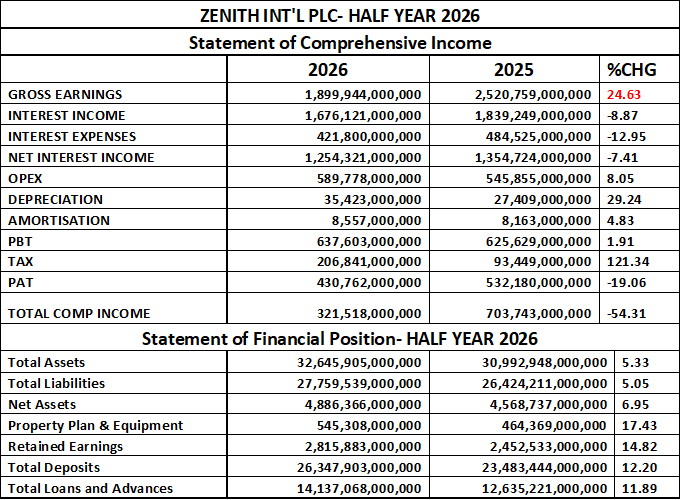
Its half-year 2026 results show a decline in gross earnings to ₦1.900 trillion from ₦2.521 trillion in H1 2025, representing a 24.63% decrease. Interest income also declined by 8.87% to ₦1.676 trillion from ₦1.839 trillion, while interest expenses fell by 12.95% to ₦421.800 billion from ₦484.525 billion. Consequently, net interest income decreased by 7.41% to ₦1.254 trillion from ₦1.355 trillion. The decline in gross earnings and net interest income indicates weaker income generation during the period, although the reduction in interest expenses provided some support to the bank’s net interest position.
Operating expenses increased by 8.05% to ₦589.778 billion from ₦545.855 billion, while depreciation rose by 29.24% to ₦35.423 billion and amortization increased by 4.83% to ₦8.557 billion. These increases indicate rising operating and asset-related costs, which may have put additional pressure on earnings. Despite these cost increases, profit before tax grew modestly by 1.91% to ₦637.603 billion from ₦625.629 billion, suggesting that other income or expense items may have helped offset the decline in net interest income. However, the significant increase in tax expense to ₦206.841 billion from ₦93.449 billion, representing a 121.34% rise, substantially reduced the benefit of the improvement in pre-tax profit.
Profit after tax declined by 19.06% to ₦430.762 billion from ₦532.180 billion, while total comprehensive income fell more sharply by 54.31% to ₦321.518 billion from ₦703.743 billion. The difference between profit after tax and total comprehensive income suggests a substantial negative contribution from the translational rate difference from international businesses during the period. Overall, Zenith Bank remained profitable, with a slight improvement in pre-tax earnings, but the decline in gross earnings, higher operating costs and increased tax burden weakened its bottom-line performance. The substantial reduction in total comprehensive income also warrants attention.
Statement of Financial Position
Zenith Bank Plc’s statement of financial position for half-year 2026 shows growth in its balance sheet, with total assets increasing by 5.33% to ₦32.646 trillion from ₦30.993 trillion in the corresponding period of 2025. Total liabilities rose by 5.05% to ₦27.760 trillion from ₦26.424 trillion, while net assets increased by 6.95% to ₦4.886 trillion from ₦4.569 trillion. This indicates an expansion in the bank’s asset base alongside moderate growth in liabilities, with shareholders’ equity, as represented by net assets, growing faster than total liabilities. Retained earnings also improved by 14.82% to ₦2.816 trillion from ₦2.453 trillion, suggesting an increase in accumulated profits.
On the business-expansion front, total deposits grew by 12.20% to ₦26.348 trillion from ₦23.483 trillion, providing a larger pool of customer funds, while total loans and advances increased by 11.89% to ₦14.137 trillion from ₦12.635 trillion. The faster growth in deposits relative to loans suggests that deposit mobilization outpaced lending expansion, potentially providing capacity for further lending and liquidity management. Property, plant and equipment rose by 17.43% to ₦545.308 billion from ₦464.369 billion, reflecting an increase in investment in physical assets. Overall, the balance sheet reflects growth in deposits, lending, assets and net assets.
Financial Strength/Solvency Ratio
Half-year 2026 financial strength and solvency ratios indicate a slight improvement in its capital structure compared with the corresponding period of 2025. The debt ratio declined marginally to 85.03% from 85.26%, while the total debt-to-equity ratio decreased to 5.68x from 5.78x, suggesting a modest reduction in leverage. The equity ratio improved to 14.97% from 14.74%, indicating that a slightly larger proportion of the bank’s assets is financed by shareholders’ funds. These movements are consistent with the growth in net assets recorded during the period, although the bank remains highly leveraged, as is typical of deposit-taking financial institutions. The beta value of 0.75 suggests that the stock has historically exhibited lower market sensitivity than the broader market. Overall, the ratios point to a modest improvement in financial strength.

Profitability Ratios
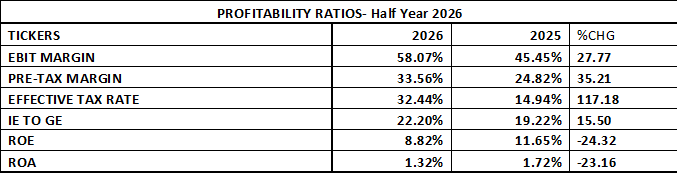
Zenith Bank Plc’s profitability ratios for half-year 2026 show an improvement in operating and pre-tax margins despite a decline in profit after tax. EBIT margin increased to 58.07% from 45.45%, representing a 27.77% relative improvement, while the pre-tax margin rose to 33.56% from 24.82%, an increase of 35.21%. These improvements suggest stronger earnings relative to the applicable revenue base before tax. However, the effective tax rate rose sharply to 32.44% from 14.94%, representing a 117.18% increase, indicating a substantially higher proportion of pre-tax profit was absorbed by taxes. The interest expense-to-gross earnings ratio (IE to GE) also increased to 22.20% from 19.22%, suggesting that interest expenses consumed a larger proportion of gross earnings, which is an area to monitor.
In contrast, return on equity (ROE) declined to 8.82% from 11.65%, while return on assets (ROA) fell to 1.32% from 1.72%, representing relative declines of 24.32% and 23.16%, respectively. This indicates that, despite improved reported margins, the bank generated lower returns from both shareholders’ funds and its asset base during the period. The weaker returns are consistent with the decline in profit after tax and the growth in the bank’s asset and equity bases. Overall, Zenith Bank recorded stronger EBIT and pre-tax margins, but the higher tax burden and declining ROE and ROA weakened its overall profitability performance.
Efficiency Ratios
Zenith Bank Plc’s efficiency ratios for half-year 2026 indicate increased operating cost pressure and lower gross earnings relative to its asset base. The operating expenses-to-gross earnings ratio (OPEX to GE) rose to 31.04% from 21.65%, representing a 43.35% relative increase, suggesting that operating expenses consumed a larger proportion of gross earnings. Gross earnings-to-total assets (GE to TA) declined to 5.82% from 8.13%, a 28.44% reduction, indicating lower income generation relative to the bank’s asset base.
Meanwhile, the loan-to-deposit ratio (LDR) edged down slightly to 53.66% from 53.80%, representing a 0.28% relative decline, as deposit growth marginally outpaced loan expansion. This comparatively stable LDR suggests that the bank maintained a similar balance between lending and deposit funding, although the lower gross earnings-to-assets ratio and rising operating cost burden point to weaker operating efficiency. Overall, Zenith Bank needs to improve income generation from its assets and exercise tighter cost control to strengthen efficiency and support sustainable profitability.

Investment Ratios
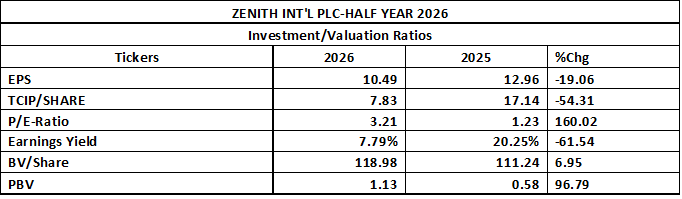
Zenith Bank Plc’s investment and valuation ratios for half-year 2026 indicate weaker earnings performance compared with the corresponding period of 2025. Earnings per share (EPS) declined by 19.06% to ₦10.49 from ₦12.96, while total comprehensive income per share fell by 54.31% to ₦7.83 from ₦17.14. These declines reflect the weaker profit after tax and lower total comprehensive income recorded during the period. However, book value per share increased by 6.95% to ₦118.98 from ₦111.24, indicating growth in the bank’s net assets attributable to shareholders. This suggests that the bank’s underlying asset value per share improved even though its earnings-generating performance weakened.
On the valuation front, the price-to-earnings (P/E) ratio increased to 3.21x from 1.23x, while the price-to-book value (P/BV) ratio rose to 1.13x from 0.58x. The earnings yield declined sharply to 7.79% from 20.25%, indicating a lower earnings return relative to the share price. Although the P/E ratio remains relatively low, the decline in EPS and earnings yield calls for caution when assessing the stock’s attractiveness. The P/BV ratio also indicates that the shares are trading at a high premium to book value. Overall, Zenith Bank’s valuation presents a mixed picture: book value per share has improved, but weaker earnings and lower earnings yield remain concerns for investors assessing its future returns.
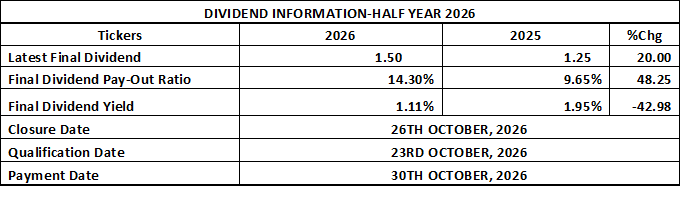
Zenith Bank Plc’s half-year 2026 dividend information shows an increase in the latest interim dividend to ₦1.50 per share from ₦1.25, representing a 20.00% rise, while the dividend payout ratio increased to 14.30% from 9.65%, indicating a higher proportion of earnings distributed to shareholders. However, the dividend yield declined to 1.11% from 1.95%, representing a 42.98% decrease and suggesting a lower dividend return relative to the share price. The reported closure date for the said interim dividend is 26th October 2026, the qualification date is 23rd October 2026, and the payment date is 30th October 2026. Overall, the higher dividend per share is positive for shareholders, while the relatively low yield may be less attractive to investors seeking immediate dividend income. Given the bank’s 19.06% decline in half-year earnings per share, the sustainability of future dividend growth will depend on its ability to restore earnings growth and maintain a sound capital position.
Final Investment Verdict (H1 2026)
Zenith Bank Plc delivered a mixed half-year performance in 2026. Although total assets grew by 5.33%, customer deposits increased by 12.20%, loans and advances rose by 11.89%, and profit before tax improved by 1.91% to ₦637.603 billion, profit after tax declined by 19.06% to ₦430.762 billion. The higher tax burden, increased operating expenses and decline in return on equity to 8.82% from 11.65% weakened overall profitability. Nevertheless, the bank maintained a strong deposit franchise, expanded its balance sheet and increased its interim dividend to ₦1.50 per share from ₦1.25.
From a valuation perspective, the reported P/E ratio of 3.21x and P/BV ratio of 1.13x suggest a relatively modest earnings multiple and a price slightly above book value. However, the earnings yield fell to 7.79%, while EPS declined to ₦10.49. These weaknesses mean that the low P/E ratio should not, by itself, be interpreted as proof that the stock is undervalued. Asset quality, capital adequacy, dividend sustainability and the prevailing market price remain important considerations.
Final rating: HOLD. Zenith Bank retains attractive underlying strengths, including its established market position, growing deposits and positive dividend progression. However, declining earnings, weaker shareholder returns and rising operating-cost pressure justify caution until profitability shows more convincing improvement. A BUY rating would be more defensible if subsequent results demonstrate a recovery in earnings and returns, supported by sound asset quality and an attractive intrinsic value relative to the market price.