
Quarter Under Preview: 12MONTHS Unaudited 2025
Current Share Price: N38.90
Price At Release Date: N40.00
Latest Final Dividend: Nil
Latest Interim Dividend:
Estimated Beta Value: -0.30x
Estimated Intrinsic Value: N19:00
Analyst: Jeariogbe Tunde Segun
The Company
Oando Plc is a premier Nigerian indigenous energy group with roots traceable to 1956 when it commenced business as Esso Africa, a subsidiary of Exxon Corporation. Following the indigenization policy of the then government of General Olusegun Obasanjo, it was renamed Unipetrol in 1976, and subsequently acquired by Ocean & Oil in 2000. It ultimately rebranded to Oando in 2003, driven by Adewale Tinubu and Omamofe Boyo, it became a leading integrated energy provider. In 2007, Oando Plc evolved from downstream marketing to an integrated energy company, focusing on exploration, production, and gas distribution. By 2024, Oando completed a $783 million deal to acquire the Nigerian Agip Oil Company (NAOC), a wholly owned subsidiary of Italian oil giant- Eni- significantly increasing its upstream reserves. Oando is currently listed on both Nigerian Exchange Limited (then Nigerian Stock Exchange) and the Johannesburg Stock Exchange (JSE).
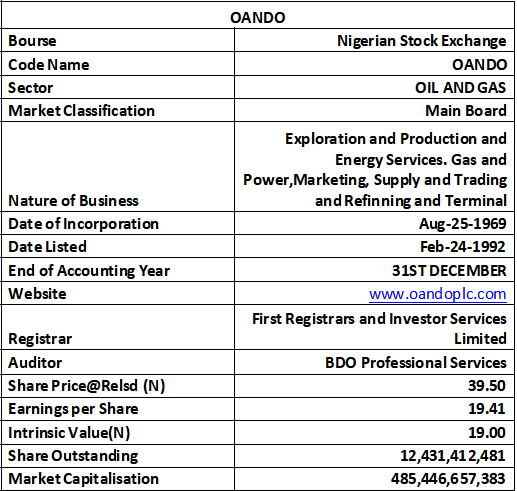
The Released Numbers
Going by the released earnings representing the unaudited numbers for the 12-months ended 2025, and comparing same with the audited numbers for the previous year, Oando Plc reported a turnover of N3.212 trillion, down from N4.086 trillion in the previous year, representing a 21.38% drop. Cost of Sales was estimated at N3.185 trillion versus N3.930 trillion. Operating Profit for the year, therefore stood at positive N50.231 billion against N569.681 billion. Operating Expenses also fell below the previous year at N278.051 from N610.858 billion.
Finance Cost was valued at N465.402 billion as against N235.835 billion in the prior year, just as Net Finance Cost is Negative at N36.195 billion compared to the negative estimate of N188.638 billion in the comparable year.
Thus, Profit before Tax stood at N15.202billion versus N383.820 billion. The Company’s bottomline was significantly lifted on the back of the Tax Credit of N226.110 billion, as against a Tax expense of N163.700 in the previous year. Therefore, Profit for the year is valued at N241.312 billion as against N220.120 billion of last year. See the table below for details:
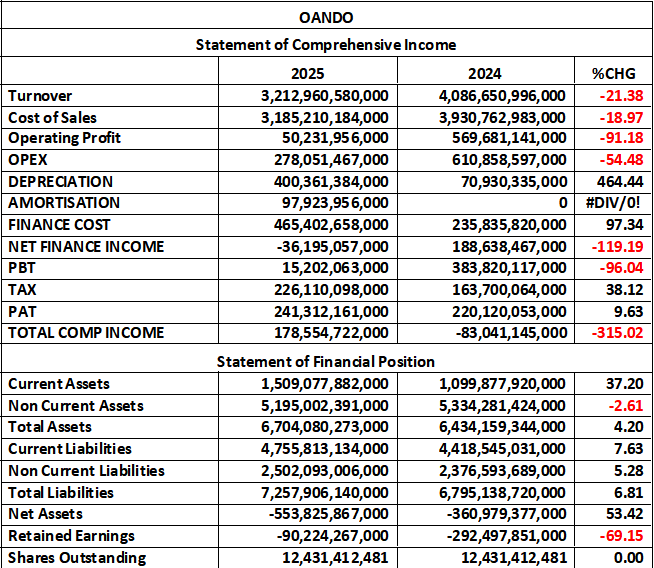
At the end of the 12-month period, Current Assets is N1.509 trillion, higher than the N1.099 trillion of the corresponding year. Non-Current Assets is N5.195 trillion against N5.334 trillion in the comparable year. Thus, Total Assets for the period is N6.704 trillion versus N6.434 trillion. The Current Liabilities stood at N4.755 trillion against N4.418 trillion. Non-Current Liabilities stood at N2.502 trillion from N2.376 trillion, and Total Liability estimate is N7.257 trillion versus N6.795 trillion. Net Assets at the end of the year is negative N553.825 billion compared to negative N360.979 billion, and Retained Earnings still lingers in the negative region to the tune of N90.224 billion against negative N292.497 billion. See the above table for details:
Financial Strength
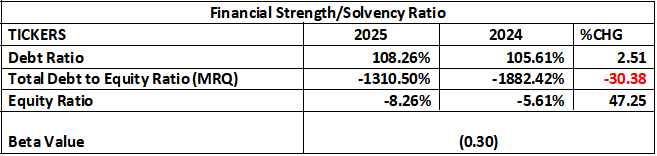
- Debt Ratio: (108.25% Vs 105.61%)– A Debt Ratio above 100% means total liabilities exceed total assets. The slight improvement suggests marginal balance sheet repair, but the company is still technically insolvent on an accounting basis. This is very weak financial strength even though directionally improving. Oando remains highly leveraged and its balance sheet constrained.
- Equity Ratio: (-8.26% Vs -5.61%)– A negative equity ratio confirms negative shareholders’ funds. The movement indicates losses are being reduced or Assets revaluation/retained earnings improvement. Still, equity remains deeply impaired. We can therefore say, financial position is improving but unhealthy, just as equity holders remain residual claimants with elevated risk.
- Total Debt to Equity: (-1,310.5% Vs -1881.42%)– It is noteworthy that this ratio needs careful interpretation. What the negative sign means is that Debt-to-Equity turns negative only when equity is negative. The ratio is correct given the negative equity. Once equity is negative, debt-to-equity loses analytical usefulness as a valuation metric. It becomes more of distress indicator. We are of the opinion that this ratio will be best used as a diagnostic not comparative.
Overall Verdict on Financial Strength: The balance sheet shows gradual healing, but Oando remains, highly speculative, debt heavy, and equity impaired. From an investment lens, this is not a balance sheet strength story, it is a turnaround/operational execution story.
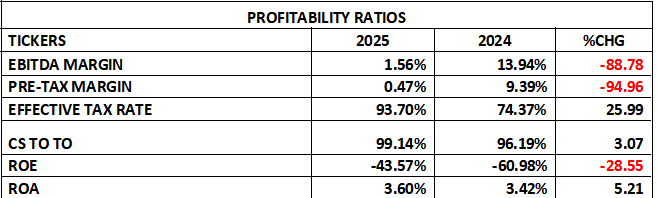
- EBITDA Margin: (1.56% Vs 13.94%)– This is a collapse in operating cash profitability. EBITDA margin falling from 13.94% to 1.56% confirms: a severe margin compression, shift away from high-turnover trading, and higher operating cost tied to upstream ramp up.
- Pre-Tax Margin: (0.47% Vs 9.39%)– Profit before Tax has been almost wiped out at operating level. The gap between EBITDA Margin and PBT implies; heavy interest burden, depreciation from new assets, and FX or finance costs still biting. Now, given Oando’s very high leverage, this is mathematically and economically sound.
- Cost Structure (shows Efficiency pressure). Cost of Sales moved to 99.14% from 96.19%. That means: for every N100 of revenue, N99.14 is spent on direct costs, which explains the near zero margins. This can be explained by the high lifting, maintenance and integrity costs; made worse by a reduced ability to pass costs to customers in trading.
- Return on Equity: (-43.67% Vs -60.98%)– Negative ROE is expected because equity is negative. The impairment reflects narrowing losses attributed to shareholders, or accounting equity recovery.
- Return on Assets: (3.60% Vs 3.42%)– Now, this is where things get interesting, ROA has improved slightly, despite Margin collapse, and lower revenue. This suggests that, assets are being used more intensively, and production volumes are offsetting price/margin pressure.
Final Verdict on Profitability Ratio: Oando is making money of volume not margin. Operating profit in 2025 is extremely thin, Net profit improvement is not coming from core margins, and asset utilization is improving, but capital structure is still suffocating returns. This is not a profit-led recovery, but rather an operational scale-up under heavy financial stress. Margins must recover before leverage can be safely carried.
Efficiency Ratio
- Operating Expenses to Turnover: (8.65% Vs 14.95%)- This is a strong improvement in cost discipline. Oando cut operating expenses sharply relative to revenue. Management clearly tightened overheads in 2025. This is important because, despite the EBITDA margin collapse, Opex is not the problem. The issue is cost of sales, not operating expenses.
- Assets Utilization Efficiency: Turnover to Total Assets (47.93% Vs 63.51%)- Assets Turnover has deteriorated materially. Oando is generating less revenue per naira of assets. This happened because; Asset base expanded sharply. Revenue declined due to reduced trading volumes, and strategic pullback from low-margin turnover.
Final Verdict on Efficiency Ratio: Operating Cost Control is improving firmly, while Asset Utilization is weakening, following which we can conclude that the integration phase is ongoing, and scalability is yet to be fully experienced. Oando is not inefficient operationally, it is under earning on a newly enlarged asset base.

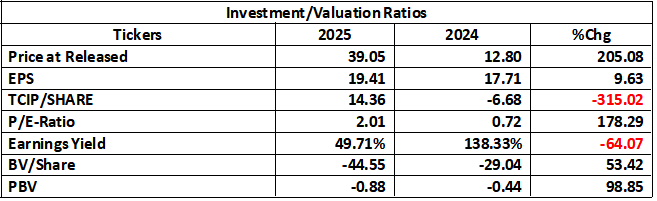
- Price at Released: Despite EPS being only marginally higher in the period, the share price is over three times higher. This tells us that the market is not reacting to EPS growth, but to perceived improvement in earnings quality and risk profile.
- Earnings Power; Earnings per share moved to N19.41 from N17.71. This number is strictly due to the Tax Credit the company enjoyed during the year. If not, a worse number is expected. The EPS itself is plausible but the quality is weak, it does not represent sustainable earnings power.
- Valuation Multiples: PE-Ratio (2.01x Vs 0.72x)- Both are deep value territories, but the difference is crucial: at 0.72x market priced earnings as highly uncertain or transient. Strong profits, but very low trust. At 2.01x the stock still looks cheap, but reflects a partial re-rating. Indicating improved confidence in sustainability of profits. What we are saying is that the rise in PE is confidence, rather than profit driven.
- Earnings Yield: The Earnings yield moved from 138.33% to 49.71%. Note that yield above 100% is abnormally high and suggests distress-level pricing. That is: the market expects a sharp drop in future earnings.
- Book Value per share: This is the most honest ratio we have observed, it shows that shareholders’ equity is still deeply negative and worse in absolute per-share terms. The implications is that the market price is entirely detached from book value, while valuation is based on future recovery, asset monetization, and oil price optionality.
Final Investment Verdict: Oando is cheap on paper but not in reality. Market pricing is forward looking, and highly speculative. Also, equity value is option-like, not intrinsic-value based.
Overall Verdict: Oando has moved from distressed value to credible deep value, but the balance sheet must fully heal before it earns a normal market multiple. The Profitability ratios portends a very strong profit stand, efficiency ratios show an improving state, financial strength is still very weak, and valuation shows a deeply undervalued state. Our rating for Oando is therefore a Speculative Buy.