
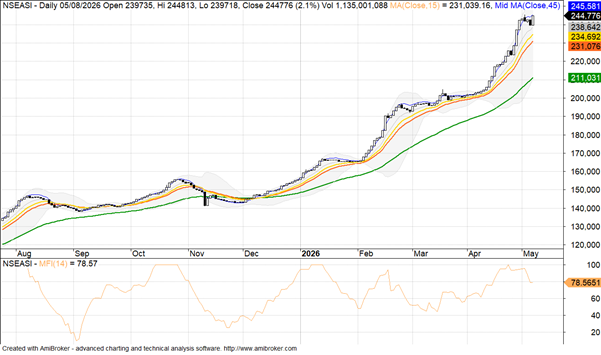
It was a seesaw movement on the Nigerian Exchange last week as the composite index closed green in three trading sessions and down in two sessions, finishing the week higher on increased buying volume that reflected the activities of bargain hunters and institutional players.
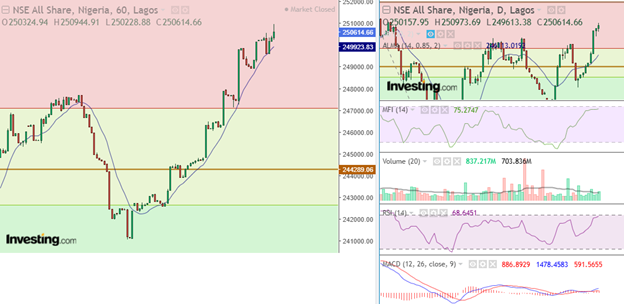
The index action below revealed the daily movement of the market.
NGXASI Daily Index Action.
The uptrend on the exchange continued as inflow of funds persisted in the face of profit taking and portfolio rebalancing, as well as position taking in some blue-chip companies and others. These supported the market as it broke out the 245,000 basis points mark before pulling back marginally, an indication that the bullish trend is still intact.
Overall, trading activity on the Exchange improved during the week with investors trading 7.075 billion shares valued at ₦324.35 billion in 474,436 deals, compared to 4.842 billion shares worth ₦287.76 billion traded in 332,453 deals the previous week.
The Financial Services sector dominated market activity with 4.260 billion shares valued at ₦131.48 billion traded in 179,609 deals, accounting for 60.22% of total traded volume and 40.54% of market value. The ICT sector followed with 769.24 million shares worth ₦45.32 billion, while the Investment sector recorded 544.81 million shares valued at ₦5.78 billion.
Access Holdings Plc, VFD Group Plc, and CWG Plc emerged as the most actively traded equities by volume, jointly accounting for 1.589 billion shares worth ₦30.10 billion in 24,954 deals. This represented 22.46% of total market volume and 9.28% of total traded value.
At the close of the week, the NGX All-Share Index advanced by 1.03% to settle at 244,775.83 basis points, while market capitalisation appreciated to ₦157.09 trillion. Most sectoral indices closed higher, although the NGX CG, NGX Premium, NGX Pension, NGX AFR Bank Value, NGX MERI Growth, NGX MERI Value, NGX Oil & Gas, and NGX Commodity indices recorded losses, while the NGX Sovereign Bond Index closed flat for the week.
On Weekly performance, the NGX 30 was up by 0.65%, the Banking Index decreased by 1.89%, the Pension Index decreased by 0.60%, the Insurance Index inclined by 4.01%, the Consumer Goods Index increased by 1.81%. However, the Oil and Gas Index recorded a negative return of 3.27%. Year-to-date, the All-Share Index has gained 57.30%, NGX 30 is up by 56.56%, the Banking Index has increased by 53.35%, the Pension Index increased by 68.01%, the Insurance Index inched higher by 3.76%, the Consumer Goods Index increase by 24.29%. However, the Oil and Gas Index recorded a positive return of 120.87%. In terms of market breadth, 69 stocks advanced, while 36 declined.
Trading for the month May started on a bullish note, with the NGX All-Share Index rising by 0.36% to a fresh record high of 243,158.97bps, while market capitalisation gained ₦62.66 billion to ₦156.06 trillion, strengthening year-to-date return to 56.26%.
Buying interests in industrial, consumer goods, and energy stocks supported the rally, with NASCON, CAP, DANGSUGAR, MAYBAKER, and STANBIC posting strong gains. Market breadth closed positive at 44 gainers against 34 losers, as NASCON led the gainers’ chart while NAHCO recorded the biggest decline. Despite the positive sentiment, trading activity slowed as total volume traded dropped by 48.30% to 967.47 million shares valued at ₦43.84 billion across 122,041 deals. VFDGROUP dominated the volume chart, while ZENITHBANK recorded the highest traded value.
The market reversed its bullish momentum on Tuesday, as profit-taking in major high-cap stocks dragged the NGX All-Share Index down by 0.58% to 241,750.15 points from 243,158.97 points recorded in the previous session. Market capitalisation declined by ₦904.40 billion to ₦155.15 trillion, while the year-to-date return moderated to 55.35%. The downturn was driven by selloffs in GUINNESS, WEMABANK, MTNN, ARADEL, BETAGLAS, FIRSTHOLDCO, ACCESSCORP, UBA, ZENITHBANK, and GTCO.
Despite the decline, market sentiment remained positive as breadth closed with 46 gainers against 26 losers. RTBRISCOE and VITAFOAM led the gainers’ chart, while GUINNESS topped decliners. VITAFOAM, ZICHIS, CAP, DANGSUGAR, and CONHALLPLC also traded at new 52-week highs. Trading activity weakened during the session, with total volume traded falling by 9.85% to 1.27 billion shares valued at ₦75.23 billion across 102,665 deals. FCMB recorded the highest traded volume, while GTCO led the value chart.
Midweek’s trading saw a strong rebound as the NGX All-Share Index gained 0.41% to close at 242,729.51bps, reversing the previous session’s losses. Market capitalisation soared by ₦628.53 billion to ₦155.78 trillion, bringing year-to-date return to 55.98%. The recovery was driven by buying interest in AIRTELAFRI, CAP, BERGER, DANGSUGAR, VITAFOAM, and WEMABANK. Market breadth stayed positive with 48 gainers against 23 losers, as AIRTELAFRI led advancers while SUNUASSUR topped decliners. Trading activity improved during the session, with total volume traded rising by 11.57% to 1.41 billion shares worth ₦59.43 billion. CWG recorded the highest traded volume and value, while ACCESSCORP, CHAMS, MTNN, and ZENITHBANK featured among the market’s most active stocks.
Wednesday’s recovery was however short-lived as profit-taking resurfaced on Thursday among the major highly priced stocks. This dragged the NGX All-Share Index down by 1.23% to 239,734.61bps. Market capitalisation declined by ₦1.92 trillion, easing the year-to-date return to 54.82%. The downturn was driven by selloffs in BUACEMENT, ACCESSCORP, DANGCEM, ZENITHBANK, UBA, and NGXGROUP. Despite the weak close, market breadth remained positive with 42 gainers against 30 losers. CAP led the gainers’ chart, while UPL recorded the biggest loss. Trading activity strengthened significantly as total volume traded rose by 29.34% to 1.83 billion shares valued at ₦72.17 billion. NEM recorded the highest traded volume, while SEPLAT led the value chart.
The last trading day of the week recorded another strong rebound to finish on a strong bullish note as the benchmark NGX All-Share Index surged by 2.10% to 244,775.83 points, recovering losses from the previous session. Market capitalisation appreciated by ₦3.24 trillion, while the year-to-date return climbed to 57.30%. The rally was driven by renewed demand for DANGCEM, CAP, FIRSTHOLDCO, BERGER, ETI, BUACEMENT, GTCO, and ZENITHBANK. Market breadth remained positive with 45 gainers against 31 losers, while NEIMETH led the gainers’ table. Trading volume, however, declined by 36.89% to 1.16 billion shares worth ₦59.80 billion. ACCESSCORP led volume trades, while MTNN recorded the highest traded value.
CAP Weekly Price Action
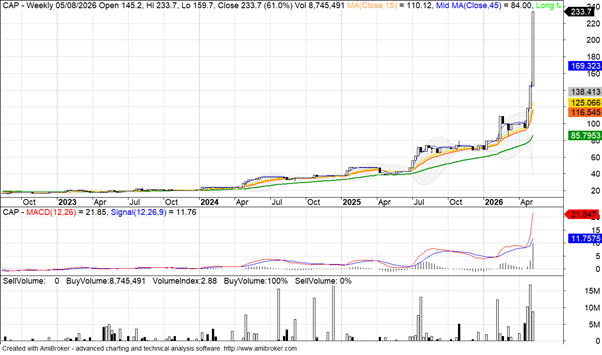
On the gainers’ table, CAP Plc led with an increase of ₦88.50, rising from ₦145.20 to ₦233.70, representing a gain of 60.95%. Zochis Agro Allied Industries Plc followed after appreciating by ₦11.58 from ₦21.78 to ₦33.36, up by 53.17%. FTN Cocoa Processors Plc gained ₦2.80 to close at ₦8.30 from ₦5.50, reflecting a 50.91% growth. RT Briscoe Plc advanced by ₦4.36 from ₦10.64 to ₦15.00, representing a 40.98% increase, while Dangote Sugar Refinery Plc added ₦23.30 to close at ₦93.00 from ₦69.70, up by 33.43%.
Nahco Weekly Price Action
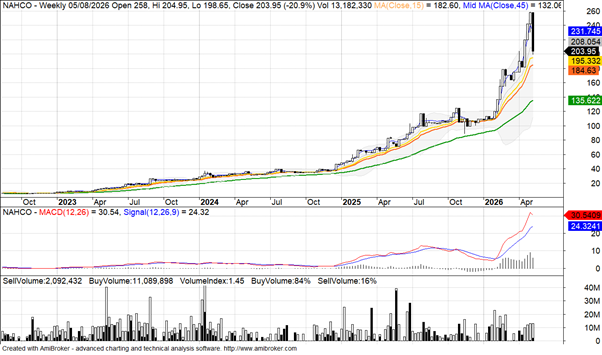
On the losers’ chart, Nigerian Aviation Handling Company Plc recorded the biggest decline, shedding ₦54.05 from ₦258.00 to ₦203.95, a drop of 20.95%. Guinness Nigeria Plc lost ₦94.40 to close at ₦402.60 from ₦497.00, representing an 18.99% decline. Access Holdings Plc depreciated by ₦3.40 from ₦27.00 to ₦23.60, down by 12.59% following its failure to pay a dividend for the 2025 full-year, while MTN Nigeria Communications Plc fell by ₦113.90 from ₦915.00 to ₦801.10, losing 12.45%. UPDC Plc also declined by ₦0.60 from ₦4.90 to ₦4.30, representing a loss of 12.24%.
Technical View
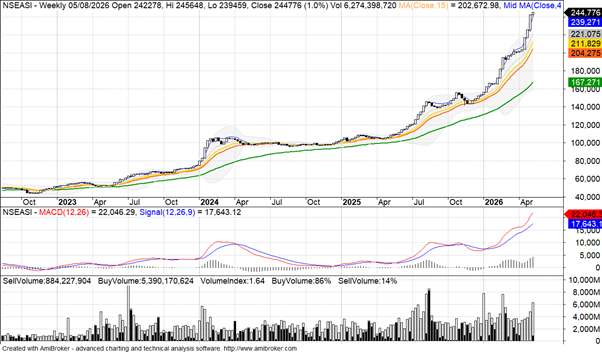
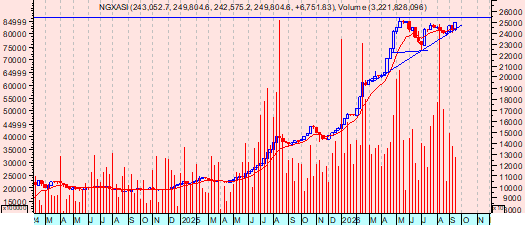
The Nigerian equities market continues to operate within a structurally bullish cycle, with the NGX All-Share Index maintaining its long-term upward trajectory despite short-term consolidation pressures. The dominant market structure remains intact, defined by sustained higher highs and higher lows, reflecting continued investor confidence and liquidity support across key sectors.
In the immediate term, the index is consolidating within a tightening range between 239,000 and 245,000 points. This phase reflects a natural pause following an extended rally, where the market is temporarily balancing strong accumulation at lower levels with profit-taking near recent highs. The repeated defence of 239,000 highlights strong underlying demand, suggesting that institutional investors are still willing to accumulate on dips. Conversely, the repeated inability to sustain a breakout above 245,000 indicates that overhead supply is gradually building, likely from short-term traders locking in gains.
From a structural standpoint, the 239,000 level is now a critical pivot zone. As long as the index remains above this level, the bullish structure is preserved. A breakdown below it would not immediately invalidate the broader uptrend but would signal a shift into a deeper corrective phase. Below this, the 235,000–237,000 region represents a stronger secondary support zone, aligning with previous breakout areas and likely serving as a re-accumulation zone if tested. The long-term structural support remains around 230,000, which marks the base of the current bullish cycle and would only come into play under significant market stress.
On the upside, the 245,000 resistance zone is increasingly important from a technical perspective. The market has tested this area multiple times without a decisive breakout, indicating that it is becoming a key supply zone. A strong and sustained break above this level would be technically significant, as it would confirm continuation of the broader bullish trend and likely trigger momentum-driven buying. Such a breakout would open the path toward the 250,000 psychological level, followed by potential extension into uncharted territory if liquidity remains supportive.
However, failure to break above resistance in the near term increases the probability of extended sideways movement. In such a scenario, the market would likely continue oscillating between 239,000 and 245,000, forming a consolidation base. This type of price action is typically constructive in a bull market, as it allows momentum indicators to reset while strong hands accumulate positions ahead of the next upward expansion.
Momentum analysis shows that the market is still trending upward on a higher timeframe, but short-term indicators are beginning to flatten. This reflects a loss of immediate upward acceleration rather than a trend reversal. The presence of shallow pullbacks rather than deep corrections is a key sign that bullish sentiment remains intact. In stronger bear phases, declines tend to be sharper and more sustained, which is not currently the case.
Volume behaviour further reinforces the underlying strength of the market. Trading activity continues to show participation from institutional players, particularly in banking, industrial goods, and consumer sectors. Importantly, volume spikes during declines are not dominant, suggesting that selling pressure is not aggressive enough to overturn the broader trend. Instead, volume tends to increase during accumulation phases and selective rallies, which is consistent with a healthy bullish structure.
Sector rotation is also playing a key role in sustaining the index. Gains are not uniformly distributed but are concentrated in large-cap stocks that have strong index weightings. This type of leadership-driven rally is typical in mature bull markets, where fewer but stronger names carry the index higher. It also indicates that the market is becoming more selective, with investors focusing on earnings strength, valuation support, and dividend expectations.
Market Outlook
Looking ahead, the most probable short-term scenario is continued consolidation within the 239,000 to 245,000 range. This phase is likely to persist until a catalyst triggers a directional breakout. Such catalysts may include stronger-than-expected earnings results, improved macroeconomic stability, or renewed foreign portfolio inflows. During this consolidation, volatility is expected to remain elevated as the market reacts to earnings releases and sector-specific news.
In the medium term, the bullish trend remains intact, with the market still positioned for potential continuation higher. A confirmed breakout above 245,000 would signal the next leg of the rally, likely driven by momentum buying and increased participation from both institutional and retail investors. In contrast, a breakdown below 239,000 would shift the market into a corrective phase, but even such a move would likely be viewed as a retracement within a larger uptrend rather than a full trend reversal.
Overall, the NGX remains in a healthy but maturing bullish phase. The trend is still upward, liquidity conditions remain supportive, and market leadership is intact. However, the pace of gains is expected to moderate in the short term as the index consolidates and builds strength for its next decisive move.
Trending in the Economy: NNPC Limited posted a ₦276 billion profit after tax in March 2026, boosted by higher gas production. Output rose to 7,731 mmscf/d from 7,458 mmscf/d in February, while crude oil production improved slightly to 1.56 million barrels per day.
The company generated ₦2.774 trillion in revenue and remitted ₦2.888 trillion to the government in Q1. Despite stronger production, crude sales weakened during the month, even as gas sales improved. NNPC linked the mixed performance to restored output after maintenance at the Bonga field, though pipeline disruptions still affected overall supply flow.
Nigeria recorded significant year-on-year drops in several staple food prices in March 2026, based on NBS data. Eggs fell by 20.12%, beans plunged almost 50%, garri declined 41.19%, and onions dropped 19.63%. Ginger moved in the opposite direction, rising 20.46% due to supply shortages.
However, prices edged higher month-on-month, influenced by transport and energy costs. Regional disparities persisted, with the South-East generally more expensive. Inflation stood at 15.38%, while food imports reached ₦7.65 trillion in 2025.
Global Market and Oil: U.S. stocks ended Friday on a strong note, with the S&P 500 and Nasdaq both hitting fresh record highs. The rally was driven largely by AI-linked tech stocks, especially Nvidia, Sandisk, and Micron, alongside a better-than-expected U.S. jobs report that reinforced confidence in the economy.
Nvidia rose 1.8%, while Micron and Sandisk surged more than 15% each as demand for AI data centre components continued to accelerate. This pushed the Philadelphia Semiconductor Index sharply higher, extending its second-quarter gain to about 55%. The broader tech sector also outperformed, rising 2.7%, while utilities lagged.
Investor sentiment was further supported by a strong corporate earnings season. So far, about 83% of S&P 500 companies have beaten profit expectations, well above the long-term average of 67%. First-quarter earnings are now projected to grow nearly 29% year-on-year, with AI-heavy large-cap stocks leading the gains.
Economic data added to the optimism. U.S. employment rose more than expected in April, while unemployment held steady at 4.3%. This reinforced expectations that the Federal Reserve will keep interest rates unchanged for an extended period, with markets pricing stability in the 3.50%–3.75% range through year-end.
By the close, the S&P 500 gained 0.84% to 7,398.93, the Nasdaq jumped 1.71% to 26,247.08, and the Dow edged up 0.02% to 49,609.16. Both the S&P 500 and Nasdaq recorded their sixth straight weekly gain, their longest winning streak since October 2024. Year-to-date gains now stand at about 8% for the S&P 500 and 13% for the Nasdaq.
Despite the strong equity performance, geopolitical tensions weighed on sentiment. Renewed conflict between U.S. and Iranian forces in the Gulf pushed Brent crude above $100 per barrel, raising concerns about energy supply disruptions through the Strait of Hormuz.
Not all earnings reactions were positive. Cloudflare dropped 24% after announcing job cuts and issuing weaker-than-expected revenue guidance. Trade Desk fell 1.8% on a soft outlook, while CoreWeave slid 11.4% after increasing capital expenditure projections due to higher component costs. Expedia also declined 9% as it flagged weaker travel demand linked to Middle East tensions.
Market breadth was slightly negative, with declining stocks outpacing gainers within the S&P 500. Trading activity remained steady at 17.2 billion shares, slightly below the recent 20-session average of 17.6 billion.