

Period Under Review: FULL YEAR 31ST DECEMBER 2025
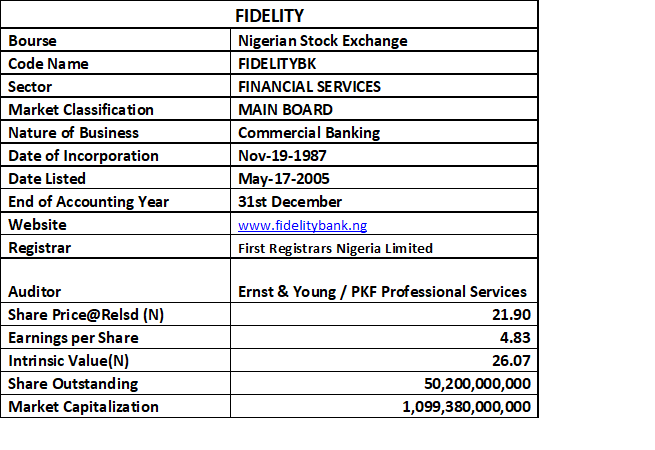
Current Share Price: N22.30
Price At Released: N21.90
Latest Final Dividend: NIL
Latest Interim Dividend: NIL
Estimated Beta Value: 0.32x
Estimated Intrinsic Value: N26.07
Rating: Moderate Buy/Hold
Analyst: Jeariogbe Tunde Segun
The Bank
Fidelity Bank Plc was incorporated in 1987 and commenced operations the following year as Fidelity Union Merchant Bank before later transitioning into a commercial bank in 1999. It obtained a universal banking license in 2001, enabling it to expand its range of financial services to individuals, small businesses, corporate organizations, and government institutions. A major milestone in its growth journey came during the 2005 banking consolidation exercise in Nigeria, when Fidelity Bank merged with FSB International Bank Plc and Manny Bank Plc, significantly increasing its branch network, customer base, and market presence across the country.
Over the years, Fidelity Bank has evolved into one of Nigeria’s leading tier-2 commercial banks, operating through key business segments like Retail Banking, Corporate Banking, and Investment Banking. Through these segments, the bank provides services such as consumer banking, SME financing, corporate lending, trade finance, treasury operations, digital banking solutions, and investment-related services. The bank has also invested heavily in technology and innovation, helping it strengthen its digital banking operations and improve customer experience across its growing network of branches and electronic channels. Today, Fidelity Bank serves millions of customers within Nigeria and through its United Kingdom subsidiary, FidBank UK Limited.
In recent years, Fidelity Bank has continued to strengthen its financial position and expand its operations both locally and internationally. As part of the Central Bank of Nigeria’s new banking recapitalization programme, the bank successfully raised additional capital through public offering, rights issues, and a private placement exercise. By early 2026, Fidelity Bank had exceeded the ₦500 billion minimum capital requirement for banks with international authorization, increasing its eligible capital base to over ₦560 billion. This achievement positioned the bank among the Nigerian banks that successfully met the recapitalization threshold ahead of the regulatory deadline, further reinforcing investor confidence and the bank’s long-term growth strategy.
The Released Numbers
Fidelity Bank Plc recorded a strong growth in gross earnings for the 2025 financial year ended December as gross earnings increased by 45.65% from ₦1.04 trillion in 2024 to ₦1.52 trillion in 2025. The impressive performance was largely driven by growth in interest income, which rose by 36.60% to ₦1.30 trillion compared to ₦950.59 billion recorded in the previous year. Despite the challenging economic environment and rising interest rate regime in Nigeria, the bank was able to improve its revenue-generating capacity, reflecting growth in its loan book, investment portfolio, and overall banking operations.
However, the increase in earnings was accompanied by a significant rise in interest expenses and operating costs. Interest expenses grew by 45.62% from ₦320.82 billion to ₦467.17 billion, indicating the higher cost of funds during the year. Operating expenses also increased by 31.42% to ₦415.48 billion, while depreciation expense rose sharply by 79.26% to ₦27.49 billion. Nevertheless, the bank still achieved a growth in net interest income, which increased by 32.01% from ₦629.77 billion in 2024 to ₦831.35 billion in 2025, showing that revenue growth was sufficient to absorb rising funding and operational costs.
Profitability, however, declined during the year as Profit Before Tax (PBT) dropped 9.75% from ₦385.22 billion in 2024 to ₦347.66 billion in 2025. Profit After Tax (PAT) also declined by 12.82% to ₦242.44 billion compared to ₦278.11 billion recorded in the previous year, while Total Comprehensive Income fell by 23.75% to ₦252.46 billion. The decline in profitability despite strong revenue growth suggests that the bank faced pressure from higher funding costs, operating expenses, and other macroeconomic challenges during the financial year. Overall, Fidelity Bank still demonstrated resilience through strong revenue expansion and sustained positive earnings performance.
Fidelity Bank Plc recorded notable growth in its financial position during the 2025 financial year, as total assets increased by 18.61% from ₦8.82 trillion in 2024 to ₦10.46 trillion in 2025. Total liabilities also rose by 18.33% to ₦9.38 trillion, reflecting the growth in customer deposits and other funding obligations. Despite the increase in liabilities, the bank maintained a positive growth in shareholders’ funds, with net assets rising by 21.13% from ₦897.87 billion to ₦1.09 trillion. This improvement in net assets indicates a stronger capital base and enhanced financial stability for the bank during the year under review.
The bank also demonstrated strong growth in its deposit base and investment in long-term assets. Total deposits increased by 16.07% from ₦5.94 trillion in 2024 to ₦6.89 trillion in 2025, reflecting sustained customer confidence and improved deposit mobilization efforts. Property, plant, and equipment recorded a significant increase of 161.59% to ₦203.72 billion, suggesting major investments in infrastructure, branch expansion, technology, and operational capacity enhancement. However, retained earnings declined by 6.37% from ₦185.26 billion to ₦173.46 billion, largely reflecting the impact of lower profitability and possible dividend distributions during the financial year.
In terms of credit performance, total loans and advances declined slightly from ₦4.39 trillion to ₦4.28 trillion, indicating a cautious lending strategy amid the prevailing economic uncertainties. Asset quality, however, improved significantly as Stage 3 Expected Credit Losses (non-performing loans) reduced by 24.52% from ₦111.61 billion in 2024 to ₦84.25 billion. Similarly, total credit exposure across Stage 1, Stage 2, and Stage 3 loans declined marginally by 2.09%. The reduction in impaired loans suggests an improvement in the bank’s risk management and loan recovery efforts, which positively supports overall asset quality and financial soundness.
Financial Strength/Solvency Ratios
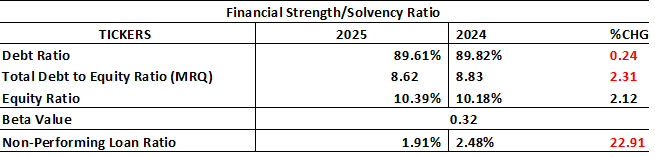
Fidelity Bank maintained a relatively stable solvency position during the 2025 financial year, as its debt ratio slightly improved from 89.82% in 2024 to 89.61% in 2025. Similarly, the total debt-to-equity ratio declined from 8.83x to 8.62x, indicating a modest reduction in leverage levels and suggesting improved capital support relative to liabilities. The bank’s equity ratio also improved marginally from 10.18% to 10.39%, reflecting gradual strengthening of shareholders’ funds within the overall asset structure. These movements indicate that despite operating with a high leverage structure typical of the banking industry, Fidelity Bank was able to maintain a stable capital and solvency profile during the year under review.
Asset quality also improved significantly during the period, as Non-Performing Loan (NPL) ratio fell from 2.48% in 2024 to 1.91% in 2025, representing a 22.91% improvement. The reduction in NPL ratio suggests enhanced credit risk management, better loan recovery efforts, and improved quality of the bank’s loan portfolio. Importantly, the NPL ratio remained below the 5% regulatory threshold prescribed by the Central Bank of Nigeria, indicating that the bank maintained a healthy loan book and sound risk management practices despite the challenging economic environment.
Profitability Ratios
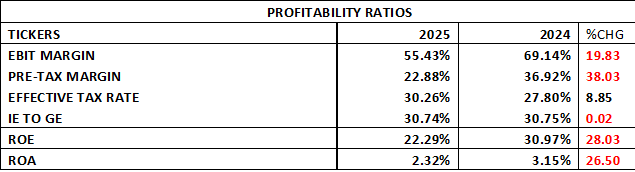
The bank experienced a decline in profitability in the 2025 financial year, as reflected in several key profitability ratios with EBIT margin sliding from 69.14% in 2024 to 55.43% in 2025, indicating that a lower proportion of revenue was converted into operating profit. Similarly, the pre-tax profit margin dropped significantly from 36.92% to 22.88%, reflecting the impact of rising operating costs, higher interest expenses, and other macroeconomic pressures on overall earnings performance. These declines suggest that although the bank achieved strong revenue growth during the year, profitability was pressured by increasing costs within the operating environment.
The bank’s effective tax rate increased from 27.80% in 2024 to 30.26% in 2025, indicating a higher tax burden on earnings during the period. Meanwhile, the Interest Expense to Gross Earnings ratio remained relatively stable at 30.74% compared to 30.75% recorded in the previous year. This stability suggests that despite the increase in absolute interest expenses, the bank was still able to manage its funding costs relative to gross earnings. However, the elevated cost environment continued to weigh on net profitability and earnings efficiency during the financial year.
Returns generated for shareholders and assets also declined during the year under review. Return on Equity (ROE) dropped from 30.97% in 2024 to 22.29% in 2025, indicating lower returns generated on shareholders’ investments. Similarly, Return on Assets (ROA) decreased from 3.15% to 2.32%, reflecting reduced efficiency in generating profit from the bank’s asset base. Despite these declines, both ROE and ROA remained positive, suggesting that the bank still maintained profitable operations, although at a lower efficiency level compared to the previous financial year.
Efficiency Ratios
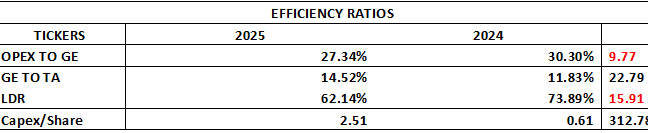
Fidelity Bank Plc recorded mixed efficiency performance during the 2025 financial year. The Operating Expense to Gross Earnings ratio improved from 30.30% in 2024 to 27.34% in 2025, indicating better cost management and improved operational efficiency despite the challenging economic environment. In addition, the Gross Earnings to Total Assets ratio increased from 11.83% to 14.52%, reflecting stronger asset utilization and improved capacity of the bank’s asset base to generate revenue. This suggests that the bank was able to deploy its assets more effectively in generating income during the year under review.
However, the Loan-to-Deposit Ratio (LDR) declined from 73.89% in 2024 to 62.14% in 2025, indicating a more cautious lending approach and a lower proportion of deposits being converted into loans. While this may reduce credit risk exposure, it could also limit potential interest income growth if excess liquidity is not efficiently utilized. Meanwhile, Capital Expenditure per Share increased significantly from 0.61 to 2.51, representing a growth of 312.78%. This substantial increase suggests that the bank made considerable investments in infrastructure, technology, and operational expansion, which may support long-term growth and service delivery efficiency.
Investment/Valuation Ratios
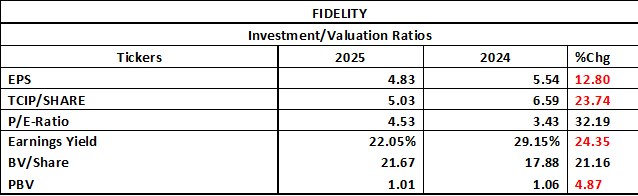
Fidelity Bank Plc recorded mixed performance across its investment and valuation indicators during the 2025 financial year. Earnings Per Share (EPS) declined by 12.80% from 5.54 in 2024 to 4.83 in 2025, reflecting the reduction in profit after tax recorded during the year. Similarly, Total Comprehensive Income per Share decreased by 23.74% from 6.59 to 5.03, indicating lower comprehensive returns attributable to shareholders. Earnings Yield also declined from 29.15% in 2024 to 22.05% in 2025, suggesting a reduction in the earnings generated relative to the market price of the bank’s shares. These declines generally reflect the pressure on profitability experienced during the financial year.
Despite the decline in earnings-based indicators, the bank recorded improvements in valuation and book value metrics. Book Value per Share increased by 21.16% from 17.88 to 21.67, indicating growth in shareholders’ equity and stronger net asset backing for investors. In addition, the Price-to-Earnings (P/E) ratio rose from 3.43x to 4.53x, suggesting improved investor confidence and a higher market valuation relative to earnings. Meanwhile, the Price-to-Book Value (PBV) ratio declined slightly from 1.06x to 1.01x, implying that the bank’s shares traded close to their book value during the year. Overall, the valuation ratios suggest that although profitability weakened, the bank still maintained reasonable investor confidence supported by its strengthening capital base and asset position.
Dividend Information
Fidelity Bank Plc did not declare a final dividend for the 2025 financial year, compared to a final dividend of ₦2.10 per share paid in 2024. Consequently, the final dividend pay-out ratio declined from 37.92% in 2024 to 0.00% in 2025, while the final dividend yield also dropped from 11.05% to 0.00%. The absence of a final dividend declaration may reflect the bank’s decision to retain earnings in order to strengthen capital reserves, support business expansion, and maintain compliance with regulatory capital requirements, particularly in light of the ongoing banking sector recapitalization programme and prevailing economic uncertainties.

Final Verdict
Overall, Fidelity Bank Plc demonstrated strong growth in gross earnings, asset base, deposits, and shareholders’ funds during the 2025 financial year, reflecting resilience and continued expansion despite a challenging macroeconomic environment. The bank also showed improvement in asset quality, as evidenced by the decline in its non-performing loan ratio below the regulatory threshold, while maintaining stable solvency and capital adequacy positions. However, profitability indicators weakened during the year due to rising interest expenses, higher operating costs, and increased tax burden, leading to declines in profit margins, earnings per share, and returns on equity and assets. Nevertheless, the successful completion of the bank’s recapitalization exercise and the growth in book value per share positioned the bank for stronger long-term stability and future growth opportunities.
Recommendations
Based on the overall financial performance and ratio analysis, it is recommended that Fidelity Bank Plc should focus on improving cost efficiency, optimizing funding structure, and enhancing profitability through prudent risk management and increased deployment of low-cost deposits. The bank should also continue strengthening its digital banking operations, loan recovery strategies, and non-interest income streams in order to improve earnings sustainability. In addition, maintaining strong asset quality and efficient capital utilization will be essential in supporting shareholder value and long-term competitiveness within the Nigerian banking industry.
Investment Ratings
From an investment perspective, Fidelity Bank Plc may be considered a Moderate Buy/Hold investment. The bank’s strong revenue growth, improving asset quality, expanding capital base, and successful recapitalization exercise provide positive long-term fundamentals for investors. However, the decline in profitability ratios, earnings per share, and the absence of a final dividend declaration may limit short-term investor returns. Therefore, long-term investors may still find the stock attractive due to its growth potential and relatively stable financial position, while short-term income-focused investors may adopt a cautious approach pending improvement in profitability and dividend performance.