

Period Under Preview: -Full Year 2025
Current Share Price: N38.00
Latest Final Dividend: Nil
Latest Interim Dividend: Nil
Estimated Beta Value: -0.43x
Estimated Fair Value: N45:00
Analyst: Jeariogbe Tunde Segun
The Company
Oando Plc is one of Nigeria’s leading indigenous energy companies, with a history that dates back to 1956 when it was incorporated as Esso Africa. The company underwent several transformations over the decades, becoming Unipetrol Nigeria Plc in 1991 following its privatization by the Federal Government of Nigeria.
In 2000, Unipetrol acquired a majority stake in Agip Nigeria Plc, significantly expanding its operations in the downstream petroleum sector. In 2003, the company rebranded as Oando PLC, marking the beginning of its evolution into an integrated energy company with interests across the oil and gas value chain.
Over the years, Oando PLC has diversified its operations beyond petroleum marketing into exploration and production, natural gas distribution, energy services, and clean energy initiatives. The company has built a strong presence in both upstream and downstream segments, operating through various subsidiaries and strategic partnerships. Oando has also expanded its footprint across several African countries, reinforcing its vision of becoming Africa’s preferred energy solutions provider. Its listing on the Nigerian Exchange Limited (formerly The Nigerian Stock Exchange) has enabled it to attract investment while maintaining high standards of corporate governance and transparency.
A significant milestone in Oando’s history occurred in 2024 when the company completed the acquisition of the Nigerian Agip Oil Company (NAOC) from the Italian energy giant Eni. This landmark transaction substantially increased Oando’s crude oil reserves, production capacity, and strategic importance within Nigeria’s oil and gas industry.
Today, Oando PLC continues to focus on sustainable growth by optimizing its upstream assets, expanding its gas business, investing in renewable energy opportunities, and supporting Nigeria’s energy transition while creating value for shareholders and other stakeholders.
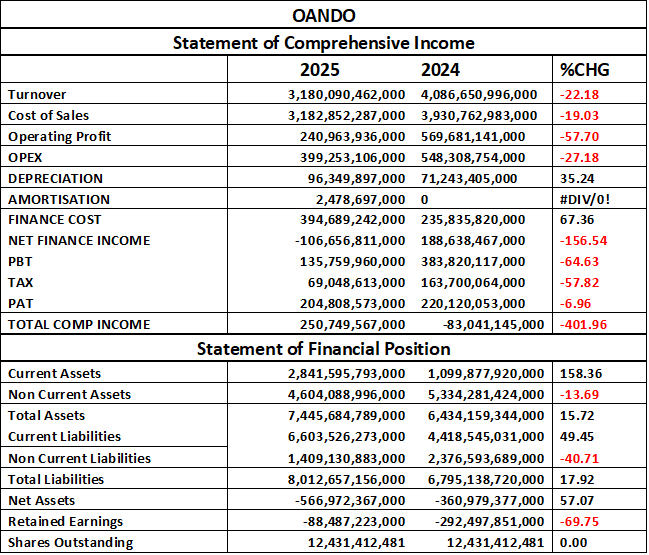
Statement of Comprehensive Income
Oando PLC’s 2025 financial performance reflects a challenging operating environment, with revenue declining by 22.18% to ₦3.18 trillion from ₦4.09 trillion in 2024. Although the cost of sales also reduced by 19.03%, the decline was slower than the fall in revenue, leading to a significant contraction in margins. Consequently, operating profit dropped sharply by 57.70% to ₦240.96 billion, indicating weaker operational efficiency during the year. On the positive side, operating expenses (OPEX) decreased by 27.18%, demonstrating management’s effort to control administrative and operating costs despite the difficult business environment.
The company’s profit was further pressured by rising financing costs which increased by 67.36% to ₦394.69 billion, while net finance income declined from a positive ₦188.64 billion in 2024 to a negative ₦106.66 billion in 2025. As a result, profit before tax (PBT) fell by 64.63% to ₦135.76 billion, and despite the tax rebate, profit after tax (PAT) declined by 6.96% to ₦204.81 billion. The sharp increase in depreciation and amortisation expenses also suggests that the company is carrying a larger asset base following recent the acquisitions, which may support future production but have reduced current-year’s earnings.
Despite the weaker earnings performance, Oando Plc reported a remarkable turnaround in total comprehensive income, which improved from a negative of ₦83.04 billion in 2024 to a gain of ₦250.75 billion in 2025. This indicates a strong positive movements in other comprehensive income, such as foreign currency translation reserves or fair value adjustments, thereby strengthening shareholders’ equity.
From an investment perspective, the company’s short-term profitability has weakened due to declining revenue and a significantly higher finance costs. That notwithstanding, the improved comprehensive income and expanded asset base provide a foundation for future growth. Investors should monitor management’s ability to convert these strategic investments into a stronger revenue growth, improved operating margins, and lower financing costs before expecting sustained earnings recovery.
Statement of Financial Position
Oando PLC’s 2025 Statement of Financial Position reflects a significant expansion in its asset base, with total assets increasing by 15.72% to ₦7.45 trillion from ₦6.43 trillion in 2024. The growth was primarily driven by a remarkable 158.36% increase in current assets to ₦2.84 trillion, indicating stronger liquidity in the short term. However, non-current assets declined by 13.69% to ₦4.60 trillion, suggesting asset reclassification, disposals, or depreciation of long-term assets. The substantial increase in current assets enhances the company’s ability to meet short-term operational needs and provides greater financial flexibility.
On the liabilities side, the company’s financial leverage remains a major concern. Current liabilities rose sharply by 49.45% to ₦6.60 trillion, while total liabilities increased by 17.92% to ₦8.01 trillion, despite a 40.71% reduction in non-current liabilities. Consequently, total liabilities exceeded total assets, resulting in negative net assets of ₦566.97 billion, compared with negative ₦360.98 billion in the previous year. Although retained losses jumped significantly from ₦292.50 billion to ₦88.49 billion, the company continues to operate with a negative equity position, reflecting the need for sustained profitability and further balance sheet strengthening.
From an investment perspective, Oando presents both opportunities and risks. The increase in total assets and the significant improvement in retained earnings indicate that the company’s recent strategic investments, including its upstream expansion, may begin to yield long-term benefits. However, the high debt burden, rising current liabilities, and persistent negative shareholders’ equity remain key risks that investors should monitor closely.
**However, while long-term investors may find value waiting to be tapped in Oando’s growth potential and strategic positioning within Nigeria’s energy sector, a cautious approach is, nonetheless, advisable until the company consistently improves its capital structure, restores positive net assets, and demonstrates stronger cash flow generation and balance sheet resilience.
Financial Strength/Solvency Analysis
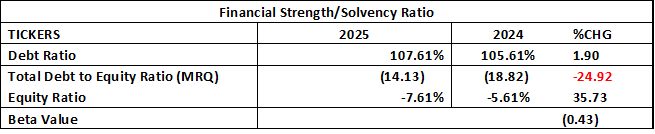
Oando Plc’s solvency ratios indicate that it remains highly leveraged despite some improvements in its capital structure. The debt ratio increased from 105.61% in 2024 to 107.61% in 2025, meaning that total liabilities continue to exceed total assets. Similarly, the equity ratio remained negative, deteriorating from -5.61% to -7.61%, reflecting the company’s negative shareholders’ equity position. Although the total debt-to-equity ratio improved from -18.82x to -14.13x, the negative ratio is still a consequence of negative equity rather than a healthy reduction in leverage. These figures suggest that Oando continues to rely heavily on debt financing, thereby exposing the company to refinancing and interest rate risks.
From an investment perspective, Oando’s financial strength remains weak, following which investors should approach the stock with caution despite its strategic growth prospects. The company’s high leverage and negative equity increase financial risk, particularly in periods of volatile oil prices or rising borrowing costs. Nevertheless, the improvement in the debt-to-equity ratio and the company’s recent strategic acquisitions may strengthen future earnings and gradually restore shareholders’ equity if effectively managed. Long-term investors may consider the stock for its growth potential, but sustained improvements in solvency, debt reduction, and capital adequacy will be essential before Oando Plc can be regarded as a financially strong investment.
Profitability Ratio Analysis
Oando Plc’s profitability ratios indicate that earnings performance weakened considerably in 2025 compared with the previous year. The EBIT margin declined from 13.94% to 7.58%, while the pre-tax margin fell from 9.39% to 4.27%, reflecting increased operating and financing pressures that reduced the company’s ability to convert revenue into profit. Furthermore, the cost of sales to turnover ratio increased from 96.19% to 100.09%, implying that the cost of generating revenue slightly exceeded turnover during the year. This deterioration highlights pressure on gross margins and underscores the need for improved cost management and operational efficiency.
The company’s return ratios present a mixed picture. Return on Assets (ROA) declined from 3.42% to 2.75%, indicating that Oando generated lower earnings from its asset base despite its expansion. Although Return on Equity (ROE) remained negative at -36.12%, it improved significantly from -60.98% in 2024, suggesting that the company’s negative equity position is gradually recovering. In addition, the effective tax rate reduced from 74.37% to 33.71%, easing the tax burden and providing some support to net earnings despite weaker operating performance.
From an investment perspective, Oando remains a company with strong long-term growth potential but short-term profitability challenges. The sharp decline in operating and pre-tax margins, coupled with the exceptionally high cost of sales ratio, indicates that profitability remains under pressure. However, the improvement in ROE and the lower effective tax rate suggest that management’s restructuring efforts are beginning to produce positive results. Investors should monitor the company’s ability to improve operating margins, control production costs, and sustain earnings growth. Until profitability strengthens consistently, Oando Plc is best suited to investors with a medium to long-term investment horizon who are willing to accept higher risk in anticipation of future value creation.
Efficiency Ratio Analysis
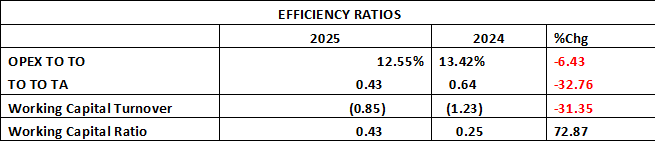
Oando Plc’s efficiency ratios present a mixed picture of operational performance in 2025. The Operating Expenses to Turnover (OPEX/TO) ratio improved from 13.42% in 2024 to 12.55% in 2025, indicating better cost control as the company spent a lower proportion of its revenue on operating expenses. However, the Turnover to Total Assets (Asset Turnover) ratio declined from 0.64x to 0.43x, suggesting that the company’s expanded asset base generated less revenue per naira invested in assets. Although the Working Capital Turnover ratio improved from -1.23x to -0.85x, it remained negative, reflecting continued pressure on working capital management. Meanwhile, the Working Capital Ratio improved significantly from 0.25x to 0.43x, indicating better liquidity, though it remains below the ideal benchmark of 1.0.
From an investment perspective, Oando is showing gradual improvements in operational efficiency through stronger cost management and better liquidity. Nevertheless, the decline in asset turnover and the persistence of negative working capital turnover indicate that the company has not yet optimized the utilization of its enlarged asset base. Investors should monitor management’s ability to translate recent strategic investments into higher revenue generation and improved cash flow. While the improving efficiency indicators are encouraging, sustained gains in asset productivity and working capital management will be critical before Oando can be regarded as a consistently efficient and financially attractive investment.
Investment/Valuation Ratio Analysis
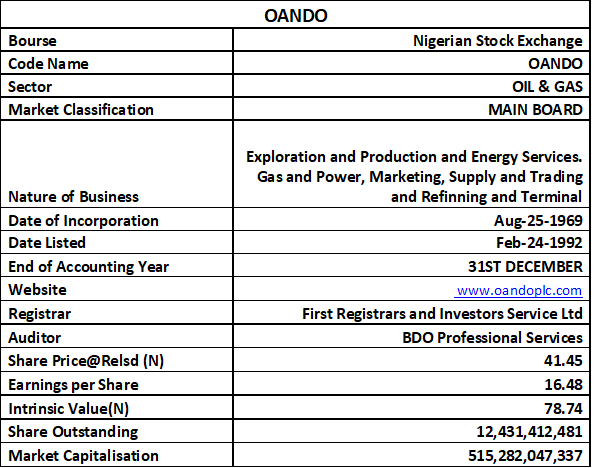
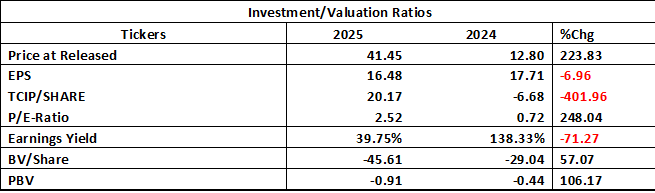
Oando PLC’s valuation metrics present a mixed picture, reflecting a strong market confidence despite the weaker earnings performance. The company’s share price increased significantly from ₦12.80 to ₦41.45, representing a 223.83% appreciation, indicating positive investor sentiment and optimism about the company’s long-term growth prospects. However, Earnings Per Share (EPS) declined by 6.96% from ₦17.71 to ₦16.48, suggesting a modest reduction in earnings attributable to shareholders. Despite the lower EPS, Total Comprehensive Income per Share improved substantially from -₦6.68 to ₦20.17, reflecting a strong recovery in comprehensive earnings and strengthening shareholders’ overall value.
The company’s Price-to-Earnings (P/E) ratio rose from 0.72x to 2.52x, indicating that investors are now willing to pay a higher multiple for Oando’s earnings, largely driven by expectations of its future growth following the strategic expansion. However, the earnings yield declined sharply from 138.33% to 39.75%, making the stock relatively less attractive from an earnings-return perspective than in the previous year. In addition, Book Value Per Share remained negative, deteriorating from minus ₦29.04 to minus ₦45.61, while the Price-to-Book Value (PBV) ratio also remained negative due to the company’s negative shareholders’ equity. These indicators reflect that the market valuation is currently supported more by growth expectations than by the strength of the company’s actual underlying net assets.
From an investment perspective, Oando remains a high-risk, high-potential investment. The remarkable appreciation in its share price demonstrates the strong investor confidence in its strategic direction, particularly following the strategic upstream expansion. However, the decline in EPS, negative book value, and continued negative equity all suggest that the company’s fundamentals have not yet fully caught up with its market valuation.
Therefore, investors with a long-term outlook may benefit if management successfully converts its expanded asset base into stronger and more sustainable earnings. Nevertheless, conservative investors should exercise caution and closely monitor improvements in profitability, balance sheet strength, and cash flow before taking significant investment positions.
Final Investment Verdict – Oando PLC (FY 2025)
A review of Oando Plc’s Statement of Comprehensive Income, Statement of Financial Position, Financial Strength, Profitability, Efficiency, and Valuation Ratios, presents a mixed investment profile. Operationally, the business experienced a decline in revenue and margins, while finance costs increased substantially, weighing in on profitability. The balance sheet also remains under pressure, with negative shareholders’ equity, a debt ratio above 100%, and high leverage. We believe that these are significant financial risks that conservative investors should not ignore.
Nevertheless however, Oando’s long-term outlook is considerably stronger than its current financial ratios suggest, given that the acquisition of NAOC has transformed the company’s upstream asset base and production capacity, just as total comprehensive income improved significantly during the year. The market appears to recognize this future potential, as reflected in the strong appreciation of the share price. The share price seems to be reacting already to the expectation that management could successfully integrate the new assets, reduce finance costs, improve operating margins, and restore positive equity, earnings will grow substantially over the next few years.
Investment Recommendation
Recommendation: BUY (Long-Term) / HOLD (Existing Investors)
Long-term investors: BUY on price weakness. Oando is suitable for investors with a 3–5 year investment horizon who can tolerate above-average risk.
Existing shareholders: HOLD. The company’s strategic transformation is not yet fully reflected in its earnings, but the long-term outlook remains promising.
Short-term traders and conservative investors: HOLD/AVOID until profitability, leverage, and equity position improve further.
Estimated Intrinsic Value
Using a blend of: Earnings Power (EPS = ₦16.48), Sustainable earnings multiple, Asset quality, Negative book value adjustment, and Long-term growth prospects from the NAOC acquisition, the estimated intrinsic value is strategically estimate to differentiate options among investors preferences. Therefore, it is safe to state that the Conservative Value of Oando Plc is ₦38.00 per share; Base (Fair) Value is ₦45.00 per share; while the Optimistic Value (3–5 year outlook) is between ₦52.00–₦58.00 per share.
Our Final Opinion of Intrinsic Value
Given the reported market price of ₦41.45 as at the time this report is compiled, Oando appears to be trading close to fair value, with modest upside potential of about 9% to the base intrinsic value and greater upside if the company executes its growth strategy successfully. While it is no longer deeply undervalued, it remains an attractive long-term investment for investors seeking exposure to Nigeria’s oil and gas sector, provided such investors are comfortable with the company’s elevated financial risk.