
Period Under Preview: HALF YEAR END 30TH JUNE, 2026
Current Share Price: N29.20
Price At Release Date: N30.95
Latest Final Dividend: N1.25
Latest Interim Dividend: NIL
Estimated Beta Value: 0.45x
Estimated Intrinsic Value: N39.75
Rating: Strong Buy (for both Medium & Long Term Investors)
Analyst: Jeariogbe Tunde Segun
The Bank
Wema Bank Plc is one of Nigeria’s oldest indigenous financial institutions, established on 2 May 1945 by Chief Matthew Adekoya Okupe and a group of Nigerian entrepreneurs to provide banking services to indigenous businesses and individuals during the colonial era. It operated for decades as Agbonmagbe Bank Limited. Following the successive banking sector reforms and expansion, the bank changed its name to Wema Bank Limited in 1969. Specifically, the name change was due to a financial takeover and ownership restructuring by the government of the old Western Region of Nigeria to enable the bank meet the new capital requirements. Specifically, the Western Nigeria Marketing Board (owned by the regional government) converted its £200,000 deposit with the bank into equity shares. The board then took effective control of Agbonmagbe Bank, changing the bank’s private, family-linked identity to reflect its new status as a state-backed public institution. Wema (derived from Western Marketing Board) Bank was official rebranded in 1969.
In 1987, Wema Bank transformed from a private to a public limited liability company and subsequently listed its shares on the then Nigerian Stock Exchange (now NGX) three years later in 1990. It has over the decades grown through a combination of branch expansion, strategic restructuring, recapitalization, and improvements in corporate governance, which have enabled it to remain a significant player in Nigeria’s banking industry.
During the 2004-2006 banking consolidation exercise when the Central Bank of Nigeria (CBN) required banks in Nigeria to raise their minimum capital to N25 billion, the owner-states of Odua Group the investment vehicle of the old Western Region (now Oyo, Ondo, Ogun, Osun, and Ekiti state governments), which also owned the National Bank Nigeria Limited opted to consolidate both institutions.
National Bank of Nigeria was founded in February 1933 by three prominent Nigerian businessmen and nationalists: Dr. Akinola Maja, Chief T.A. Doherty, and Mr. H.A. Subair, in response to the routine refusal by the British banks which dominated the Nigerian financial system: Bank of British West Africa (now First Bank) and Barclays Bank (now Union Bank). The foreign banks prioritized European trading firms when grant credit, loans, or financial backing to indigenous African merchants, particularly indigenous Cocoa farmers, traders, and local businesses. National Bank soon became one of the “big three” indigenous giants on the Nigerian financial landscape in the 1920s, alongside the African Continental Bank and the old Bank of the North. National Bank was taken over by the Western Regional Government in 1961 and served as a critical engine to drive economic and infrastructural development across the region.
Wema Bank, subsequently absorbed and integrated the assets of National Bank of Nigeria Limited, while retaining the name Wema Bank Plc.
Due to the 2008 economic meltdown, and part of a deliberate restructuring exercise, Wema Bank scaled back its operations to become a regional player focusing on the South-South and South-West zones. During the period, Wema Bank Plc transformed into a technology-driven financial institution and became widely recognized for innovation in digital banking. Helped by the enhanced capital base and financial health, the bank successfully regained its National Banking Licence from the CBN in December 2015
The launch of ALAT, Nigeria’s first fully digital bank, marked a major milestone in its digital transformation strategy and strengthened its position in retail and electronic banking. Today, Wema Bank operates as a national commercial bank licensed by the Central Bank of Nigeria, offering a broad range of banking products and financial services to individuals, small and medium-sized enterprises, and corporate customers. The bank continues to focus on innovation, financial inclusion, customer-centric service delivery, and sustainable growth, making it one of Nigeria’s leading indigenous banks.
Statement of Comprehensive Income
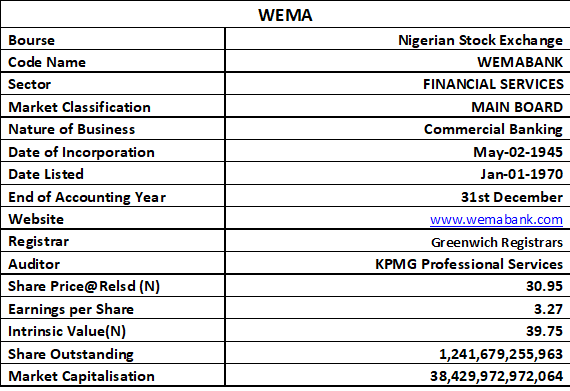
Wema Bank Plc delivered an impressive financial performance in the first half of 2026, demonstrating strong earnings growth and improved profitability. Gross earnings increased by 36.90% to ₦415.09 billion from ₦303.20 billion recorded in the corresponding period of 2025, driven primarily by a 42.69% increase in interest income to ₦342.64 billion. Despite a 32.72% rise in interest expenses, the bank maintained a healthy net interest income of ₦195.45 billion, representing a 51.26% year-on-year growth. This reflects the bank’s ability to expand its earning assets while effectively managing funding costs in a high-interest-rate environment.
Profitability remained robust during the period under review. Profit Before Tax (PBT) rose significantly by 53.65% to ₦154.56 billion, while Profit After Tax (PAT) increased by 50.12% to ₦131.37 billion, despite a 77.29% increase in tax expenses. Operating expenses grew by 20.44%, which was considerably lower than the growth in gross earnings, indicating improved cost efficiency and positive operating leverage. Total Comprehensive Income also advanced by 47.67% to ₦130.13 billion, confirming that the bank’s earnings growth translated into stronger shareholder value.
From an investment perspective, Wema Bank Plc continues to exhibit strong fundamentals that support a positive long-term outlook. The sustained growth in revenue, expanding net interest income, disciplined cost management, and over 50% growth in profitability suggest that the bank is well-positioned to deliver improved full-year earnings and potentially higher shareholder returns. Coupled with its growing digital banking franchise through ALAT and expanding retail banking presence, Wema Bank remains an attractive investment opportunity for investors seeking exposure to Nigeria’s banking sector. Based on the half-year 2026 performance, the stock merits a BUY recommendation for medium- to long-term investors, subject to prevailing market conditions and valuation.
Statement of Financial Position
Wema Bank Plc delivered an impressive financial performance in the first half of 2026, demonstrating strong earnings growth and improved profitability. Gross earnings increased by 36.90% to ₦415.09 billion from ₦303.20 billion recorded in the corresponding period of 2025, driven primarily by a 42.69% increase in interest income to ₦342.64 billion. Despite a 32.72% rise in interest expenses, the bank maintained a healthy net interest income of ₦195.45 billion, representing a 51.26% year-on-year growth. This reflects the bank’s ability to expand its earning assets while effectively managing funding costs in a high-interest-rate environment.
Profit remained robust during the period under review. Profit Before Tax (PBT) rose significantly by 53.65% to ₦154.56 billion, while Profit After Tax (PAT) increased by 50.12% to ₦131.37 billion, despite a 77.29% increase in tax expenses. Operating expenses grew by 20.44%, which was considerably lower than the growth in gross earnings, indicating improved cost efficiency and positive operating leverage. Total Comprehensive Income also advanced by 47.67% to ₦130.13 billion, confirming that the bank’s earnings growth translated into stronger shareholder value.
From an investment perspective, Wema Bank Plc continues to exhibit strong fundamentals that support a positive long-term outlook. The sustained growth in revenue, expanding net interest income, disciplined cost management, and over 50% growth in profit suggest that the bank is well-positioned to deliver improved full-year earnings and potentially higher shareholder returns. Coupled with its growing digital banking franchise through ALAT (Wema Bank fully digital banking platform) and expanding retail banking presence, Wema Bank remains an attractive investment opportunity for investors seeking exposure to Nigeria’s banking sector. Based on the half-year 2026 performance, the stock merits a BUY recommendation for medium- to long-term investors, subject to prevailing market conditions and valuation.
Financial Strength/Solvency Ratio
The financial strength indicators show that Wema Bank Plc has continued to strengthen its capital base while maintaining a healthy funding structure. The Debt Ratio declined to 87.83% from 91.86%, indicating that a lower proportion of the bank’s assets is financed through liabilities, while the Total Debt-to-Equity Ratio improved from 11.29x to 7.22x, reflecting a significant reduction in leverage. At the same time, the Equity Ratio increased from 8.14% to 12.17%, representing a 49.52% improvement, which demonstrates stronger capitalization and an enhanced capacity to absorb potential losses. Furthermore, the bank’s Beta value of 0.45 suggests that its share price is less volatile than the overall market, making it relatively defensive during periods of market uncertainty.
From an investment standpoint, these solvency indicators reinforce confidence in Wema Bank’s financial stability and long-term growth prospects. The improvement in equity relative to assets and the reduction in leverage reflect prudent capital management and a stronger balance sheet capable of supporting future business expansion. A lower beta also enhances the stock’s appeal to investors seeking lower-risk exposure within the Nigerian banking sector. Combined with the bank’s impressive earnings growth, expanding asset base, and strong profitability in the first half of 2026, these financial strength ratios support a BUY recommendation for medium- to long-term investors looking for sustainable capital appreciation.

Profitability Ratio
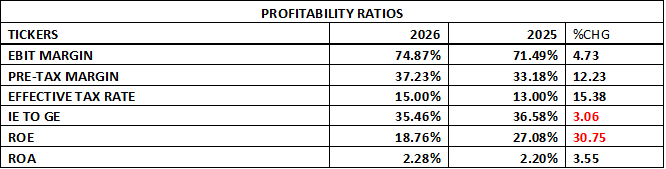
Wema Bank Plc’s profitability ratios for the half-year ended 30 June 2026 underscore the bank’s strong earnings capacity and improving operational efficiency. EBIT Margin increased to 74.87% from 71.49%, while the Pre-Tax Margin improved to 37.23% from 33.18%, indicating that the bank converted a larger proportion of its revenue into operating and pre-tax profits. The Interest Expense-to-Gross Earnings ratio declined from 36.58% to 35.46%, reflecting improved funding cost management despite the prevailing high-interest-rate environment. Although the Effective Tax Rate increased to 15.00% from 13.00%, the bank maintained strong earnings momentum, while Return on Assets (ROA) edged higher to 2.28% from 2.20%, demonstrating improved efficiency in utilizing its asset base to generate profits.
From an investment perspective, these profitability indicators reinforce Wema Bank’s ability to sustain earnings growth and create long-term shareholder value. The decline in Return on Equity (ROE) to 18.76% from 27.08% is largely attributable to the significant increase in shareholders’ equity following stronger retained earnings and capital growth, rather than a deterioration in profitability. This stronger capital base enhances the bank’s financial resilience and positions it for future expansion. Overall, the combination of higher operating margins, improved asset utilization, and disciplined cost management supports a positive earnings outlook. Consequently, Wema Bank Plc remains an attractive BUY for medium- to long-term investors seeking sustainable growth, improving fundamentals, and potential capital appreciation.
Efficiency Ratios
Wema Bank Plc’s efficiency ratios for the half-year ended 30 June 2026 indicate continued improvement in operational efficiency and balance sheet utilization. The Operating Expenses-to-Gross Earnings (OPEX/GE) ratio declined to 24.92% from 28.33%, reflecting improved cost control and stronger operating leverage as revenue growth outpaced the increase in operating expenses. Although the Gross Earnings-to-Total Assets (GE/TA) ratio moderated slightly to 7.21% from 7.63%, the decline is attributable to the rapid expansion of the bank’s asset base, which is expected to support higher earnings in subsequent periods.
Meanwhile, the Loan-to-Deposit Ratio (LDR) increased to 58.58% from 51.76%, indicating a more efficient deployment of customer deposits into interest-earning assets while remaining within prudent risk management limits. Capital expenditure per share also rose from ₦0.03 to ₦0.04, reflecting continued investment in technology, digital infrastructure, and business expansion.
From an investment perspective, these efficiency metrics reinforce Wema Bank’s ability to convert revenue into profit while prudently utilizing its resources. The significant improvement in the cost-to-income profile demonstrates effective expense management, while the higher loan-to-deposit ratio is expected to enhance future interest income without compromising liquidity. Continued investment in capital assets supports the bank’s long-term digital transformation strategy and operational competitiveness. Overall, the efficiency indicators complement the bank’s strong earnings growth, improving profitability, and strengthened balance sheet, making Wema Bank Plc a compelling BUY for medium- to long-term investors seeking sustainable earnings growth and long-term capital appreciation.

Investment/Valuation Ratios
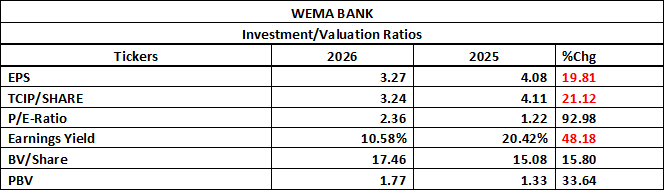
Wema Bank Plc’s investment and valuation ratios for the half-year ended 30 June 2026 present a picture of a fundamentally stronger bank whose share price has appreciated in response to improved financial performance. Earnings Per Share (EPS) moderated to ₦3.27 from ₦4.08, while Total Comprehensive Income Per Share (TCI/Share) declined to ₦3.24 from ₦4.11, largely because the earnings were spread over a larger capital base following the bank’s recapitalization and increased shareholders’ funds. Despite this, the bank continues to generate healthy earnings, supported by robust growth in gross earnings, profitability, and retained earnings. The Book Value per Share increased from ₦15.08 to ₦17.46, reflecting a stronger net asset position and increased intrinsic value for shareholders.
The valuation multiples indicate that the market has begun to recognize the bank’s improved fundamentals. The Price-to-Earnings (P/E) Ratio increased from 1.22x to 2.36x, suggesting that investors are willing to pay a higher multiple for Wema Bank’s earnings because of expectations of sustained growth. Consequently, the Earnings Yield declined from 20.42% to 10.58%, not because earnings weakened, but because the share price appreciated faster than earnings growth. Similarly, the Price-to-Book Value (PBV) ratio increased from 1.33x to 1.77x, indicating improved investor confidence and a higher market valuation relative to the bank’s book value.
From an investment perspective, Wema Bank Plc remains an attractive investment despite the upward re-rating of its share price. The increase in book value, stronger capital base, improving profitability, and sustained earnings growth provide a solid foundation for future value creation. While the higher P/E and PBV ratios suggest that the stock is no longer as deeply undervalued as in the previous year, the multiples remain reasonable relative to the bank’s growth prospects and the broader Nigerian banking sector. With continued expansion in digital banking, stronger balance sheet fundamentals, and consistent earnings momentum, Wema Bank Plc retains a BUY recommendation for medium- to long-term investors seeking both capital appreciation and sustainable shareholder value.
Final Investment Verdict on Wema Bank Plc Half-Year 2026 Results
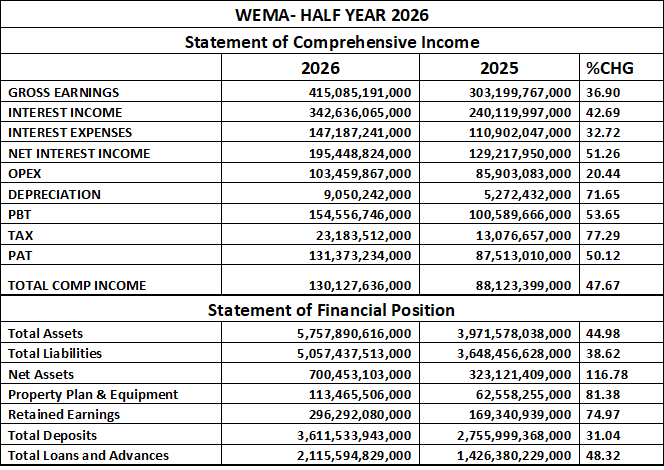
Wema Bank Plc delivered an outstanding half-year 2026 performance, reinforcing its position as one of the fastest-growing and fundamentally strongest tier-2 banks in Nigeria. The bank recorded exceptional growth across virtually all key performance indicators, with gross earnings rising by 36.90%, net interest income increasing by 51.26%, profit before tax growing by 53.65%, and profit after tax advancing by 50.12%. These impressive earnings were supported by strong balance sheet expansion, as total assets grew by 44.98%, loans and advances increased by 48.32%, deposits expanded by 31.04%, and shareholders’ funds (net assets) surged by 116.78%. These figures demonstrate that the bank is not only growing rapidly but is doing so on a solid capital foundation.
The bank’s financial ratios further validate the strength of its performance. Solvency improved significantly, with a lower debt ratio, a reduced debt-to-equity ratio, and a stronger equity ratio, reflecting enhanced financial stability. Profitability ratios remained robust, as evidenced by improvements in EBIT margin, pre-tax margin, and return on assets, while efficiency ratios showed disciplined cost management through a lower operating expenses-to-gross earnings ratio and a more productive deployment of deposits into loans. Although earnings per share and return on equity moderated due to the enlarged capital base following recapitalization, this should be viewed positively because the stronger equity position provides greater capacity for future earnings growth rather than indicating operational weakness.
Overall, Wema Bank Plc has produced one of the strongest half-year results in the Nigerian banking industry. The combination of sustained earnings growth, improved capital adequacy, stronger asset quality indicators, expanding digital banking operations, and prudent cost management places the bank in a strong position to deliver another record full-year performance. While the stock has already attracted increased investor interest, its valuation remains attractive relative to its growth prospects and intrinsic value. Consequently, Wema Bank Plc earns an Overall Rating: BUY (Strong Buy) for medium- to long-term investors. Existing shareholders should accumulate or hold their positions, while new investors may consider taking positions on price pullbacks, as the bank remains well-positioned to deliver sustainable earnings growth, attractive shareholder returns, and long-term capital appreciation.