
Market Update For August 7, 2026
The Nigerian Exchange (NGX) closed the trading week on a strong note on Friday, August 7, 2026, extending its winning streak to three consecutive sessions as sustained buying interest in blue-chip stocks outweighed widespread profit-taking across the broader market. The benchmark index maintained its upward trajectory despite cautious investor sentiment, reflecting continued confidence in fundamentally strong companies with resilient earnings prospects. The day’s performance was largely driven by renewed accumulation in banking heavyweights, reinforcing the sector’s position as the market’s primary growth engine.
Trading opened on a cautious footing as investors balanced profit-taking in recently appreciated stocks with fresh bargain hunting in fundamentally sound equities. Early selling pressure across consumer goods, industrial and insurance counters briefly weighed on market sentiment, but steady demand for large-cap banking stocks gradually reversed the declines. As the session progressed, institutional investors continued to build positions in quality names, allowing the market to finish firmly in positive territory despite the broader weakness across several sectors.
The banking sector remained the clear driver of market performance. Stocks such as First HoldCo, AccessCorp, UBA, Zenith Bank and NGX Group attracted sustained buying interest as investors positioned ahead of second-quarter earnings releases and anticipated dividend declarations. The continued preference for banking stocks reflects expectations of stronger profitability, resilient asset quality and improved shareholder returns amid Nigeria’s evolving macroeconomic environment. Institutional investors remained focused on companies with solid fundamentals, while retail investors also participated through selective bargain hunting.
Although the market recorded another positive close, underlying sentiment remained mixed. Investors continued to lock in gains on several stocks that had appreciated significantly in recent weeks, resulting in declines across a larger number of equities than those that advanced. This selective buying pattern suggests that market participants remain cautious, preferring quality stocks while avoiding speculative positions. The negative breadth therefore indicates that the current rally is still being supported mainly by heavyweight counters rather than broad participation across sectors.
Market activity strengthened considerably compared with the previous session, reflecting improved liquidity and stronger investor participation. Financial services stocks dominated both volume and value traded, reinforcing the sector’s influence on overall market direction. The increase in turnover also points to sustained institutional activity as portfolio managers continued to rebalance holdings in response to the ongoing earnings season and evolving macroeconomic conditions.
The positive performance of the local bourse came against a backdrop of heightened attention to both domestic and global economic developments. Investors continued to assess the outlook for inflation, interest rates, exchange rate stability and fiscal reforms, all of which are expected to influence corporate earnings and investor confidence in the months ahead. The current earnings season is also expected to provide clearer insight into how listed companies are navigating prevailing economic conditions, with strong corporate results likely to sustain buying interest in fundamentally sound stocks.
Foreign portfolio investors also remain focused on Nigeria’s macroeconomic reforms, particularly measures aimed at improving liquidity in the foreign exchange market, strengthening fiscal sustainability and supporting economic growth. Continued policy stability could encourage additional foreign inflows into the equity market, particularly into highly capitalised companies with strong earnings visibility and attractive dividend yields.
In the international commodities market, crude oil prices remained volatile as investors monitored geopolitical developments in the Middle East and negotiations surrounding the reopening of the Strait of Hormuz. Brent crude futures settled at $83.33 per barrel, gaining 84 cents or 1.0%, while U.S. West Texas Intermediate (WTI) crude rose 89 cents, or 1.2%, to $78.18 per barrel. Despite Friday’s rebound, both benchmarks recorded weekly losses of more than 9%, reflecting easing fears of prolonged supply disruptions after the sharp rally seen earlier in the week. Market sentiment improved following weaker-than-expected U.S. employment data, which strengthened expectations that the U.S. Federal Reserve may adopt a less aggressive monetary policy stance, potentially supporting global energy demand. However, uncertainty surrounding the Strait of Hormuz continued to dominate the outlook. Reports indicated that Iran is seeking transit fees of between 5% and 7% of cargo values, Oman has proposed fees of around 3%, while the United States remains opposed to any transit charges. The Strait remains strategically important, with about 20% of global crude oil and liquefied natural gas (LNG) shipments passing through the waterway, making any disruption a significant risk to global energy supply and prices. For Nigeria, sustained stability in oil prices remains crucial for government revenue, foreign exchange earnings and overall investor confidence in the domestic financial markets.
Overall, Friday’s trading reinforced the resilience of the Nigerian equity market. While profit-taking persisted across many stocks, the ability of blue-chip equities to sustain the market’s upward momentum demonstrates continued institutional confidence in the long-term outlook of fundamentally strong companies. Investors are expected to remain selective as they monitor corporate earnings, macroeconomic data and developments in the global commodities market.
Technical Analysis and Outlook
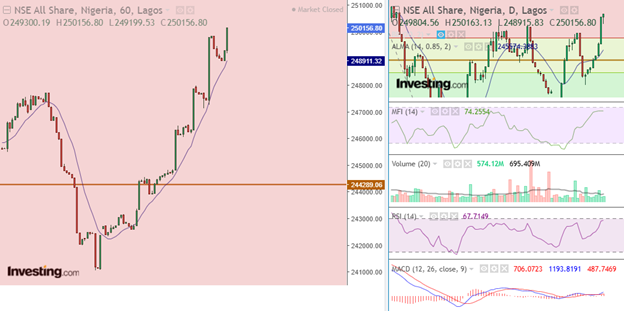
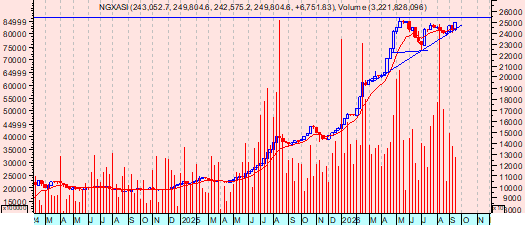
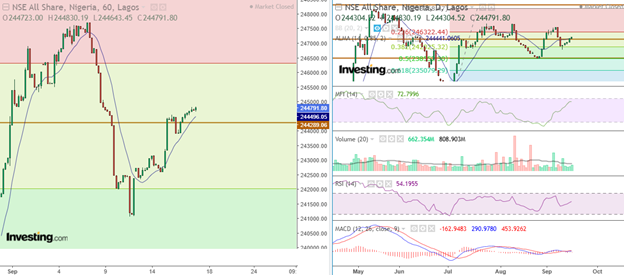
Technically, the NGX maintained its short-term bullish structure as the benchmark index continued to trade above key support levels, confirming that buyers remain firmly in control of the market. However, the negative market breadth indicates that the rally remains relatively narrow, with gains concentrated in a limited number of large-cap stocks. For the current uptrend to strengthen further, broader participation across sectors will be required. Looking ahead, investors are expected to focus on second-quarter earnings releases, dividend expectations, inflation trends, foreign exchange developments and global oil price movements for fresh direction. Bargain hunting in fundamentally strong stocks is likely to continue, although intermittent profit-taking could create pockets of volatility. Overall, the market retains a positive outlook, supported by sustained institutional demand, improving corporate earnings expectations and resilient investor confidence.
The NGX All-Share Index (ASI) gained 368.45 points, or 0.15%, to close at 245,577.79, while market capitalisation increased by ₦237.83 billion to ₦158.52 trillion, lifting the market’s year-to-date return to 57.81%. Market breadth closed negative with 21 gainers, 30 losers and four unchanged stocks, highlighting the dominance of selective buying. Trading activity remained strong as investors exchanged 1.42 billion shares worth ₦24.33 billion in 39,765 deals. FTGINSURE led the volume chart with 824.40 million shares, while AccessCorp recorded the highest value of trades. In the oil market, Brent crude settled at $83.33 per barrel, up 84 cents (1.0%), while WTI crude rose to $78.18 per barrel, gaining 89 cents (1.2%), although both benchmarks still recorded weekly losses of over 9%. Top gainers: UPDC Plc (+9.23%) to ₦3.55, CWG Plc (+6.56%) to ₦19.50, First HoldCo Plc (+5.00%) to ₦147.00, Neimeth International Pharmaceuticals Plc (+4.24%) to ₦8.60, and Cutix Plc (+4.00%) to ₦2.60. Top losers: Red Star Express Plc (-10.00%) to ₦18.00, CAP Plc (-9.98%) to ₦115.45, John Holt Plc (-9.82%) to ₦10.10, ABC Transport Plc (-9.57%) to ₦5.20, and Legend Internet Plc (-8.70%) to ₦4.20 each.